
AI in Construction Market Outlook: Size, Share, Trends, Growth Analysis, Competitive Landscape & Forecast, 2026-2033

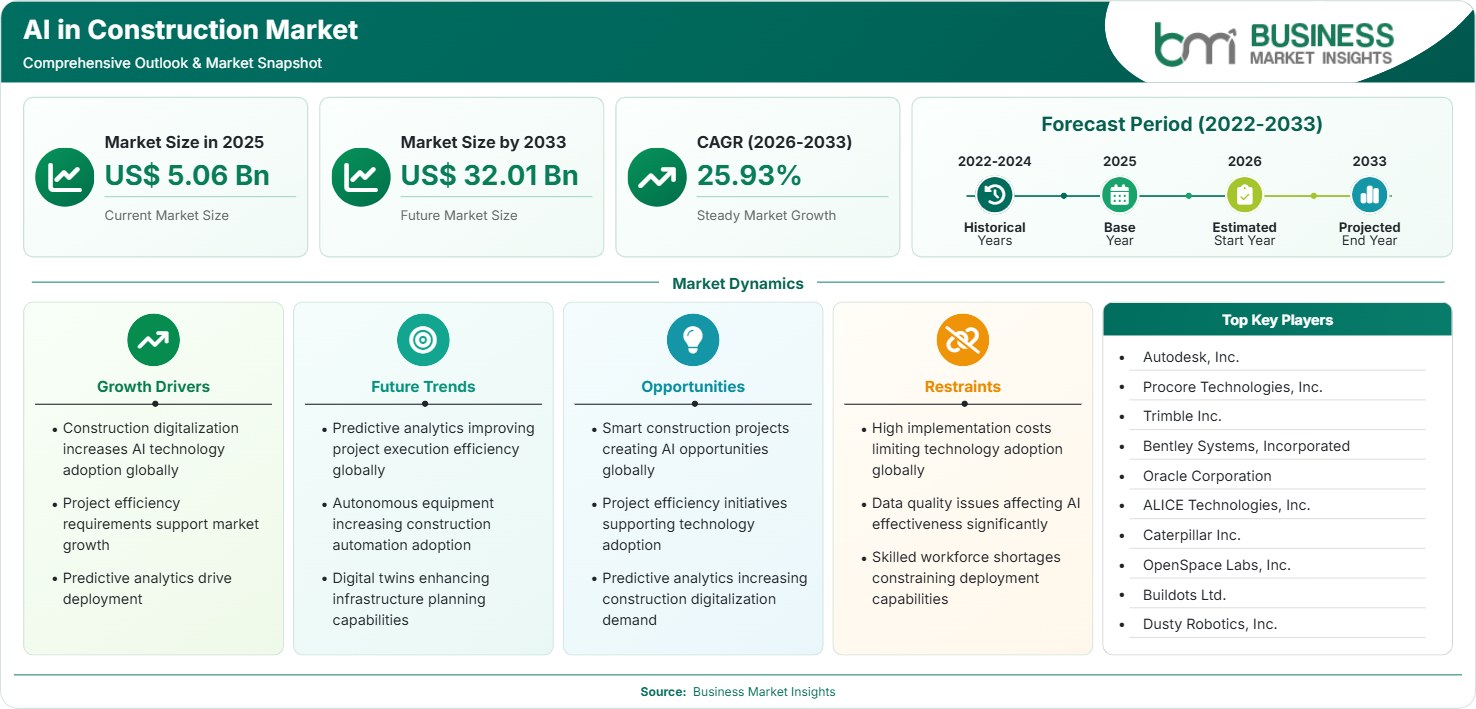
The AI in Construction Market size was valued at US$5.06 Billion in 2025 and is projected to reach US$32.01 Billion by 2033, growing at a CAGR of 25.93% during 2026–2033, driven by intelligent project controls, labor optimization, predictive risk management, autonomous equipment, and expanding cloud-based construction workflows.

Report Coverage
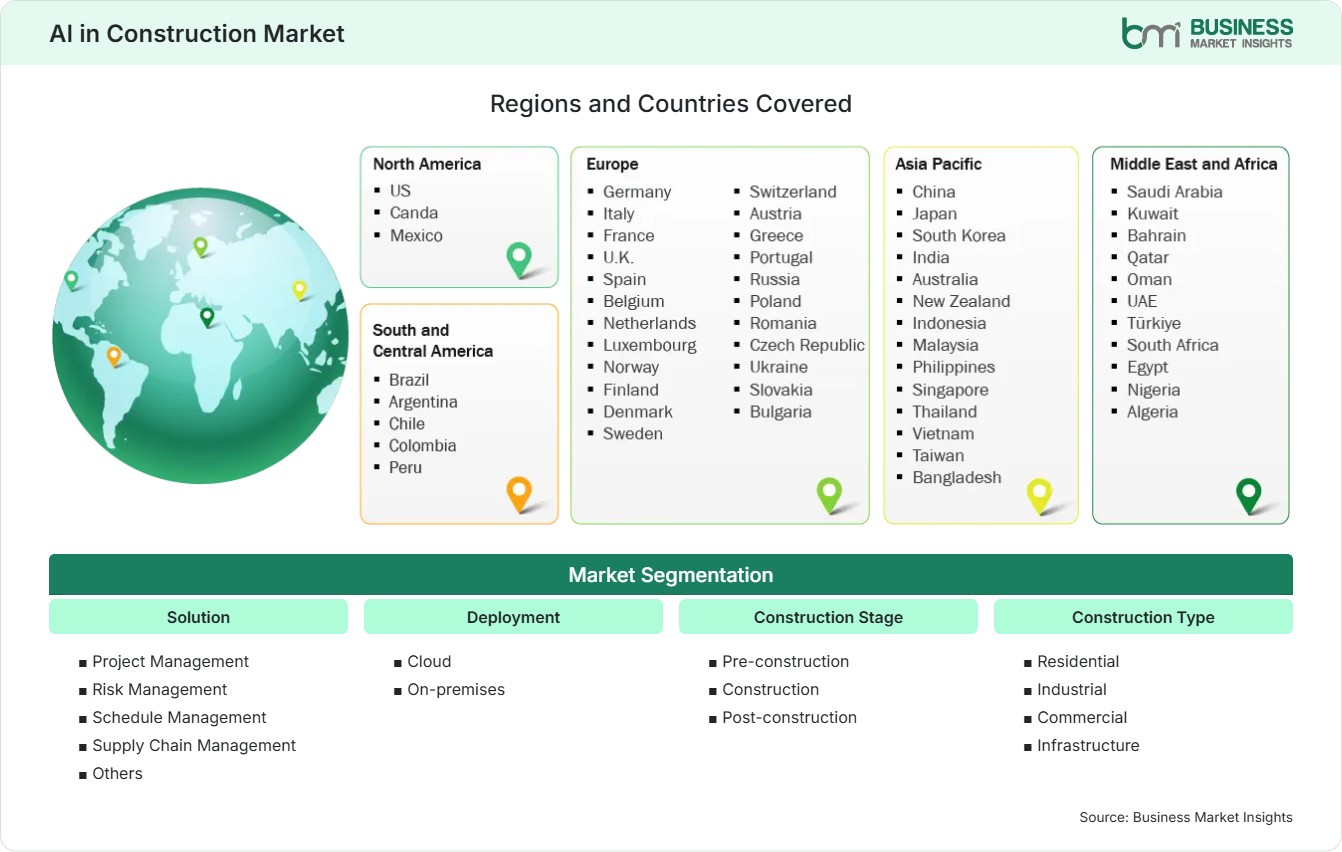
  • Solution: Project Management, Risk Management, Schedule Management, Supply Chain Management, Others
  • Deployment: Cloud, On-premises
  • Construction Stage: Pre-construction, Construction, Post-construction
  • Construction Type: Residential, Industrial, Commercial, Infrastructure
US$ 5.06 Bn Market size in 2025
US$ 32.01 Bn Market Size by 2033
25.93% CAGR, 2026 - 2033
2026-2033 Forecast Period

AI Overview

AI in Construction Market Summary

  • North America Region: North America holds an AI in Construction Market share of 34%–38% in 2025, growing with a CAGR of 24%–26%, influenced by mature construction software adoption, labor shortages, infrastructure investment, cloud migration, and demand for predictive project controls.
  • Fastest Growing Region: Asia Pacific holds a market share of 21%–25% in 2025, growing with a CAGR of 29%–32%, supported by infrastructure expansion, smart-city programs, digitalization, modular construction, and increasing technology investment.
  • Leading Segment: Project Management holds a market share of 29%–33% in 2025, growing with a CAGR of 24%–27%, driven by integrated workflows, resource optimization, automated reporting, cost visibility, and demand for centralized project intelligence.
  • High Growth Segment: Cloud deployment holds an AI in Construction Market share of 58%–62% in 2025, growing with a CAGR of 28%–31%, supported by scalable infrastructure, remote collaboration, real-time data access, software integration, and lower implementation barriers.
  • Key Market Opportunity: Construction companies can combine generative AI, BIM, computer vision, digital twins, and autonomous machinery to create connected project environments that improve forecasting, coordination, safety, and asset utilization.
  • Major Market Players: Autodesk, Inc.; Procore Technologies, Inc.; Trimble Inc.; Bentley Systems, Incorporated; Oracle Corporation; ALICE Technologies, Inc.; Caterpillar Inc.; OpenSpace Labs, Inc.; Buildots Ltd.; Dusty Robotics, Inc.
Strategic Insights

AI in Construction Market: Strategic Insights

AI in Construction Market Strategic Framework
FREE PDF
Request your free sample
Request free sample
Stakeholder View

Key Takeaways

  • The value chain is shifting from standalone point solutions toward connected platforms that integrate BIM, project controls, field data, equipment telemetry, contracts, and asset information. Vendors able to unify fragmented datasets can capture a larger share of enterprise technology budgets.
  • Project management, risk management, and schedule optimization provide the clearest near-term monetization opportunities because contractors can connect AI outputs directly with measurable project outcomes such as fewer delays, improved resource utilization, faster reporting, and better contingency management.
  • Agentic AI is becoming the next technology layer. Instead of merely generating recommendations, newer systems can retrieve project information, interpret drawings and photographs, trigger workflows, review documents, and execute defined actions under organizational permissions.
  • Asia Pacific presents an attractive expansion case because large infrastructure pipelines, urbanization, digital construction initiatives, and growing engineering software adoption create conditions for rapid deployment. Japan, South Korea, China, Singapore, and India represent differentiated opportunities across infrastructure and commercial construction.
  • Investment is increasingly concentrated around platforms that combine AI with proprietary construction data. Recent product launches from Procore, Autodesk, Trimble, Oracle, Bentley Systems, and Caterpillar show that established vendors are embedding intelligence into existing customer workflows rather than treating AI as a standalone product.
  • M&A and partnership activity is likely to favor specialized capabilities in reality capture, robotics, scheduling, document intelligence, and digital twins. Strategic buyers can accelerate AI deployment by acquiring validated datasets and workflow expertise rather than developing every capability internally.
Geographic Outlook

AI in Construction Market Regional Highlights

North America AI in Construction Market

North America accounted for an estimated 34%–38% share in 2025 and is projected to record a 24%–26% CAGR through 2033. The AI in Construction Market share reflects mature software adoption, established BIM practices, high labor costs, and strong contractor demand for predictive controls. The region also benefits from large infrastructure programs and data-center construction. Market growth is supported by enterprise platforms connecting project, field, equipment, and financial information, while adoption increasingly shifts from pilots toward repeatable workflows.

  • U.S. contractors remain the largest regional demand center because cloud construction platforms, BIM adoption, and software spending provide a strong base for AI deployment across project controls.
  • Canada presents opportunities in infrastructure, energy, transportation, and commercial development, where labor availability and geographic dispersion strengthen the case for remote monitoring and automated project intelligence.
  • North American buyers increasingly prioritize secure enterprise deployments, integration with existing systems, and explainable recommendations because project information includes sensitive contractual, commercial, and design data.
  • Infrastructure modernization and data-center construction create high-value applications for schedule optimization, visual progress verification, equipment intelligence, and automated documentation.

US AI in Construction Market

The U.S. AI in Construction Market represented an estimated 82%–86% of North American demand in 2025 and is expected to expand at a 24%–26% CAGR through 2033. The country combines deep construction technology penetration, large contractor networks, infrastructure spending, and strong venture activity. AI deployment is moving toward agentic workflows, autonomous machinery, predictive safety, and visual intelligence. The market also benefits from established ecosystems connecting BIM, project management, estimating, equipment, and field documentation systems, enabling faster commercialization of specialized AI applications.

  • Large general contractors are moving AI beyond experimentation into document review, scheduling, risk detection, progress tracking, estimating, and contract workflows, creating recurring enterprise software demand.
  • Data-center, semiconductor, transportation, and infrastructure projects require high coordination intensity, making predictive scheduling, digital twins, computer vision, and automated field verification commercially relevant.
  • The U.S. also provides a strong testing environment for autonomous construction equipment as equipment manufacturers integrate AI, sensors, edge computing, and real-time site intelligence.

Europe AI in Construction Market

Europe represented an estimated 25%–29% AI in Construction Market share in 2025 and is projected to grow at a 25%–27% CAGR through 2033. Germany, the United Kingdom, France, and the Nordic countries provide the leading adoption base, while Poland and Spain offer faster expansion opportunities. European demand is shaped by energy-efficient buildings, infrastructure renewal, labor constraints, sustainability requirements, and digital construction standards. AI applications that connect design intelligence with carbon management, procurement, scheduling, and asset performance are gaining strategic importance across major construction programs.

  • Germany is a leading opportunity because industrial construction expertise, engineering software adoption, and manufacturing-linked building projects support advanced planning, simulation, and automated quality control.
  • The United Kingdom combines strong digital construction capabilities with infrastructure and housing requirements, supporting demand for predictive project controls and computer-vision-based site monitoring.
  • Nordic markets emphasize productivity, sustainability, and data-driven asset management, creating opportunities for AI systems that connect construction decisions with operational performance and resource efficiency.
  • France and Spain provide growth opportunities through infrastructure modernization, urban development, and increasing use of BIM-enabled workflows.

Asia Pacific AI in Construction Market

Asia Pacific accounted for an estimated 21%–25% share in 2025 and is forecast to expand at a 29%–32% CAGR, making it the fastest-growing region. China, Japan, South Korea, Singapore, and India form the principal adoption markets. Rapid urban development, infrastructure programs, smart-city investments, modular construction, and expanding engineering technology ecosystems support demand. AI in Construction Market trends increasingly center on automated progress monitoring, generative planning, robotics, digital twins, and cloud collaboration, particularly where project scale creates strong returns from productivity improvements.

  • China offers substantial opportunities across transportation, industrial facilities, urban development, and renewable infrastructure, with AI increasingly linked to BIM, robotics, site monitoring, and intelligent equipment.
  • Japan and South Korea combine advanced manufacturing ecosystems with construction labor constraints, creating demand for robotics, automated inspection, scheduling intelligence, and productivity-enhancing field technologies.
  • India is emerging as a high-growth market as infrastructure investment, urban expansion, digital public infrastructure, and construction technology adoption broaden among large contractors and developers.
  • Singapore provides a digitally mature regional hub where BIM, automation, smart-building initiatives, and regulatory technology programs support advanced construction applications.

Rest of World AI in Construction Market

Rest of World accounted for around 11%-15% of the AI in Construction Market share in 2025 and is expected to grow at a 22%-25% CAGR till 2033. South and Central America are driven by infrastructure renewal and construction related to mining, housing needs, and urbanization. Brazil and Mexico represent the largest addressable markets in Latin America, while numerous urban, tourism, transportation, and energy projects drive the Middle East. Markets in the Gulf region are highly interested in digital twins, autonomous construction machines, visual intelligence, and centralized project control systems for complex projects.

Growth in Latin America is increasingly driven by cloud platforms, as contractors no longer need to develop their own IT infrastructure to use advanced solutions. The Middle East and Africa are characterized by significant projects providing substantial opportunities for schedule optimization, computer vision, remote monitoring, and digital asset management.

  • Brazil and Mexico provide the strongest regional software opportunities because large infrastructure and commercial projects can justify AI-enabled project controls.
  • Saudi Arabia and the United Arab Emirates are high-potential markets where mega-project complexity encourages digital twins, automated progress monitoring, and integrated construction intelligence.
  • South Africa provides opportunities across infrastructure, mining-related construction, energy projects, and asset-intensive development where productivity and remote monitoring are commercially important.
  • Gulf developers increasingly favor connected platforms capable of coordinating multiple contractors, consultants, suppliers, and assets across geographically distributed project environments.
Global Market Geography
FREE PDF
Request your free sample
Request free sample
Segment Analysis

AI in Construction Market Segmentation

Solution

The Solution layer was the main application layer in 2025, with Project Management holding around 29%-33% market share and growing at a 24%-27% CAGR. Adoption of AI in Construction is driven by the integration of project data, automation, analytics, and the need for quicker decision-making. The scope of the AI in Construction Market is growing as platforms connect project controls and field intelligence.

  • Project Management: Centralized AI workflows improve task coordination, reporting, resource allocation, document retrieval, and decision-making across complex projects with multiple contractors and stakeholders.
  • Risk Management: Predictive models identify contractual, safety, schedule, quality, and cost risks earlier, allowing teams to prioritize interventions before issues become expensive project disruptions.
  • Schedule Management: AI evaluates dependencies, resources, constraints, and historical performance to generate resilient schedules, compare scenarios, and identify opportunities for acceleration or recovery.
  • Supply Chain Management: Intelligent systems analyze procurement data, delivery schedules, supplier information, and material availability to improve forecasting and reduce disruption across project supply networks.

Deployment

Deployment is becoming cloud-driven, with Cloud taking up 58% to 62% of the market share and a 28% to 31% CAGR. Cloud platforms enable easy integration, facilitate distributed collaboration, allow for continuous model updates, and minimize the need for infrastructure on the contractor’s side. AI in Construction Market trends are shifting towards software architectures that integrate centralized data with access control mechanisms to ensure intelligence operates across the organization.

  • Cloud: Cloud deployment enables scalable AI processing, continuous software updates, centralized project information, remote collaboration, and integration with BIM, ERP, field applications, and equipment systems.
  • On-premises: On-premises systems remain relevant for organizations with strict data governance, legacy infrastructure, sensitive projects, or requirements for localized control over construction information.

Construction Stage

Construction Stage adoption spans the complete project lifecycle, with Pre-construction providing strong AI value through estimation, design analysis, bidding, and planning. Construction applications are expanding through visual intelligence and predictive controls, while Post-construction is developing around asset handover and operational intelligence. The broad lifecycle creates opportunities to reuse project data instead of treating each stage as a disconnected technology environment.

  • Pre-construction: AI supports estimating, constructability analysis, design review, bid preparation, scenario planning, and early risk identification before resources are committed.
  • Construction: Field intelligence combines imagery, schedules, BIM, sensors, and equipment data to monitor progress, detect deviations, improve safety, and automate routine reporting.
  • Post-construction: AI can organize handover information, improve asset records, identify maintenance requirements, and connect construction data with long-term facility management systems.

Construction Type

Construction Type demand depends on the complexity of the construction project, data-intensive construction, repetitiveness, and investment capacity. Industrial and infrastructure construction projects have strong potential for advanced scheduling, digital twins, equipment autonomy, and predictive analytics. Construction of residences offers opportunities to automate layout, estimating, quality management, and standardized construction processes.

  • Residential: AI supports standardized planning, automated layout, estimating, quality inspection, and progress monitoring across repetitive housing and multifamily projects.
  • Industrial: Complex facilities require advanced sequencing, resource optimization, digital twins, and scenario analysis to manage specialized equipment, trades, and commissioning requirements.
  • Commercial: Office, retail, hospitality, healthcare, and data-center projects benefit from coordinated BIM, visual monitoring, document intelligence, and schedule optimization.
  • Infrastructure: Roads, railways, utilities, airports, and large civil projects offer strong applications for autonomous equipment, geospatial intelligence, progress monitoring, and predictive asset workflows.
Market Forces

AI in Construction Market Dynamics

Key Market Drivers

Agentic AI Is Moving Construction Software From Insight to Action

The construction software is moving away from dashboards and recommendations toward agentic software that can understand project context and execute workflows with control. Procore has developed agentic features for interpreting drawings, specifications, photographs, RFIs, submittals, logs, and contracts. Autodesk is developing Autodesk Assistant by leveraging specialized and agentic AI across its Forma industry cloud. The trends in the market will help AI in Construction Market growth because contractors will be able to link the intelligence and operations, rather than using two different types of tools. The benefit from a business standpoint is to reduce administrators' manual tasks without taking decision-making away from project managers.

Labor Constraints Are Increasing Demand for Automated Productivity Tools

Labor availability will continue to be a structural limitation for construction firms, thereby making technology solutions that lower coordination requirements and minimize repetitive field tasks even more valuable. AI will help automate document management, progress reporting, estimating, inspections, and equipment tracking, while allowing skilled personnel to focus on more complex decision-making. The 2026 autonomy strategy of Caterpillar shows how automation, using AI, machine learning, computer vision, LiDAR, radar, GPS, and edge computing, is becoming a trend in creating smart machines. Thus, the application of AI extends beyond software solutions to physical manufacturing operations. The business implications are not limited to labor substitution, as contractors will be able to achieve greater consistency and better utilization of rare skills.

Fragmented Project Data Is Creating Demand for Connected Intelligence

Construction projects produce data through various processes, including BIM, drawings, contracts, schedules, photos, inspections, equipment systems, procurement systems, and financial systems. The fragmented nature of data reduces the usefulness of traditional analytics, as it may be produced across different systems. An AI platform will only add value when data and analysis are integrated into the project's context. Procore's creation of a unified data environment involving BIM, documents, quality, assets, and AI represents the path for enterprise construction technology. The catalyst, hence, is not AI but the ability to connect data. Companies that provide reliable permissions, interoperability, structured data, and data lineage can build more competitive positions.

Key Market Opportunities

AI-Enabled Digital Twins Can Connect Planning With Physical Execution

Digital twins provide a way to bring together BIM, reality capture, schedules, sensors, and project controls into continuously evolving models of construction assets. It allows AI systems to leverage them to compare planned and actual states, explore scenarios, identify gaps, and take appropriate actions. As evidenced by the OpenSpace 2026 platform development strategy, AI applications in the construction industry increasingly rely on visual and spatial intelligence, as well as on AI algorithms' ability to learn from actual construction sites. Thus, the AI in Construction Market forecasts depend on vendors' ability to deploy their models in operational environments. The opportunities are greatest for data centers, infrastructure, industrial plants, hospitals, and large commercial buildings.

Predictive Safety and Risk Intelligence Can Expand Enterprise Adoption

The potential for safety and risk management offers a compelling investment proposition, as prevention yields tangible economic and operational benefits. AI will be able to examine the project’s history, location, schedule, contractual arrangements, imagery, and safety performance to identify risk patterns before the situation reaches a crisis point. The safety advisor from Oracle is built on a model trained on data spanning over 10,000 project-years of experience, demonstrating the applicability of industry-tailored datasets for predictive use cases. The same approach applies to identifying risks associated with contractual disputes, scheduling, quality issues, and procurement disruptions. The investment opportunity is especially pertinent for large contractors who require risk management consistency across multiple projects.

AI-Powered Estimating and Procurement Can Improve Margin Protection

Estimating and Procurement are commercially sensitive processes because even minor mistakes in quantity takeoffs, labor assumptions, sequencing, and material availability can significantly impact profit margins. AI can review drawings, specifications, prior estimates, supplier information, and schedules, thereby speeding up the estimation process and identifying errors. As stated in Trimble's June 2026 report, contractors who used AI’s new capabilities reduced MEP pre-takeoff work by up to 60%. Such functionality can be implemented further into the procurement process and can result in better supplier choices, demand forecasting, delivery scheduling, and contingency plan creation. Thus, this area is related to money-making and profit preservation.

Market Restraints and Challenges

Data Quality and Interoperability Limit AI Reliability

Factor: There may be gaps or inconsistencies in the construction information, including out-of-date or dispersed records across disjointed systems, while project teams have their own ways of naming things and structuring information. Impact: The reliability of AI's output may be compromised when such models are applied to fragmented or poorly managed information, thereby undermining the trustworthiness of the AI tool itself and its use for automation. Also, construction-specific AI requires proper contextual understanding of spatial and temporal information that is not necessarily available in general business models. Data integrity and intellectual property management are among key issues that Autodesk's studies identified as factors of responsible AI adoption. With the growing integration of systems by contractors, interoperability, model behavior transparency, proper data governance, and auditing have become crucial demands for vendors.

Cybersecurity, Governance, and Workforce Readiness Can Slow Deployment

Factor: Construction firms handle commercially sensitive design, contract, employee, methodological, and infrastructure data, but many project teams lack the capability to govern advanced AI technology. Impact: Security concerns, lack of accountability, employee resistance, and insufficient training could delay enterprise-level implementation of the technology or even limit it to pilot projects. According to Autodesk research for 2025, only 40 percent of business leaders surveyed achieved their AI objectives, demonstrating that merely having the technology does not mean it is used effectively. The responsible implementation would entail role-based access control, proper integrations, human supervision, workforce training, and procedures for assessing AI output.

Company Analysis

Competitive Landscape

The AI in Construction Market analysis indicates a competitive structure spanning enterprise construction software, engineering platforms, equipment manufacturers, specialized scheduling providers, computer vision companies, and construction robotics specialists. Established vendors are embedding AI within existing platforms, while specialists differentiate through proprietary datasets and focused workflows.

Company Name

Overview

Products and Services relevant to this market

Autodesk, Inc.

Global design and engineering software provider expanding AI across architecture, engineering, construction, and connected project workflows.

Autodesk Forma, Autodesk Construction Cloud capabilities, Autodesk Assistant, Construction IQ, BIM, design automation, risk intelligence, and project data analytics.

Procore Technologies, Inc.

Construction management technology provider developing connected project data environments and agentic AI workflows.

Procore Platform, Procore AI, Procore Helix, project management, document workflows, BIM, quality, safety, analytics, and AI agents.

Trimble Inc.

Construction technology company connecting positioning, modeling, field data, estimating, project controls, and equipment workflows.

Trimble Construction One, AI estimating, MEP takeoff, project management, field technology, BIM, connected construction, and analytics.

Bentley Systems, Incorporated

Infrastructure engineering software company integrating AI with engineering applications and digital infrastructure workflows.

MicroStation, STAAD.Pro, iTwin, infrastructure digital twins, AI assistants, engineering analytics, and asset lifecycle solutions.

Oracle Corporation

Enterprise technology provider offering construction management, analytics, predictive intelligence, and project safety capabilities.

Oracle Construction and Engineering, Construction Intelligence Cloud, predictive analytics, safety intelligence, project controls, and enterprise data management.

ALICE Technologies, Inc.

Specialized construction technology company focused on AI-driven planning, scheduling, scenario analysis, and optimization.

Generative construction scheduling, project planning, risk analysis, schedule optimization, estimating support, and scenario simulation.

Caterpillar Inc.

Construction equipment manufacturer integrating AI, computer vision, edge computing, autonomy, and connected machinery.

Autonomous excavators and loaders, machine intelligence, telematics, fleet technology, computer vision, AI assistants, and autonomous construction workflows.

OpenSpace Labs, Inc.

Visual intelligence provider converting jobsite imagery into structured construction information and actionable project intelligence.

Reality capture, progress tracking, spatial intelligence, AI agents, 360-degree documentation, BIM integration, and field workflows.

Buildots Ltd.

Construction technology company applying AI and computer vision to automated progress tracking and project performance management.

AI progress tracking, computer vision, schedule monitoring, site analytics, project performance intelligence, and mobile field applications.

Dusty Robotics, Inc.

Construction robotics specialist focused on automated layout and model-to-field execution for building projects.

FieldPrinter robotic layout, BIM-to-field workflows, automated floor layout, construction coordination, and quality-focused field automation.

Trust & Transparency

Research Methodology

The market analysis combines proprietary research with secondary data from government agencies, company disclosures, regulatory filings, industry databases and expert interviews. Market estimates are validated through data triangulation, cross-market benchmarking and analyst review.

View Full Research Methodology

Questions Answered

Frequently Asked Questions

What does an AI in Construction Market report help technology buyers evaluate?

A comprehensive report helps buyers compare solution categories, deployment models, construction stages, regional opportunities, competitive positioning, adoption drivers, restraints, and emerging applications. It can also support technology prioritization and investment planning across construction portfolios.

How can contractors manage AI governance risks?

Contractors should establish access controls, approved use cases, human review requirements, data ownership rules, cybersecurity procedures, model validation, and audit trails. Governance should be integrated into procurement and project-management processes rather than added after deployment.

What type of data is required for construction AI?

Useful datasets include BIM models, drawings, schedules, contracts, photographs, inspection records, cost information, equipment telemetry, procurement records, and historical project outcomes. Data quality and consistent project context are as important as data volume.

Which construction applications are most suitable for early AI adoption?

Document review, estimating assistance, progress monitoring, schedule analysis, risk identification, and automated reporting are suitable starting points because they generate measurable productivity benefits without requiring complete automation of critical field decisions.

How does AI improve construction project scheduling?

AI analyzes dependencies, resource availability, historical performance, constraints, and changing site conditions to identify schedule risks and evaluate alternative sequencing strategies. This allows project teams to test recovery options earlier and make scheduling decisions using broader project information.

Access the Full AI in Construction Market Report

Get segment-level forecasts, regional estimates, competitive benchmarking, company profiles and downloadable Excel datasets.

Access the full AI in Construction Market Report
350 pages PDF & Excel | 2026-10-22
Similar Research

Related Market Reports