
Electric Construction Equipment Market Outlook: Size, Share, Trends, Growth Analysis, Competitive Landscape & Forecast, 2026-2033

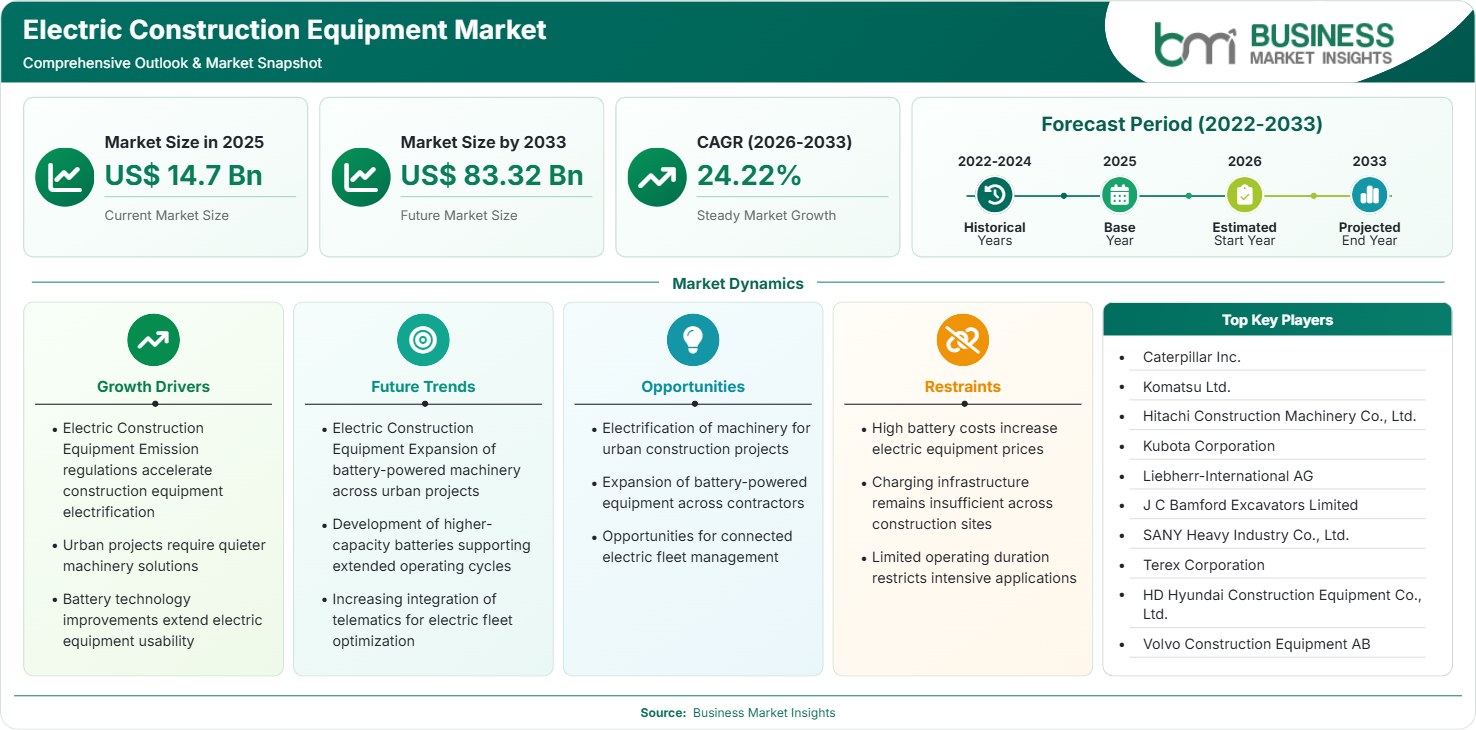
The Electric Construction Equipment Market size was valued at US$ 14.7 billion in 2025 and is projected to reach US$ 83.32 billion by 2033, growing at a CAGR of 24.22% during 2026–2033, driven by battery innovation, emission controls, charging infrastructure, fleet modernization, and zero-emission construction opportunities.

Report Coverage
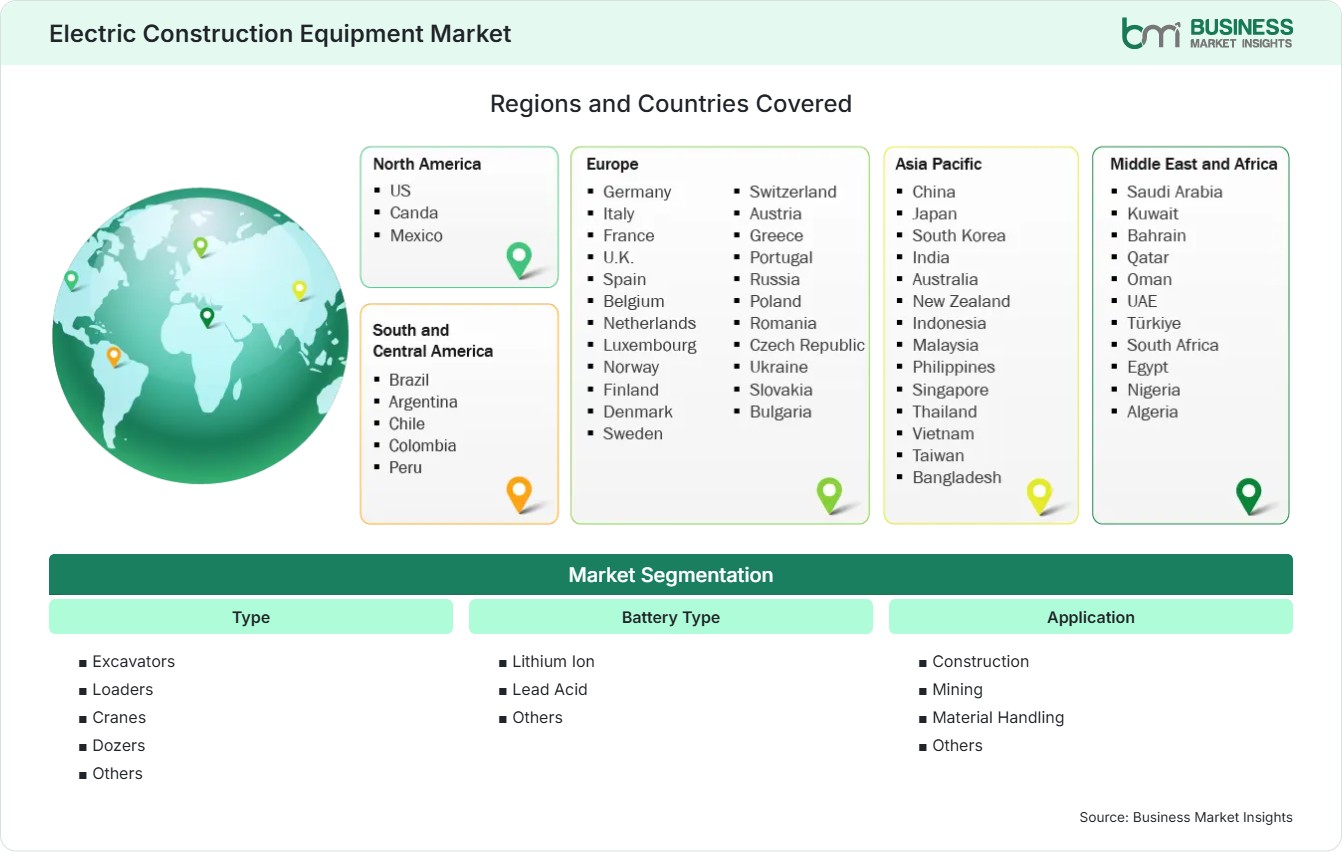
  • Type: Excavators, Loaders, Cranes, Dozers, Others
  • Battery Type: Lithium Ion, Lead Acid, Others
  • Application: Construction, Mining, Material Handling, Others
US$ 14.7 Bn Market size in 2025
US$ 83.32 Bn Market Size by 2033
24.22% CAGR, 2026 - 2033
2026-2033 Forecast Period

AI Overview

Electric Construction Equipment Market Summary

  • North America Region: North America holds a market share of 28%–31% in 2025, growing with a CAGR of 23%–25% during 2026–2033, influenced by fleet replacement, infrastructure investment, rental adoption, charging expansion, and emissions compliance. The US market is projected to expand at 22%–24% CAGR, supported by public infrastructure programs, rental fleets, and construction decarbonization.
  • Fastest Growing Region: Asia Pacific holds a market share of 34%–38% in 2025, growing with a CAGR of 25%–27% during 2026–2033, influenced by infrastructure expansion, domestic battery manufacturing, urbanization, localized equipment production, and accelerating deployment across China, India, Japan, and Southeast Asia.
  • Leading Segment: Excavators hold a market share of 36%–39% in 2025, growing with a CAGR of 24%–26% during 2026–2033, supported by high utilization, broad construction applications, compact electric models, mining demand, urban emission restrictions, and increasingly mature electric powertrains.
  • High Growth Segment: Cranes hold a market share of 9%–12% in 2025, growing with a CAGR of 26%–28% during 2026–2033, supported by electrified lifting systems, port modernization, indoor operations, lower noise requirements, infrastructure construction, and demand for precise low-emission material handling.
  • Key Market Opportunity: Integrated machine, battery, charging, telematics, financing, and energy-management packages can reduce adoption barriers, creating recurring revenue opportunities for manufacturers, rental companies, infrastructure providers, and technology partners.
  • Major Market Players: Caterpillar Inc.; Komatsu Ltd.; Hitachi Construction Machinery Co., Ltd.; Kubota Corporation; Liebherr-International AG; J C Bamford Excavators Limited; SANY Heavy Industry Co., Ltd.; Terex Corporation; HD Hyundai Construction Equipment Co., Ltd.; Volvo Construction Equipment AB.
Strategic Insights

Electric Construction Equipment Market: Strategic Insights

Electric Construction Equipment Market Strategic Framework
FREE PDF
Request your free sample
Request free sample
Stakeholder View

Key Takeaways

  • The value chain in the Electric Construction Equipment Market is expanding beyond original equipment manufacturers toward battery suppliers, power-electronics specialists, charging providers, grid operators, software vendors, rental companies, and financing partners. Competitive differentiation increasingly depends on the reliability of this connected ecosystem rather than machine hardware alone.
  • It is the excavators who offer the most extensive range of commercial applications since a single machine design can be used for trenching, earthmoving, demolition, utilities, urban infrastructure, and certain types of mining. With loaders and cranes, there is additional potential in cases where repetitive duty cycles make it easier to assess the economics of charging.
  • Development of products is heading in the direction of modular batteries, higher-voltage designs, regenerative systems, fast charging, tethered operation, remote monitoring, and the use of energy-aware fleet software. Companies such as Caterpillar, Komatsu, Hitachi Construction Machinery, and Volvo Construction Equipment are adopting various combinations of electrification and intelligent machine technologies.
  • Asia Pacific offers a strong investment opportunity since China and India together have large fleets of construction equipment and are engaged in infrastructure development as well as expanding their domestic battery capabilities. Moreover, India is creating local electric equipment options, such as the L120 Electric wheel loader offered by Volvo Construction Equipment India.
  • More emphasis is now being placed on integrated solutions as opposed to individual machines. This shift is demonstrated by the collaboration between Volvo Construction Equipment and Hitachi Energy in May 2026, which involves combining equipment, power supply, charging, energy management, and site integration.
  • Rental and the equipment-as-a-service options can lower the initial capital obstacle linked to electric machines, and they also enable contractors to assess usage, charging needs, the residual values and the overall operating economics before deciding on the full electrification of their fleets.
Geographic Outlook

Electric Construction Equipment Market Regional Highlights

North America Electric Construction Equipment Market

North America represents a 28%–31% share in 2025 and is growing at a 23%–25% CAGR from 2026–2033. The region benefits from fleet replacement, infrastructure modernization, rental penetration, and increasing demand for quieter equipment. The United States accounts for 70%–74% of North American demand, while Canada and Mexico support localized opportunities in infrastructure and resource projects. The regional Electric Construction Equipment Market share reflects relatively advanced equipment financing, established dealer networks, and early adoption of battery-electric compact machinery.

  • Public infrastructure schemes are helping to facilitate the renewal of equipment, while contractors are becoming more inclined to evaluate operating costs, emissions performance, charging requirements, and machine utilization before deciding to choose electric options for their new fleets.
  • Rental channels are important for speeding up adoptions since contractors are able to use electric machinery without having to take on the full technology risk, especially in urban projects where the low noise level and the fact that there are no tailpipe emissions provide operational benefits.
  • A second method of adoption is offered by mining and quarrying, since manufacturers have introduced larger battery-electric hauling and excavating machines that are suitable for higher-utilization applications.
  • The charging infrastructure is still mainly found at demonstration projects and on controlled worksites, which provides chances for mobile charging, depot charging, energy storage, and integrated power-management solutions.

US Electric Construction Equipment Market

The US Electric Construction Equipment Market accounts for 70%–74% of North American demand in 2025 and is projected to expand at a 22%–24% CAGR through 2033. Demand is supported by infrastructure renewal, commercial construction, data-center development, rental fleets, and contractor interest in lower operating emissions. A 2025 industry estimate placed the US market at US$4.24 billion, demonstrating the country's substantial role in regional demand.

  • Electric compact equipment is becoming more practical to use in urban construction, in indoor demolition, in the field of utilities, and in landscaping and municipal applications since limits on noise and exhaust can have a major impact on the way a project is carried out.
  • Large contracting companies are now looking at charging logistics and fleet usage as well as the purchase price, and are therefore finding telematics and energy-management software to be useful additions to electric machines.
  • Caterpillar is working on several electric machines. These include 301.9 electric mini excavators, 906 electric compact wheel loaders, 320 electric medium excavators, and 950 GC electric medium wheel loaders.

Europe Electric Construction Equipment Market

Europe Electric Construction Equipment Market represents a 20%–23% share in 2025 and is growing at a 24%–26% CAGR from 2026–2033. Germany, the United Kingdom, France, Norway, and Sweden form important adoption centers, while Norway and other Nordic markets provide favorable operating environments for zero-emission equipment. Europe's regulatory focus on emissions, urban air quality, and sustainable procurement supports accelerated commercialization. Volvo Construction Equipment's electric articulated hauler program further demonstrates the region's movement toward larger electrified machines.

  • Germany is leading in the area of large-scale industrial and quarrying applications, with manufacturers showing off electric wheel loaders, excavators, and articulated haulers for demanding material-handling operations.
  • Norway offers an excellent testing environment since construction customers and infrastructure projects are actively assessing zero-emission machinery under real operating conditions.
  • The United Kingdom is becoming an important market for the deployment of electric articulated haulage, due to infrastructure projects and the demand for lower-emission construction operations.
  • France and the Nordic countries provide opportunities for the use of electric equipment in urban construction projects, in public infrastructure, in utilities, and in areas of environmentally sensitive construction.

Asia Pacific Electric Construction Equipment Market

Asia Pacific Electric Construction Equipment Market accounts for a 34%–38% share in 2025 and is growing at a 25%–27% CAGR from 2026–2033, making it the fastest-growing regional market. China provides scale, India provides rapid infrastructure expansion, and Japan and South Korea contribute technology and industrial expertise. Independent market estimates place Asia Pacific at 35.4% of global demand in 2025, supporting the modeled regional range used here.

  • Because of its large scale in equipment manufacturing, its in-depth battery supply chain, and the demand from its infrastructure, China has been able to enable electric loaders and excavators to move quickly from pilot installations to full commercial fleet adoption.
  • India has strong potential for growth in the areas of highways, railways, urban infrastructure, industrial corridors, and the manufacture of local equipment, since domestic original equipment manufacturers are increasingly offering electrical products.
  • Japan promotes technology-intensive applications by making use of its established manufacturers of construction machinery, its knowledge of batteries, its research into hydrogen, and its carefully controlled demonstration projects.
  • There are still considerable development prospects in the areas of ports, industrial parks, infrastructure construction, and material handling in Southeast Asia, but the availability of charging facilities and financing continues to be major factors affecting adoption.

Rest of World Electric Construction Equipment Market

Rest of World Electric Construction Equipment Market represents a 10%–14% share in 2025 and is growing at a 21%–23% CAGR from 2026–2033. South and Central America are supported by mining, ports, infrastructure, and urban construction, while Brazil provides the largest regional opportunity. Middle Eastern demand is linked to mega-projects, logistics, industrial development, and construction modernization. South Africa and Gulf markets offer high-value applications where controlled sites can support charging deployment and fleet electrification.

  • Brazil offers a great deal of potential for the use of electric equipment in urban infrastructure, in mining, at ports, and in industrial construction, even though the availability of charging infrastructure and financing affects the economics of the projects.
  • In Chile and Peru, there are mining-related opportunities that allow electrification to be incorporated into controlled operating environments featuring a central energy infrastructure and predictable equipment routes.
  • The Gulf countries are carrying out smart-city, logistics, tourism, and industrial projects in which low-emission equipment can help to meet the sustainability targets and the high standards required by the projects.
  • Because South Africa has both a demand for mining and is modernizing its infrastructure, there is potential for the sale of electric loaders, excavators, and material-handling equipment at controlled sites.
Global Market Geography
FREE PDF
Request your free sample
Request free sample
Segment Analysis

Electric Construction Equipment Market Segmentation

Type

The Type segment is led by excavators, which represent a 36%–39% market share in 2025 and a 24%–26% CAGR from 2026–2033. The Electric Construction Equipment Market scope covers excavators, loaders, cranes, and dozers, with adoption supported by broad utilization across construction, mining, utilities, demolition, and urban infrastructure, while battery-electric architectures increasingly address compact and medium-duty applications.

  • Excavators: Electric excavators benefit from versatile duty cycles, expanding model availability, lower site noise, and suitability for urban, utility, infrastructure, demolition, and selected mining applications.
  • Loaders: Electric loaders gain traction in repetitive material movement, quarrying, recycling, warehousing, and urban projects where frequent duty cycles can support predictable charging and energy utilization.
  • Cranes: Electric cranes benefit from precise electric drives, controlled lifting environments, lower noise, and increasing demand for efficient equipment around ports, industrial sites, infrastructure projects, and urban construction.
  • Dozers: Electric dozers remain more specialized because sustained high-load operation requires substantial energy capacity, although controlled worksites and tethered configurations improve electrification feasibility.

Battery Type

Battery Type is dominated by lithium-ion technology, supported by high energy density, falling battery-system costs, fast-charging development, and expanding industrial production. The segment is projected to maintain a 60%–65% Electric Construction Equipment Market share in 2025 with a 24%–26% CAGR from 2026–2033, as manufacturers increasingly optimize battery packaging.

  • Lithium Ion: Lithium-ion batteries provide the energy density, cycle performance, packaging flexibility, and charging characteristics required for compact and medium electric construction equipment across diverse duty cycles.
  • Lead Acid: Lead-acid batteries remain relevant in cost-sensitive and lower-duty applications where equipment size, operating duration, and charging requirements allow simpler energy-storage architectures.

Application

Application demand is concentrated in construction, which represents a 42%–46% Electric Construction Equipment Market share in 2025 and a 24%–26% CAGR from 2026–2033. Urban projects, infrastructure, utilities, and commercial construction provide particularly favorable conditions because zero tailpipe emissions and lower operating noise can improve site compatibility.

  • Construction: Construction applications benefit from growing zero-emission procurement, urban restrictions, equipment rental demand, infrastructure development, and the availability of increasingly capable electric excavators and loaders.
  • Mining: Mining creates high-value opportunities for electrified equipment where controlled routes, centralized charging, ventilation benefits, and high machine utilization can strengthen lifecycle economics.
  • Material Handling: Material handling applications favor electric machines because repetitive loading, lifting, and movement can be scheduled around charging cycles and performed in enclosed or emissions-sensitive facilities.
Market Forces

Electric Construction Equipment Market Dynamics

Key Market Drivers

Battery Performance Is Expanding Electric Machine Capability

Battery performance is a central driver because energy density determines operating time, machine weight, charging frequency, and productivity. The International Energy Agency has documented a long-term decline in lithium-ion battery costs, improving the economic foundation for electrification across transport and industrial applications. Current construction platforms increasingly combine lithium-ion batteries with regenerative braking, high-voltage electrical systems, efficient motors, and fast charging. The Electric Construction Equipment Market growth, therefore, depends not only on battery capacity but also on power-management software and thermal control.

Emission Rules Are Reshaping Equipment Procurement

Regulatory pressure is increasingly influencing equipment specifications, procurement criteria, and project design. The International Energy Agency has highlighted the construction and buildings sector's substantial contribution to global emissions, strengthening the case for lower-carbon machinery. Urban authorities, public infrastructure owners, and environmentally sensitive projects can impose emissions, noise, or sustainability requirements that favor electric equipment. The Electric Construction Equipment Market trends are therefore moving from voluntary sustainability initiatives toward procurement-linked requirements.

Rental Fleets Are Lowering Technology Adoption Barriers

Rental companies can accelerate electrification by pooling demand, adopting standard charging procedures, and distributing equipment use among multiple contractors. Electric machines are especially appealing to rental fleets working on city projects since their lower noise levels and complete lack of tailpipe emissions allow them to be used in a wider variety of locations. Rental usage data also gives manufacturers evidence regarding battery degradation, charging habits, maintenance needs, and the residual values of the machines. The information obtained in this way helps to improve both product development and financing models. For contractors, having access to rental services reduces their initial capital outlay and, at the same time, gives them the chance to compare electric and diesel machines under the same project conditions. Thus, a route for commercialization is created on which fleet operators, original equipment manufacturers, charging providers, and contractors all work together to develop practical deployment models.

Key Market Opportunities

Integrated Charging and Energy Management

The Electric Construction Equipment Market Forecasts indicate expanding investment potential across integrated charging infrastructure, battery systems, and energy-management solutions. Volvo Construction Equipment and Hitachi Energy announced a May 2026 collaboration focused on integrated zero-emission construction sites, covering power supply, charging, energy management, and operational integration. Such system-level offerings can address a central purchasing problem: contractors do not acquire an electric machine in isolation but must ensure reliable energy availability throughout the workday.

Heavy-Duty Electrification for Mining and Quarrying

Heavy-duty applications offer a promising future as manufacturers shift away from producing compact machinery. Volvo Construction Equipment started series production of the A30 Electric and A40 Electric articulated haulers in 2026, the payloads being 29 tonnes and 39 tonnes respectively. These machines show that battery-electric designs are now being used in more productive quarrying and mining operations. The potential also includes high-utilization loaders, excavators, and material transport equipment that operate on fixed routes.

Battery-Swapping and Flexible Power Architectures

Battery swapping, modular battery packs, tethered operation, and hybrid charging all provide ways to increase electrification in situations where standard overnight charging is inadequate. At CONEXPO-CON/AGG 2026, Hitachi Construction Machinery and DIMAAG showed an electric excavator weighing 1.7 tons that used swappable battery modules and portable fast charging. The design allows for continuous operation since one module can charge while another is in use, thus tackling the issue of downtime on urban and indoor construction sites. This model offers opportunities for specialist charging operators and energy service providers.

Market Restraints and Challenges

High Upfront Equipment and Infrastructure Costs

The fact is that electric machines usually entail a large initial outlay, as battery packs, power electronics, thermal management systems, charging equipment, and electrical upgrades all contribute to the capital costs. As a result, contractors who use the machines only a little each year may find it difficult to justify the high initial cost, even if their operating costs are reduced. This problem is made worse on scattered or short-term projects because the charging infrastructure has to be set up repeatedly. Although financing, rental, leasing, battery-as-a-service, and equipment-as-a-service arrangements can help alleviate the problem, the extent to which these options are available commercially depends on the location.

Charging Availability and Operational Downtime

The fact is that construction sites often work in temporary, isolated, or power-limited situations in which the available grid capacity may not meet the demands of high-power equipment. As a result, limitations on charging can lead to reduced machine usage, the need for mobile power systems, or the requirement for contractors to keep diesel equipment as a backup. Since large excavators and loaders need considerably more energy output than smaller machines, the level of infrastructure complexity increases. The fact that Volvo Construction Equipment has developed machines that combine on-board batteries with grid-connected operation shows one way in which manufacturers are addressing this constraint.

Company Analysis

Competitive Landscape

The Electric Construction Equipment Market analysis indicates that competition is shifting toward integrated electrification platforms, machine software, battery engineering, charging compatibility, and lifecycle services. The selected companies combine global OEM scale with specialist capabilities and regional manufacturing networks.

Company Name

Overview

Products and Services relevant to this market

Caterpillar Inc.

Global heavy equipment manufacturer expanding battery-electric machine development across compact and heavy construction applications.

Electric excavators, electric wheel loaders, battery systems, tethered electric machines, digital fleet technologies, and charging solutions.

Komatsu Ltd.

Japanese equipment manufacturer developing battery-electric, hybrid, and alternative-energy construction machinery for multiple duty cycles.

Electric mini excavators, battery systems, autonomous technologies, electrified excavators, and low-emission equipment development.

Hitachi Construction Machinery Co., Ltd.

Construction machinery specialist expanding electric excavator solutions and partnerships focused on charging and battery modularity.

Electric compact excavators, battery systems, fast charging, digital technologies, and electrification partnerships.

Kubota Corporation

Japanese manufacturer with established compact equipment expertise and growing electrification capabilities for urban applications.

Electric compact excavators, compact loaders, construction machinery, batteries, and related equipment technologies.

Liebherr-International AG

Diversified machinery group developing electric and alternative-drive solutions across construction and material-handling equipment.

Electric excavators, cranes, loaders, mining equipment, powertrain systems, and energy-efficient machinery.

J C Bamford Excavators Limited

Global construction equipment manufacturer with an established compact machinery portfolio and electric product development.

Electric mini excavators, compact equipment, loaders, construction machinery, and fleet support services.

SANY Heavy Industry Co., Ltd.

Chinese machinery manufacturer combining large-scale production with expanding electric construction equipment capabilities.

Electric excavators, cranes, loaders, mining equipment, batteries, and digital fleet technologies.

Terex Corporation

Global lifting and material-processing equipment provider with opportunities across electrified lifting and handling applications.

Electric cranes, aerial work platforms, material-handling equipment, power systems, and service solutions.

HD Hyundai Construction Equipment Co., Ltd.

Global equipment manufacturer developing electrified machinery for construction and infrastructure applications.

Electric mini excavators, excavators, loaders, smart construction technologies, and equipment services.

Volvo Construction Equipment AB

Global construction equipment manufacturer with one of the industry's broadest battery-electric machine portfolios.

Electric excavators, wheel loaders, articulated haulers, charging solutions, digital services, and fleet-management technologies.

Trust & Transparency

Research Methodology

The market analysis combines proprietary research with secondary data from government agencies, company disclosures, regulatory filings, industry databases and expert interviews. Market estimates are validated through data triangulation, cross-market benchmarking and analyst review.

View Full Research Methodology

Questions Answered

Frequently Asked Questions

How can contractors evaluate electric equipment economically?

Contractors can use the Electric Construction Equipment Market Report to compare total cost of ownership, including electricity, charging infrastructure, maintenance, utilization, financing, residual value, productivity, downtime, and project-specific emissions or noise requirements.

Why are compact electric machines commercially important?

Compact machines can operate in enclosed, urban, residential, and environmentally sensitive locations where exhaust emissions and noise create restrictions. Their lower energy requirements also make charging infrastructure easier to deploy, creating an accessible entry point for contractors testing electrification.

What role can construction equipment rental companies play?

Rental companies can accelerate adoption by reducing upfront capital requirements and allowing contractors to evaluate electric machines under actual project conditions. They can also standardize charging infrastructure and collect utilization data that supports financing and residual-value models.

How are manufacturers addressing heavy-equipment charging limitations?

Manufacturers are combining larger battery packs, fast charging, tethered operation, grid-connected systems, modular batteries, and energy-management software. Volvo Construction Equipment's EC500 Electric development illustrates a dual battery and grid-connected approach for a 50-tonne-class excavator.

What equipment characteristics determine electric machine suitability?

Electric suitability depends on duty-cycle predictability, average power demand, operating hours, charging access, machine weight, and site conditions. Equipment with repeatable routes or scheduled breaks can generally accommodate charging more readily than continuously operated machines with unpredictable workloads.

Access the Full Electric Construction Equipment Market Report

Get segment-level forecasts, regional estimates, competitive benchmarking, company profiles and downloadable Excel datasets.

Access the full Electric Construction Equipment Market Report
350 pages PDF & Excel | 2026-09-30
Similar Research

Related Market Reports