
Artificial Intelligence Ai In Manufacturing Market Outlook: Size, Share, Trends, Growth Analysis, Competitive Landscape & Forecast, 2026-2033

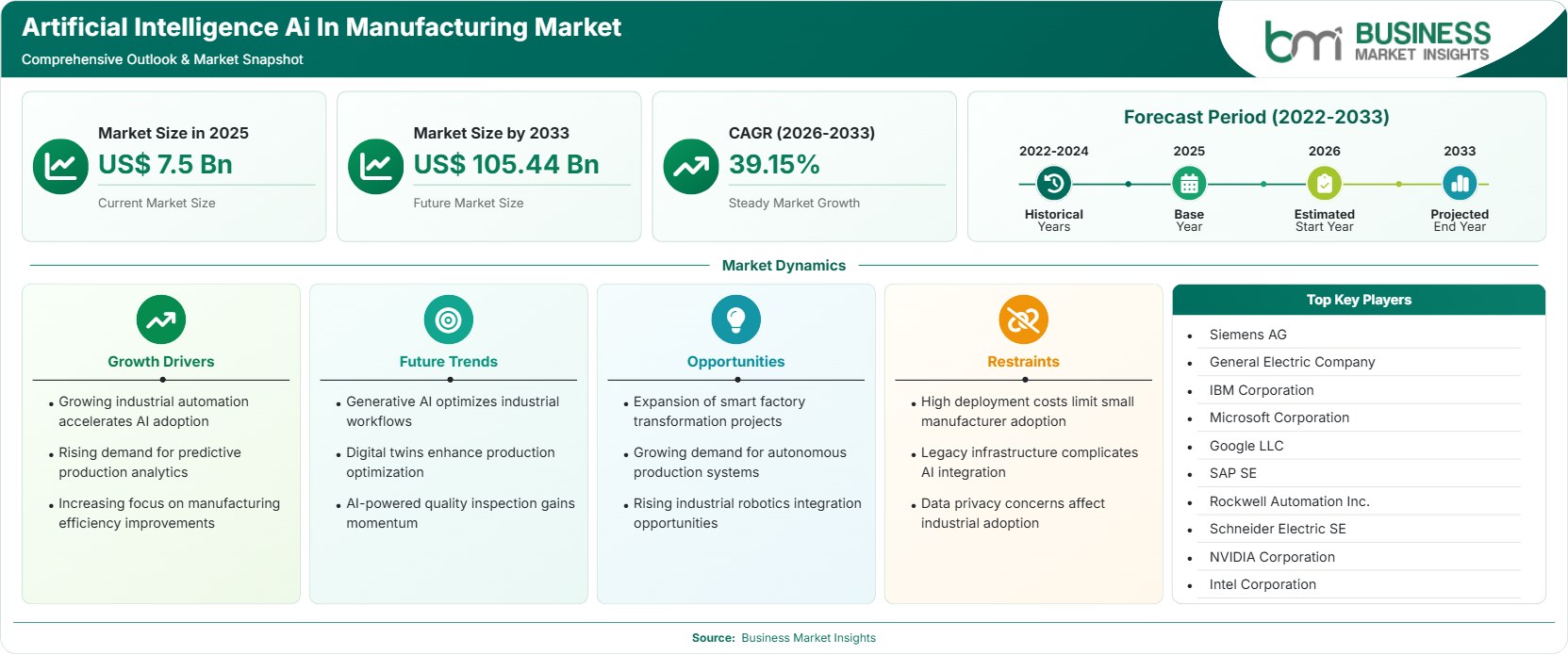
The Artificial Intelligence AI in Manufacturing Market size was valued at US$ 7.50 billion in 2025 and is projected to reach US$ 105.44 billion by 2033, growing at a CAGR of 39.15% during 2026–2033. Growing industrial automation, increasing use of predictive production analytics, and rising focus on manufacturing efficiency continue driving rapid adoption of AI-enabled manufacturing technologies.

Report Coverage
  • Component: Hardware, Software, Services
  • Technology: Computer Vision, Machine Learning, Natural Language Processing, Context Awareness
  • Application: Predictive Maintenance & Inspection , Production Planning, Supply Chain Management, Energy Management, Quality Management, Industrial Robotics, Others
  • Industry: Automotive, Healthcare, Semiconductor & Electronics, Energy & Power, Metals & Machinery, FMCG, Others
US$ 7.5 Bn Market size in 2025
US$ 105.44 Bn Market Size by 2033
39.15% CAGR, 2026 - 2033
2026-2033 Forecast Period

01 AI Overview

Artificial Intelligence Ai In Manufacturing Market Summary

  • North America Region: North America accounts for 36%–39% market share in 2025 and is projected to expand at a CAGR of 37.8%–38.6% during 2026–2033. Strong industrial digitalization, widespread cloud adoption, and advanced manufacturing investments continue driving regional growth. The U.S. remains the largest contributor with a CAGR of 38.0%–38.8%, supported by high investment in smart factories and industrial AI platforms.
  • Fastest Growing Region: Asia Pacific represents 28%–31% market share in 2025 and is expected to register a CAGR of 41.2%–42.0%, driven by rapid factory automation, expanding electronics manufacturing, government-backed Industry 4.0 initiatives, and rising industrial AI investments.
  • Leading Segment: Software accounts for 46%–49% market share in 2025 and is anticipated to grow at a CAGR of 39.8%–40.6%, supported by increasing deployment of AI platforms, analytics software, and industrial automation applications.
  • High Growth Segment: Machine Learning captures 33%–36% market share in 2025 and is projected to record a CAGR of 42.5%–43.3%, driven by predictive analytics, intelligent automation, and continuous process optimization.
  • Key Market Opportunity: Rising deployment of autonomous production systems, AI-powered robotics, and smart factory technologies is creating significant opportunities for industrial software providers and automation solution developers.
  • Major Market Players: Siemens AG, General Electric Company, IBM Corporation, Microsoft Corporation, Google LLC, SAP SE, Rockwell Automation, Inc., Schneider Electric SE, NVIDIA Corporation, and Intel Corporation.
02 Strategic Insights

Artificial Intelligence Ai In Manufacturing Market: Strategic Insights

Artificial Intelligence Ai In Manufacturing Market Strategic Framework
FREE PDF
Request your free sample
Request free sample
03 Stakeholder View

Key Takeaways

  • Industrial AI adoption is shifting from pilot implementations toward enterprise-wide deployment as manufacturers seek measurable improvements in productivity, quality, and operational efficiency.
  • Software platforms integrating predictive analytics, digital twins, and machine learning continue generating the strongest commercial opportunities across manufacturing operations.
  • AI-enabled robotics and intelligent automation are reducing production variability while improving worker safety and manufacturing flexibility.
  • Asia Pacific offers the strongest long-term investment opportunity through expanding industrial production, electronics manufacturing, and government support for smart factory initiatives.
  • Strategic partnerships between industrial automation companies, cloud service providers, and AI software developers continue accelerating technology commercialization.
  • Increasing investment in edge computing, industrial IoT, and real-time analytics is strengthening intelligent manufacturing ecosystems across global production facilities.
04 Geographic Outlook

Artificial Intelligence Ai In Manufacturing Market Regional Highlights

North America Artificial Intelligence AI in Manufacturing Market

North America accounts for 36%–39% Artificial Intelligence AI in Manufacturing Market share in 2025 and is expected to register a CAGR of 37.8%–38.6% during 2026–2033. Strong digital infrastructure, high industrial automation adoption, and substantial investment in AI-enabled manufacturing continue supporting regional expansion. Manufacturers increasingly deploy intelligent production systems, predictive maintenance platforms, and industrial robotics to improve efficiency, reduce operational costs, and strengthen production resilience.

  • Smart factory investments continue accelerating AI deployment across automotive, aerospace, electronics, and industrial manufacturing facilities.
  • Cloud-based manufacturing platforms improve production visibility, operational intelligence, and real-time decision-making.
  • Industrial cybersecurity investments strengthen adoption of connected manufacturing technologies.
  • Increasing research and development expenditure continues supporting AI innovation across advanced manufacturing sectors.

US Artificial Intelligence AI in Manufacturing Market

The United States contributes 83%–86% of North American revenue and is projected to expand at a CAGR of 38.0%–38.8% through 2026–2033. Rapid adoption of industrial AI, advanced robotics, and digital manufacturing technologies continues strengthening the country's leadership in smart manufacturing.

  • Manufacturers increasingly deploy AI-powered predictive maintenance to reduce equipment downtime.
  • Industrial cloud platforms support real-time production monitoring and process optimization.
  • Semiconductor investments accelerate intelligent manufacturing technology adoption.
  • Collaboration between technology companies and manufacturers strengthens industrial AI innovation.

Europe Artificial Intelligence AI in Manufacturing Market

Europe represents 25%–28% market share in 2025 and is expected to expand at a CAGR of 37.2%–38.0% during the forecast period. Industry 4.0 initiatives, advanced engineering capabilities, and strong manufacturing automation continue supporting regional growth. Germany remains the leading market, while Poland records the fastest growth due to expanding industrial digitalization and manufacturing modernization.

  • Automotive manufacturers continue integrating AI across production planning and quality assurance processes.
  • Government-backed digital manufacturing initiatives accelerate smart factory investments.
  • Sustainability objectives encourage intelligent energy management and process optimization.
  • Manufacturing software providers continue expanding industrial AI capabilities across multiple sectors.

Asia Pacific Artificial Intelligence AI in Manufacturing Market

Asia Pacific holds 28%–31% market share in 2025 and is projected to record the fastest 41.2%–42.0% CAGR during 2026–2033. Large-scale industrialization, electronics manufacturing expansion, rising automation investments, and supportive government policies continue driving regional demand. China leads the regional market, while India records the fastest growth through expanding manufacturing capacity and digital transformation initiatives.

  • Industrial robotics adoption continues increasing across automotive and electronics manufacturing facilities.
  • Government incentives encourage investment in AI-enabled smart factory infrastructure.
  • Semiconductor manufacturing expansion supports advanced industrial automation deployment.
  • Rising cloud adoption strengthens implementation of intelligent manufacturing platforms.

Rest of World Artificial Intelligence AI in Manufacturing Market

The Rest of World region accounts for 6%–8% market share in 2025 and is projected to expand at a CAGR of 38.5%–39.2% during 2026–2033. Growing industrial diversification, infrastructure modernization, and digital transformation initiatives continue supporting adoption across Latin America, the Middle East, and Africa.

  • Brazil leads industrial AI adoption across Latin America through expanding manufacturing modernization projects.
  • Gulf countries continue investing in smart industrial infrastructure and digital production facilities.
  • Mining and energy industries increasingly deploy AI-powered operational monitoring systems.
  • Regional manufacturers strengthen competitiveness through automation and predictive analytics investments.
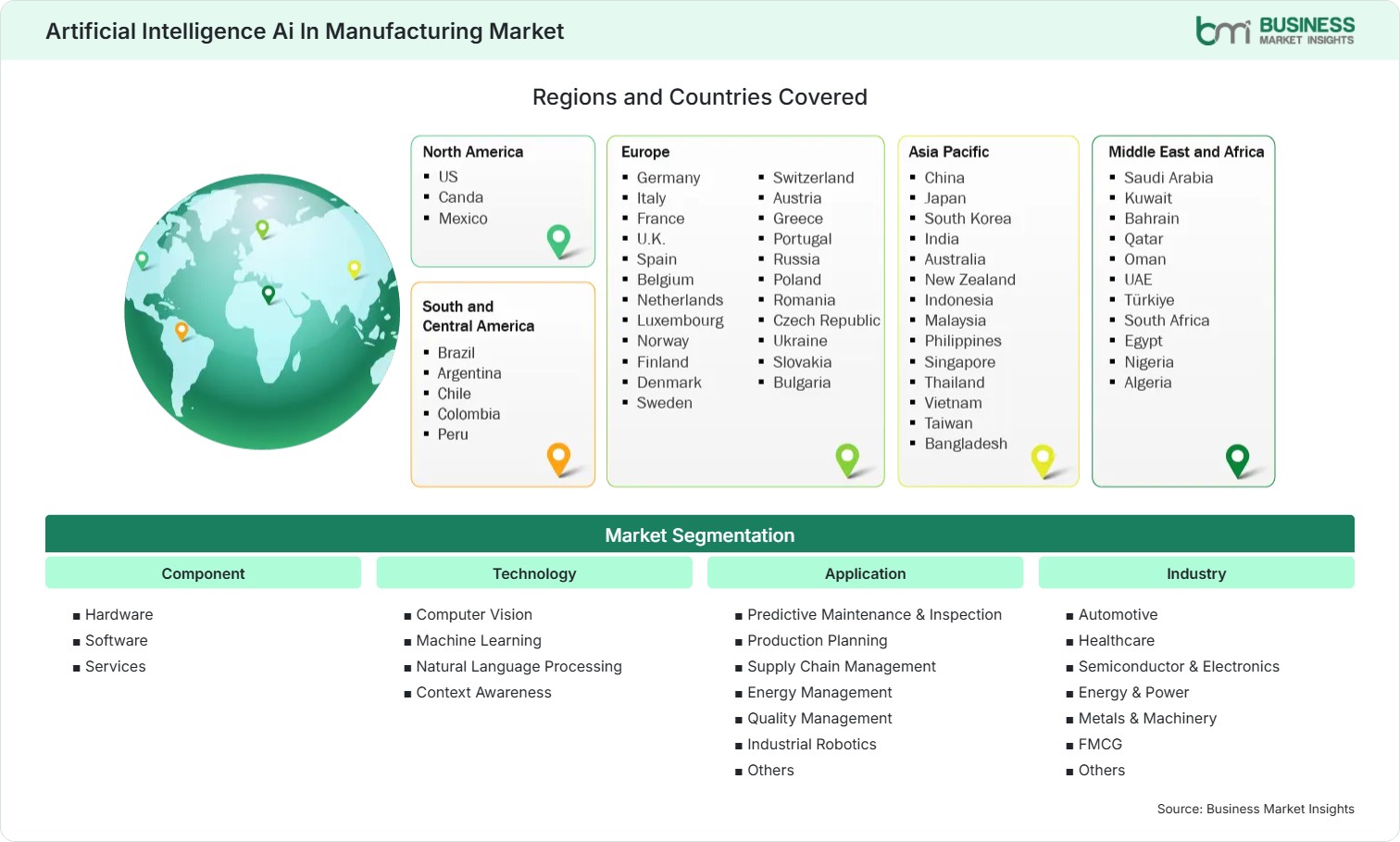
Global Market Geography
FREE PDF
Request your free sample
Request free sample
05 Segment Analysis

Artificial Intelligence Ai In Manufacturing Market Segmentation

Component

The component segment forms the technological foundation of industrial AI deployment, combining computing infrastructure with intelligent software and implementation services. It accounted for 46%–49% market share in 2025 and is expected to register a CAGR of 39.8%–40.6% during 2026–2033. Increasing cloud adoption, industrial IoT integration, and enterprise digital transformation continue expanding the Artificial Intelligence AI in Manufacturing Market scope across production environments.

  • Hardware: Includes industrial processors, AI accelerators, sensors, cameras, edge computing devices, and networking infrastructure that support real-time data collection and intelligent manufacturing operations.
  • Software: Represents the largest component due to widespread adoption of AI platforms, predictive analytics, digital twins, computer vision applications, and manufacturing execution software integrated with artificial intelligence capabilities.
  • Services: Demand continues increasing as manufacturers require consulting, deployment, system integration, employee training, cloud migration, and ongoing technical support to maximize AI implementation success.

Technology

Technology innovations continue reshaping manufacturing operations by improving automation, quality inspection, predictive analytics, and production optimization. The segment represented 33%–36% artificial intelligence ai in manufacturing market share in 2025 and is projected to expand at a CAGR of 42.5%–43.3% during 2026–2033. Current Artificial Intelligence AI in Manufacturing Market trends indicate rising investments in intelligent algorithms capable of supporting autonomous industrial decision-making.

  • Computer Vision: Widely deployed for automated visual inspection, defect detection, worker safety monitoring, object recognition, and production quality assurance across manufacturing facilities.
  • Machine Learning: Records the fastest adoption by enabling predictive maintenance, process optimization, demand forecasting, equipment diagnostics, and continuous improvement using operational manufacturing data.
  • Natural Language Processing: Supports intelligent documentation, voice-enabled factory assistance, maintenance reporting, knowledge management, and conversational interfaces for manufacturing personnel.
  • Context Awareness: Improves operational intelligence by interpreting real-time production environments, equipment status, workforce interactions, and environmental conditions to enhance manufacturing efficiency.

Application

AI applications continue expanding throughout manufacturing value chains as organizations seek higher efficiency, lower downtime, and improved production quality. This segment accounted for 31%–34% market share in 2025 and is expected to register a CAGR of 40.5%–41.3% during the forecast period. Manufacturers increasingly deploy AI across critical operational processes to improve decision-making and optimize resource utilization.

  • Predictive Maintenance & Inspection (PMI): Leads adoption by reducing unexpected equipment failures through continuous condition monitoring, predictive diagnostics, and proactive maintenance scheduling.
  • Production Planning: AI optimizes production schedules, workforce allocation, inventory utilization, and manufacturing capacity based on real-time operational requirements.
  • Supply Chain Management: Intelligent algorithms improve procurement planning, logistics coordination, inventory forecasting, supplier management, and end-to-end supply chain visibility.
  • Energy Management: AI systems monitor industrial energy consumption, optimize equipment utilization, reduce operational waste, and improve sustainability performance.
  • Quality Management: Automated inspection technologies enhance product consistency by identifying manufacturing defects, reducing scrap rates, and supporting continuous quality improvement.
  • Industrial Robotics: AI-powered robots improve production flexibility, precision, material handling, assembly operations, and collaborative manufacturing environments.

Industry

Industrial AI adoption varies across sectors according to production complexity, automation requirements, and digital transformation priorities. The industry segment represented 34%–37% market share in 2025 and is anticipated to grow at a CAGR of 40.8%–41.6% during 2026–2033. Expanding industrial automation continues strengthening AI deployment across both discrete and process manufacturing industries.

  • Automotive: Remains the largest adopter through AI-enabled robotics, predictive maintenance, autonomous inspection, and intelligent production scheduling.
  • Healthcare: Pharmaceutical and medical device manufacturers utilize AI to improve production quality, regulatory compliance, and manufacturing efficiency.
  • Semiconductor & Electronics: AI enhances wafer inspection, yield optimization, process control, and precision manufacturing for advanced electronic components.
  • Energy & Power: Intelligent analytics improve equipment monitoring, predictive maintenance, asset optimization, and operational reliability across energy facilities.
  • Metals & Machinery: AI supports equipment diagnostics, production automation, process optimization, and quality inspection in heavy manufacturing operations.
  • FMCG: Consumer goods manufacturers deploy AI for demand forecasting, packaging optimization, production planning, and supply chain efficiency.
06 Market Forces

Artificial Intelligence Ai In Manufacturing Market Dynamics

Key Market Drivers

Growing industrial automation accelerates AI adoption

Industrial automation continues to advance as manufacturers seek higher productivity, reduced operational costs, and greater production flexibility. Artificial Intelligence technology is increasingly being used along with programmable logic controllers, industrial robots, digital twins, and the IIoT to automate processes and make decisions. According to IFR, the world installation level for industrial robots continues to be at a record high, which shows that significant investments are being made in automated production lines. AI allows these production lines to learn and adapt to changing production conditions. These developments continue supporting Artificial Intelligence AI in Manufacturing Market growth, particularly across automotive, electronics, machinery, and consumer goods manufacturing facilities.

Rising demand for predictive production analytics

Manufacturers increasingly depend on predictive analytics to improve production planning, equipment utilization, and operational efficiency. Analytics powered by AI processes machine data, sensor data, and past production data to predict equipment failure, improve scheduling, and eliminate process variability. This way, manufacturing companies can increase production efficiency and lower the cost of maintenance while not disrupting the production process. With the amount of data increasing in the factory as a result of equipment connectivity and IoT systems, the demand for analytics increases. These capabilities are becoming an essential part of digital manufacturing strategies across both discrete and process industries.

Increasing focus on manufacturing efficiency improvements

Manufacturing companies are under constant pressure to improve productivity while controlling operational costs and maintaining product quality. AI assists in meeting these goals by improving workflow management, minimizing bottlenecks in production, maximizing inventory management, and improving quality inspections. AI-based computer vision technology performs production defect identification better than the traditional inspection methods, whereas intelligent scheduling software makes better use of available manpower and machines. Energy conservation is another area where AI has been widely used by manufacturers. These innovations continue shaping Artificial Intelligence AI in Manufacturing Market trends as organizations accelerate digital transformation initiatives.

Key Market Opportunities

Expansion of smart factory transformation projects

Global investments in smart manufacturing continue creating substantial opportunities for AI solution providers. Manufacturers are modernizing production facilities through integrated digital technologies that combine artificial intelligence, cloud computing, industrial IoT, robotics, and edge computing. These intelligent factories enable real-time monitoring, autonomous production decisions, predictive maintenance, and flexible manufacturing operations. Governments across North America, Europe, and Asia continue supporting industrial modernization through digital manufacturing initiatives and Industry 4.0 programs. Artificial Intelligence AI in Manufacturing Market Forecasts indicate that continued investment in smart factory infrastructure will generate strong demand for scalable AI platforms, industrial software, and intelligent automation solutions.

Growing demand for autonomous production systems

Manufacturers increasingly seek production environments capable of operating with minimal manual intervention while maintaining high productivity and consistent product quality. Autonomous production systems leverage AI algorithms to monitor equipment performance, adjust manufacturing parameters, optimize workflows, and respond to operational disruptions without human input. These intelligent capabilities improve manufacturing flexibility while reducing production errors and operational downtime. Continued advancements in edge AI, industrial connectivity, and high-performance computing are expected to accelerate deployment of autonomous manufacturing technologies across industries requiring precision, scalability, and continuous process optimization.

Rising industrial robotics integration opportunities

Industrial robots are becoming increasingly intelligent through integration with artificial intelligence, enabling more flexible, adaptive, and collaborative manufacturing operations. AI-powered robotic systems perform complex assembly tasks, automated inspection, material handling, packaging, and quality assurance with greater precision than conventional automation technologies. Manufacturers continue expanding collaborative robot deployments to improve worker productivity and operational safety while reducing repetitive manual tasks. As AI capabilities continue advancing, industrial robotics will play a central role in supporting flexible manufacturing, customized production, and higher operational efficiency across multiple industrial sectors.

Market Restraints and Challenges

High deployment costs limit small manufacturer adoption

Implementing industrial AI solutions often requires significant investment in computing infrastructure, industrial sensors, cloud platforms, software licenses, system integration, workforce training, and cybersecurity capabilities. Factor: High capital expenditure creates financial barriers for small and medium-sized manufacturers with limited technology budgets. Impact: Many organizations postpone AI deployment or implement only limited pilot projects, slowing broader adoption despite clear operational benefits. Vendors are responding with cloud-based subscription models, modular AI platforms, and scalable deployment options to reduce implementation costs and improve accessibility for smaller manufacturers.

Legacy infrastructure complicates AI integration

Many manufacturing facilities continue operating with aging machinery and legacy production systems that were not designed for modern digital connectivity. Factor: Limited interoperability between legacy equipment and advanced AI platforms complicates data integration, system modernization, and real-time communication across production environments. Impact: Integration complexity increases implementation time, project costs, and operational disruption while reducing the speed of AI deployment. Manufacturers increasingly invest in industrial gateways, retrofit technologies, and hybrid digital architectures to bridge legacy infrastructure with next-generation intelligent manufacturing systems.

07 Company Analysis

Competitive Landscape

Competition in the market is driven by advances in industrial automation, cloud computing, AI software platforms, and intelligent robotics. Artificial Intelligence AI in Manufacturing Market analysis shows that leading companies are strengthening their portfolios through strategic partnerships, AI-enabled industrial software, edge computing solutions, and integrated automation platforms. Continuous investments in research and development, industrial digitalization, and smart factory technologies are enabling vendors to expand their presence across automotive, electronics, healthcare, energy, and process manufacturing industries.

Company Name

Overview

Products and Services Relevant to this Market

Siemens AG

Global industrial technology company providing automation, digitalization, and intelligent manufacturing solutions for multiple industries.

Industrial AI software, Siemens Xcelerator, digital twins, factory automation, industrial IoT, and predictive maintenance solutions.

General Electric Company

Industrial technology provider focused on intelligent manufacturing, industrial analytics, and digital operations.

Industrial AI platforms, predictive maintenance, manufacturing analytics, industrial automation, and asset performance management solutions.

IBM Corporation

Technology company delivering enterprise AI, cloud computing, and industrial analytics solutions worldwide.

IBM Watsonx, AI software, industrial analytics, hybrid cloud platforms, predictive maintenance, and manufacturing optimization services.

Microsoft Corporation

Global software company supporting manufacturers through AI, cloud computing, and industrial digital transformation technologies.

Microsoft Azure AI, Azure IoT, Copilot, machine learning platforms, industrial cloud services, and manufacturing analytics.

Google LLC

Technology company offering advanced artificial intelligence, cloud infrastructure, and industrial data analytics solutions.

Google Cloud AI, Vertex AI, industrial machine learning, data analytics, computer vision, and cloud computing services.

SAP SE

Enterprise software provider delivering intelligent manufacturing and digital supply chain management platforms.

SAP Digital Manufacturing, AI-powered ERP, manufacturing execution software, predictive analytics, and supply chain solutions.

Rockwell Automation, Inc.

Automation specialist providing industrial control systems and intelligent manufacturing technologies.

FactoryTalk software, industrial automation, AI-enabled analytics, digital manufacturing platforms, and industrial control solutions.

Schneider Electric SE

Global provider of industrial automation and energy management technologies with integrated AI capabilities.

EcoStruxure platform, industrial automation, predictive maintenance, AI-driven energy management, and smart factory solutions.

NVIDIA Corporation

Computing technology company enabling AI acceleration across manufacturing and industrial automation applications.

NVIDIA Omniverse, AI GPUs, edge AI platforms, robotics computing, simulation software, and industrial AI infrastructure.

Intel Corporation

Semiconductor manufacturer delivering processors and AI technologies supporting intelligent industrial operations.

Intel Xeon processors, AI accelerators, edge computing platforms, industrial vision systems, and manufacturing AI hardware.

10 Trust & Transparency

Research Methodology

The market analysis combines proprietary research with secondary data from government agencies, company disclosures, regulatory filings, industry databases and expert interviews. Market estimates are validated through data triangulation, cross-market benchmarking and analyst review.

View Full Research Methodology

11 Questions Answered

Frequently Asked Questions

What does the Artificial Intelligence AI in Manufacturing Market Report include?

The Market Report provides comprehensive insights into market dynamics, competitive landscape, regional performance, technology trends, segmentation analysis, investment opportunities, and strategic developments influencing future industrial AI adoption.

Which region is expected to grow the fastest?

Asia Pacific is projected to record the highest growth owing to expanding industrial automation, strong electronics manufacturing, government-backed Industry 4.0 initiatives, increasing robotics deployment, and rapid investments in smart factory infrastructure.

Why is machine learning witnessing rapid adoption in manufacturing?

Machine learning enables predictive maintenance, production optimization, demand forecasting, quality improvement, and intelligent decision-making by continuously analyzing operational data generated across connected manufacturing environments.

Which component accounts for the largest market share?

Software represents the leading component because manufacturers increasingly deploy AI platforms, predictive analytics, computer vision applications, and manufacturing execution software to optimize production efficiency and operational performance.

What is driving the Artificial Intelligence AI in Manufacturing Market?

The market is driven by increasing industrial automation, rising demand for predictive analytics, expanding smart factory initiatives, rapid adoption of industrial IoT, and growing investment in AI-powered manufacturing software and robotics.

Access the Full Artificial Intelligence Ai In Manufacturing Market Report

Get segment-level forecasts, regional estimates, competitive benchmarking, company profiles and downloadable Excel datasets.

Access the full Artificial Intelligence Ai In Manufacturing Market Report
350 pages PDF & Excel | 2026-08-12