
Additive Manufacturing Equipment Market Outlook: Size, Share, Trends, Growth Analysis, Competitive Landscape & Forecast, 2026-2033

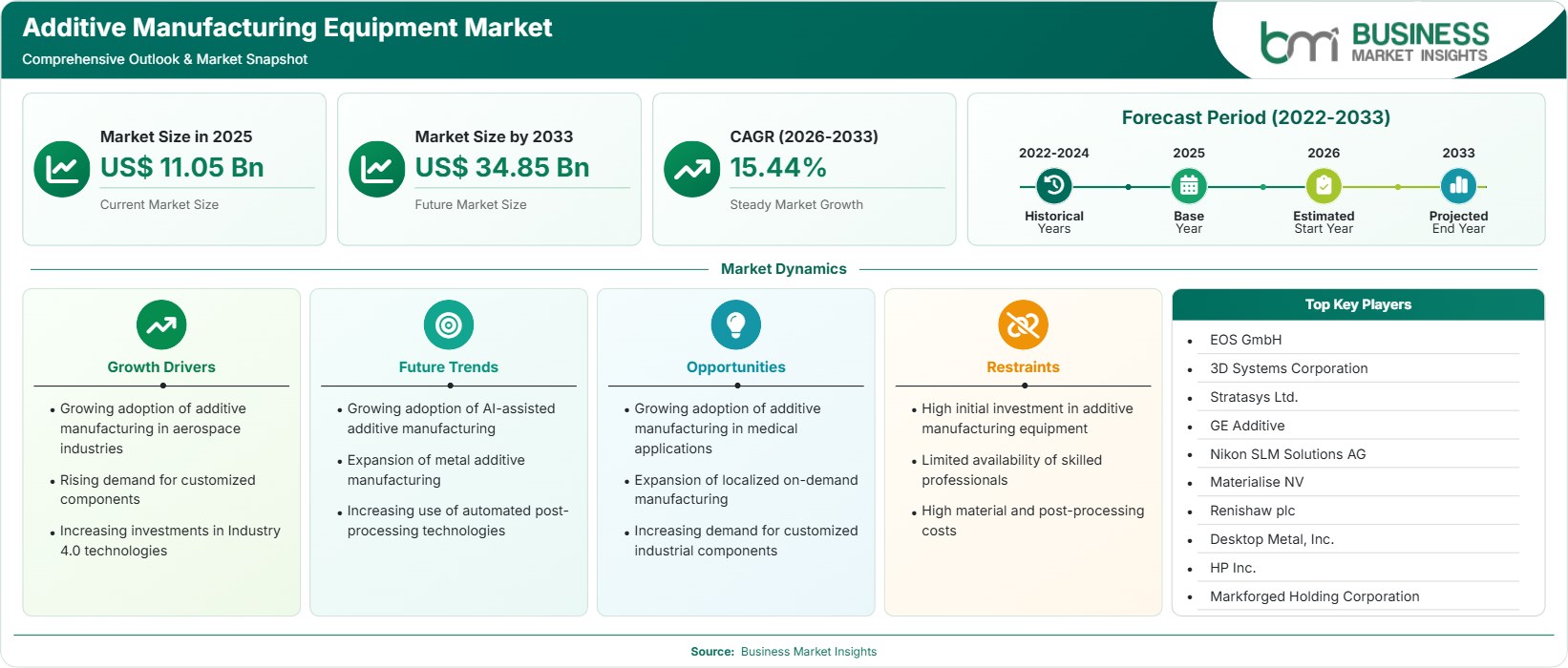
The Additive Manufacturing Equipment Market size was valued at US$ 11.05 Billion in 2025 and is projected to reach US$ 34.85 Billion by 2033, growing at a CAGR of 15.44% during 2026–2033. Market growth is being driven by increasing adoption of additive manufacturing across aerospace, automotive, healthcare, and industrial sectors. Rising demand for customized components, rapid prototyping capabilities, and Industry 4.0 integration is accelerating investments in advanced additive manufacturing technologies worldwide.

Report Coverage
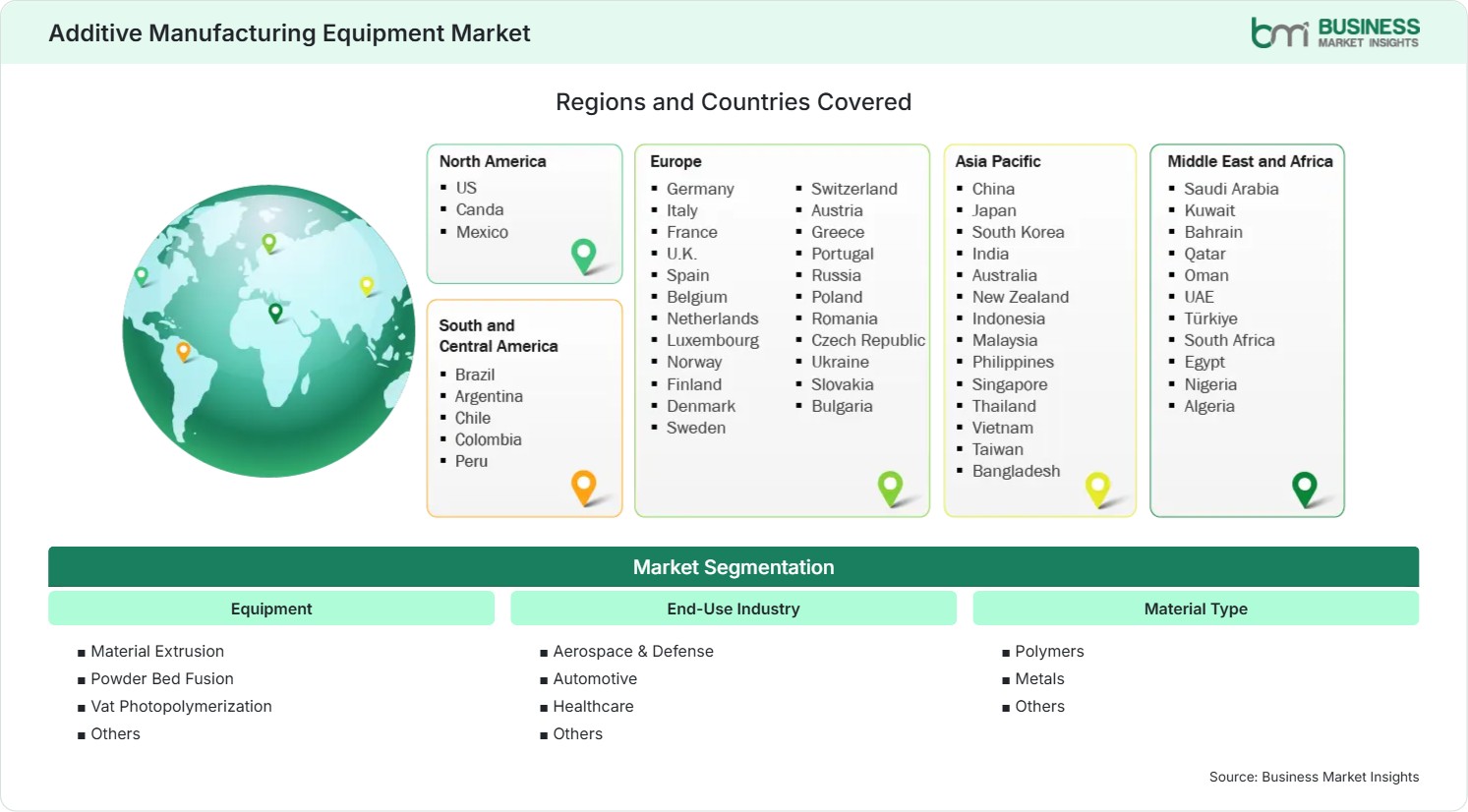
  • Equipment: Material Extrusion, Powder Bed Fusion, Vat Photopolymerization, Others
  • End-Use Industry: Aerospace & Defense, Automotive, Healthcare, Others
  • Material Type: Polymers, Metals, Others
US$ 11.05 Bn Market size in 2025
US$ 34.85 Bn Market Size by 2033
15.44% CAGR, 2026 - 2033
2026-2033 Forecast Period

01 AI Overview

Additive Manufacturing Equipment Market Summary

  • North America remains the leading regional market, accounting for approximately 36%–39% share in 2025, supported by strong aerospace, defense, and advanced manufacturing investments.
  • Asia Pacific is projected to witness the fastest growth through 2033 due to expanding industrialization, growing digital manufacturing initiatives, and increasing adoption of additive manufacturing technologies.
  • Powder Bed Fusion is the leading equipment category with approximately 38%–42% share in 2025, driven by demand for complex and high-performance components.
  • Aerospace & Defense represents the largest end-use industry, accounting for 28%–32% share in 2025, supported by increasing production of lightweight and customized parts.
  • Polymers remain the dominant material segment due to versatility, affordability, and widespread utilization in prototyping and production applications.
  • Key Companies: EOS GmbH, 3D Systems Corporation, Stratasys Ltd., GE Additive, Nikon SLM Solutions AG, Materialise NV, Renishaw plc, Desktop Metal, Inc., HP Inc., and Markforged Holding Corporation.
02 Strategic Insights

Additive Manufacturing Equipment Market: Strategic Insights

Additive Manufacturing Equipment Market Strategic Framework
FREE PDF
Request your free sample
Request free sample
03 Stakeholder View

Key Takeaways

  • Additive manufacturing is evolving from a prototyping technology into a production solution, enabling manufacturers to produce complex, lightweight, and customized components across multiple industries.
  • Aerospace & defense remains a key revenue-generating sector due to growing demand for lightweight structures, reduced component counts, and rapid production cycles.
  • Material innovation and improvements in machine performance are expanding the range of applications suitable for additive manufacturing technologies.
  • Asia Pacific presents significant investment opportunities driven by industrial modernization, government support for advanced manufacturing, and increasing adoption of Industry 4.0 practices.
  • Companies are focusing on automation, workflow optimization, and digital manufacturing integration to improve productivity and reduce production costs.
  • Localized and on-demand manufacturing capabilities are increasingly becoming strategic priorities for manufacturers seeking supply chain resilience and shorter product development cycles.
04 Geographic Outlook

Additive Manufacturing Equipment Market Regional Highlights

North America Additive Manufacturing Equipment Market

North America accounted for approximately 36%–39% share in 2025 and is projected to grow at a 14.8%–15.5% CAGR through 2033. The region benefits from strong aerospace and defense sectors, advanced manufacturing infrastructure, and substantial investments in industrial innovation. Organizations increasingly utilize additive manufacturing technologies to improve product development, reduce material waste, and support digital manufacturing strategies. Growing adoption across healthcare and automotive industries continues supporting Additive Manufacturing Equipment Market expansion.

  • Aerospace companies continue investing in additive manufacturing for production of lightweight, high-performance components and rapid prototyping applications.
  • Industry 4.0 initiatives are accelerating the integration of additive manufacturing equipment into connected production environments.
  • Healthcare organizations increasingly utilize additive manufacturing for customized medical devices and dental applications.
  • Strong research and development activities continue supporting innovation in materials, software, and equipment technologies.

US Additive Manufacturing Equipment Market

The United States accounts for approximately 81%–85% Additive Manufacturing Equipment Market share within North America and is expected to expand at a 14.9%–15.7% CAGR during 2026–2033. Demand is supported by advanced industrial capabilities, defense modernization, and increasing investment in digital manufacturing technologies. Strong adoption across aerospace, healthcare, and automotive sectors continues driving equipment purchases and technology upgrades.

  • Aerospace and defense sectors remain major adopters of high-end additive manufacturing equipment.
  • Increasing investment in localized manufacturing capabilities supports technology adoption.
  • Medical device manufacturers continue utilizing additive manufacturing for customized patient-specific products.
  • Industrial companies are leveraging additive technologies for spare parts and production optimization.

Europe Additive Manufacturing Equipment Market

Europe represented approximately 27%–30% share in 2025 and is forecast to register a 15.0%–15.8% CAGR through 2033. The market is supported by strong industrial automation initiatives, sustainability objectives, and advanced manufacturing ecosystems. Germany, France, Italy, and the United Kingdom remain key regional markets due to extensive engineering and automotive capabilities in Additive Manufacturing Equipment Market.

  • Automotive manufacturers increasingly employ additive manufacturing for lightweight components and product development.
  • Industrial sustainability objectives encourage efficient production methods with reduced material waste.
  • Research institutions continue advancing additive manufacturing technologies and material capabilities.
  • Growing adoption of metal additive manufacturing supports expansion of industrial applications.

Asia Pacific Additive Manufacturing Equipment Market

Asia Pacific accounted for approximately 24%–27% share in 2025 and is projected to witness the fastest growth at a 16.8%–17.6% CAGR through 2033. Growing industrialization, increasing investments in advanced manufacturing, and expanding adoption of automation technologies continue supporting Additive Manufacturing Equipment Market forecasts. Governments and manufacturers are actively encouraging digital production capabilities to strengthen competitiveness and innovation.

  • China remains a major market due to large-scale manufacturing activity and technology investments.
  • India is witnessing increasing adoption through industrial modernization and engineering innovation initiatives.
  • Expansion of electronics, automotive, and healthcare manufacturing supports equipment demand.
  • Growing interest in localized production is encouraging adoption across multiple industries.

Rest of World Additive Manufacturing Equipment Market

The Rest of World region accounted for approximately 6%–8% share in 2025 and is expected to grow at a 15.1%–15.9% CAGR through 2033. Increasing awareness of advanced manufacturing technologies and improving industrial capabilities are supporting adoption across South and Central America, the Middle East, and Africa. Investments in industrial diversification continue creating Additive Manufacturing Equipment Market opportunities.

  • Industrial modernization projects are increasing deployment of additive manufacturing technologies.
  • Demand for localized production capabilities is encouraging adoption among manufacturers.
  • Healthcare applications continue gaining traction across emerging markets.
  • Infrastructure development and industrial diversification support long-term market expansion.
Global Market Geography
FREE PDF
Request your free sample
Request free sample
05 Segment Analysis

Additive Manufacturing Equipment Market Segmentation

Equipment

The equipment segment is led by Powder Bed Fusion, accounting for approximately 38%–42% share in 2025 and projected to expand at a 16.0%–16.8% CAGR through 2033. The technology is widely adopted for producing highly complex, high-strength, and lightweight components used in aerospace, defense, healthcare, and industrial applications. Continuous improvements in build quality, precision, and material compatibility are further supporting Additive Manufacturing Equipment Market growth.

  • Material Extrusion (FDM/FFF): Widely utilized for rapid prototyping, tooling, and cost-effective part production due to operational simplicity, affordability, and broad material availability.
  • Powder Bed Fusion (SLS, SLM, DMLS, EBM): The leading category owing to superior precision, ability to manufacture complex geometries, and suitability for high-performance metal and polymer parts.
  • Vat Photopolymerization (SLA, DLP): Increasingly adopted for applications requiring exceptional surface finish, dimensional accuracy, and detailed component production.

End-Use Industry

The end-use industry segment is dominated by Aerospace & Defense, accounting for approximately 28%–32% share in 2025 and expected to grow at a 16.2%–17.0% CAGR through 2033. Demand is driven by increasing production of lightweight components, fuel-efficiency initiatives, and the need for rapid prototyping and customized manufacturing solutions. Growing investment in advanced manufacturing is supporting broader adoption across defense and aerospace programs in Additive Manufacturing Equipment Market share.

  • Aerospace & Defense: The largest end-use segment due to demand for lightweight structures, complex part geometries, reduced material waste, and accelerated product development cycles.
  • Automotive: Adoption continues expanding as manufacturers utilize additive manufacturing for prototyping, tooling, lightweight components, and customized production applications.
  • Healthcare (Medical & Dental): Strong growth is supported by increasing demand for patient-specific implants, surgical guides, prosthetics, dental devices, and personalized medical solutions.

Material Type

The material type segment is led by Polymers, accounting for approximately 48%–52% share in 2025 and projected to register a 15.8%–16.5% CAGR through 2033. Polymers remain widely utilized due to their versatility, affordability, ease of processing, and compatibility with various additive manufacturing technologies. Ongoing material innovation is further expanding their applications in industrial and consumer sectors.

  • Polymers: The dominant material category owing to extensive use in prototyping, functional parts, healthcare applications, and consumer product manufacturing.
  • Metals: Increasingly utilized in aerospace, defense, automotive, and industrial sectors where high strength, durability, and performance are required.
06 Market Forces

Additive Manufacturing Equipment Market Dynamics

Key Market Drivers

Growing Adoption of Additive Manufacturing in Aerospace Industries

The aerospace industry continues to be one of the strongest adopters of additive manufacturing technologies due to the need for lightweight, high-performance components and efficient production processes. Additive manufacturing enables the production of complex geometries that would be difficult or impossible to achieve through conventional manufacturing methods. Aerospace manufacturers are increasingly utilizing these technologies to reduce component weight, improve fuel efficiency, shorten production cycles, and minimize material waste. Continuous investments in aircraft modernization programs and next-generation aerospace platforms are expected to drive sustained demand for advanced additive manufacturing equipment.

Rising Demand for Customized Components

Manufacturers across industries are becoming increasingly interested in customized products that suit their unique customer and business requirements. Additive manufacturing offers unmatched flexibility, enabling the production of customized components in low quantities without incurring high tooling costs. Some of the industries that utilize this aspect include the healthcare, automotive, aerospace, and industrial equipment manufacturing industries. The increasing demand for customized products and quick design changes is reinforcing the case for additive manufacturing.

Increasing Investments in Industry 4.0 Technologies

Industrial 4.0 concepts are driving increased use of digital manufacturing solutions, automation technologies, and integrated production systems. Additive manufacturing machines have an important part to play in such an environment since they facilitate flexible production, integration of digital processes, and product development. Companies are now investing in smart factories that make effective use of manufacturing technologies to enhance their efficiency and competitiveness. The integration of additive manufacturing with artificial intelligence, industrial analytics, robotics, and remote monitoring systems will help market growth in the forecast period.

Key Market Opportunities

Growing Adoption of Additive Manufacturing in Medical Applications

Additive manufacturing technologies have found widespread use in the healthcare industry for producing personalized implants, prosthetics, dental applications, surgical tools, and other patient-specific solutions. Using additive manufacturing enables customization to the specific anatomic needs of each individual patient. Medical device manufacturers have also started using additive manufacturing to speed up the design and manufacturing of devices. With the increasing focus of healthcare providers on personalized medicine, the need for specialized equipment for additive manufacturing will grow.

Expansion of Localized On-Demand Manufacturing

Manufacturers are increasingly adopting localized and on-demand production strategies to improve supply chain resilience, shorten delivery times, and reduce inventory requirements. Additive manufacturing supports decentralized production by enabling components to be manufactured closer to the point of use without extensive tooling investments. This capability is particularly valuable in aerospace, healthcare, automotive, and industrial sectors where rapid product availability is essential. The growing emphasis on flexible manufacturing networks and digital production ecosystems continues creating opportunities for equipment manufacturers. As organizations seek to improve operational agility, localized manufacturing is expected to become an increasingly important market driver.

Increasing Demand for Customized Industrial Components

Industrial manufacturers are increasingly seeking customized components designed for specific operational requirements and performance conditions. Additive manufacturing technologies allow efficient production of low-volume and highly complex parts while reducing material waste and production lead times. Industries such as aerospace, energy, automotive, and industrial machinery are utilizing customized components to optimize equipment performance and improve operational efficiency. The ability to create custom designs without the high costs of tooling makes additive manufacturing even more compelling. Rising pressure on product customization and engineering solutions will offer substantial opportunities in the forecasted period.

Market Restraints and Challenges

High Initial Investment in Additive Manufacturing Equipment

Factor: Advanced additive manufacturing systems require significant capital investment for equipment acquisition, facility preparation, software integration, material handling infrastructure, and workforce training. High-performance metal printing systems, in particular, represent substantial upfront expenditures for manufacturers. Additional costs associated with maintenance, quality assurance systems, and process validation can further increase total ownership costs.

Impact: The high initial investment can limit adoption among small and medium-sized manufacturers, particularly in price-sensitive markets. Organizations may delay implementation despite recognizing the long-term operational benefits of additive manufacturing technologies. Capital intensity can also extend return-on-investment timelines, creating challenges for companies evaluating technology adoption. These factors continue to influence purchasing decisions and represent a significant barrier to broader market penetration.

Limited Availability of Skilled Professionals

Factor: Successful deployment of additive manufacturing technologies requires expertise in equipment operation, design optimization, material science, software workflows, quality control, and post-processing techniques. The rapid expansion of the industry has created growing demand for professionals possessing specialized technical skills and practical experience.

Impact: Workforce shortages can slow technology adoption, affect production efficiency, and increase operational costs for manufacturers. Companies often face challenges recruiting and retaining personnel capable of managing advanced additive manufacturing operations. Limited access to skilled talent may also reduce the effectiveness of technology implementation and delay scaling initiatives. Addressing workforce development and training requirements remains a critical challenge for sustained market growth.

07 Company Analysis

Competitive Landscape

The competitive landscape is characterized by continuous technological advancements in industrial 3D printing systems, material development, software integration, and production-scale additive manufacturing solutions. The Additive Manufacturing Equipment Market analysis indicates that leading companies are focusing on improving printing speed, accuracy, automation capabilities, and material compatibility while expanding solutions for aerospace, healthcare, automotive, and industrial manufacturing applications. Strategic partnerships, product innovation, and expansion of digital manufacturing ecosystems remain key competitive strategies.

Company Name

Overview

Products and Services relevant to this market

EOS GmbH

Pioneer in industrial additive manufacturing technologies with a strong presence in metal and polymer printing solutions.

Powder bed fusion systems, industrial 3D printers, additive manufacturing software, and production support services.

3D Systems Corporation

Global provider of additive manufacturing technologies serving healthcare, aerospace, and industrial markets.

Stereolithography systems, metal and polymer 3D printers, manufacturing software, and healthcare printing solutions.

Stratasys Ltd.

Leading additive manufacturing company specializing in polymer-based 3D printing technologies and production systems.

FDM printers, PolyJet systems, industrial additive manufacturing equipment, and digital manufacturing solutions.

GE Additive

Advanced manufacturing business focused on industrial metal additive manufacturing technologies.

Metal additive manufacturing machines, powder bed fusion systems, process optimization technologies, and manufacturing services.

Nikon SLM Solutions AG

Provider of metal additive manufacturing systems designed for industrial-scale production applications.

Metal 3D printing systems, selective laser melting technologies, industrial manufacturing solutions, and process support services.

Materialise NV

Technology company specializing in additive manufacturing software and production solutions.

Manufacturing software, workflow optimization platforms, medical printing solutions, and industrial additive manufacturing services.

Renishaw plc

Engineering technology company offering precision additive manufacturing equipment and metrology solutions.

Metal additive manufacturing systems, process monitoring solutions, healthcare manufacturing technologies, and precision engineering services.

Desktop Metal, Inc.

Additive manufacturing company focused on accelerating mass production through advanced 3D printing technologies.

Metal and polymer printing systems, manufacturing platforms, production-scale additive solutions, and workflow software.

HP Inc.

Global technology company expanding industrial additive manufacturing through advanced printing technologies.

Multi Jet Fusion printers, industrial 3D printing systems, production software, and manufacturing workflow solutions.

Markforged Holding Corporation

Manufacturer of industrial additive manufacturing solutions for composite and metal applications.

Composite printers, metal printing systems, cloud-based manufacturing software, and connected production technologies.


10 Trust & Transparency

Research Methodology

The market analysis combines proprietary research with secondary data from government agencies, company disclosures, regulatory filings, industry databases and expert interviews. Market estimates are validated through data triangulation, cross-market benchmarking and analyst review.

View Full Research Methodology

11 Questions Answered

Frequently Asked Questions

What are the major challenges facing the Additive Manufacturing Equipment Market?

Key challenges include high capital investment requirements for advanced equipment and the limited availability of skilled professionals capable of operating and optimizing additive manufacturing systems.

Which material segment dominates the market?

Polymers represent the largest material segment because of their versatility, cost-effectiveness, ease of processing, and broad applicability across prototyping and production activities.

Why is aerospace a major end-use industry?

Aerospace manufacturers increasingly utilize additive manufacturing to produce lightweight structures, reduce material waste, improve fuel efficiency, and accelerate product development cycles.

Which equipment technology leads the Additive Manufacturing Equipment Market report?

Powder Bed Fusion holds the leading market position due to its ability to manufacture highly precise, complex, and high-performance components for aerospace, healthcare, and industrial applications.

What is additive manufacturing equipment?

Additive manufacturing equipment refers to industrial and commercial systems that create three-dimensional objects layer by layer from digital designs using materials such as polymers, metals, and photopolymers.

Access the Full Additive Manufacturing Equipment Market Report

Get segment-level forecasts, regional estimates, competitive benchmarking, company profiles and downloadable Excel datasets.

Access the full Additive Manufacturing Equipment Market Report
350 pages PDF & Excel | 2026-08-20