
Manufacturing Waste Management Market Outlook: Size, Share, Trends, Growth Analysis, Competitive Landscape & Forecast, 2026–2033

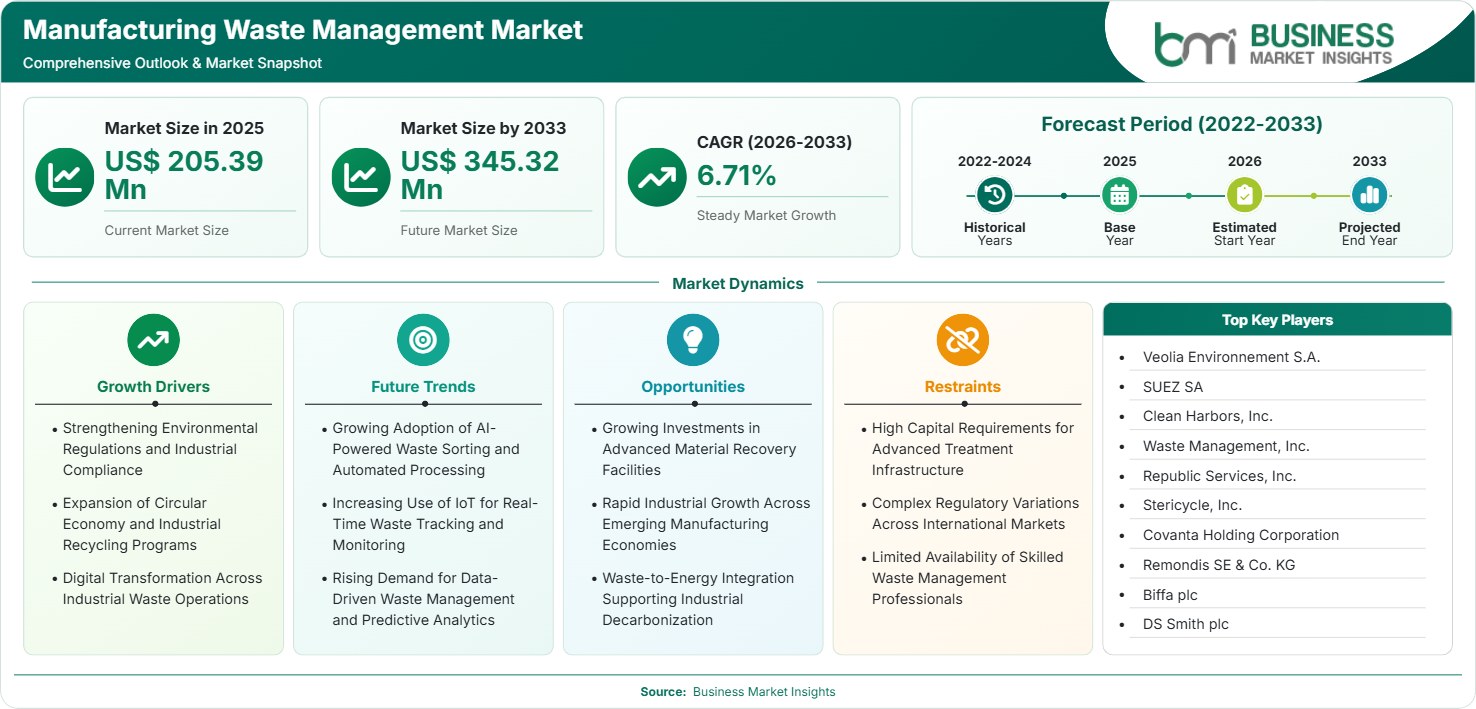
The Manufacturing Waste Management Market size was valued at US$ 205.39 Million in 2025 and is projected to reach US$ 345.32 Million by 2033, growing at a CAGR of 6.71% during 2026–2033. Rising industrial production, stricter environmental regulations, circular economy initiatives, advanced recycling technologies, and increasing corporate sustainability investments continue creating long-term opportunities across global manufacturing ecosystems.

Report Coverage
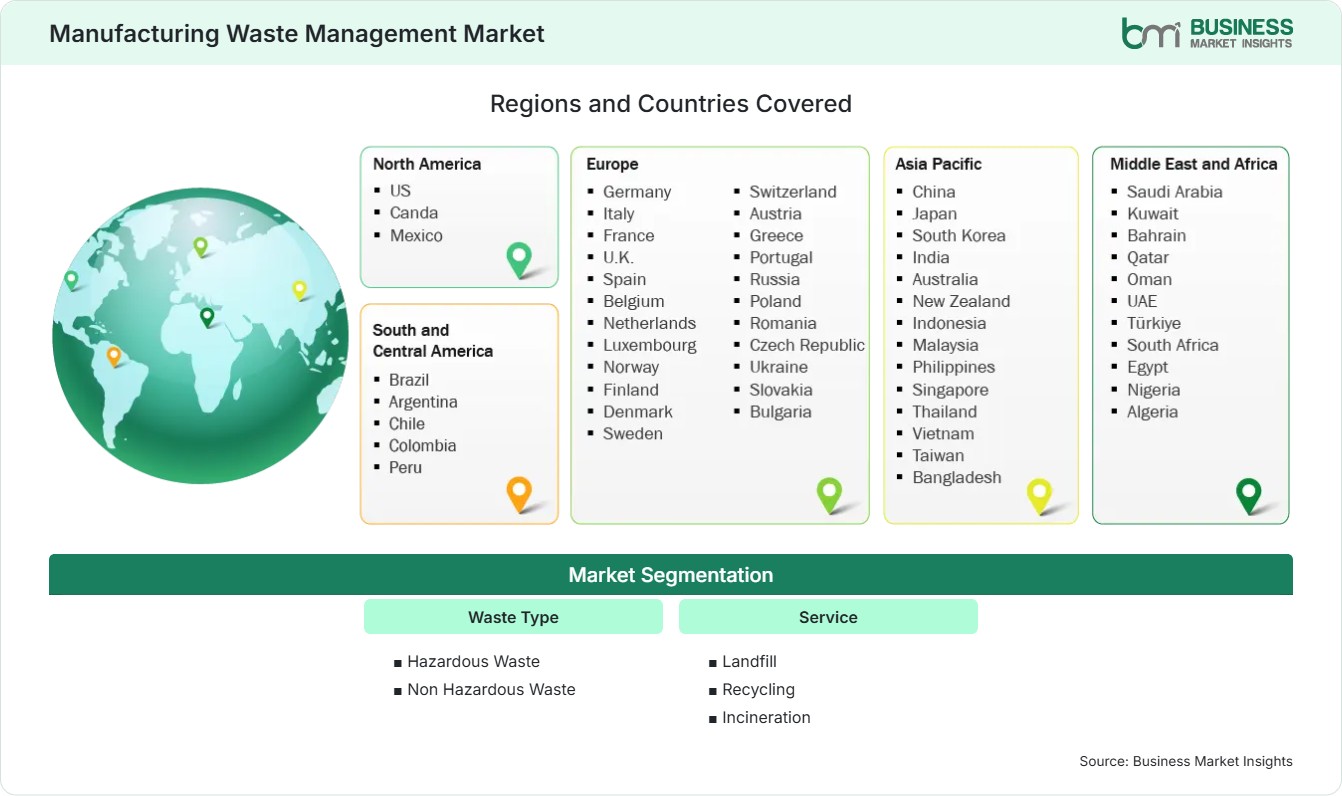
  • Waste Type: Hazardous Waste , Non Hazardous Waste
  • Service: Landfill, Recycling, Incineration
US$ 205.39 Mn Market size in 2025
US$ 345.32 Mn Market Size by 2033
6.71% CAGR, 2026 - 2033
2026-2033 Forecast Period

AI Overview

Manufacturing Waste Management Market Summary

  • North America Region: North America holds 34%–37% market share in 2025, expanding at a 6.0%–6.4% CAGR during 2026–2033. The maturing environmental policies, industrialization, digitalization of waste management processes, and circular manufacturing practices will continue to drive sustainable waste processing among industries. The U.S. will benefit from strict industrial policies, increased investment in recycling systems, digitalization, and industrial sustainability initiatives and register a CAGR of 6.1% to 6.5% by 2033.
  • Fastest Growing Region: Asia Pacific accounts for 28%–31% market share in 2025 while advancing at a 7.8%–8.3% CAGR between 2026 and 2033. Accelerating industrialization, expanding manufacturing capacity, government recycling mandates, infrastructure investment, and growing environmental awareness continue strengthening regional waste management capabilities.
  • Leading Segment: Hazardous Waste represents 54%–57% market share during 2025 and progresses at a 6.5%–6.9% CAGR throughout 2026–2033. Strict disposal regulations, increasing chemical manufacturing, pharmaceutical production growth, hazardous waste traceability requirements, and specialized treatment technologies continue supporting sustained demand across industrial facilities.
  • High Growth Segment: Recycling captures 42%–45% market share in 2025 while registering a 7.4%–7.8% CAGR during 2026–2033. Resource recovery initiatives, corporate sustainability commitments, rising recycled material demand, landfill diversion targets, and technological innovation continue accelerating adoption throughout manufacturing industries.
  • Key Market Opportunity: Growing investments in AI-enabled waste sorting, industrial material recovery, digital compliance platforms, circular economy partnerships, and resource efficiency programs enable manufacturers to reduce disposal costs while generating additional revenue from recyclable industrial materials.
  • Major Market Players: Veolia Environnement S.A., SUEZ SA, Clean Harbors, Inc., Waste Management, Inc., Republic Services, Inc., Stericycle, Inc., Covanta Holding Corporation, Remondis SE & Co. KG, Biffa plc, and DS Smith plc.
Strategic Insights

Manufacturing Waste Management Market: Strategic Insights

Manufacturing Waste Management Market Strategic Framework
FREE PDF
Request your free sample
Request free sample
Stakeholder View

Key Takeaways

  • The management of industrial waste is moving from being compliance-focused to becoming a resource optimization ecosystem that allows industries to reclaim useful secondary materials and increase manufacturing efficiency by reducing their reliance on raw materials.
  • The hazardous waste treatment services along with recycling services will still remain the most profitable as industries keep increasing their investments in sustainable manufacturing processes while fulfilling more stringent requirements for environmental compliance.
  • Artificial intelligence, robotics, real-time IoT monitoring, predictive analytics, blockchain waste tracking, and automation in material recovery have changed the nature of operational efficiency along with improving the accuracy of waste sorting and compliance reporting.
  • Asia Pacific presents the most attractive long-term investment opportunity owing to rapid industrial expansion, increasing manufacturing output, supportive environmental regulations, infrastructure modernization, and expanding recycling capacity across emerging economies.
  • Strategic acquisitions, integrated waste service partnerships, recycling infrastructure investments, and digital environmental management platforms continue strengthening competitive positioning while enabling service providers to deliver comprehensive industrial sustainability solutions.
  • Manufacturers increasingly prioritize zero-waste manufacturing strategies, closed-loop production models, renewable energy integration, and industrial symbiosis partnerships to improve profitability while meeting global environmental, social, and governance performance expectations.
Geographic Outlook

Manufacturing Waste Management Market Regional Highlights

North America Manufacturing Waste Management Market

North America maintains leadership with 34%–37% Manufacturing Waste Management Market share during 2025 while advancing at a 6.0%–6.4% CAGR through 2033. Strong environmental enforcement, industrial automation, circular economy investments, advanced recycling infrastructure, and high compliance standards continue supporting regional expansion.

  • Industrial manufacturers increasingly deploy AI-powered waste monitoring platforms, improving material segregation, regulatory reporting, operational transparency, and recovery efficiency while reducing compliance costs across complex manufacturing facilities.
  • Stringent EPA regulations continue encouraging hazardous waste treatment investments, landfill diversion initiatives, advanced recycling technologies, and circular manufacturing programs supporting sustainable industrial production across major manufacturing clusters.
  • Automotive, aerospace, pharmaceutical, electronics, and chemical manufacturing industries continue expanding demand for integrated waste collection, recycling, treatment, and disposal services aligned with sustainability objectives.

US Manufacturing Waste Management Market

The United States manufacturing waste management market contributes approximately 74%–77% of regional revenue while recording a projected 6.1%–6.5% CAGR between 2026 and 2033. Manufacturing modernization, ESG investments, digital compliance systems, advanced recycling infrastructure, and industrial sustainability programs continue driving nationwide adoption.

  • Federal and state environmental regulations continue accelerating investments in advanced hazardous waste treatment technologies, industrial recycling systems, and digital waste traceability platforms supporting regulatory compliance.
  • Rapid expansion of semiconductor, electric vehicle battery, and pharmaceutical manufacturing increases generation of specialized industrial waste requiring technologically advanced treatment solutions.
  • Industrial companies increasingly adopt circular manufacturing strategies, recovering valuable metals, plastics, chemicals, and packaging materials while reducing landfill dependency and improving profitability.

Europe Manufacturing Waste Management Market

Europe manufacturing waste management market accounts for 27%–30% market share during 2025 and expands at a 6.3%–6.8% CAGR through 2033. Circular economy legislation, carbon neutrality commitments, strict landfill restrictions, and extended producer responsibility regulations continue strengthening regional adoption.

  • European Green Deal initiatives continue promoting recycling infrastructure investments, waste reduction programs, industrial resource efficiency, and sustainable production across manufacturing industries.
  • Germany remains the largest regional contributor through advanced manufacturing capabilities, strong environmental regulations, and extensive industrial recycling infrastructure supporting circular economy objectives.
  • Poland records the fastest regional expansion as industrial investments, automotive production, electronics manufacturing, and infrastructure modernization continue accelerating waste management requirements.

Asia Pacific Manufacturing Waste Management Market

Asia Pacific manufacturing waste management market represents 28%–31% market share during 2025 while registering the fastest regional expansion at 7.8%–8.3% CAGR through 2033. Rapid industrialization, manufacturing relocation, urbanization, environmental reforms, and expanding recycling infrastructure continue driving regional growth. China remains the largest regional market, whereas India demonstrates the highest growth supported by industrial investments, and expanding domestic manufacturing capabilities.

  • China continues investing heavily in industrial recycling infrastructure, hazardous waste treatment facilities, and digital environmental monitoring supporting manufacturing sustainability.
  • India records the fastest regional expansion driven by industrial corridor development, manufacturing incentives, environmental regulations, and increasing investments in organized waste management infrastructure.
  • Japan and South Korea emphasize advanced recycling technologies, robotics-enabled waste sorting, and resource efficiency supporting high-value manufacturing industries.
  • Southeast Asian economies continue strengthening environmental regulations while attracting manufacturing investments requiring modern industrial waste management capabilities.

Rest of World Manufacturing Waste Management Market

The Rest of World region contributes 8%–10% market share in 2025 while expanding at a 6.8%–7.2% CAGR through 2033. Industrial diversification, mining activities, infrastructure development, and environmental policy reforms continue strengthening regional opportunities. Brazil leads South and Central America through industrial expansion, whereas Saudi Arabia records the fastest growth across the Middle East and Africa owing to industrial diversification, manufacturing investments, and sustainability initiatives.

  • Brazil continues strengthening industrial recycling infrastructure through manufacturing investments, mining expansion, environmental regulations, and growing adoption of sustainable industrial waste treatment solutions.
  • Saudi Arabia accelerates waste management investments under industrial diversification programs supporting manufacturing development, circular economy initiatives, and advanced environmental infrastructure.
  • Mining, metals, petrochemicals, food processing, and construction industries continue generating increasing demand for integrated industrial waste management solutions.
Global Market Geography
FREE PDF
Request your free sample
Request free sample
Segment Analysis

Manufacturing Waste Management Market Segmentation

Waste Type

The Waste Type segment accounted for approximately 54%–57% market share in 2025 and is projected to expand at a 6.5%–6.9% CAGR through 2033. The Manufacturing Waste Management Market scope continues expanding as manufacturers integrate advanced treatment technologies, digital waste tracking systems, and circular economy practices to improve environmental performance while reducing operational risks and disposal costs.

  • Hazardous Waste: Hazardous waste remains essential for chemical manufacturing, pharmaceuticals, electronics, mining, and metal processing industries. Increasing environmental regulations, traceability requirements, and specialized treatment technologies continue strengthening adoption across industrial facilities worldwide.
    • Chemical Waste: Chemical waste management supports safe treatment of solvents, acids, alkalis, catalysts, and industrial chemicals. Growing specialty chemical production and stringent environmental regulations continue encouraging advanced treatment technologies and compliant disposal practices.
    • Biomedical Waste: Biomedical waste generated during pharmaceutical manufacturing and biotechnology production requires specialized collection, sterilization, transportation, and disposal solutions. Increasing pharmaceutical output and bioscience investments continue strengthening treatment requirements globally.
    • Flammable and Toxic Substances: Industrial facilities handling flammable liquids, toxic compounds, combustible residues, and reactive chemicals increasingly adopt specialized containment, transportation, and treatment services to minimize environmental liabilities and workplace safety risks.
  • Non Hazardous Waste:
    Non hazardous waste management supports recycling, material recovery, and landfill diversion initiatives across automotive, food processing, electronics, packaging, and textile manufacturing operations. Growing sustainability commitments continue expanding recovery-focused waste management solutions.
    • Organic Waste: Organic industrial waste generated by food processing, beverage manufacturing, pulp, and bio-based industries increasingly supports composting, anaerobic digestion, and renewable energy production through sustainable recovery technologies.
    • Packaging Waste: Packaging waste recycling continues benefiting from corporate sustainability initiatives, extended producer responsibility regulations, and increasing demand for recycled paper, plastics, cardboard, and flexible packaging materials across manufacturing industries.
    • Metal Scraps: Metal scrap recovery remains critical for automotive, machinery, aerospace, and heavy engineering industries. Rising metal prices and circular manufacturing practices continue encouraging efficient recycling and secondary raw material utilization.
    • Glass and Ceramics: Glass and ceramic waste recycling supports construction materials, industrial manufacturing, and packaging industries by recovering reusable materials while reducing landfill disposal and production-related carbon emissions.
    • E-Waste: Electronic manufacturing generates increasing volumes of e-waste containing valuable metals and electronic components. Advanced recycling technologies continue improving precious metal recovery while supporting environmental compliance and resource conservation objectives.

Service

The Service segment reflects increasing emphasis on sustainable waste processing technologies across manufacturing industries. It represented approximately 43%–46% market share in 2025 while advancing at a 7.4%–7.8% CAGR through 2033. Manufacturing Waste Management Market trends increasingly emphasize integrated service models combining collection, treatment, recycling, compliance reporting, and resource recovery.

  • Landfill: Landfill services continue supporting disposal of industrial waste streams unsuitable for recycling or thermal treatment. Advanced engineered landfill facilities increasingly incorporate environmental monitoring, methane capture, and groundwater protection technologies.
  • Recycling: Recycling remains the fastest-growing service owing to increasing industrial sustainability targets, material recovery investments, circular economy strategies, and rising demand for secondary raw materials across manufacturing value chains.
  • Incineration: Incineration provides effective treatment for hazardous industrial waste through controlled thermal destruction while enabling energy recovery, volume reduction, pathogen elimination, and regulatory compliance across multiple manufacturing industries.
Market Forces

Manufacturing Waste Management Market Dynamics

Key Market Drivers

Strengthening Environmental Regulations and Industrial Compliance

The environmental rules for the production of industrial waste are becoming stricter globally, and hence compliance with such rules has become one of the main drivers of the market. This includes the Basel Convention, EU Waste Framework Directive, and national hazardous waste management rules which mandate certified waste management systems in place among others. The Manufacturing Waste Management Market growth is further supported by digital reporting platforms, mandatory waste traceability, and extended producer responsibility programs.

Expansion of Circular Economy and Industrial Recycling Programs

Shift from the traditional linear production processes to the circular manufacturing process progresses, there is increased investment in industrial recycling and material recovery facilities. There are rising trends in which metals, plastics, papers, solvents, and chemicals are recovered from production waste in order to cut the reliance on raw materials. According to the World Economic Forum, circular economy practices could create trillions of dollars worth of economic value across the globe in the coming decades.

Digital Transformation Across Industrial Waste Operations

The application of digital technologies in the area of waste management is becoming more apparent through innovations in areas such as artificial intelligence, IoT sensors, cloud-based compliance management, robotics, and predictive analytics. Real-time smart waste management systems allow for tracking of waste production and the optimization of waste collection schedules as well as improving segregation accuracy and ensuring proper regulatory reporting. The use of automation and material identification technology increases efficiency of waste recovery and decreases costs associated with handling.

Key Market Opportunities

Growing Investments in Advanced Material Recovery Facilities

Industrial companies are understanding that waste should be viewed as an important secondary resource that requires investments rather than a disposal problem. Modern waste recovery plants equipped with AI sorting technologies, optical scanners, robots, and automated sorting equipment increase the efficiency of recycling while providing high-quality recycled products. Manufacturing Waste Management Market Forecasts indicates that investments in resource recovery facilities will increase industrial sustainability as well as generate new income sources from recycled metals, plastics, paper, and special materials.

Rapid Industrial Growth Across Emerging Manufacturing Economies

The expansion of industries in India, Vietnam, Indonesia, Mexico, Saudi Arabia, Brazil, and many other developing countries in Africa provides future opportunities for integrated waste management services. Investments into industries through government incentives, infrastructure development, and foreign direct investments result in the growing production of industrial wastes that need to be managed professionally. International environmental standards are adopted by developing countries along with hazardous waste management.

Waste-to-Energy Integration Supporting Industrial Decarbonization

Waste-to-energy technologies continue gaining momentum as manufacturers seek to reduce landfill dependency while improving renewable energy generation. Modern thermal treatment facilities recover energy from non-recyclable industrial waste, supporting carbon reduction initiatives and enhancing resource utilization. Industrial companies increasingly integrate waste-derived fuels into manufacturing operations to improve energy security and reduce fossil fuel consumption. Government incentives promoting renewable energy infrastructure, combined with stricter landfill regulations, create attractive opportunities for investment in advanced thermal treatment facilities.

Market Restraints and Challenges

High Capital Requirements for Advanced Treatment Infrastructure

Factor: Building the current generation of hazardous waste treatment plants, modern waste recycling facilities, sophisticated monitoring equipment, and energy-from-waste facilities demands significant capital outlay in addition to highly qualified technical manpower. Small producers frequently find it difficult to justify the expense involved in spite of mounting regulatory requirements. Impact: Infrastructure costs hinder technology adoption, especially amongst smaller companies in manufacturing industries where expenses are an important issue.

Complex Regulatory Variations Across International Markets

Factor: Waste management regulations vary substantially from country to country concerning waste classification, waste transport, documentation, waste recycling criteria, hazardous waste disposal and reporting. International companies should comply with several different regulatory regimes and at the same time maintain their consistent level of environmental performance. Impact: The increased complexity of regulation leads to higher costs, administration load and risks of non-compliance on the part of international manufacturing companies and waste management companies.

Company Analysis

Competitive Landscape

The manufacturing waste management market analysis indicates that companies are increasingly investing in AI-enabled waste monitoring, digital compliance platforms, advanced recycling infrastructure, and waste-to-energy technologies to strengthen operational efficiency and support circular manufacturing initiatives.

Company Name

Overview

Products and Services Relevant to this Market

Veolia Environnement S.A.

Global environmental services provider offering integrated industrial waste solutions, resource recovery, water management, and energy efficiency services across manufacturing industries.

Hazardous waste treatment, industrial recycling, waste collection, resource recovery, waste-to-energy solutions, environmental consulting, compliance services, and circular economy programs.

SUEZ SA

International environmental solutions company specializing in sustainable waste treatment, industrial recycling, hazardous material management, and resource optimization for industrial customers.

Industrial waste collection, hazardous waste treatment, recycling services, material recovery, environmental monitoring, circular economy solutions, and industrial sustainability consulting.

Clean Harbors, Inc.

North American leader focused on hazardous waste management, emergency response, industrial cleaning, and environmental services supporting manufacturing and energy sectors.

Hazardous waste transportation, treatment, disposal, industrial cleaning, emergency spill response, recycling, field services, and environmental compliance solutions.

Waste Management, Inc.

Leading waste management company delivering comprehensive industrial waste collection, recycling, landfill, and sustainability solutions across North America.

Industrial waste collection, recycling, landfill services, sustainability consulting, waste audits, resource recovery, and environmental reporting solutions.

Republic Services, Inc.

Major provider of environmental services supporting industrial customers through integrated recycling, waste collection, landfill management, and sustainability initiatives.

Industrial waste collection, recycling, landfill operations, resource recovery, environmental consulting, and circular economy support services.

Stericycle, Inc.

Specialized compliance company providing regulated waste management and secure environmental solutions for healthcare, pharmaceutical, and manufacturing industries.

Biomedical waste treatment, hazardous waste disposal, compliance management, secure transportation, regulatory documentation, and environmental risk management services.

Covanta Holding Corporation

Waste-to-energy specialist converting industrial and municipal waste into renewable energy while supporting sustainable waste diversion strategies.

Waste-to-energy services, hazardous waste destruction, thermal treatment, energy recovery, industrial waste processing, and environmental compliance solutions.

Remondis SE & Co. KG

European recycling and environmental services provider with strong expertise in industrial resource recovery and circular economy solutions.

Industrial recycling, hazardous waste treatment, material recovery, waste logistics, environmental consulting, and sustainable resource management services.

Biffa plc

United Kingdom environmental services company supporting commercial and industrial customers through recycling and integrated waste management operations.

Industrial waste collection, recycling, landfill diversion, waste audits, resource recovery, and sustainability support services.

DS Smith plc

Global packaging and recycling company focused on circular economy solutions, packaging recovery, and sustainable material management across industrial supply chains.

Packaging waste recycling, paper recovery, circular packaging solutions, material recovery, sustainability consulting, and recycling infrastructure services.

Trust & Transparency

Research Methodology

The market analysis combines proprietary research with secondary data from government agencies, company disclosures, regulatory filings, industry databases and expert interviews. Market estimates are validated through data triangulation, cross-market benchmarking and analyst review.

View Full Research Methodology

Questions Answered

Frequently Asked Questions

Why are emerging economies becoming important markets?

Rapid industrialization, manufacturing expansion, supportive government policies, infrastructure modernization, stronger environmental regulations, and increasing foreign investments are creating significant opportunities for integrated waste treatment, recycling, and resource recovery services across developing manufacturing economies.

What technologies are reshaping the Manufacturing Waste Management Market Report?

Artificial intelligence, robotics, IoT sensors, blockchain-enabled traceability, cloud-based compliance platforms, automated sorting systems, predictive analytics, and advanced material recovery technologies are improving waste segregation, regulatory reporting, operational efficiency, and resource recovery across manufacturing facilities.

How does recycling contribute to industrial sustainability?

Industrial recycling reduces raw material consumption, lowers production costs, minimizes landfill disposal, conserves natural resources, decreases greenhouse gas emissions, and supports circular manufacturing strategies by recovering valuable materials for reuse within industrial production processes.

Which industries generate the highest demand for manufacturing waste management services?

Chemical manufacturing, pharmaceuticals, automotive, electronics, aerospace, food processing, mining, metal fabrication, and heavy engineering industries generate substantial hazardous and non-hazardous waste requiring specialized treatment, recycling, transportation, and regulatory compliance services.

What factors are accelerating adoption of industrial waste management solutions?

Increasing environmental regulations, circular economy initiatives, industrial sustainability goals, digital waste monitoring, and rising investments in recycling infrastructure are encouraging manufacturers to adopt integrated waste management systems that improve compliance while reducing operational costs and environmental impact.

Access the Full Manufacturing Waste Management Market Report

Get segment-level forecasts, regional estimates, competitive benchmarking, company profiles and downloadable Excel datasets.

Access the full Manufacturing Waste Management Market Report
350 pages PDF & Excel | 2026-08-17