
Facility Management Market Outlook: Size, Share, Trends, Growth Analysis, Competitive Landscape & Forecast, 2026-2033

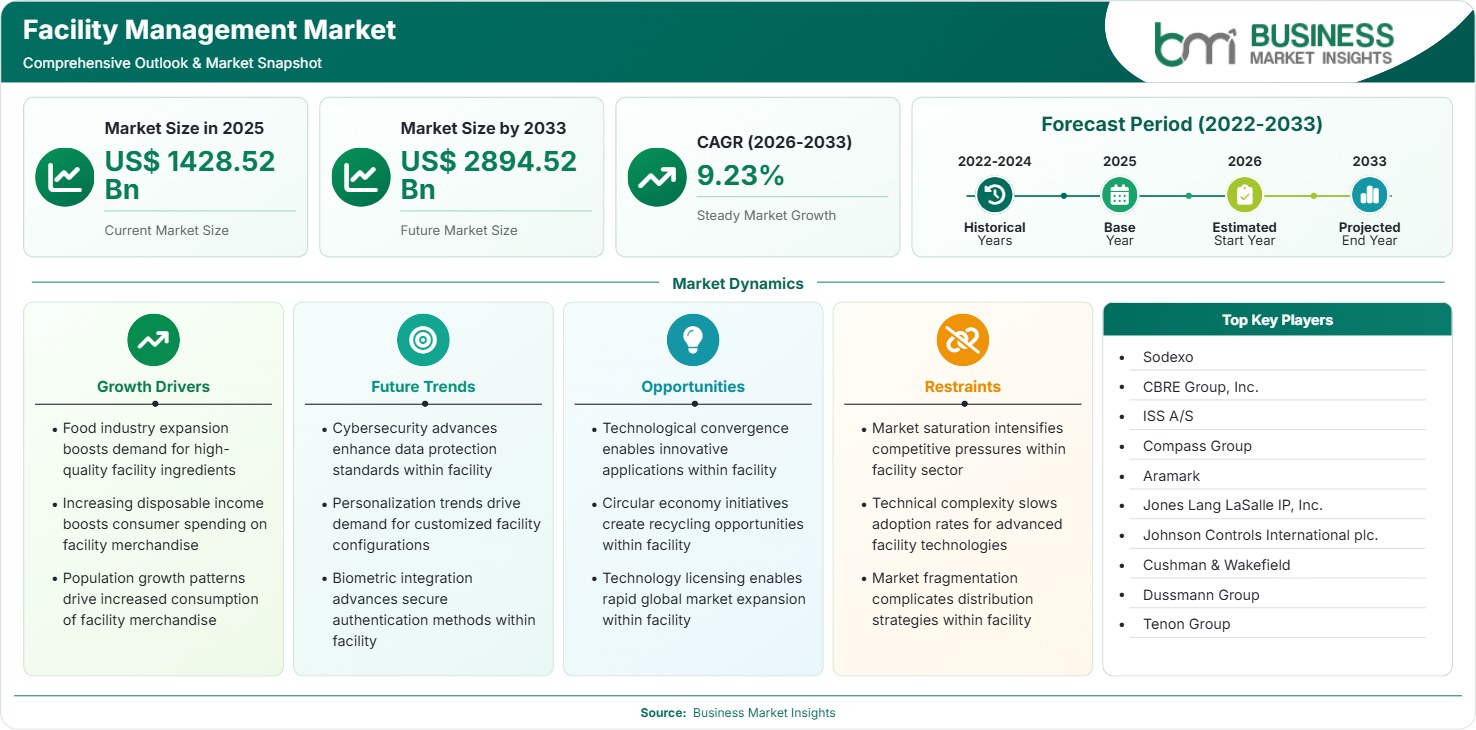
The Facility Management Market size was valued at US$ 1428.52 Billion in 2025 and is projected to reach US$ 2894.52 Billion by 2033, growing at a CAGR of 9.23% during 2026–2033. Increasing digital building management, expanding outsourcing of integrated facility services, rising smart infrastructure investments, and growing emphasis on workplace sustainability, operational efficiency, and predictive maintenance continue creating significant growth opportunities across commercial, industrial, healthcare, and public sector facilities.

Report Coverage
  • Offering: In-House, Outsourced
  • Service Type: Hard Services, Soft Services
  • Industry Vertical: Healthcare, Business & Corporate, Manufacturing, Government, Education, Military & Defense, Hospitality
US$ 1428.52 Bn Market size in 2025
US$ 2894.52 Bn Market Size by 2033
9.23% CAGR, 2026 - 2033
2026-2033 Forecast Period

AI Overview

Facility Management Market Summary

  • North America Region: North America holds 34%–37% market share in 2025, expanding at a 8.7%–9.3% CAGR during 2026–2033. Growth is supported by widespread smart building deployment, outsourced integrated services, ESG initiatives, and predictive maintenance adoption. The U.S. market benefits from mature commercial infrastructure and digital workplace transformation, advancing at 8.8%–9.4% CAGR.
  • Fastest Growing Region: Asia Pacific accounts for 27%–30% market share in 2025 and is anticipated to grow at 10.8%–11.6% CAGR during 2026–2033. Rapid urbanization, infrastructure investments, industrial expansion, commercial real estate growth, and smart city development continue strengthening regional demand for integrated facility management solutions.
  • Leading Segment: Outsourced (Single & Bundled Services) represents 61%–64% market share in 2025 and is forecast to register a 9.6%–10.2% CAGR. Organizations increasingly outsource non-core operations to improve efficiency, reduce operating expenses, standardize service quality, and enhance regulatory compliance.
  • High Growth Segment: Hard Services account for 53%–56% market share in 2025 while expanding at a 9.9%–10.6% CAGR. Increasing investments in intelligent building systems, HVAC modernization, energy optimization, digital asset monitoring, and preventive maintenance continue accelerating adoption.
  • Key Market Opportunity: AI-powered predictive maintenance, IoT-enabled facility monitoring, cloud-based workplace management platforms, and sustainability-driven building optimization are enabling providers to deliver measurable cost savings, operational resilience, energy efficiency, and enhanced occupant experiences.
  • Major Market Players: Sodexo; CBRE Group, Inc.; ISS A/S; Compass Group PLC; Aramark; Jones Lang LaSalle Incorporated; Johnson Controls International plc; Cushman & Wakefield plc; Dussmann Group; Tenon Group; OCS Group International Limited; EFS Facilities Services Group; Veolia Environnement SA; American Facility Services Group.
Strategic Insights

Facility Management Market: Strategic Insights

Facility Management Market Strategic Framework
FREE PDF
Request your free sample
Request free sample
Stakeholder View

Key Takeaways

  • The market ecosystem is rapidly transitioning from standalone maintenance contracts toward integrated facility management models that combine hard services, soft services, digital workplace management, sustainability consulting, and predictive asset maintenance under long-term service agreements, improving operational efficiency and cost transparency.
  • Outsourced bundled services present the strongest commercial opportunity as enterprises increasingly prioritize strategic outsourcing to reduce operating expenses, enhance regulatory compliance, optimize workforce allocation, and improve service quality across geographically dispersed facilities.
  • Artificial intelligence, IoT sensors, robotics, digital twins, cloud-based Computerized Maintenance Management Systems (CMMS), and predictive analytics are reshaping service delivery by enabling real-time monitoring, predictive maintenance, automated workflows, and data-driven facility optimization.
  • Asia Pacific offers the most compelling long-term investment potential due to rapid urbanization, commercial real estate expansion, smart city initiatives, industrial infrastructure development, and government investments supporting intelligent building management technologies.
  • Strategic acquisitions, technology partnerships, and integrated workplace management platform investments are becoming primary competitive strategies as global providers strengthen digital capabilities and expand end-to-end facility service portfolios across multiple industry verticals.
  • Sustainability-focused facility operations, including energy optimization, carbon reduction initiatives, renewable energy integration, and green building certifications, are emerging as major competitive differentiators influencing enterprise procurement decisions.
Geographic Outlook

Facility Management Market Regional Highlights

North America Facility Management Market

North America accounts for 34%–37% of global revenue in 2025 while registering a projected 8.7%–9.3% CAGR during 2026–2033. The region benefits from mature commercial real estate, widespread outsourcing practices, advanced smart building deployment, and strong investments in workplace digitalization. The Facility Management Market share remains the highest globally because organizations continue prioritizing operational efficiency, predictive maintenance, sustainability compliance, and integrated workplace management across commercial, healthcare, industrial, education, and government facilities.

  • Strong adoption of AI-enabled predictive maintenance platforms enables facility owners to reduce operational downtime, optimize maintenance scheduling, extend equipment lifecycle, and improve overall building performance through real-time asset intelligence.
  • Growing ESG commitments encourage organizations to implement energy-efficient HVAC systems, intelligent lighting controls, renewable energy integration, and sustainability-focused building operations supporting long-term carbon reduction objectives.
  • Increasing demand from healthcare, life sciences, logistics, and hyperscale data centers continues expanding outsourcing opportunities for integrated facility management providers across complex critical infrastructure environments.
  • Rising cybersecurity investments for connected building systems strengthen demand for secure IoT-enabled facility management platforms capable of protecting operational technology and building automation networks.
  • Commercial office modernization and hybrid workplace strategies continue driving investments in workplace experience management, occupancy analytics, and digital facility operations.

US Facility Management Market

The United States represents approximately 82%–85% of North American revenue while expanding at a projected 8.8%–9.4% CAGR during the Facility Management Market period. Large corporate campuses, healthcare infrastructure, manufacturing facilities, educational institutions, and federal properties increasingly adopt integrated digital facility solutions to improve operational efficiency, reduce lifecycle costs, strengthen sustainability performance, and comply with evolving workplace regulations.

  • Fortune 500 enterprises increasingly outsource bundled services to improve operational consistency while allowing internal resources to focus on strategic business activities rather than non-core facility operations.
  • Growth in hyperscale data centers creates substantial opportunities for specialized maintenance, energy optimization, environmental monitoring, and mission-critical infrastructure management providers.
  • Federal sustainability programs encourage investments in energy-efficient public buildings, intelligent infrastructure, and advanced building automation technologies supporting long-term operational resilience.
  • AI-powered workplace analytics improve occupancy planning, employee experience, maintenance scheduling, and facility utilization across hybrid work environments.

Europe Facility Management Market

Europe captures 25%–28% of global Facility Management Market revenue in 2025 and is projected to expand at 8.9%–9.5% CAGR through 2033. Strong environmental regulations, stringent workplace safety standards, and widespread adoption of green building certifications continue supporting integrated facility management demand. Germany remains the leading regional market, while Eastern European countries demonstrate comparatively faster expansion due to infrastructure modernization and commercial real estate investments.

  • EU sustainability regulations encourage facility operators to improve building energy performance, implement carbon reduction initiatives, and modernize aging commercial infrastructure using intelligent facility technologies.
  • Germany maintains regional leadership through strong industrial infrastructure, advanced manufacturing facilities, and widespread adoption of digital maintenance platforms supporting operational excellence.
  • Poland and Romania exhibit relatively stronger growth as multinational companies expand logistics, manufacturing, and commercial facilities throughout Central and Eastern Europe.
  • Growing investments in healthcare infrastructure and smart public buildings continue generating opportunities for integrated service providers across the region.
  • Digital twins and Building Information Modeling (BIM) increasingly support predictive asset management and lifecycle optimization across commercial real estate portfolios.

Asia Pacific Facility Management Market

Asia Pacific represents 27%–30% of global revenue in 2025 while recording the fastest regional CAGR of 10.8%–11.6% through 2033. Rapid urbanization, expanding commercial construction, smart city initiatives, industrial automation, and increasing corporate outsourcing continue driving regional demand. China remains the largest regional Facility Management Market, while India records the fastest expansion supported by infrastructure development and digital transformation initiatives.

  • China's commercial real estate expansion and manufacturing modernization continue strengthening demand for integrated hard and soft facility services across industrial and corporate facilities.
  • India experiences rapid growth through expanding IT parks, healthcare infrastructure, airports, educational campuses, and government-backed smart city development initiatives.
  • Japan increasingly invests in robotics, automated building maintenance, and energy-efficient commercial infrastructure to address labor shortages and improve operational productivity.
  • Southeast Asian economies continue expanding hospitality, logistics, and commercial office infrastructure requiring comprehensive outsourced facility management solutions.
  • Government investments in transportation infrastructure and public utilities further stimulate long-term demand for professional facility management services.

Rest of World Facility Management Market

The Rest of the World contributes 10%–13% of global Facility Management Market revenue in 2025 and is projected to grow at 9.2%–9.8% CAGR during 2026–2033. Growth is supported by expanding commercial infrastructure, energy projects, healthcare investments, and hospitality developments across South America, the Middle East, and Africa. Brazil leads South & Central America, while Saudi Arabia demonstrates the fastest expansion driven by mega infrastructure developments.

  • Saudi Arabia's Vision 2030 projects generate substantial demand for integrated facility management services supporting airports, hospitality assets, commercial developments, and smart cities.
  • The UAE continues expanding premium commercial real estate and mixed-use developments requiring advanced workplace management and sustainability-focused operational services.
  • Brazil remains South America's largest Facility Management Market owing to commercial property expansion, industrial modernization, and increasing outsourcing across enterprise facilities.
  • Mining, oil and gas, and industrial infrastructure projects across Africa continue creating opportunities for specialized hard facility management providers.
  • Growing international investment in tourism, transportation, healthcare, and education infrastructure strengthens long-term market demand throughout emerging economies.
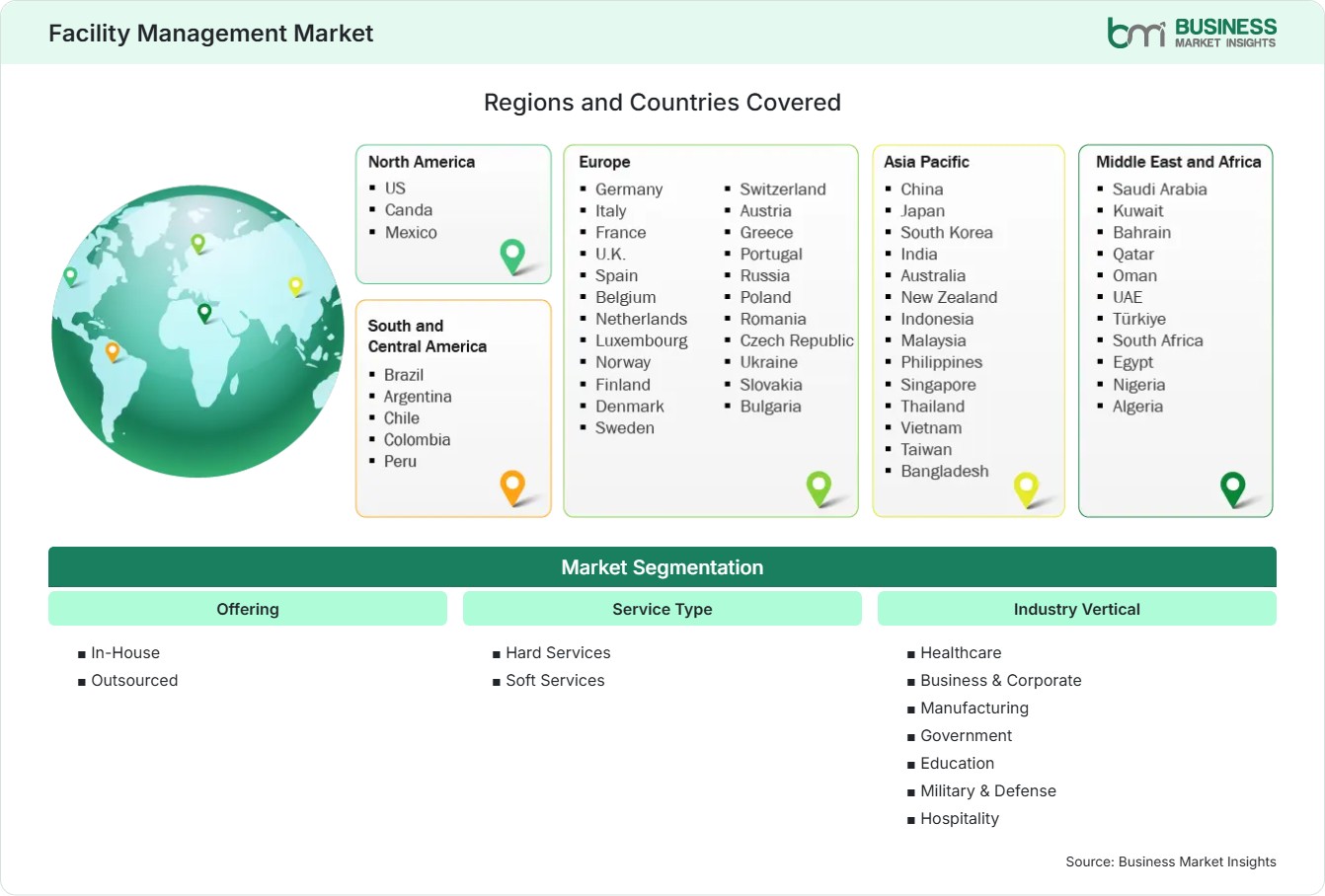
Global Market Geography
FREE PDF
Request your free sample
Request free sample
Segment Analysis

Facility Management Market Segmentation

Offering

The Offering segment represents the core delivery model of the market, with outsourced services gaining stronger traction as organizations focus on operational efficiency, cost optimization, and access to specialized expertise. The segment accounted for 61%–64% market share in 2025 and is projected to expand at a 9.6%–10.2% CAGR through 2033. The Facility Management Market scope continues widening as enterprises increasingly adopt integrated digital service contracts combining maintenance, workplace management, sustainability, and compliance solutions.

  • In-House: Organizations retain direct operational control to ensure customized service delivery, particularly across highly regulated sectors such as defense, healthcare, and critical infrastructure requiring stringent security and compliance.
  • Outsourced (Single & Bundled Services): Enterprises increasingly outsource integrated services to improve operational efficiency, reduce lifecycle costs, access specialized expertise, enhance scalability, and simplify vendor management through bundled service contracts.

Service Type

Service Type remains the largest operational segment, supported by increasing investments in intelligent building technologies, preventive maintenance, energy optimization, and workplace experience management. The segment accounted for 53%–56% market share during 2025 and is anticipated to register a 9.9%–10.6% CAGR through 2033. Increasing digitalization and Facility Management Market trends continue accelerating demand for integrated hard and soft service portfolios capable of delivering measurable operational value.

  • Hard Services
    • Mechanical, Electrical, Plumbing, & HVAC Maintenance: Increasing investments in smart building systems and predictive maintenance technologies improve equipment reliability, energy efficiency, regulatory compliance, and operational continuity across commercial and industrial facilities.
    • Energy Management: Organizations implement intelligent monitoring platforms, automated controls, renewable integration, and energy optimization strategies to reduce operating costs while meeting sustainability and carbon reduction objectives.
    • Asset Management: Digital asset lifecycle management solutions enhance maintenance planning, equipment utilization, capital expenditure optimization, and long-term infrastructure reliability using predictive analytics and IoT-enabled monitoring.
    • Offshore Facility Management: Offshore energy and industrial facilities require specialized maintenance, asset integrity management, workforce accommodation, logistics support, and environmental compliance services under demanding operating conditions.
  • Soft Services
    • Janitorial and Sanitization: Enhanced hygiene standards across healthcare, education, hospitality, and commercial workplaces continue driving professional cleaning, sanitation, and infection prevention service adoption.
    • Office Support Services: Organizations increasingly utilize outsourced administrative support, reception management, mailroom operations, workspace coordination, and document handling to improve workplace productivity.
    • Housekeeping: Commercial buildings, hotels, hospitals, and institutional facilities prioritize professional housekeeping services to improve occupant satisfaction, operational efficiency, and service quality consistency.
    • Pest Control: Preventive pest management programs help organizations maintain regulatory compliance, protect assets, reduce health risks, and ensure uninterrupted facility operations.
    • Security and Guarding: Integrated security services combining trained personnel, surveillance technologies, access control, and emergency response continue expanding across corporate, industrial, and public facilities.
    • Ground Maintenance: Landscape management, exterior maintenance, irrigation, snow removal, and outdoor infrastructure services enhance property value, sustainability, safety, and visitor experience.

Industry Vertical

Industry-specific requirements continue shaping service innovation, with highly regulated industries demanding integrated maintenance, compliance management, digital monitoring, and sustainability solutions. This segment accounted for 48%–51% Facility Management Market share in 2025 and is expected to grow at a 9.4%–10.0% CAGR through 2033 as organizations prioritize operational resilience and workplace optimization.

  • Healthcare: Hospitals and healthcare campuses require continuous facility operations, infection prevention, HVAC reliability, critical equipment maintenance, and strict regulatory compliance to ensure uninterrupted patient care.
  • Business & Corporate: Corporate offices increasingly adopt integrated workplace management, hybrid workspace optimization, smart building technologies, sustainability initiatives, and employee experience enhancement solutions.
  • Manufacturing: Industrial facilities require preventive maintenance, equipment reliability, utility management, environmental compliance, and production-support services to maximize operational efficiency and minimize downtime.
  • Government: Public sector organizations prioritize integrated facility operations, infrastructure modernization, energy efficiency, asset preservation, and regulatory compliance across administrative and civic buildings.
  • Education: Educational institutions increasingly invest in campus maintenance, energy-efficient infrastructure, digital facility management, security services, and healthy learning environments.
  • Military & Defense: Defense facilities require secure infrastructure management, mission-critical maintenance, specialized engineering support, regulatory compliance, and high-security operational standards across sensitive installations.
  • Hospitality: Hotels, resorts, convention centers, and entertainment venues emphasize housekeeping, technical maintenance, guest safety, sustainability initiatives, and premium workplace services to improve customer satisfaction and operational excellence.
Market Forces

Facility Management Market Dynamics

Key Market Drivers

Expansion of Smart Buildings and Digital Infrastructure

The rapid deployment of smart buildings is transforming facility operations through connected sensors, artificial intelligence, digital twins, and cloud-based management platforms. According to industry estimates, commercial buildings account for a substantial share of global electricity consumption, encouraging owners to implement intelligent monitoring systems that improve energy efficiency and operational performance. Facility Management Market growth is increasingly supported by predictive maintenance technologies capable of reducing equipment downtime, lowering maintenance costs, and extending asset life. Integration of IoT devices, Building Management Systems (BMS), and Computerized Maintenance Management Systems (CMMS) enables real-time monitoring, automated fault detection, and data-driven decision-making. These capabilities improve occupant comfort while helping organizations achieve sustainability targets and regulatory compliance.

Growing Outsourcing of Integrated Facility Services

Organizations across commercial, healthcare, manufacturing, and government sectors are increasingly outsourcing integrated facility management to specialized service providers. Rising labor costs, increasing compliance requirements, and the need for operational flexibility encourage enterprises to consolidate multiple services under bundled contracts. Outsourcing enables organizations to focus on core business operations while benefiting from specialized technical expertise, standardized service delivery, and scalable workforce management. Large multinational providers continue investing in digital service platforms, workforce mobility applications, and remote asset monitoring to improve operational efficiency. This trend supports long-term contractual relationships, recurring revenue models, and continuous service innovation throughout the global facility management ecosystem.

Sustainability and Energy Optimization Initiatives

Governments, corporations, and institutional building owners continue prioritizing carbon reduction, energy efficiency, and sustainable infrastructure investments. International green building certification programs and ESG reporting requirements encourage facility operators to modernize HVAC systems, lighting infrastructure, water management, and energy monitoring platforms. Intelligent energy management reduces operational expenses while improving environmental performance. Renewable energy integration, automated energy controls, and predictive maintenance further strengthen long-term building efficiency. Increasing corporate commitments toward net-zero emissions continue to accelerate investments in digital facility technologies that optimize resource utilization while supporting resilient and environmentally responsible infrastructure management.

Key Market Opportunities

AI-Driven Predictive Maintenance Solutions

AI provides many possibilities since it allows predictive maintenance on commercial buildings, industrial plants, healthcare institutions, and even public infrastructure. AI systems use information on equipment performance, sensor readings, and maintenance history to detect future problems before they happen. This approach decreases downtime, increases equipment efficiency, and reduces maintenance costs. The need for predictive maintenance solutions in the cloud rises along with enterprises' digitalizing their facility operations. Facility Management Forecasts indicate increased spending on intelligent asset management, digital twins, and remote diagnostics, enabling the service provider to scale up software-based services and deliver tangible operational efficiencies and lifecycle cost savings.

Expansion of Smart City Infrastructure Projects

Global investments in smart cities create long-term opportunities for integrated facility management providers. Smart transport systems, airports, hospitals, schools, utility companies, and government offices that need advanced facility management are funded by governments. There is an increased need for facilities management due to digital infrastructure, smart utilities, energy-efficient public buildings, and central monitoring systems. Service providers that can integrate IoT, automation, security, and sustainable practices will take advantage of multi-year government infrastructure contracts.

Growth in Sustainable Workplace Management

Corporate sustainability commitments are creating new opportunities for providers offering energy optimization, waste management, indoor environmental quality monitoring, and workplace wellness services. Organizations are constantly looking for holistic ways of improving employee productivity, minimizing emissions, and cutting utility bills. With green office certifications, circular economy solutions, and the use of renewable energy sources, the service offerings become even more extensive. Systems that measure the environmental performance, occupancy, and operational efficiency of the digital workplace can be considered an extra offering for enterprises.

Market Restraints and Challenges

Fragmented Service Delivery and Workforce Shortages

Factor: The industry remains highly fragmented across many regional providers, while qualified technical personnel for HVAC, electrical systems, automation, and integrated facility operations remain in limited supply.

Impact: Workforce shortage causes an increase in recruitment costs, delays in service delivery, and inconsistent operations in geographically scattered locations. A huge investment is required for workforce training, workforce management software, certifications, and automation technologies to ensure quality in the services provided. Small enterprises will have more difficulties than large multinational enterprises because of their higher technical, geographical, and financial abilities.

High Initial Digital Transformation Costs

Factor: Implementation of IoT-enabled sensors, cloud-based facility management software, AI-powered analytics, cybersecurity systems, and digital twin platforms requires substantial upfront capital investment.

Impact: Small and medium enterprises can delay their efforts towards digitalization due to financial constraints and uncertainty about near-term returns on investment. The integration of the existing facility management systems into the building's infrastructure makes the process more difficult and time-consuming. However, there is a need for a balanced approach to modernization without disruption, cybersecurity, and long-term technology scalability.

Company Analysis

Competitive Landscape

The competitive environment is shaped by global integrated service providers, real estate management firms, technology-enabled facility operators, and specialized maintenance companies. The Facility Management Market analysis highlights increasing competition around digital transformation, sustainability services, workplace experience solutions, and integrated outsourcing models. Leading companies are expanding service portfolios through technology investments, strategic partnerships, and geographic expansion to address evolving enterprise facility requirements.

Company Name

Overview

Products and Services relevant to this market

Sodexo

Global services company providing integrated facility management and workplace solutions across healthcare, corporate, education, and government sectors worldwide.

Integrated facilities management, workplace services, cleaning, maintenance, food services, energy efficiency solutions, and employee experience management platforms.

CBRE Group, Inc.

Global commercial real estate services provider offering comprehensive facility management, workplace solutions, and property operations expertise across multiple industries.

Facilities management, technical maintenance, workplace experience, energy management, property operations, and smart building advisory services.

ISS A/S

International workplace experience and facility services company focused on integrated service delivery and technology-enabled operational solutions.

Cleaning services, technical services, workplace management, catering, security, property maintenance, and integrated facility management solutions.

Compass Group PLC

Global food and support services provider delivering workplace, healthcare, education, and corporate facility service solutions.

Support services, workplace management, cleaning solutions, catering operations, facilities support, and hospitality-related facility services.

Aramark

U.S.-based service provider offering facility management and hospitality solutions for businesses, education institutions, healthcare organizations, and sports venues.

Facilities services, workplace solutions, cleaning, maintenance support, food services, and operational management solutions.

Jones Lang LaSalle Incorporated

Global real estate services company providing integrated facility management and workplace optimization solutions for commercial and institutional clients.

Integrated facilities management, workplace strategy, building operations, sustainability consulting, energy management, and property technology solutions.

Johnson Controls International plc

Building technology and solutions provider specializing in intelligent infrastructure, automation, energy efficiency, and facility optimization services.

Building automation systems, HVAC solutions, fire safety systems, energy management, predictive maintenance, and smart building technologies.

Cushman & Wakefield plc

Global real estate services company delivering facility management, workplace advisory, and operational solutions across diverse property portfolios.

Facilities management, workplace services, technical operations, sustainability solutions, occupancy management, and property advisory services.

Dussmann Group

German multinational service provider offering technical, cleaning, healthcare, and integrated facility management solutions across Europe.

Technical building services, cleaning, security, catering, energy management, and integrated facility operations.

Tenon Group

Indian facility services company providing integrated workplace management solutions for corporate, industrial, and institutional customers.

Security services, housekeeping, engineering maintenance, integrated facility management, and workforce management solutions.

OCS Group International Limited

Global facilities services provider delivering workplace, healthcare, aviation, and specialist support services across multiple regions.

Cleaning, technical services, healthcare support, security, aviation services, and integrated facility management solutions.

EFS Facilities Services Group

Middle East-based integrated facilities management provider serving commercial, industrial, government, and infrastructure sectors.

Hard services, soft services, asset management, energy management, maintenance, and integrated facilities solutions.

Veolia Environnement SA

Environmental services company supporting sustainable facility operations through resource management, energy optimization, and infrastructure solutions.

Energy management, waste management, water services, environmental solutions, facility operations, and sustainability consulting.

American Facility Services Group

U.S.-based facility services provider specializing in commercial cleaning, maintenance, and workplace support operations.

Janitorial services, facility maintenance, sanitation, workplace support, cleaning programs, and customized facility service solutions.

Trust & Transparency

Research Methodology

The market analysis combines proprietary research with secondary data from government agencies, company disclosures, regulatory filings, industry databases and expert interviews. Market estimates are validated through data triangulation, cross-market benchmarking and analyst review.

View Full Research Methodology

Questions Answered

Frequently Asked Questions

What does the Facility Management Market Report provide?

The report provides detailed insights into market valuation, regional performance, segment analysis, competitive strategies, technology trends, growth factors, challenges, and future investment opportunities.

What role does sustainability play in facility management?

Sustainability initiatives encourage energy-efficient buildings, carbon reduction strategies, renewable energy integration, waste management optimization, and compliance with environmental standards.

What is driving demand for outsourced facility management?

Companies increasingly outsource services to reduce operational complexity, access specialized expertise, improve cost efficiency, and focus internal resources on core business functions.

How is technology changing facility management operations?

Artificial intelligence, IoT sensors, digital twins, robotics, and cloud platforms enable predictive maintenance, automated monitoring, energy optimization, and data-driven decision-making across modern facilities.

What industries are the largest users of Facility Management Market services?

Healthcare, corporate offices, manufacturing, education, hospitality, government, and defense sectors represent major users because they require continuous maintenance, safety compliance, operational efficiency, and specialized facility support.

Access the Full Facility Management Market Report

Get segment-level forecasts, regional estimates, competitive benchmarking, company profiles and downloadable Excel datasets.

Access the full Facility Management Market Report
350 pages PDF & Excel | 2026-08-18