
Liquid Waste Management Market Outlook: Size, Share, Trends, Growth Analysis, Competitive Landscape & Forecast, 2026-2033

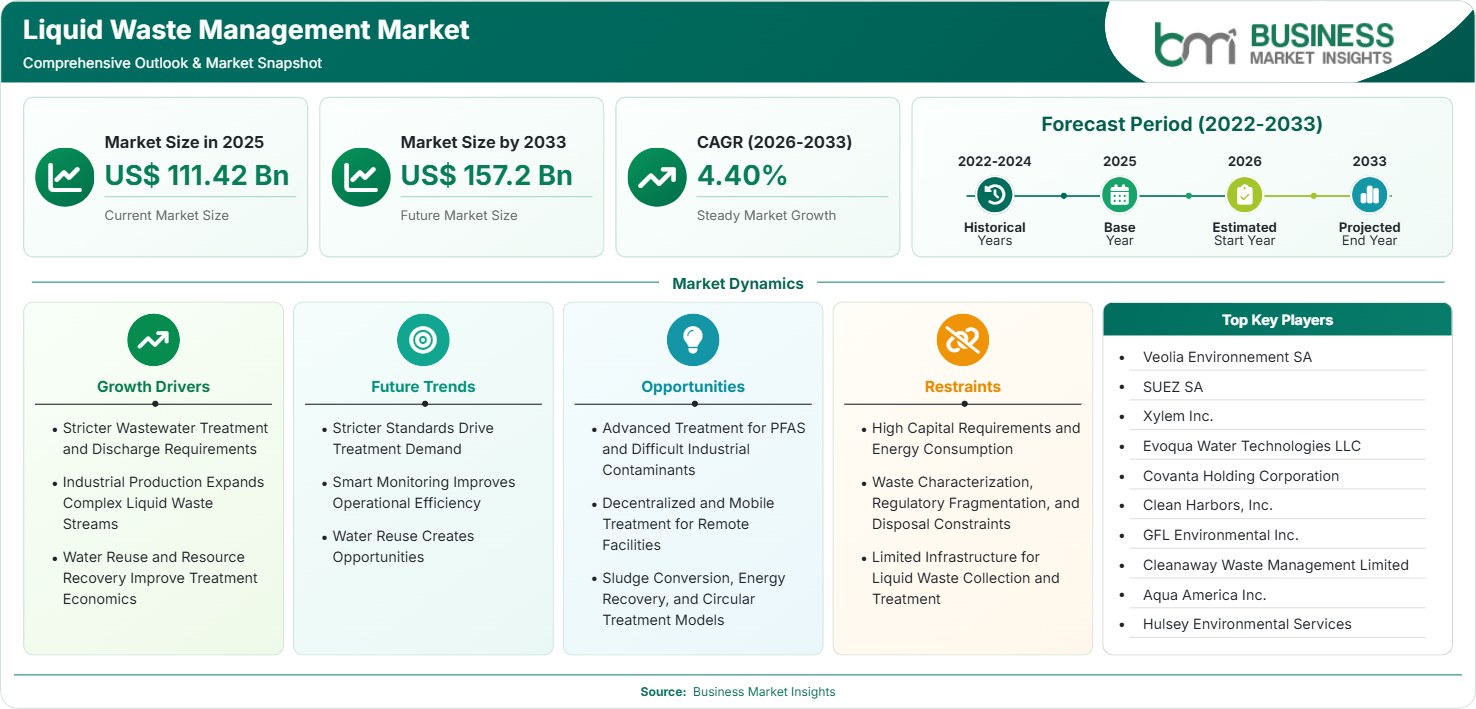
The Liquid Waste Management Market size was valued at US$ 111.42 Billion in 2025 and is projected to reach US$ 157.2 Billion by 2033, growing at a CAGR of 4.40% during 2026–2033, driven by wastewater regulation, industrial treatment demand, resource recovery, water reuse, and infrastructure modernization.

Report Coverage
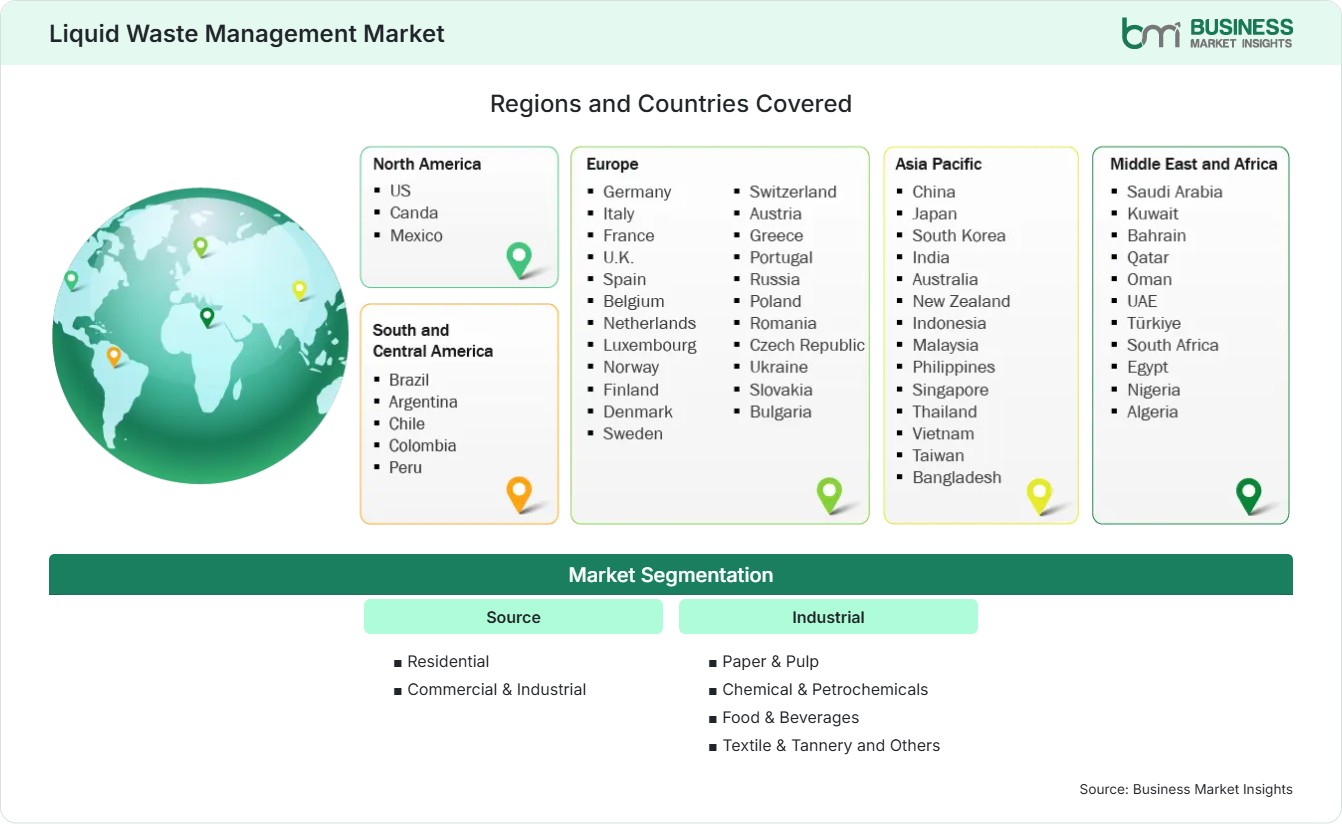
  • Source: Residential, Commercial & Industrial
  • Industrial: Paper & Pulp, Chemical & Petrochemicals, Food & Beverages, Textile & Tannery and Others
US$ 111.42 Bn Market size in 2025
US$ 157.2 Bn Market Size by 2033
4.40% CAGR, 2026 - 2033
2026-2033 Forecast Period

AI Overview

Liquid Waste Management Market Summary

  • North America Region: North America holds a 34%–37% share in 2025 and records a 4.0%–4.4% CAGR during 2026–2033. Mature wastewater infrastructure, industrial compliance, hazardous-liquid handling, PFAS treatment, municipal upgrades, and resource recovery create recurring demand across utilities and industries.
    The U.S. anchors regional demand, with a 4.1%–4.5% CAGR through 2033, supported by industrial treatment, remediation, and wastewater infrastructure investment.
  • Fastest Growing Region: Asia Pacific holds a 22%–25% Liquid Waste Management Market share in 2025 and records a 5.1%–5.7% CAGR during 2026–2033. Industrialization, urban wastewater generation, stricter discharge requirements, manufacturing expansion, water scarcity, treatment investments, and reuse initiatives strengthen long-term opportunities.
  • Leading Segment: Industrial holds a 56%–60% share in 2025 and records a 4.5%–4.9% CAGR during 2026–2033. Complex effluents, environmental compliance, hazardous waste handling, onsite treatment, sludge management, and growing industrial water reuse sustain segment leadership.
  • High Growth Segment: Chemical & Petrochemicals holds a 17%–21% share in 2025 and records a 5.1%–5.8% CAGR during 2026–2033. Contaminant complexity, stringent discharge standards, water reuse, process-efficiency requirements, and hazardous-liquid treatment needs support above-average expansion.
  • Key Market Opportunity: Advanced treatment, wastewater reuse, sludge-to-resource conversion, PFAS removal, digital monitoring, decentralized treatment, and integrated industrial services can increase value captured per liquid-waste stream.
  • Major Market Players: Veolia Environnement SA, SUEZ SA, Xylem Inc., Evoqua Water Technologies LLC, Covanta Holding Corporation, Clean Harbors, Inc., GFL Environmental Inc., Cleanaway Waste Management Limited, Aqua America Inc., and Hulsey Environmental Services.
Strategic Insights

Liquid Waste Management Market: Strategic Insights

Liquid Waste Management Market Strategic Framework
FREE PDF
Request your free sample
Request free sample
Stakeholder View

Key Takeaways

  • The value chain is moving toward integrated contracts covering collection, transportation, pretreatment, treatment, dewatering, disposal, water recovery, and compliance documentation. Providers with end-to-end capabilities can improve asset utilization and customer retention.
  • Industrial applications offer the clearest upside because chemical, petrochemical, food, pulp and paper, and textile operations generate complex liquid streams requiring specialized treatment rather than conventional municipal wastewater processes.
  • Technology investment is shifting toward membrane systems, high-rate biological treatment, digital monitoring, automated dosing, PFAS removal, sludge dewatering, anaerobic digestion, and resource-recovery technologies that improve treatment economics.
  • Asia Pacific offers the strongest expansion case because manufacturing growth and urbanization are increasing liquid-waste volumes while governments are tightening wastewater-discharge requirements and expanding water-reuse infrastructure.
  • M&A is strengthening specialized environmental-services networks. Clean Harbors announced a $225 million acquisition of Terra Nova Solutions in May 2026, adding permitted wastewater treatment, solidification, and waste-processing assets.
  • Water scarcity is transforming wastewater from a disposal liability into a secondary resource. Industrial customers increasingly value treated effluent, recovered materials, renewable energy, and reduced freshwater dependence alongside regulatory compliance.
Geographic Outlook

Liquid Waste Management Market Regional Highlights

North America Liquid Waste Management Market

North America holds a 34%–37% Liquid Waste Management Market share in 2025 and records a 4.0%–4.4% CAGR during 2026–2033. The region benefits from mature collection networks, established treatment infrastructure, extensive industrial service providers, environmental enforcement, and growing remediation requirements. The United States represents the dominant regional market, while Canada adds demand through municipal upgrades, resource extraction, industrial processing, and wastewater modernization. Treatment providers are increasingly differentiating through specialized hazardous-liquid management, PFAS capabilities, mobile treatment, and resource recovery.

  • Industrial generators increasingly outsource difficult liquid streams because specialized treatment providers can spread compliance, permitting, transportation, and infrastructure costs across multiple customers and treatment assets.
  • PFAS regulation and remediation requirements are strengthening demand for activated carbon, ion exchange, membrane treatment, destruction technologies, and specialized disposal routes across industrial and municipal applications.
  • Digital monitoring is improving treatment reliability through remote measurement, predictive maintenance, automated dosing, and centralized operational visibility across geographically dispersed wastewater assets.
  • Resource recovery is becoming strategically relevant as utilities and industrial facilities seek biogas, recovered solids, reusable water, and lower disposal volumes to improve environmental and economic performance.

US Liquid Waste Management Market

The U.S. represents 80%–84% of North American demand in 2025 and records a 4.1%–4.5% CAGR during 2026–2033. Demand is supported by extensive industrial activity, stringent environmental rules, aging municipal assets, hazardous-waste requirements, and a sophisticated network of specialized service providers. Clean Harbors reported wastewater treatment within its Environmental Services portfolio and continued investing in technical and field services in 2026.

  • Industrial wastewater providers are expanding mobile and onsite treatment because remote facilities require flexible solutions that reduce hauling requirements while maintaining compliance with discharge and permit conditions.
  • Municipal operators are investing in rehabilitation, capacity improvements, energy efficiency, and advanced treatment as aging assets face increasing performance and resilience requirements.
  • Acquisition activity is strengthening regional treatment networks. Clean Harbors acquired Terra Nova Solutions, whose five sites support wastewater treatment, solidification, and waste-processing activities.

Europe Liquid Waste Management Market

Europe holds a 25%–28% share in 2025 and records a 4.1%–4.6% CAGR during 2026–2033of the Liquid Waste Management Market. Germany, France, the United Kingdom, Italy, and the Netherlands lead commercial activity, while Spain and Nordic countries offer additional technology and resource-recovery opportunities. European demand is strongly influenced by wastewater directives, circular-economy goals, industrial decarbonization, and energy recovery. SUEZ is advancing wastewater services, sludge treatment, and energy recovery projects, illustrating the region’s transition from disposal-oriented infrastructure toward circular treatment systems.

  • Germany remains a leading industrial-treatment market because chemical, automotive, food, pharmaceutical, and manufacturing facilities require reliable treatment of complex process effluents.
  • France is strengthening wastewater circularity through sludge digestion, biomethane generation, treated-water reuse, and performance-driven municipal service contracts.
  • The United Kingdom provides opportunities in municipal treatment, industrial services, resource recovery, and waste-to-energy integration, with major operators expanding long-term public-sector contracts.
  • European customers increasingly prioritize energy efficiency, carbon reduction, sludge minimization, and measurable environmental performance alongside treatment compliance.

Asia Pacific Liquid Waste Management Market

Asia Pacific holds a 22%–25% share in 2025 and records a 5.1%–5.7% CAGR during 2026–2033, making it the fastest-growing region. China, India, Japan, South Korea, Australia, and Southeast Asian economies form major demand centers. Rapid industrialization, urbanization, water stress, and manufacturing expansion are increasing wastewater-treatment requirements. SUEZ’s 2025 Kochi contract in India illustrates the region’s infrastructure opportunity, combining long-term water-service modernization with operational improvement and network upgrades.

  • China provides substantial industrial-treatment opportunities across chemicals, petrochemicals, textiles, food processing, electronics, and manufacturing, where discharge controls are becoming more sophisticated.
  • India combines industrial expansion with substantial urban wastewater infrastructure needs, creating demand for decentralized systems, network rehabilitation, industrial treatment, and water reuse.
  • Southeast Asia offers opportunities around palm processing, food manufacturing, chemicals, mining, electronics, and rapidly expanding urban centers where treatment capacity often lags generation.
  • Japan, South Korea, and Australia contribute through advanced treatment technologies, industrial water-reuse systems, resource recovery, and highly regulated wastewater-management environments.

Rest of World Liquid Waste Management Market

Rest of World holds a 15%–18% share in 2025 and records a 3.4%–4.0% CAGR during 2026–2033 of the Liquid Waste Management Market. South America and Central America are supported by industrial activity, mining, food processing, urban growth, and environmental infrastructure needs, with Brazil and Mexico representing major demand centers. The Middle East and Africa present additional opportunities through water scarcity, desalination, industrial diversification, and wastewater reuse. SUEZ’s 2026 Oman agreement demonstrates the scale of regional infrastructure investment, covering wastewater services for 2.3 million people.

  • Brazil combines food processing, mining, chemicals, and municipal wastewater requirements, creating demand for treatment, sludge management, industrial reuse, and specialized liquid-waste services.
  • Mexico is developing industrial wastewater capabilities alongside manufacturing expansion, particularly around automotive, food, chemicals, and export-oriented industrial clusters.
  • Gulf countries are prioritizing water reuse and treatment efficiency because scarcity increases the economic value of recovered water and reduces dependence on freshwater resources.
  • South Africa provides a regional gateway for industrial and municipal treatment services, while other African markets remain constrained by infrastructure financing and treatment-capacity gaps.
Global Market Geography
FREE PDF
Request your free sample
Request free sample
Segment Analysis

Liquid Waste Management Market Segmentation

Source

The source category covers residential, commercial, and industrial liquid streams, with the largest share coming from industrial liquid streams. The industrial requirement shows a share of 56%-60% and a CAGR of 4.5%-4.9% in the value chain model from 2026 to 2034. The Liquid Waste Management Market scope is increasingly becoming centered on industrial requirements.

  • Residential: Septage, sewage, greywater, and household liquid waste require collection, treatment, desludging, and safe disposal, with infrastructure quality and sanitation coverage determining service intensity.
  • Commercial & Industrial: Commercial premises and industrial facilities generate diverse liquid streams requiring collection, pretreatment, specialized treatment, monitoring, and compliant disposal or reuse depending on contaminant characteristics.

Industrial

The industrial liquid waste management category is expected to account for 56%-60% of the market share in 2025 and is projected to experience a 4.5%-4.9% CAGR in the Liquid Waste Management Market from 2026 to 2034. Factors such as difficult-to-manage contaminants, stringent environmental regulations, production growth, and water reclamation contribute to the market across various industries.

  • Paper & Pulp: High-organic-load effluent, suspended solids, bleaching chemicals, and process-water requirements drive biological treatment, clarification, filtration, reuse, and sludge-management demand.
  • Chemical & Petrochemicals: Complex hydrocarbons, solvents, salts, toxic compounds, and variable process streams require advanced pretreatment, separation, polishing, monitoring, and specialized disposal solutions.
  • Food & Beverages: High biological oxygen demand and organic loading from food-processing operations support demand for anaerobic digestion, biological treatment, solids separation, water recovery, and odor control.
  • Textile & Tannery: Dyes, salts, suspended solids, heavy metals, and variable chemical loads require coagulation, oxidation, membranes, biological treatment, and tightly controlled effluent management.
Market Forces

Liquid Waste Management Market Dynamics

Key Market Drivers

Stricter Wastewater Treatment and Discharge Requirements

The expansion of the Liquid Waste Management Market trends is significantly by rising demand for wastewater treatment and by the environmental impacts of untreated wastewater. According to the WHO, only 27% of industrial wastewater in countries with available data was treated safely, highlighting significant treatment gaps and the need for accelerated investment. The needs of industrial customers become more specific, as traditional treatment may be inefficient for PFAS, hydrocarbons, solvents, salts, nutrients, metals, or high-strength organic matter. Compliance also extends beyond discharge, encompassing sludge treatment, transportation, monitoring, reporting, and site remediation. Vendors that offer a complete treatment chain have an edge because their clients can avoid dealing with different providers.

Industrial Production Expands Complex Liquid Waste Streams

The increase in manufacturing has direct consequences for the complexity of liquid waste, as industry generates diverse waste streams containing chemicals, suspended solids, oil, nutrients, salts, and organic matter. Plants in the chemical, petrochemical, food processing, textile, pulp and paper, mining, and pharmaceutical industries require waste treatment processes suited to their respective process chemistries. It therefore creates a recurring need for specialists who can sample, characterize, pretreat, treat, transport, dispose of, and report on liquid wastes. Today, industrial clients are basing their evaluation of water treatment not only on disposal costs but also on overall costs, manufacturing reliability, freshwater savings, and environmental performance. The second-quarter 2026 report by Xylem indicated a rise in demand for water solutions among industrial customers and utilities.

Water Reuse and Resource Recovery Improve Treatment Economics

Water scarcity is changing the commercial logic of liquid-waste management by increasing the value of recovered water and usable by-products. Treatment facilities can convert organic wastewater into biogas, recover nutrients, reduce sludge volumes, and return treated effluent to industrial processes. SUEZ’s 2026 Oman contract includes wastewater services, treated effluent networks, and performance targets across a major population cluster, illustrating how operators are increasingly evaluated on service outcomes rather than disposal alone. The Veolia Group also focuses on developing integrated solutions that manage water, waste, and resources in the industrial market, which includes water and wastewater treatment in semiconductor production. This model facilitates higher-value agreements, as customers can measure their savings in freshwater purchases, disposal costs, energy recovery, regulatory compliance, and resource efficiency.

Key Market Opportunities

Advanced Treatment for PFAS and Difficult Industrial Contaminants

Persistent contaminants are creating specialized treatment opportunities because conventional biological processes are insufficient for several emerging pollutants. PFAS cleanup, in particular, requires multiple steps, such as adsorption, ion exchange, membrane filtration, concentration, and the destruction or disposal of waste. Clean Harbors expanded its environmental services in 2026 by acquiring Terra Nova Solutions, a provider with multiple permits for wastewater and waste treatment operations. In addition, the company introduced PFAS disposition and treatment guidelines in April 2026, which shows the increasing importance of special contaminant management. Liquid Waste Management Market Forecasts must account for revenue growth from specialized treatments rather than the total volume of wastewater. Waste management companies that can provide sampling, treatment, logistics, regulatory, and final disposition services can earn higher profits from technically challenging waste.

Decentralized and Mobile Treatment for Remote Facilities

Systems of treatment that can move and operate independently can serve areas that lack permanent facilities, are overburdened or too costly to build, or are geographically distant from central locations. Remote industry plants, construction activities, oil and gas drilling, camps, disaster response areas, and rural areas can make use of systems that are portable and flexible enough to be moved and relocated. Clean Harbors offers portable wastewater treatment plants and membranes suitable for remote locations that reduce the cost of transporting materials for disposal and help maintain regulatory compliance. This is an appealing market for suppliers of services such as portable biological treatment, membrane technology, disinfection, solid waste management, and remote operation and control.

Sludge Conversion, Energy Recovery, and Circular Treatment Models

Strategic opportunities are emerging in sludge management due to the increasing need among treatment plants to explore alternative methods to disposal. Sludge can be converted to biogas through anaerobic digestion, while dewatering and stabilization minimize transport needs and offer opportunities for energy or material recovery. SUEZ's 2026 contract renewal for Hérault Méditerranée will include an investment of €14 million in an anaerobic digester at the Posidonia wastewater treatment plant to manage sludge and harvest energy. Such projects can increase the profitability of wastewater management facilities by generating energy and reducing disposal costs. Suppliers can diversify into other services, such as engineering, construction, operations, maintenance, and monitoring, in addition to treatment equipment.

Market Restraints and Challenges

High Capital Requirements and Energy Consumption

Factor: The installation of advanced water treatment systems requires substantial upfront costs for membrane treatment technology, biological reactors, sludge treatment systems, pumping equipment, control and automation technology, chemicals for water purification, and other equipment and infrastructure, whereas some water treatment techniques are energy-intensive.

Impact: Municipal authorities and small-scale industries would delay investment, opt for low-cost treatment methods, or avoid using advanced treatment technologies, despite the positive environmental impact of these technologies. Energy exposure is highly relevant for the aeration process, pumping, thermal treatment, reverse osmosis, and sludge treatment. Water treatment companies should prove that their technology not only treats contaminated water but also makes economic sense in the long run. Public-private partnerships, long-term service agreements, modular water infrastructure, and performance-based agreements can be used to spread the cost burden. However, such financing capacity is uneven across different regions. The financing challenge is especially acute in emerging markets due to low municipal budgets and unorganized industrial structures.

Waste Characterization, Regulatory Fragmentation, and Disposal Constraints

Factor: The chemical composition, toxicity, organic load, solid content, and flow dynamics of liquid wastes may differ widely, as do regulations from place to place and by classification.

Impact: Processing costs are higher where waste streams are variable and difficult to categorize. In the case of unexpected substances in industrial waste streams, changes to the processing procedure and the addition of treatment stages become necessary. The issue of complex regulations is particularly prevalent where hazardous liquid streams enter new areas, since the transportation, handling, treatment, and disposal of these streams each require different regulations. Treatment companies must ensure that they have high laboratory skills, a chain of custody, compliance skills, and contingency planning. This ensures certain advantages for permitted firms within the network.

Company Analysis

Competitive Landscape

The Liquid Waste Management Market analysis indicates a fragmented but consolidating ecosystem combining global environmental-service companies, water-technology providers, hazardous-waste specialists, municipal operators, and regional service firms. Competitive advantage is increasingly determined by treatment breadth, permitted infrastructure, geographic networks, specialized contaminant capabilities, digital monitoring, and long-term customer contracts.

Company Name

Overview

Products and Services relevant to this market

Veolia Environnement SA

Global environmental-services company spanning water, waste, and energy management across municipal and industrial customers.

Wastewater treatment, industrial water services, sludge management, hazardous-liquid treatment, water reuse, resource recovery, engineering, operation, and maintenance.

SUEZ SA

Global water and environmental-services provider with strong municipal and industrial wastewater capabilities.

Wastewater treatment, sludge dewatering, sewer operations, water reuse, smart monitoring, industrial water services, and resource-recovery solutions.

Xylem Inc.

Water-technology company serving utilities, industrial customers, and infrastructure operators with equipment and digital solutions.

Pumps, biological treatment, filtration, disinfection, analytics, smart water systems, wastewater equipment, and digital asset-management technologies.

Evoqua Water Technologies LLC

Specialized water-treatment business within Xylem focused on engineered systems and industrial water applications.

Industrial wastewater treatment, filtration, ion exchange, biological systems, membranes, disinfection, mobile treatment, and process-water solutions.

Covanta Holding Corporation

Formerly associated with waste-to-energy operations and now integrated within the Reworld environmental-services platform.

Waste processing, energy recovery, environmental services, resource recovery, disposal management, and infrastructure operations.

Clean Harbors, Inc.

North American environmental and industrial-services provider with specialized hazardous and non-hazardous waste capabilities.

Wastewater treatment, liquid waste services, transportation, treatment facilities, PFAS solutions, field services, remediation, and waste processing.

GFL Environmental Inc.

Diversified North American environmental-services company offering both solid and liquid waste management.

Liquid waste collection, industrial services, wastewater management, transportation, environmental remediation, and integrated waste solutions.

Cleanaway Waste Management Limited

Australia’s major diversified waste-management provider serving municipal, commercial, and industrial customers.

Liquid waste services, wastewater treatment, industrial cleaning, waste collection, resource recovery, hazardous waste, and environmental services.

Aqua America Inc.

Water and wastewater utility business associated with Essential Utilities, serving regulated water and wastewater customers.

Wastewater collection, treatment, utility operations, infrastructure maintenance, water services, and network management.

Hulsey Environmental Services

Regional environmental-services company focused on liquid waste and wastewater management support.

Liquid waste hauling, industrial cleaning, wastewater services, vacuum services, treatment support, and compliant disposal solutions.

Trust & Transparency

Research Methodology

The market analysis combines proprietary research with secondary data from government agencies, company disclosures, regulatory filings, industry databases and expert interviews. Market estimates are validated through data triangulation, cross-market benchmarking and analyst review.

View Full Research Methodology

Questions Answered

Frequently Asked Questions

How can an investor use a Liquid Waste Management Market Report?

A Market Report should be evaluated through regional infrastructure gaps, industrial production patterns, regulatory requirements, treatment technology adoption, outsourcing intensity, resource-recovery potential, and competitive consolidation. Investors should also assess permitted asset density, recurring contracts, specialized contaminant capabilities, and exposure to capital-intensive municipal projects.

What should companies assess before outsourcing liquid-waste services?

Customers should evaluate permits, treatment capacity, transportation coverage, laboratory capabilities, emergency response, regulatory knowledge, technology breadth, disposal routes, service reliability, and documented environmental performance. The ability to manage variable waste characteristics and provide complete chain-of-custody documentation is particularly important for regulated industrial streams.

What technologies are gaining importance for difficult liquid streams?

Membrane separation, biological treatment, advanced oxidation, activated carbon, ion exchange, PFAS treatment, dissolved-air flotation, sludge dewatering, anaerobic digestion, and digital monitoring are gaining importance. Technology selection increasingly depends on contaminant characteristics, treatment objectives, energy consumption, footprint, and lifecycle economics.

How is water scarcity affecting liquid-waste service economics?

Water scarcity raises the value of treated effluent because recovered water can offset freshwater purchases and improve industrial resilience. This shifts treatment economics from disposal cost toward total resource value, encouraging reuse, closed-loop systems, energy recovery, and performance-based wastewater contracts.

Why is industrial liquid waste more complex than municipal wastewater?

Industrial liquid waste can contain highly variable concentrations of chemicals, hydrocarbons, salts, metals, solvents, nutrients, and process solids. Treatment must therefore be tailored to individual production processes, contaminant chemistry, discharge requirements, and recovery objectives rather than relying on standardized municipal treatment alone.

Access the Full Liquid Waste Management Market Report

Get segment-level forecasts, regional estimates, competitive benchmarking, company profiles and downloadable Excel datasets.

Access the full Liquid Waste Management Market Report
350 pages PDF & Excel | 2026-10-22
Similar Research

Related Market Reports