
Sustainable Manufacturing Market Outlook: Size, Share, Trends, Growth Analysis, Competitive Landscape & Forecast, 2026-2033

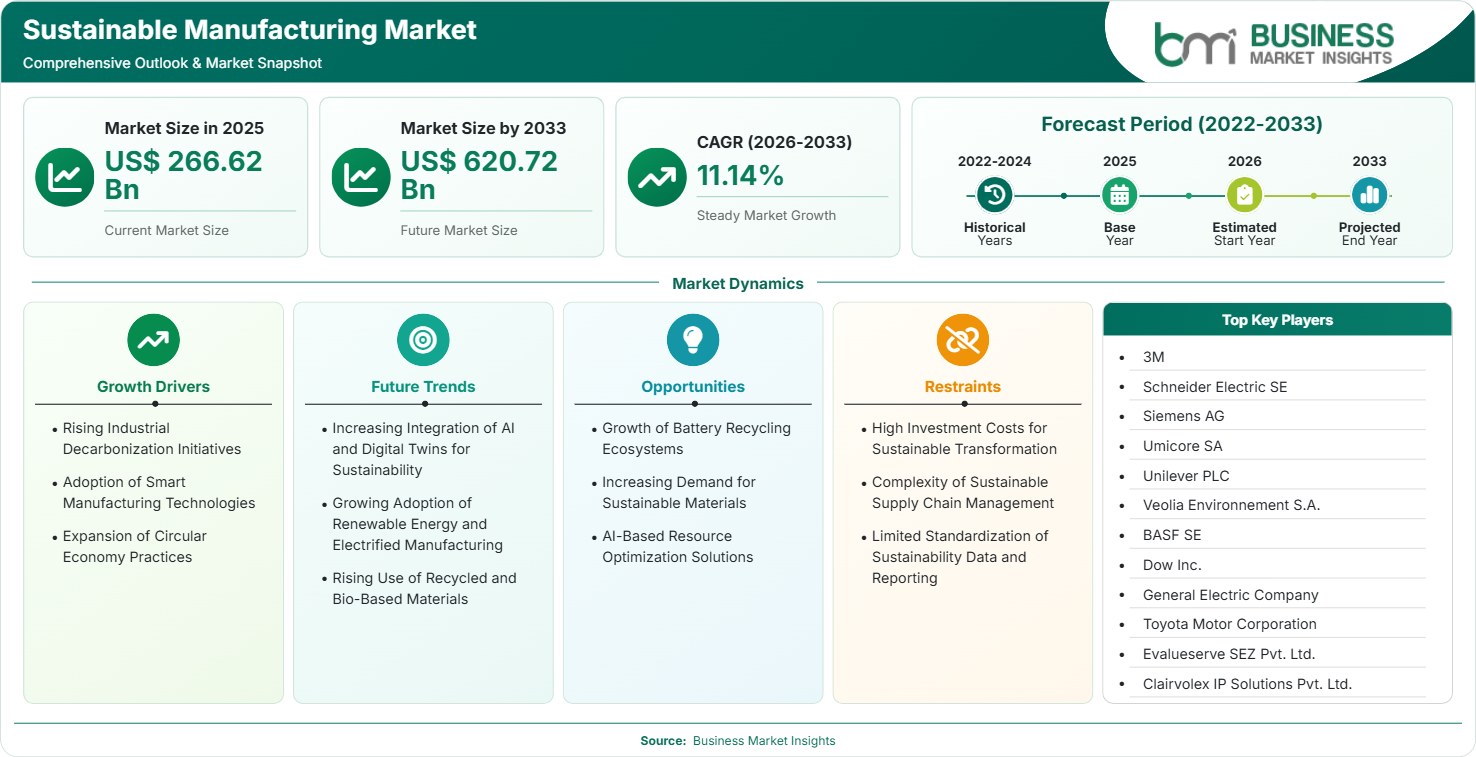
The Sustainable Manufacturing Market size was valued at US$ 266.62 Billion in 2025 and is projected to reach US$ 620.72 Billion by 2033, growing at a CAGR of 11.14% during 2026–2033. Increasing industrial decarbonization, circular economy adoption, recycled material integration, renewable energy utilization, and advanced manufacturing technologies are driving market expansion while creating opportunities across automotive, electronics, chemicals, and packaging industries.

Report Coverage
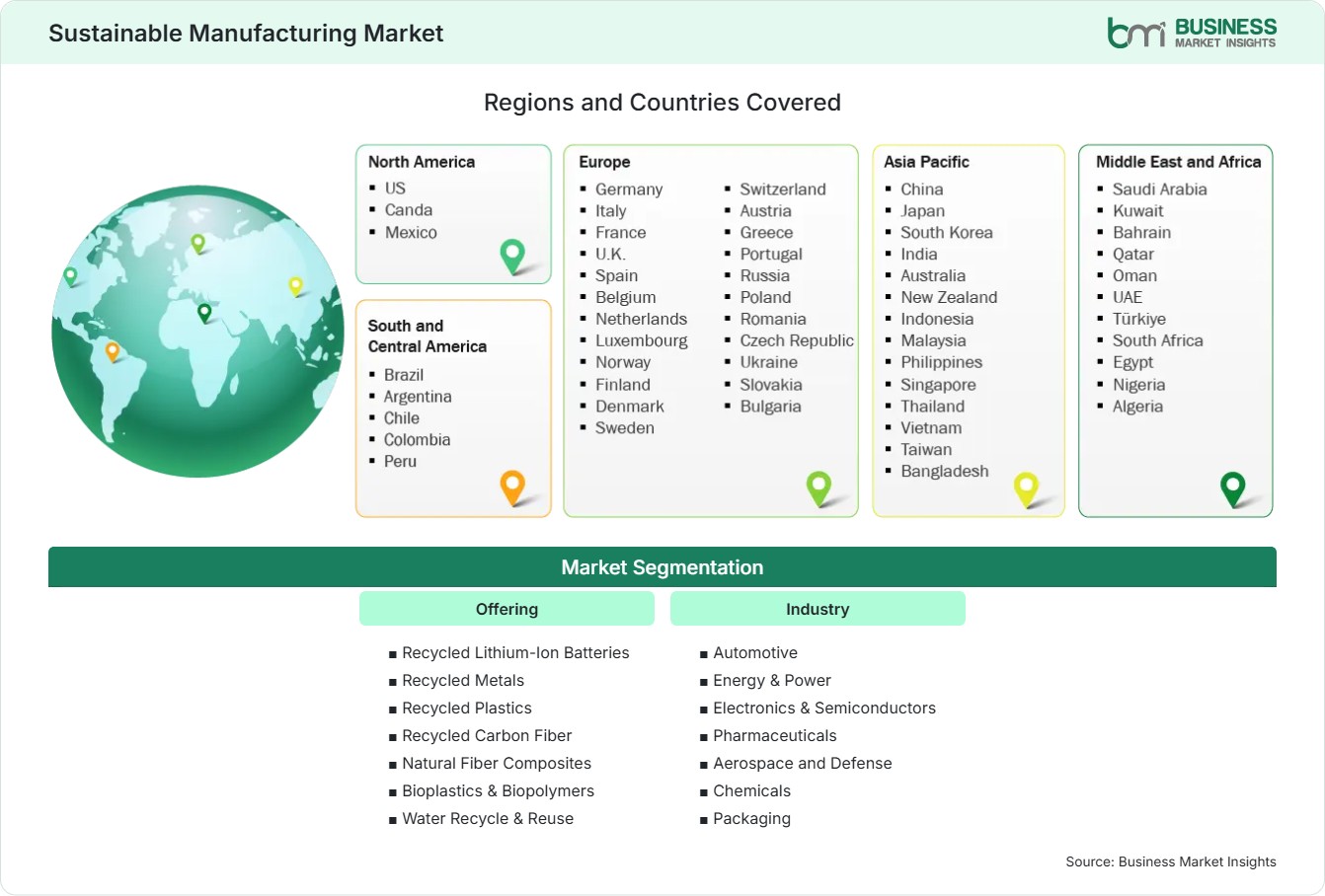
  • Offering: Recycled Lithium-Ion Batteries, Recycled Metals, Recycled Plastics, Recycled Carbon Fiber, Natural Fiber Composites, Bioplastics & Biopolymers, Water Recycle & Reuse
  • Industry: Automotive, Energy & Power, Electronics & Semiconductors, Pharmaceuticals, Aerospace and Defense, Chemicals, Packaging
US$ 266.62 Bn Market size in 2025
US$ 620.72 Bn Market Size by 2033
11.14% CAGR, 2026 - 2033
2026-2033 Forecast Period

AI Overview

Sustainable Manufacturing Market Summary

  • North America Region: North America holds 35%–38% market share in 2025, expanding at a CAGR of 10.2%–10.8% through 2033, supported by industrial automation, ESG investments, recycling infrastructure, clean energy adoption, and sustainable production initiatives. The U.S. remains the primary contributor with advanced manufacturing investments, government incentives, and corporate sustainability programs supporting a 10.3%–10.9% CAGR during 2026–2033.
  • Fastest Growing Region: Asia Pacific captures 27%–30% share in 2025 and grows at a CAGR of 12.8%–13.5% through 2033, driven by manufacturing expansion, renewable energy investments, industrial modernization, circular economy programs, government sustainability policies, and increasing adoption of resource-efficient production systems.
  • Leading Segment: Automotive accounts for 24%–27% share in 2025 with a CAGR of 11.5%–12.1% during 2026–2033, supported by electric vehicle production, battery recycling, lightweight materials, recycled metals, supply chain sustainability initiatives, and low-carbon manufacturing strategies.
  • High Growth Segment: Bioplastics & Biopolymers represents 13%–16% share in 2025 and records a CAGR of 14.8%–15.6% through 2033, supported by renewable material adoption, sustainable packaging demand, regulatory pressure on conventional plastics, and innovation in bio-based polymers.
  • Key Market Opportunity: Expansion of circular manufacturing ecosystems, AI-based resource optimization, sustainable material development, industrial water recycling, and carbon reduction technologies provides attractive investment opportunities across global manufacturing value chains.
  • Major Market Players: 3M, Schneider Electric SE, Siemens AG, Umicore SA, Unilever PLC, Veolia Environnement S.A., BASF SE, Dow Inc., General Electric Company, Toyota Motor Corporation, Evalueserve SEZ Pvt. Ltd., Clairvolex IP Solutions Pvt. Ltd.
Strategic Insights

Sustainable Manufacturing Market: Strategic Insights

Sustainable Manufacturing Market Strategic Framework
FREE PDF
Request your free sample
Request free sample
Stakeholder View

Key Takeaways

  • The market ecosystem is shifting from linear manufacturing models toward circular value chains integrating recycling, renewable resources, waste recovery, and digital monitoring systems to improve operational resilience and resource efficiency.
  • Automotive, electronics, packaging, and chemical industries provide significant growth opportunities as manufacturers increase adoption of recycled materials, sustainable components, energy-efficient production methods, and low-carbon manufacturing processes.
  • Advanced technologies including artificial intelligence, digital twins, industrial IoT, and automated sustainability management platforms are becoming essential tools for optimizing resource utilization, reducing emissions, and improving manufacturing intelligence.
  • Asia Pacific offers strong investment potential due to expanding manufacturing capacity, government-supported sustainability programs, renewable energy deployment, and increasing adoption of environmentally responsible industrial practices.
  • Strategic partnerships, acquisitions, and technology collaborations are increasing as companies seek advanced recycling capabilities, sustainable material expertise, and stronger circular supply chain networks.
Geographic Outlook

Sustainable Manufacturing Market Regional Highlights

North America Sustainable Manufacturing Market

North America represented 35%–38% Sustainable Manufacturing Market share in 2025 and is projected to expand at a CAGR of 10.2%–10.8% from 2026–2033. The region maintains leadership due to advanced industrial infrastructure, strong sustainability regulations, high corporate ESG adoption, and significant investments in automation and clean technologies. The United States and Canada are accelerating circular manufacturing through recycling facilities, renewable energy integration, and smart factory deployment.

  • Federal sustainability incentives and industrial modernization programs are encouraging manufacturers to invest in energy-efficient equipment, renewable power systems, recycling infrastructure, and advanced production technologies that reduce emissions and improve operational efficiency.
  • Automotive and electronics industries are increasing adoption of recycled materials, battery recovery systems, and resource-efficient manufacturing processes to achieve carbon reduction targets while strengthening supply chain resilience.
  • Digital manufacturing platforms, artificial intelligence, and industrial IoT solutions are enabling companies to monitor energy consumption, optimize processes, minimize waste, and improve sustainability reporting capabilities.
  • Strong collaboration between technology providers, manufacturers, and government organizations is accelerating development of circular economy models and low-carbon industrial solutions.

US Sustainable Manufacturing Market

The United States accounted for 74%–77% of North America's Sustainable Manufacturing Market share in 2025 and is forecast to achieve a CAGR of 10.3%–10.9% through 2033. Government support for domestic manufacturing, renewable energy adoption, battery production, and recycling infrastructure is strengthening long-term market development across multiple industrial sectors.

  • Expansion of electric vehicle manufacturing and battery production is increasing demand for recycled lithium-ion batteries, critical mineral recovery, and sustainable material supply chains across automotive ecosystems.
  • Semiconductor and electronics manufacturers are implementing water recycling, energy optimization, and cleaner production systems to meet environmental targets and customer sustainability requirements.
  • Large manufacturers are adopting digital twins, automation platforms, and AI-enabled monitoring solutions to improve production efficiency while reducing resource consumption and environmental impact.

Europe Sustainable Manufacturing Market

Europe captured 28%–31% Sustainable Manufacturing Market share in 2025 and is estimated to grow at a CAGR of 10.8%–11.4% during 2026–2033. Germany leads regional adoption through advanced engineering capabilities and manufacturing expertise, while Poland represents a rapidly expanding market supported by industrial investment and modernization. European manufacturers are increasingly integrating recycled materials, renewable energy, and sustainable production technologies across industrial value chains.

  • The European Green Deal and circular economy initiatives are encouraging manufacturers to improve resource efficiency, reduce waste generation, and increase adoption of recycled materials.
  • Germany remains the regional leader due to strong automotive, machinery, and chemical industries investing in digital manufacturing, energy efficiency, and sustainable production systems.
  • Poland demonstrates high growth potential through expanding industrial capacity, foreign investment inflows, renewable energy development, and modernization of manufacturing infrastructure.
  • European chemical and packaging industries are increasing investments in bio-based materials, recycled polymers, and sustainable product development to meet environmental compliance requirements.

Asia Pacific Sustainable Manufacturing Market

Asia Pacific accounted for 27%–30% Sustainable Manufacturing Market share in 2025 and is expected to register the fastest growth with a CAGR of 12.8%–13.5% between 2026–2033. The region benefits from expanding manufacturing capacity, government sustainability initiatives, renewable energy investments, and increasing adoption of advanced production technologies. China remains the largest contributor, while India represents one of the fastest-growing markets due to industrial expansion, clean energy development, and policy support for sustainable manufacturing practices.

  • China continues strengthening its position through large-scale investments in renewable energy, recycling infrastructure, electric vehicle production, and industrial automation technologies.
  • India is experiencing rapid adoption due to manufacturing incentives, renewable energy expansion, industrial modernization programs, and growing demand for sustainable production solutions.
  • Japan and South Korea are advancing sustainable manufacturing through energy-efficient technologies, hydrogen initiatives, advanced materials, and precision engineering capabilities.
  • Electronics and semiconductor industries across Asia Pacific are investing in water recycling, waste reduction systems, and energy-efficient manufacturing facilities.

Rest of World Sustainable Manufacturing Market

The Rest of World region held 8%–10% share in 2025 and is projected to grow at a CAGR of 11.6%–12.2% through 2033. South & Central America are expanding sustainable manufacturing through renewable energy availability, recycling development, and industrial modernization. The Middle East & Africa are increasing investments in green industrial projects, clean energy integration, and resource-efficient manufacturing. Brazil leads regional adoption, while Saudi Arabia demonstrates strong growth through industrial diversification initiatives.

  • Brazil is expanding sustainable industrial activities through renewable energy utilization, bio-based materials, recycling programs, and resource-efficient manufacturing practices.
  • Saudi Arabia is accelerating green industrial development through Vision 2030 initiatives, renewable energy investments, and sustainable manufacturing infrastructure projects.
  • South Africa is improving industrial sustainability through recycling expansion, cleaner production technologies, and environmental modernization programs.
  • International investment programs are supporting manufacturing upgrades, sustainable infrastructure development, and technology transfer across emerging economies.
  • Growing demand for responsible production practices is encouraging manufacturers to adopt circular economy approaches and improve environmental performance.
Global Market Geography
FREE PDF
Request your free sample
Request free sample
Segment Analysis

Sustainable Manufacturing Market Segmentation

Offering

The Offering segment accounted for 52%–55% share in 2025 and is projected to grow at a CAGR of 11.7%–12.3% during 2026–2033. Increasing adoption of recycled materials, renewable resources, industrial water conservation, and circular production models is strengthening segment expansion. The Sustainable Manufacturing Market scope continues widening as manufacturers prioritize resource efficiency, supply chain resilience, carbon reduction, and compliance with environmental standards across industrial applications.

  • Recycled Lithium-Ion Batteries: Growing electric vehicle adoption and energy storage deployment are increasing battery recycling demand, enabling recovery of lithium, cobalt, nickel, and other valuable materials while supporting circular supply chains.
  • Recycled Metals: Recycled steel, aluminum, copper, and specialty metals are gaining importance as industries reduce energy consumption, lower emissions, and improve raw material security through secondary resource utilization.
  • Recycled Plastics: Automotive, packaging, electronics, and consumer goods manufacturers increasingly integrate recycled polymers to reduce plastic waste, meet sustainability targets, and comply with recycled-content regulations.
  • Recycled Carbon Fiber: Aerospace, automotive, wind energy, and composite manufacturers are adopting recycled carbon fiber solutions to achieve lightweight designs while improving material efficiency and sustainability performance.
  • Natural Fiber Composites: Renewable fibers such as flax, hemp, and bamboo are increasingly used in automotive components, consumer products, and industrial applications due to lightweight properties and lower environmental impact.
  • Bioplastics & Biopolymers: Demand is increasing for bio-based polymers and biodegradable materials across packaging, healthcare, and consumer applications due to regulatory support and growing preference for renewable alternatives.
  • Water Recycle & Reuse: Industrial water management solutions enable manufacturers to reduce freshwater consumption, improve regulatory compliance, and enhance operational resilience in water-intensive production environments.

Industry

The Industry segment represented 45%–48% market share in 2025 and is expected to expand at a CAGR of 11.2%–11.9% during 2026–2033. Different industrial sectors are adopting sustainability strategies based on resource intensity, environmental regulations, and lifecycle requirements. Manufacturers are implementing circular production, renewable energy integration, sustainable sourcing, and digital monitoring technologies to improve efficiency while reducing environmental impact across global value chains.

  • Automotive: Electric vehicle production, battery recycling, lightweight materials, and recycled metals are transforming automotive manufacturing while supporting lower lifecycle emissions and circular supply chain development.
  • Energy & Power: Renewable energy equipment manufacturers are adopting sustainable materials, recycled metals, and efficient production systems to support clean energy infrastructure expansion and industrial decarbonization.
  • Electronics & Semiconductors: Electronics manufacturers are increasing adoption of water recycling, energy-efficient fabrication, waste reduction systems, and sustainable material sourcing to meet environmental performance expectations.
  • Pharmaceuticals: Pharmaceutical companies are implementing green chemistry, solvent recovery, energy optimization, and water conservation practices to improve manufacturing sustainability and regulatory compliance.
  • Aerospace and Defense: Aerospace manufacturers are adopting lightweight composites, recycled materials, digital manufacturing technologies, and efficient production systems to reduce environmental impact while maintaining performance standards.
  • Chemicals: Chemical manufacturers are investing in renewable feedstocks, sustainable catalysts, recycled inputs, and cleaner production processes to reduce emissions and improve resource efficiency.
  • Packaging: Packaging companies are expanding recycled plastics, biodegradable materials, lightweight designs, and renewable packaging solutions to address regulatory requirements and changing consumer expectations.
Market Forces

Sustainable Manufacturing Market Dynamics

Key Market Drivers

Rising Industrial Decarbonization Initiatives

Industrial decarbonization has become a major priority as manufacturers seek to reduce emissions, improve energy efficiency, and achieve corporate sustainability goals. The International Energy Agency states that industrial operations produce a considerable number of emissions as a result of which there is a need for cleaner production processes. The Sustainable Manufacturing Market growth can be attributed to the use of renewable energy, electrification of processes, improved recycling, and carbon management. Government policies and corporate net-zero goals have encouraged manufacturing companies to adopt sustainable production processes. These industry trends are revolutionizing production processes in the automotive, chemicals, electronics, and packaging industries.

Adoption of Smart Manufacturing Technologies

Digital transformation is enabling manufacturers to improve sustainability performance through artificial intelligence, industrial IoT, automation, and digital twin technologies. The Sustainable Manufacturing Market trends enable monitoring of energy usage, efficiency, and waste creation and resource utilization in real time. This technology can assist companies to enhance operations, minimize losses, plan for maintenance, and improve environmental reporting abilities. The use of digital tools along with sustainability goals enables manufacturers to make improvements without decreasing productivity. Growing investments are being made in the implementation of connected factories and intelligent manufacturing systems.

Expansion of Circular Economy Practices

Increasing focus on resource conservation and supply chain resilience is driving adoption of circular manufacturing models. Companies are building infrastructure for recycling and material recovery, using renewable materials and closing the loop through production systems in order to decrease dependence on virgin materials. Government regulations that incentivize extended producer responsibility and waste minimization practices are also motivating companies to re-design their products and increase material recovery. This is becoming critical for industries that are facing volatility in the availability of raw materials and environmental regulation requirements.

Key Market Opportunities

Growth of Battery Recycling Ecosystems

The rapid expansion of electric vehicles and energy storage systems is creating significant opportunities for battery recycling technologies. Lithium, cobalt, nickel, and other critical metals are being recovered through innovative processes, reducing reliance on imported raw materials and strengthening supply chain resilience. Government incentives supporting critical mineral recovery are increasing investment in recycling technologies. Companies developing advanced battery recycling solutions can capitalize on growing demand across multiple applications, supporting the Sustainable Manufacturing Market Forecast as industries prioritize resource efficiency, circular production, and lower environmental impact.

Increasing Demand for Sustainable Materials

Growing environmental concerns and regulatory restrictions on conventional materials are accelerating adoption of sustainable alternatives. The use of bioplastic, natural fiber composite, recycled plastics, and renewable materials is becoming increasingly significant in areas such as packaging, automobiles, healthcare, and consumer goods. Scientific innovations in materials are enhancing the features of these materials without having any negative effects on the environment. Companies that are willing to develop sustainable materials will be able to take advantage of emerging trends and developments.

AI-Based Resource Optimization Solutions

Artificial intelligence is creating new opportunities by enabling manufacturers to analyze production data, identify efficiency improvements, and reduce resource consumption. AI-powered systems facilitate predictive maintenance, energy management, automated quality assurance, and sustainability reporting. By implementing intelligent platforms, manufacturers are able to enhance their productivity while at the same time achieve environmental objectives. The increased need for digital sustainability solutions has led to technology companies developing sophisticated analytical systems which incorporate environmental factors with manufacturing processes.

Market Restraints and Challenges

High Investment Costs for Sustainable Transformation

Factor: Sustainable manufacturing transformation requires significant capital investment in advanced equipment, renewable energy systems, recycling infrastructure, digital technologies, and workforce training.

Impact: High upfront costs can delay adoption among small and medium-sized manufacturers with limited financial resources. Longer return periods may restrict modernization efforts, creating uneven implementation across industries despite increasing regulatory pressure and customer demand for environmentally responsible production practices.

Complexity of Sustainable Supply Chain Management

Factor: Global manufacturing networks require detailed tracking of materials, supplier emissions, recycled content, and lifecycle performance to meet sustainability reporting requirements.

Impact: Limited standardization, inconsistent supplier data, and fragmented reporting systems increase operational complexity and compliance costs. These challenges can slow sustainability implementation, reduce supply chain transparency, and make it difficult for manufacturers to verify environmental performance across international production networks.

Company Analysis

Competitive Landscape

The competitive environment is shaped by investments in circular production, industrial automation, sustainable materials, recycling technologies, and digital sustainability platforms. Sustainable Manufacturing Market analysis highlights that leading companies are strengthening their positions through innovation, partnerships, research activities, and technology development focused on reducing emissions, improving resource efficiency, and enabling sustainable industrial ecosystems.

Company Name

Overview

Products and Services relevant to this market

3M

Global technology company specializing in diversified industrial solutions, material science innovation, and sustainability-focused manufacturing technologies.

Sustainable materials, industrial solutions, filtration technologies, recycled-content products, adhesives, and resource-efficient manufacturing solutions.

Schneider Electric SE

Energy management and industrial automation leader supporting digital transformation and sustainable factory operations.

Smart energy management, industrial automation, digital sustainability platforms, energy optimization, and connected manufacturing solutions.

Siemens AG

Industrial technology provider focused on digitalization, automation, and efficient manufacturing ecosystems.

Digital twins, industrial IoT, automation systems, sustainable production software, and energy-efficient manufacturing technologies.

Umicore SA

Materials technology company specializing in recycling and sustainable resource recovery solutions.

Battery recycling, metal recovery, sustainable materials, precious metal recycling, and circular economy technologies.

Unilever PLC

Consumer goods company integrating sustainability practices across manufacturing and supply networks.

Sustainable sourcing, circular packaging, renewable materials, and resource-efficient production initiatives.

Veolia Environnement S.A.

Environmental services company providing resource management and circular economy solutions.

Water recycling, waste recovery, industrial resource management, and recycling services.

BASF SE

Global chemical company developing sustainable materials and low-carbon production technologies.

Bio-based chemicals, recycled feedstocks, sustainable polymers, catalysts, and circular chemical solutions.

Dow Inc.

Materials science company focused on sustainable polymers and circular material innovations.

Recycled plastics, sustainable packaging materials, specialty polymers, and circular production solutions.

General Electric Company

Industrial technology company supporting efficient manufacturing and energy transition solutions.

Industrial software, energy-efficient equipment, digital monitoring systems, and electrification technologies.

Toyota Motor Corporation

Automotive manufacturer implementing resource-efficient production and circular manufacturing strategies.

Sustainable vehicle manufacturing, battery recycling, hybrid technologies, recycled materials, and lean manufacturing systems.

Evalueserve SEZ Pvt. Ltd.

Research and analytics company supporting sustainability intelligence and business decisions.

ESG analytics, sustainability research, market intelligence, consulting, and technology assessment services.

Clairvolex IP Solutions Pvt. Ltd.

Innovation and intellectual property management company supporting technology-driven industries.

IP analytics, innovation research, patent intelligence, and technology landscaping solutions.

Trust & Transparency

Research Methodology

The market analysis combines proprietary research with secondary data from government agencies, company disclosures, regulatory filings, industry databases and expert interviews. Market estimates are validated through data triangulation, cross-market benchmarking and analyst review.

View Full Research Methodology

Questions Answered

Frequently Asked Questions

What information does the Sustainable Manufacturing Market Report provide?

The report evaluates market trends, regional opportunities, competitive strategies, technology developments, industry adoption patterns, investment areas, and future growth factors to support strategic business planning and decision-making.

How do digital technologies support sustainable manufacturing?

Digital technologies including AI, industrial IoT, and digital twins help manufacturers monitor resource usage, optimize production processes, reduce waste, improve energy efficiency, and strengthen sustainability reporting capabilities.

Why is Asia Pacific becoming an important for Sustainable Manufacturing Market?

Asia Pacific is gaining importance due to expanding industrial capacity, government-supported green initiatives, renewable energy investments, manufacturing growth, and increasing adoption of recycling and digital production technologies.

Which industries are major users of sustainable manufacturing solutions?

Automotive, electronics, chemicals, packaging, aerospace, and energy industries are major adopters due to their focus on reducing emissions, improving resource efficiency, and meeting sustainability requirements across global supply chains.

What is driving adoption of sustainable manufacturing technologies?

Adoption is increasing due to stricter environmental regulations, corporate sustainability goals, circular economy initiatives, renewable energy integration, and growing demand for resource-efficient production systems that reduce waste and operational costs.

Access the Full Sustainable Manufacturing Market Report

Get segment-level forecasts, regional estimates, competitive benchmarking, company profiles and downloadable Excel datasets.

Access the full Sustainable Manufacturing Market Report
350 pages PDF & Excel | 2026-08-27