Market Summary
Executive Summary and Global Market Analysis
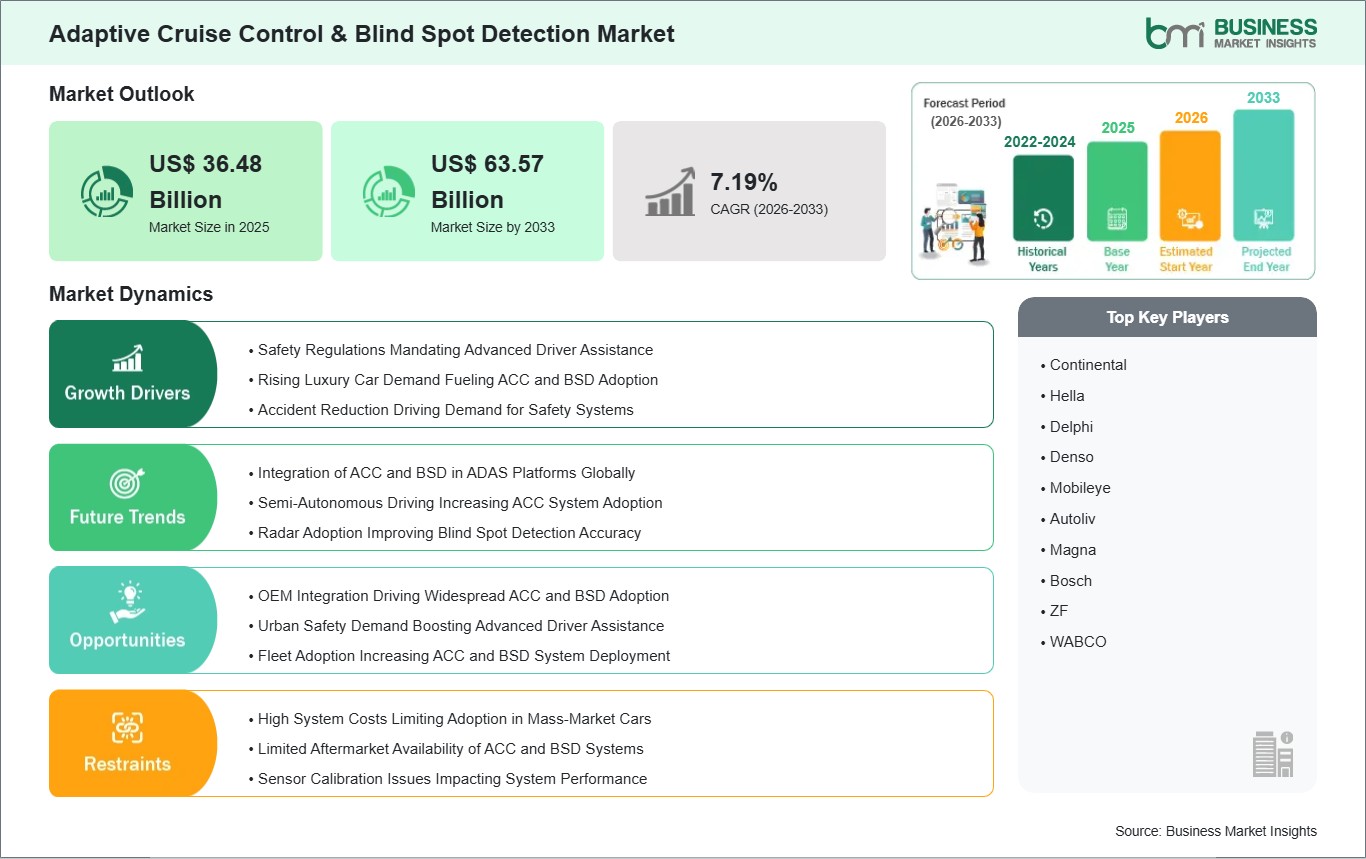
Adaptive cruise control and blind spot detection market is experiencing substantial growth due to the increasing adoption of advanced driver assistance systems (ADAS), rising focus on road safety, and growing demand for intelligent vehicle technologies. Adaptive Cruise Control (ACC) systems automatically adjust vehicle speed to maintain a safe following distance from other vehicles, while Blind Spot Detection (BSD) systems monitor adjacent lanes and alert drivers to vehicles located in blind spots.
The market is expanding rapidly as safety regulations mandating advanced driver assistance systems continue to strengthen across major automotive markets. Governments and transportation authorities are increasingly implementing vehicle safety standards that encourage or require the integration of ADAS technologies such as ACC and BSD in passenger and commercial vehicles. Rising luxury car demand is further fueling ACC and BSD adoption, as premium vehicle manufacturers continue integrating advanced safety and convenience features into modern vehicle platforms.
Technological advancements in radar sensors, infrared technologies, image recognition systems, and artificial intelligence are further supporting market growth. Integration of ACC and BSD in ADAS platforms globally is enhancing vehicle safety, improving driver convenience, and enabling advanced semi-autonomous driving capabilities. Radar adoption is improving blind spot detection accuracy and expanding the operational efficiency of driver assistance systems under varying weather and lighting conditions.
High system costs limiting adoption in mass-market cars remain a major restraint, particularly in developing automotive markets where cost sensitivity is high. Advanced sensors, radar modules, cameras, and software integration increase overall vehicle production costs and impact affordability. Limited aftermarket availability of ACC and BSD systems also restricts adoption among existing vehicle owners. In addition, sensor calibration issues impacting system performance can create operational challenges and maintenance complexities for vehicle manufacturers and service providers.
Segment Analysis
Adaptive Cruise Control & Blind Spot Detection Market Segmentation
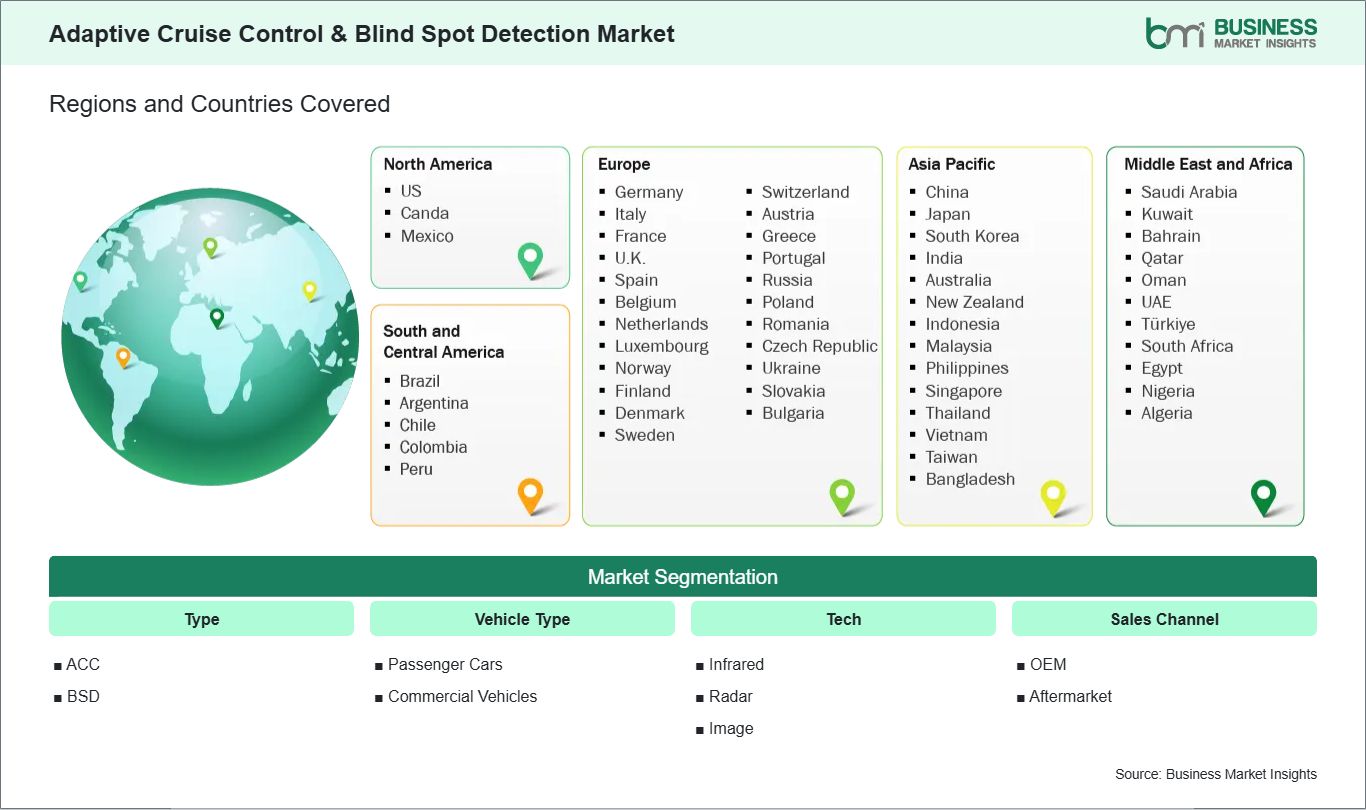
The adaptive cruise control and blind spot detection market is segmented based on type, vehicle type, technology, and sales channel, reflecting the increasing adoption of advanced automotive security and digital identity verification technologies.
By Type
- ACC: Automatically controls vehicle speed and maintains safe distance from surrounding vehicles
- BSD: Detects vehicles in adjacent blind spots and alerts drivers to improve road safety
By Vehicle Type
- Passenger Cars: Widely adopted in premium and mid-range vehicles for enhanced driving safety and convenience
- Commercial Vehicles: Increasingly integrated into trucks, buses, and logistics fleets to improve operational safety and driver assistance capabilities
By Tech
- Infrared: Utilizes infrared sensing technologies for object detection and environmental monitoring
- Radar: Employs radar sensors for accurate distance measurement and blind spot monitoring
- Image: Uses camera-based imaging systems for lane monitoring, object detection, and driver assistance functions
By Sales Channel
- OEM: Factory-installed ACC and BSD systems integrated by automotive manufacturers
- Aftermarket: Third-party driver assistance systems installed after vehicle purchase
Market Forces
Adaptive Cruise Control & Blind Spot Detection Market Drivers and Opportunities
Safety Regulations Mandating Advanced Driver Assistance
Due to safety regulations requiring advanced driver assistance systems to be implemented in vehicles all over the world, safety regulations are driving demand for Adaptive Cruise Control and Blind Spot Detection (ACC and BSD) technologies. Vehicle manufacturers are looking to integrate ACC and BSD technologies into their new models so that they'll be compliant with changing regulations and safety assessments as governments and country-level agencies are increasing the standards for vehicles with the intent to reduce roadway accidents, provide drivers better awareness, and protect passengers.
The increased demand for luxury automobiles has also contributed to the increased sales of ACC and BSD technology, as consumers now want premium driving experiences, smart safety systems, and connected vehicles. The auto industry has been increasing ADAS technology in their passenger and commercial vehicle offerings to be more competitive and differentiate their products from the competition. In addition, both consumers and fleet operators are starting to adopt advanced driver assist vehicles to help reduce the chance of an accident and make their cars operate more efficiently.
World-wide interest in semi-autonomous and autonomous connected vehicles is driving the assimilation of ACC and BSD technology into next-generation automotive applications across the globe.
OEM Integration Driving Widespread ACC and BSD Adoption
Integration with original equipment manufacturers (OEMs) is providing significant opportunities for Acceleration Control Systems (ACC) and Blind Spot Detection (BSD) to be widely adopted as part of modern vehicular architectures. OEMs are increasingly providing advanced driver assistance systems (ADAS) and have produced vehicle platforms featuring factory-generated products that provide ADAS systems to improve vehicle safety, enable intelligent mobility features, and provide a foundation for the development of fully autonomous vehicles.
The integration of ACC/BSD into ADAS on a global basis is providing increasing vehicle automation and greater driver convenience across multiple segments of demand for vehicles. The trend towards semi-autonomous driving will enhance the number of customers that adopt ACC systems because of an increasing number of vehicle designs/patterns that will be equipped with automated speed controls; lane assistance devices; and collision avoidance systems. Improved detection accuracy and performance of systems, particularly those using radar and/or cameras for BSD systems, will lead to velocity drivers having greater confidence in the ability of the ACC/BSD to function properly even when driving at high speeds or in adverse conditions such as heavy rain, snow, or fog.
As urban areas become more congested and experience higher levels of population density, the need for safety improvements and for reducing congestion and accident rates are motivating the demand for ADAS technologies. One of the major contributors to the increase in demand for ACC/BSD systems is the increased use of ACC systems, to support logistics operations, by fleets engaged in ride-hailing and commercial transportation. With an increase in the number of connected vehicles, there will be an increased prevalence of intelligent ADAS technologies that support the future of mobility infrastructure.
Size and Share Analysis
Adaptive Cruise Control & Blind Spot Detection Market Size and Share Analysis
The Adaptive Cruise Control & Blind Spot Detection Market is projected to grow from US$ 36.48 Billion in 2025 to US$ 63.57 Billion by 2033 , registering a CAGR of 7.19% from 2026 to 2033.
By type, Adaptive Cruise Control accounts for a significant market share due to increasing consumer demand for automated driving assistance, improved highway driving comfort, and enhanced collision avoidance capabilities. Blind Spot Detection systems are also witnessing substantial growth as automakers prioritize vehicle safety and accident prevention technologies across passenger and commercial vehicles.
By vehicle type, passenger cars dominate the market owing to rising integration of ADAS technologies in premium, luxury, and mid-range vehicles. Commercial vehicles are increasingly adopting ACC and BSD systems to improve driver safety, fleet management, and operational efficiency across transportation and logistics operations.
By technology, radar-based systems hold a major market share due to their high accuracy, reliability, and strong performance in varying environmental conditions. Image-based systems are witnessing strong growth with increasing advancements in camera technologies and AI-powered object recognition capabilities. Infrared technologies are also gaining traction in advanced safety applications requiring enhanced night vision and environmental sensing capabilities.
By sales channel, OEM installations dominate the market as automotive manufacturers continue integrating ACC and BSD systems into new vehicle production platforms. The aftermarket segment is growing steadily with increasing consumer awareness regarding vehicle safety technologies and rising demand for ADAS retrofitting solutions.
Report Coverage
Adaptive Cruise Control & Blind Spot Detection Market Report Coverage and Deliverables
The "Adaptive Cruise Control and Blind Spot Detection Market Size and Forecast (2022 - 2033)" report provides a detailed analysis of the market covering below areas:
- The market size and forecast at global, regional, and country levels for all market segments covered under the scope
- The market trends, as well as drivers, restraints, and opportunities
- The market analysis covering key trends, global and regional framework, major players, regulations, and recent developments
- Industry landscape and competition analysis covering market concentration, heat map analysis, prominent players, and recent developments for the market
- Detailed company profiles, including SWOT analysis
Geographic Insights
Adaptive Cruise Control & Blind Spot Detection Market Geographic Insights
The global market for adaptive cruise control and blind spot detection systems is rapidly expanding as a result of an increase in demand for intelligent mobility solutions and vehicle safety technologies, as well as a tremendous growth in connected transport infrastructures across all regions.
North America is the most dominant market because of its robust supportive regulatory framework for automotive safety technologies, the widespread acceptance of connected vehicles, and the presence of several major automotive technology companies. Both Canada and the United States are making significant investments in intelligent transportation systems, autonomous driving technologies, and advanced automotive safety infrastructure; at the same time, the rapidly increasing consumer awareness of vehicle safety and strong penetration of premium vehicles in the marketplace are contributing to widespread adoption of ACC and BSD systems.
Europe represents another important market that is being driven by stringent vehicle safety regulations, increasingly adopted Advanced Driver Assistance Systems (ADAS), and strong automotive manufacturing capabilities. Countries like Germany, France, the UK and Sweden are committed to reducing vehicle accidents and improving mobility safety through the application of intelligent transport technologies. As a result, manufacturers throughout Europe are continuing to integrate ACC and BSD systems in passenger and commercial vehicles using radar technology in order to conform with the constantly evolving safety standards that exist in Europe. Asia Pacific is experiencing tremendous growth due to the rise in vehicle production, rapid urbanization and an increasing desire for connected mobility technologies, especially in countries such as China, Japan, South Korea and India.
Industry Activity
Recent Developments
The adaptive cruise control and blind spot detection market is evaluated by gathering qualitative and quantitative data post primary and secondary research, which includes important corporate publications, association data, and databases. A few of the key developments in the Adaptive Cruise Control and Blind Spot Detection market are:
- In January 2024, Bosch expanded its 6th‑generation radar sensor portfolio for advanced driver assistance systems (ADAS). The new sensors enhance adaptive cruise control, blind spot detection, and automated emergency braking. They are designed for both passenger and commercial vehicles, supporting semi‑autonomous driving applications with improved range, accuracy, and resilience against interference.
- In May 2025, Continental has set a milestone and is celebrating the production of 200 million radar sensors. This impressive number of produced radars reflects the company’s leading position with more than 20 percent market share in essential safety technology components for the automotive sector.
Trust & Transparency
Research Methodology
The market analysis combines proprietary research with secondary data from government agencies, company disclosures, regulatory filings, industry databases and expert interviews. Market estimates are validated through data triangulation, cross-market benchmarking and analyst
review.
View Full Research Methodology
Key Sources Referred:
National Highway Traffic Safety Administration (NHTSA)
European New Car Assessment Programme (Euro NCAP)
Society of Automotive Engineers (SAE International)
International Organization of Motor Vehicle Manufacturers (OICA)
International Electrotechnical Commission (IEC)
International Organization for Standardization (ISO)
European Automobile Manufacturers’ Association (ACEA)
Automotive Information Sharing and Analysis Center (Auto-ISAC)