Market Summary
Executive Summary and Global Market Analysis
Blind spot solutions market is experiencing strong growth due to the increasing adoption of advanced driver assistance systems (ADAS), rising focus on road safety, and growing integration of intelligent sensing technologies in modern vehicles. Blind spot solutions are designed to enhance driver awareness by detecting vehicles, pedestrians, and obstacles located in areas that are difficult for drivers to observe directly. These systems utilize technologies such as cameras, radar, and ultrasonic sensors to improve situational awareness, reduce collision risks, and support safer driving experiences across passenger cars, trucks, and electric vehicles (EVs).
The market is expanding rapidly as safety mandates enforcing blind spot detection systems continue to strengthen across global automotive markets. Governments and transportation authorities are increasingly implementing vehicle safety regulations requiring the integration of blind spot monitoring technologies to reduce road accidents and improve driver safety. Premium vehicle demand is also driving blind spot solutions adoption, as luxury and high-end vehicle manufacturers increasingly integrate advanced safety and convenience features into connected vehicle platforms.
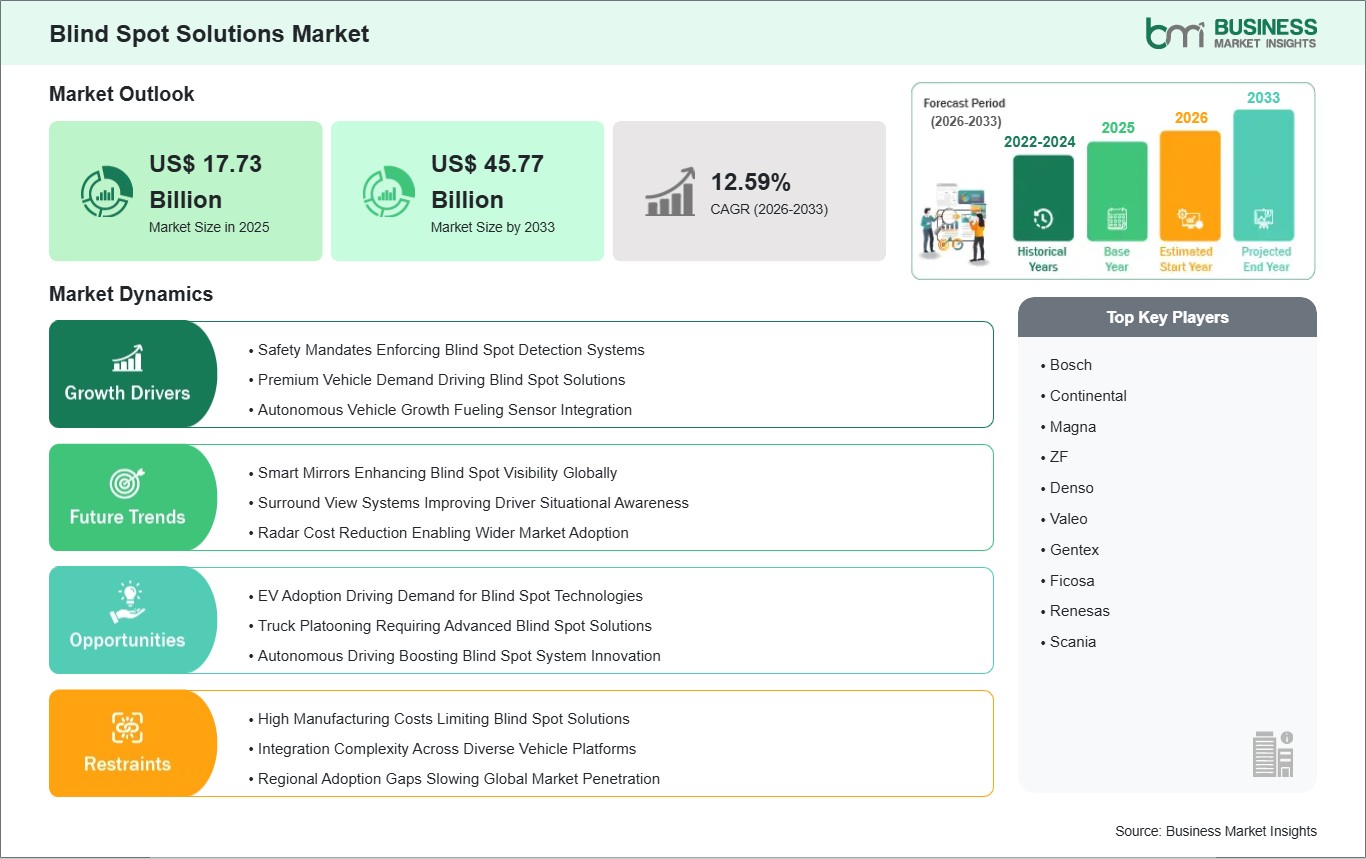
Technological advancements in radar sensors, AI-powered image processing, smart mirrors, and surround-view imaging systems are further supporting market expansion. Smart mirrors are enhancing blind spot visibility globally by improving rear and side visibility while reducing visual obstructions caused by traditional mirrors. Surround view systems are improving driver situational awareness through 360-degree imaging capabilities that support parking assistance, lane monitoring, and collision avoidance applications.
Truck platooning applications are requiring advanced blind spot solutions to improve vehicle coordination, lane safety, and collision prevention in commercial transportation operations. Furthermore, autonomous driving development is boosting blind spot system innovation through the integration of AI-driven sensing platforms, predictive analytics, and advanced environmental perception technologies.
Segment Analysis
Blind Spot Solutions Market Segmentation
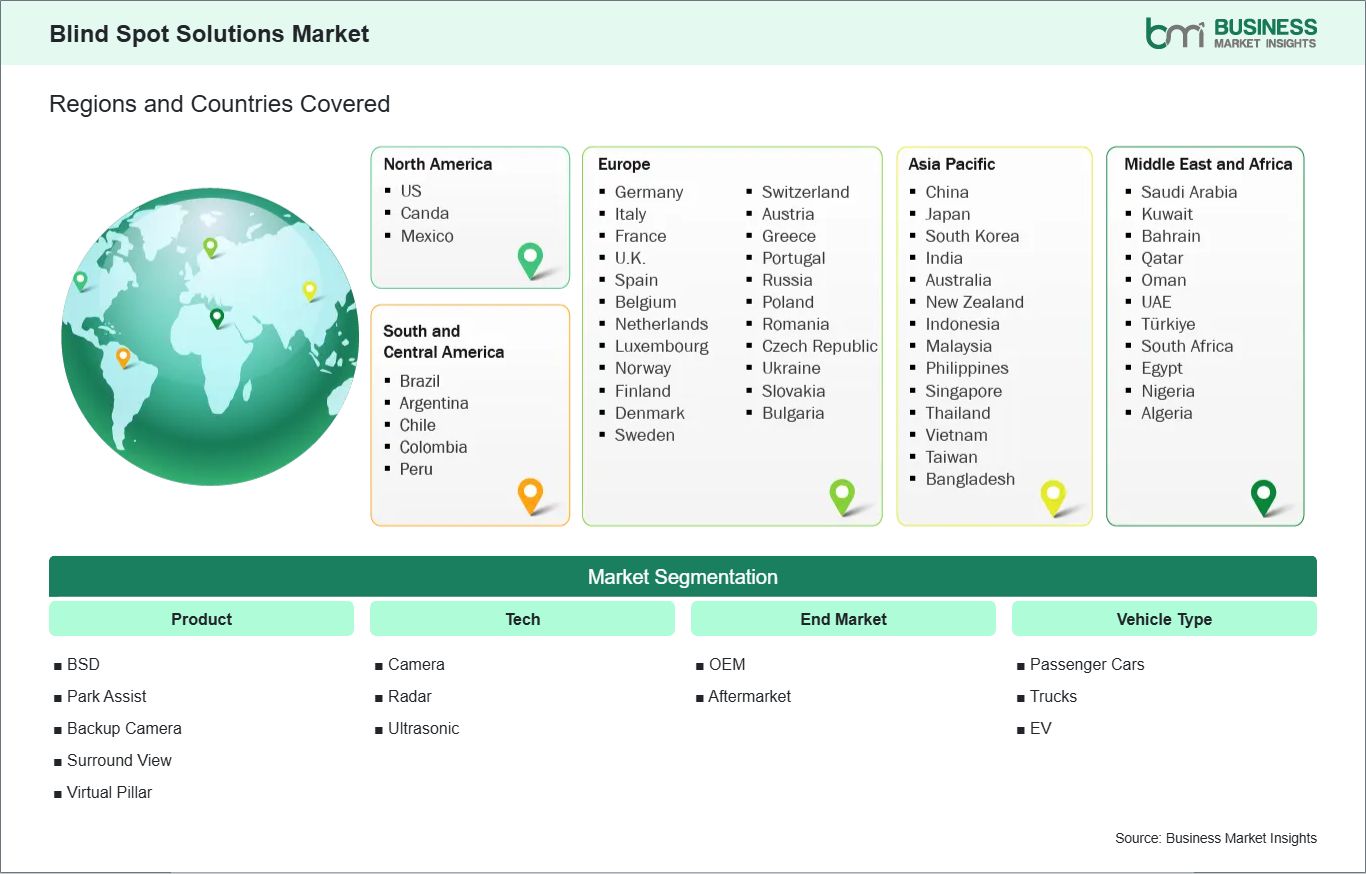
The blind spot solutions market is segmented based on product, technology, end market, and vehicle type, reflecting the increasing adoption of advanced vehicle safety and driver assistance technologies across the automotive industry.
By Product
- BSD: Detects vehicles and obstacles in blind spot areas and alerts drivers to improve safety
- Park Assist: Assists drivers during parking operations through sensor-based obstacle detection and maneuver guidance
- Backup Camera: Provides rear-view visibility to support safer reversing and parking operations
- Surround View: Delivers 360-degree vehicle visibility through integrated camera systems for enhanced situational awareness
- Virtual Pillar: Uses advanced imaging technologies to improve visibility around obstructed vehicle areas
By Tech
- Camera: Utilizes image sensing and video processing technologies for blind spot monitoring and environmental detection
- Radar: Employs radar sensors for accurate object detection and distance measurement under varying conditions
- Ultrasonic: Uses ultrasonic sensors for short-range obstacle detection and parking assistance applications
By End Market
- OEM: Factory-installed blind spot solutions integrated directly by vehicle manufacturers
- Aftermarket: Third-party blind spot monitoring systems installed after vehicle purchase
By Vehicle Type
- Passenger Cars: Widely integrated into passenger vehicles for improved driving safety and convenience
- Trucks: Increasingly adopted in commercial transportation vehicles to reduce collision risks and improve fleet safety
- EV: Integrated into electric vehicles to support advanced driver assistance and intelligent mobility systems
Market Forces
Blind Spot Solutions Market Drivers and Opportunities
Safety Mandates Enforcing Blind Spot Detection Systems
Safety regulations which require manufacturers to use higher-quality devices that can detect blind spots in cars have created an increase in demand for these devices throughout the world. Governments and transportation agencies are trying to create new regulations to keep the number of road accidents and increase the driver's awareness of other vehicles and people, and to protect the lives of those who are inside the vehicle. These regulatory changes have caused automobile manufacturers to create new safety devices and to start using these devices in their cars to meet the safety standards.
Another factor contributing to the growth of the BSD market is that higher-income consumers want cars that are equipped with more advanced technology and safety features. Therefore, many automobile manufacturers are working to deploy BSD products in their higher-end and mid-grade vehicles. Another important factor driving the installation of BSD products is the increased interest in autonomous vehicles, which are being developed using high-tech sensors, creating a demand for advanced systems for identifying the vehicle's environment to support intelligent mobility, and semi-autonomous driving functions.
Further, as the automotive industry increasingly moves toward connected mobility; advances in smart transportation infrastructure; and initiatives to prevent accidents caused by driver errors, the installation of solutions that assist drivers in detecting blind spots on vehicles will grow across next-generation vehicles worldwide.
EV Adoption Driving Demand for Blind Spot Technologies
The growth of electric vehicles (EVs) in the global automotive industry is catalyzing new business opportunities for manufacturers that offer technologies related to blind spots. As the number of EV manufacturers continues to rise, the integration of sophisticated blind spot monitoring systems is becoming an essential component of automotive safety, driver assurance, and capability to create connected mobility ecosystems. In total, the increasing rate of EV growth and production is resulting in very high demand for both camera-based, radar-based, and AI-enabled blind spot technologies as OEMs design more intelligent architectures for electric vehicles.
The technology also continues to be enhanced across several vehicle applications through the development of truck platooning, which requires the use of more advanced blind spot technologies to provide improvements in truck-to-truck coordination, driver support, and operational safety within the logistics and freight transportation industries. The development of autonomous driving is further contributing to the enhancement of existing blind spot systems as OEMs and technology companies increase their investment in AI-based sensing technologies, predictive analytical capabilities, and real-time environmental monitoring systems. Smart mirrors are enhancing visibility to blind spots globally by replacing conventional mirrors with digital imaging technologies that enhance visibility, reduce aerodynamic drag, and improve driver awareness. Surround view technologies are also enhancing the awareness of drivers by providing them with advanced images of their surroundings from 360 degrees as they park and perform other functions such as identifying obstacles and avoiding collisions. In addition, the reduction in the cost of radar technologies will enable additional markets to use these technologies; thus, making them more affordable and facilitating their use in mainstream vehicle models.
Size and Share Analysis
Blind Spot Solutions Market Size and Share Analysis
The Blind Spot Solutions Market is projected to grow from US$ 17.73 Billion in 2025 to US$ 45.77 Billion by 2033 , registering a CAGR of 12.59% from 2026 to 2033.
By product, BSD systems account for a significant market share due to increasing regulatory requirements and rising consumer demand for vehicle safety technologies. Surround view systems are witnessing strong growth owing to their ability to provide enhanced situational awareness and improve parking safety. Backup cameras continue to experience widespread adoption across passenger vehicles and commercial fleets, while park assist systems are gaining traction with increasing urban vehicle congestion and parking challenges. Virtual pillar technologies are also emerging as advanced safety solutions for improving visibility in obstructed vehicle areas.
By technology, radar-based systems dominate the market due to their high accuracy, reliability, and strong performance under varying weather and lighting conditions. Camera-based systems are witnessing substantial growth with advancements in AI-powered image processing and surround-view imaging technologies. Ultrasonic technologies continue to play an important role in short-range obstacle detection and parking assistance applications.
By end market, OEM installations dominate the market as vehicle manufacturers increasingly integrate blind spot solutions directly into factory-installed ADAS platforms. The aftermarket segment is also expanding steadily due to increasing awareness regarding vehicle safety technologies and rising demand for retrofit driver assistance systems.
By vehicle type, passenger cars account for a major market share due to rising adoption of advanced safety technologies across premium and mid-range vehicles. Trucks are increasingly integrating blind spot monitoring systems to improve fleet safety and reduce accident risks in commercial transportation operations. EVs are witnessing rapid growth as manufacturers prioritize intelligent safety systems and connected mobility technologies within electric vehicle platforms.
Report Coverage
Blind Spot Solutions Market Report Coverage and Deliverables
The "Blind Spot Solutions Market Size and Forecast (2022 - 2033)" report provides a detailed analysis of the market covering below areas:
- The market size and forecast at global, regional, and country levels for all market segments covered under the scope
- The market trends, as well as drivers, restraints, and opportunities
- The market analysis covering key trends, global and regional framework, major players, regulations, and recent developments
- Industry landscape and competition analysis covering market concentration, heat map analysis, prominent players, and recent developments for the market
- Detailed company profiles, including SWOT analysis
Geographic Insights
Blind Spot Solutions Market Geographic Insights
The market for blind spot solutions is experiencing rapid growth all over the world and is largely being driven by a strong increase in global automotive safety regulations, a rise in connected mobility technology, and the development of intelligent driver assistance systems. In North America, there is a major market due to the increased regulatory support for vehicle safety as well as the rise in connected vehicles in the region and the availability of major automotive technology manufacturers. In addition, both the U.S. and Canada are continuing to invest heavily in intelligent transportation systems, autonomous driving technologies, and advanced mobility infrastructure. The increased awareness of consumers in respect to the safety of driving on roads, along with a high level of penetration of premium vehicles into the region, is contributing to the high level of acceptance of blind spot solutions.
The European region is another significant market that is being supported by the strong automotive safety regulations in the region, an increase in ADAS system deployments in various applications, and the strength of the automotive manufacturing base in the region. Countries such as Germany, France, the United Kingdom, and Sweden are focusing their efforts on the reduction of the number of traffic accidents and improving vehicle safety through combining advanced sensing technology with advanced intelligent mobility systems. The automotive manufacturers in the European region are increasingly integrating radar-based BSD, surround view systems, and smart mirrors into both their passenger and commercial vehicle applications in the region.
The Asia Pacific region, with respect to the blind spot solutions market, is continuing to show significant growth as a result of the increasing number of vehicles being produced in the region, increased levels of urbanization, and the increasing demand for both connected and electric vehicles within the Asia Pacific regional economies
Industry Activity
Recent Developments
The blind spot solutions market is evaluated by gathering qualitative and quantitative data post primary and secondary research, which includes important corporate publications, association data, and databases. A few of the key developments in the blind spot solutions market are:
- In July 2025, Stoneridge, Inc. officially introduced its MirrorEye Multi-Purpose II (MP II) system, a next-generation Camera Monitor System (CMS) designed for buses, coaches, and rigid vehicles. The digital system completely replaces traditional side-view mirrors with high-definition cameras. Crucially, it integrates smart Blind Spot Information Systems (BSIS) and Moving Off Information Systems (MOIS) that display real-time safety warnings directly on the interior monitors, allowing heavy-duty fleets to comply with the European Union’s strict General Safety Regulation (EU 2019/2144).
- In May 2025, Technology giant Continental celebrated a massive manufacturing milestone, having produced over 200 million radar sensors worldwide for advanced driver assistance systems (ADAS). The company noted that while early vehicles utilized just one forward-facing radar, modern architectures now implement up to nine units to manage localized spatial awareness.
Trust & Transparency
Research Methodology
The market analysis combines proprietary research with secondary data from government agencies, company disclosures, regulatory filings, industry databases and expert interviews. Market estimates are validated through data triangulation, cross-market benchmarking and analyst
review.
View Full Research Methodology
Key Sources Referred:
National Highway Traffic Safety Administration (NHTSA)
European New Car Assessment Programme (Euro NCAP)
Society of Automotive Engineers (SAE International)
International Organization of Motor Vehicle Manufacturers (OICA)
International Electrotechnical Commission (IEC)
International Organization for Standardization (ISO)
European Automobile Manufacturers’ Association (ACEA)
Automotive Information Sharing and Analysis Center (Auto-ISAC)