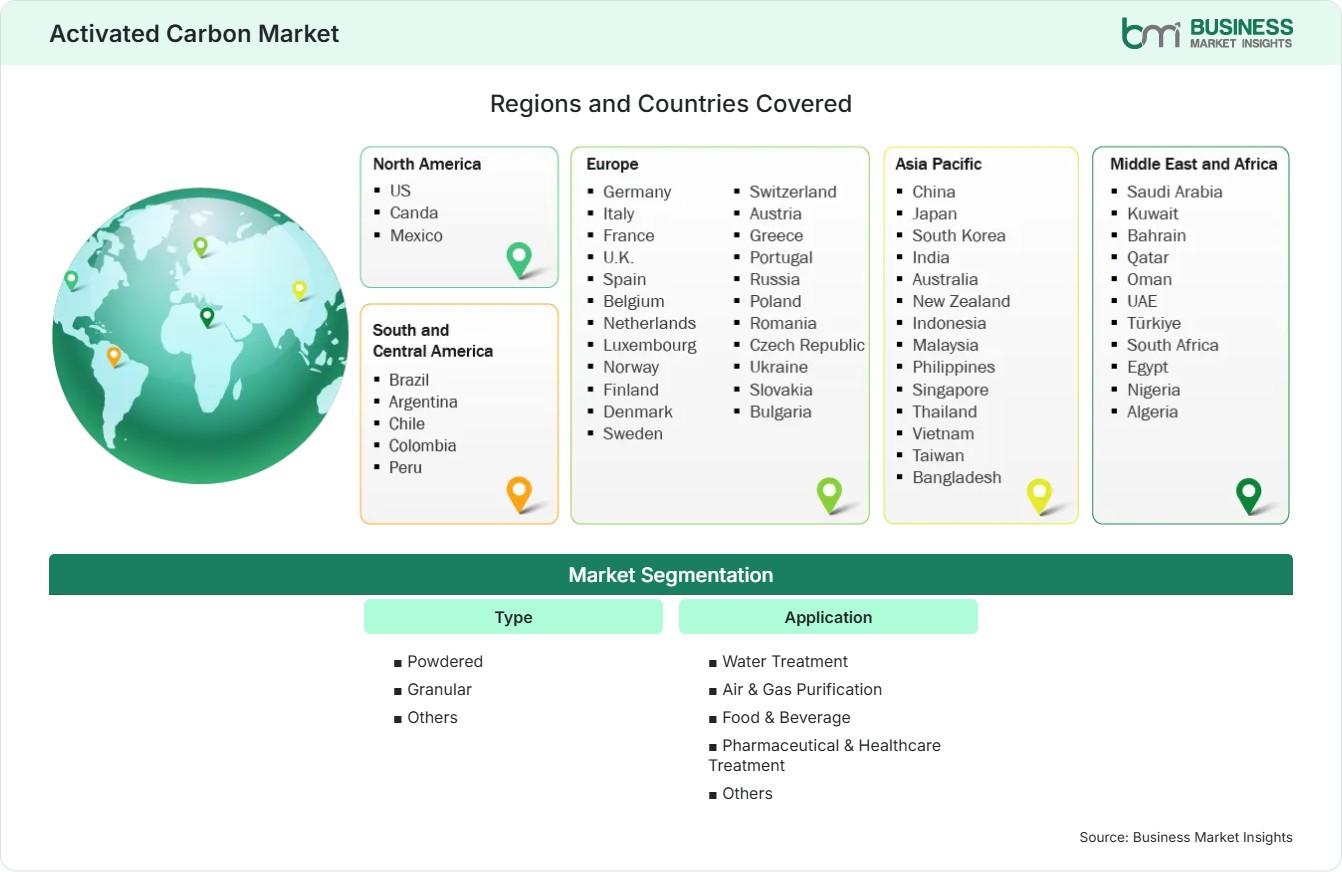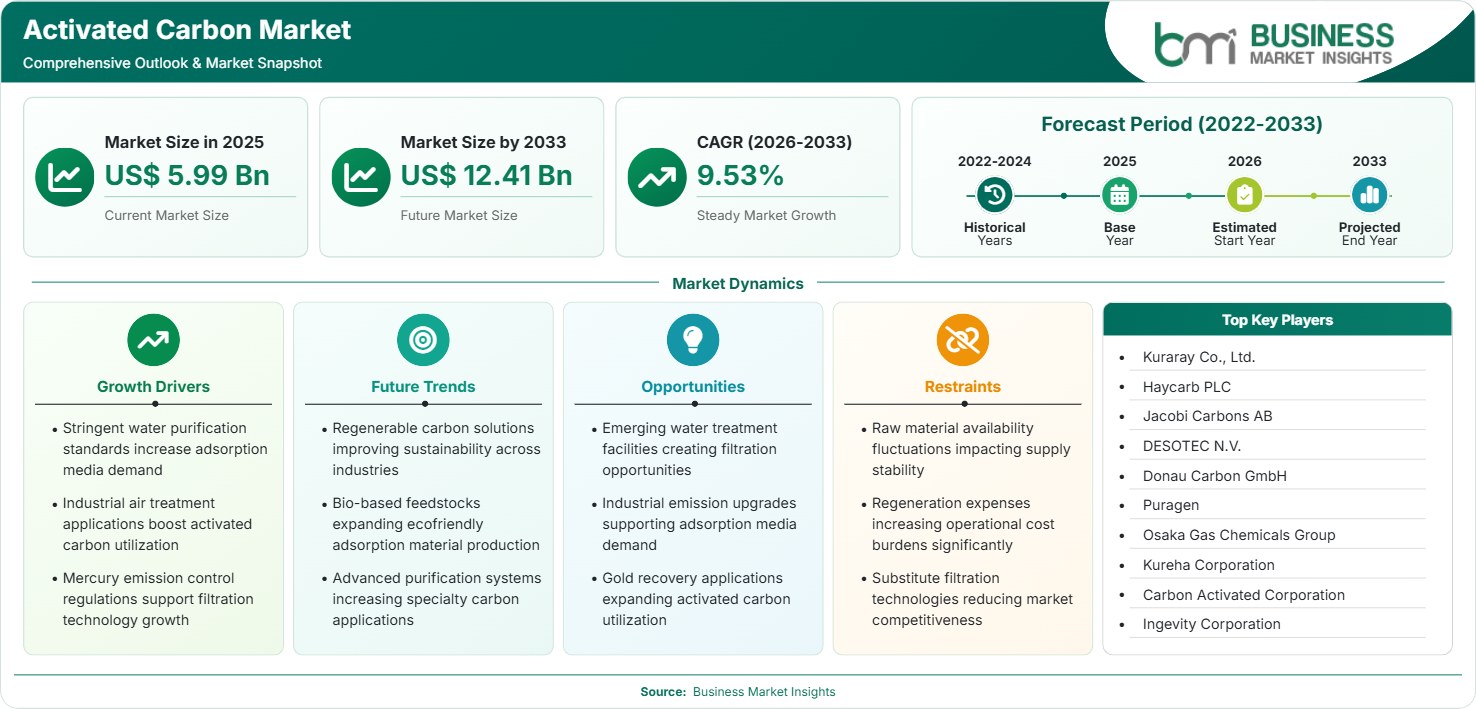
Activated Carbon Market Regional Highlights
North America Activated Carbon Market
North America holds an estimated 28%–31% Activated Carbon Market share in 2025 and is projected to expand at an 8.7%–9.2% CAGR through 2033. Demand is concentrated in municipal water treatment, PFAS removal, industrial emissions control, food processing, and reactivation. Regulatory requirements are encouraging utilities to evaluate granular media and lifecycle treatment economics.
- The demand for municipal drinking water treatment is increasing as water utilities get ready for the more stringent contaminant limits and consider granular adsorption together with reactivation schemes to extend the use of the media.
- The need for special types of carbon, engineered contact systems, analytical testing, and regeneration services is being generated by PFAS remediation, thus offering opportunities that go beyond the conventional approach of buying virgin media.
- As the cost of raw materials, tariffs, and freight affects the carbon economics of delivered products, investment in domestic supply is becoming of strategic importance.
- In industrial settings, such as those found in the chemical, manufacturing, waste, and energy sectors, air purification is still relevant since adsorption is used for controlling volatile organic compounds and in meeting the more stringent emissions requirements.
US Activated Carbon Market
The US represents approximately 68%–72% of North America's 2025 Activated Carbon Market demand and is projected to grow at an 8.9%–9.4% CAGR through 2033. Drinking-water applications provide a major demand anchor, while industrial air treatment, wastewater, food processing, and reactivation contribute diversified consumption.
- The rate at which PFAS is being treated is increasing interest in granular activated carbon, especially in those cases where water utilities need well-established adsorption technologies that can be incorporated with their present treatment facilities.
- Investment in reactivation capacity is increasing since utilities and industrial users are now more likely to evaluate carbon procurement on the basis of its total lifecycle cost rather than just the price of virgin media.
- In response to uncertainty caused by tariffs, logistics issues, and problems with the availability of feedstock, domestic producers are increasing the size of their supply programs, which are based on the reliable regional availability of resources and on contracted municipal demand.
Europe Activated Carbon Market
Europe represents an estimated 22%–25% Activated Carbon Market share in 2025, with an 8.4%–8.9% CAGR through 2033. Germany, the United Kingdom, France, Italy, and the Netherlands form important demand centers across water, food, chemicals, pharmaceuticals, and industrial emissions treatment.
- European industrial users are now requiring engineered adsorption systems that are capable of dealing with VOCs, hazardous substances, odors, and process contaminants while at the same time ensuring documented compliance with performance standards.
- Germany has to benefit from its well-established chemical, pharmaceutical, manufacturing, and environmental-treatment industries, which in turn create a continuous demand for specialized carbon grades and engineered filtration systems.
- There is an increasing demand in the United Kingdom for municipal water quality, industrial purification, and the treatment of emerging contaminants, which is creating opportunities for specialists in carbon products and regeneration.
- The European environmental policy is making the business case for regeneration stronger since dealing with products over their entire lifecycle helps to reduce the amount of waste produced and leads to better resource efficiency than repeatedly disposing of them.
Asia Pacific Activated Carbon Market
Asia Pacific holds an estimated 39%–43% Activated Carbon Market share in 2025 and is projected to expand at a 10.2%–10.8% CAGR, making it the fastest-growing regional market. China, Japan, India, South Korea, Indonesia, and Southeast Asian economies combine manufacturing, water infrastructure, food processing, pharmaceuticals, and electronics demand.
- China gains a wide range of manufacturing capacity, has made substantial investments in wastewater treatment, is subject to strict industrial pollution-control requirements, and has in place an established infrastructure for exporting activated carbon that serves a number of downstream markets.
- The country is experiencing rapid urbanization together with a pharmaceutical manufacturing sector, having substantial needs in regard to industrial wastewater, food processing, and an expanding environmental infrastructure, all of which result in continuous demand for both powdered and granular products.
- Because coconut shells are available and industrial demand is increasing, Indonesia has the opportunity for producers who are vertically integrated to link together the procurement of their feedstock with the processes of activation and export.
- Japan and South Korea have a highly technologically advanced demand for pharmaceuticals, electronics, specialty chemicals, and environmental treatment, and this supports the use of higher-value specialty carbon rather than just commodity carbon.
Rest of World Activated Carbon Market
The rest of the world represents approximately 10%–13% of the global Activated Carbon Market demand in 2025 and is expected to expand at an 8.8%–9.4% CAGR. South and Central America are supported by drinking-water treatment, food processing, mining, sugar refining, and industrial purification. Brazil and Mexico remain leading markets, while Colombia and Chile offer additional opportunities.
- The diverse carbon demands of Brazil's food, sugar, mining, and municipal sectors decrease the need to rely on a single use and therefore encourage investment in treatment solutions that are adapted to the local conditions.
- The demand for both powdered and granular adsorption technologies is encouraged in Mexico because of the country's industrial manufacturing, the requirements placed on municipal wastewater, and its food and beverage processing activities.
- The Gulf states are putting forward greater treatment demands together with their desalination and water-reuse initiatives, which provide opportunities for the use of high-performance carbon systems that are designed for tough water and industrial conditions.
- South Africa and Egypt offer opportunities in the fields of municipal water treatment, industrial purification, mining, and environmental remediation, even though the timing of the projects may be heavily influenced by infrastructure funding.