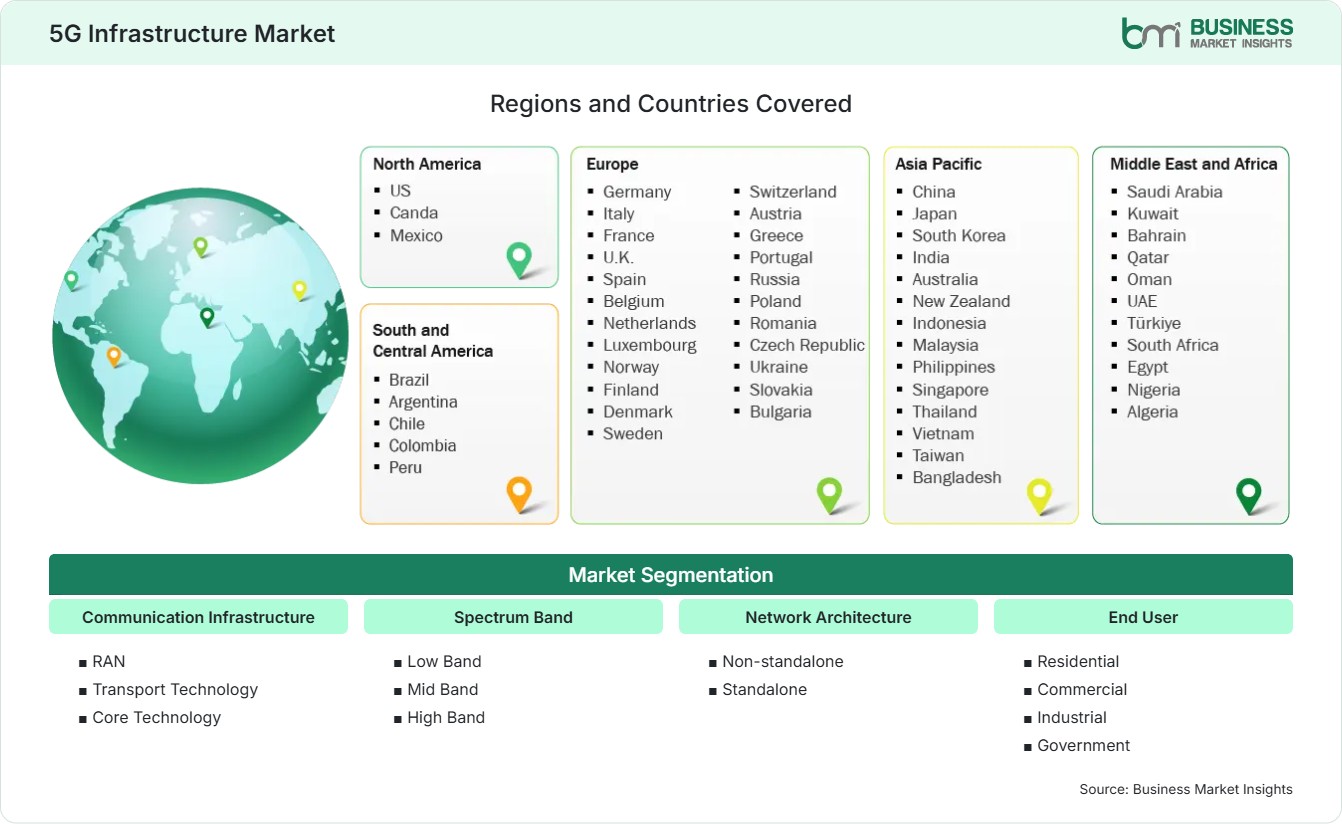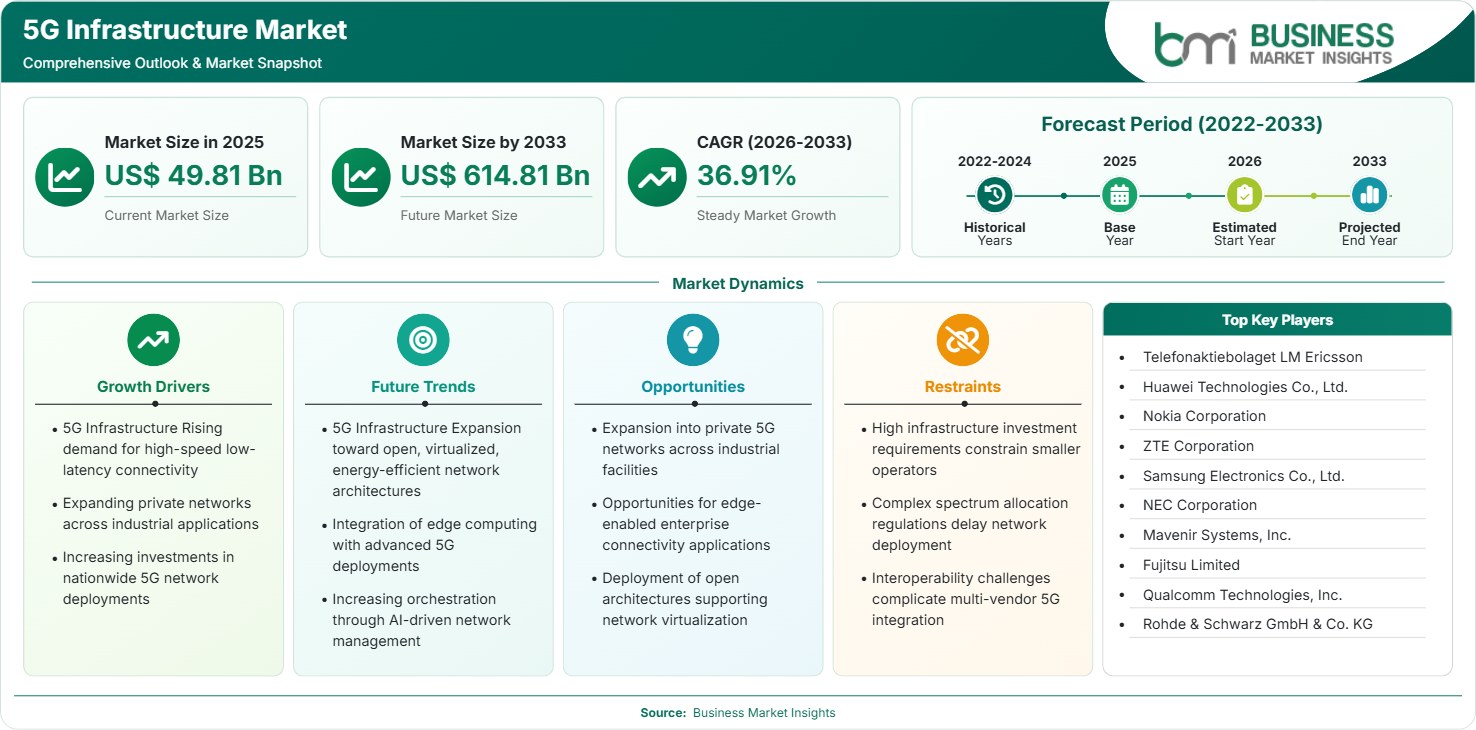
5G Infrastructure Market Regional Highlights
North America 5G Infrastructure Market
North America 5G Infrastructure Market represents a 24%–27% share in 2025 and grows at a 34%–37% CAGR through 2033. High 5G penetration supports modernization rather than first-time deployment. Mid-band expansion, private networks, FWA, cloud-native cores, and AI-driven traffic sustain infrastructure investment.
- Mid-band deployment remains central as operators balance capacity requirements, coverage economics, and spectrum utilization across metropolitan markets.
- Enterprise private networks are expanding across manufacturing, logistics, healthcare, utilities, and campuses, creating demand beyond conventional public mobile infrastructure.
- FWA provides an alternative broadband model where fiber economics are constrained, particularly in underserved suburban and rural locations.
- Network automation is gaining importance as operators seek lower energy consumption, faster provisioning, predictive maintenance, and improved distributed infrastructure utilization.
US 5G Infrastructure Market
The US 5G Infrastructure Market accounts for an 82%–86% share of North American infrastructure demand and expands at a 33%–36% CAGR during 2026–2033. The market is characterized by advanced mid-band deployment, enterprise experimentation, private wireless, AI workloads, and nationwide network modernization.
- Operators prioritize capacity upgrades and software modernization as traffic growth increases the value of spectrum efficiency and automation.
- Private 5G deployments are gaining traction where deterministic connectivity, security, and localized control offer advantages over conventional Wi-Fi architectures.
- Federal and defense requirements create specialized demand for resilient, deployable, open-architecture 5G systems across mission-critical environments.
Europe 5G Infrastructure Market
Europe 5G Infrastructure Market holds an 18%–21% share in 2025 and expands at a 35%–38% CAGR. The United Kingdom and Germany remain leading markets, while Poland and Romania provide higher growth potential. Industrial connectivity, network automation, spectrum efficiency, and energy optimization shape investment.
- The United Kingdom remains a mature deployment market, with modernization shifting toward standalone capabilities, automation, and enterprise monetization.
- Germany offers a major industrial opportunity supported by automotive, manufacturing, logistics, and private-network applications requiring reliable low-latency connectivity.
- Poland and Romania represent higher-growth markets as operators extend advanced mobile coverage and enterprises increase digital infrastructure investment.
- European sustainability priorities increase demand for radios and network equipment that reduce power consumption without compromising capacity.
Asia Pacific 5G Infrastructure Market
Asia Pacific commands a 42%–46% 5G Infrastructure Market share in 2025 and records the fastest 39%–42% CAGR through 2033. China remains the leading market, while India and Southeast Asia provide stronger incremental growth through coverage expansion, FWA, manufacturing, and enterprise digitization.
- China’s extensive deployment base creates continuing modernization demand for 5G Advanced, RedCap, Massive MIMO, AI-enabled networks, and higher-capacity infrastructure.
- India combines rapid subscriber migration with expanding FWA and enterprise applications, creating opportunities across RAN, transport, core, and managed network services.
- Indonesia and Vietnam offer high-growth opportunities as operators extend 5G coverage and enterprises adopt connected manufacturing, logistics, and digital services.
- Japan and South Korea emphasize standalone networks, differentiated connectivity, automation, and advanced enterprise applications rather than basic coverage expansion.
Rest of World 5G Infrastructure Market
South and Central America 5G Infrastructure Market provide substantial residual opportunity, with Brazil and Mexico leading regional deployment. Latin American infrastructure demand accelerates as operators expand mid-band networks, migrate subscribers from 4G, and introduce FWA services.
Middle East and Africa remain comparatively earlier-stage markets, led by Gulf economies, South Africa, and selected North African countries. The combined region represents a 9%–13% share in 2025 and expands at a 35%–38% CAGR through 2033.
- Brazil and Mexico offer leading scale opportunities, while Colombia and Chile provide attractive growth through urban capacity expansion and enterprise connectivity.
- Saudi Arabia and the United Arab Emirates remain regional leaders, supported by smart-city programs, cloud adoption, industrial digitization, and government-backed transformation.
- South Africa is positioned for higher growth as operators expand coverage and enterprises increase demand for private connectivity and FWA.
- Network sharing, infrastructure partnerships, and managed services can improve deployment economics in markets where subscriber density remains uneven.