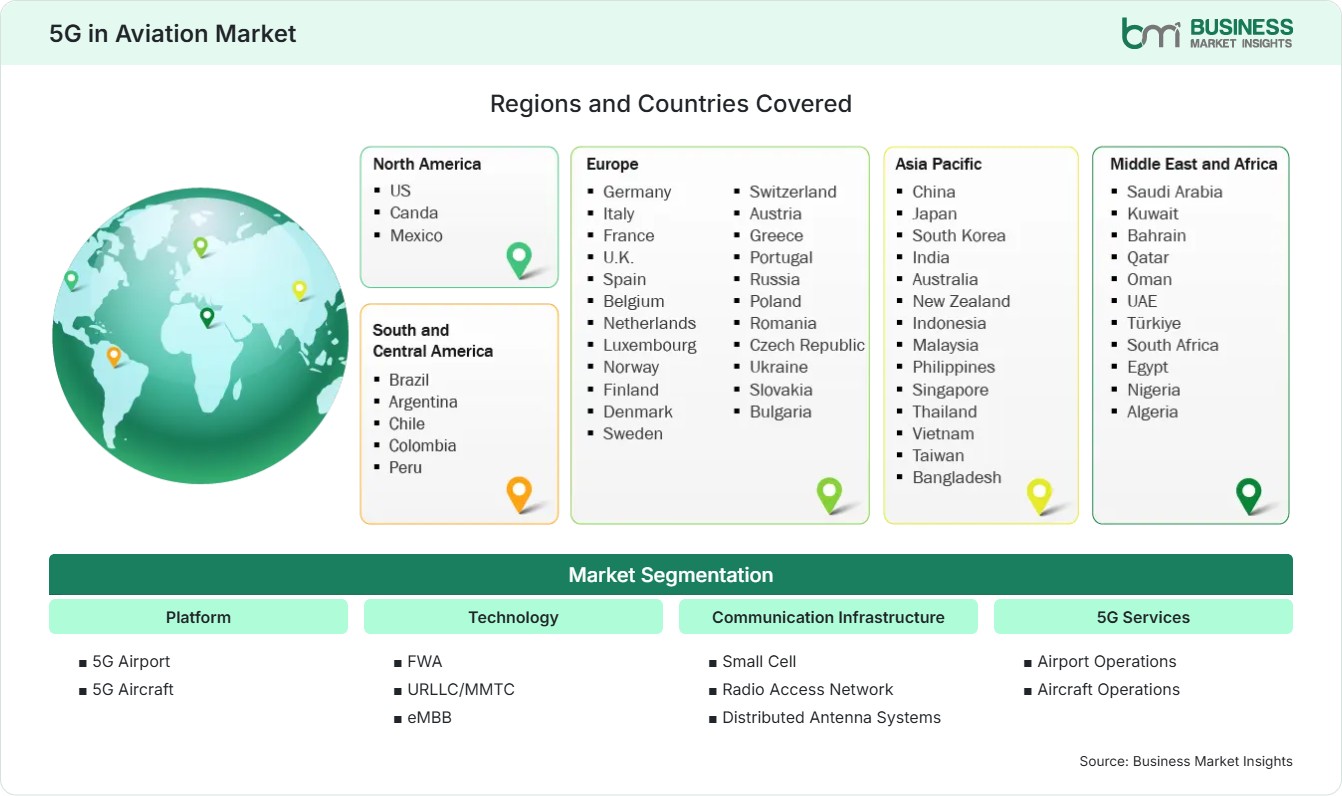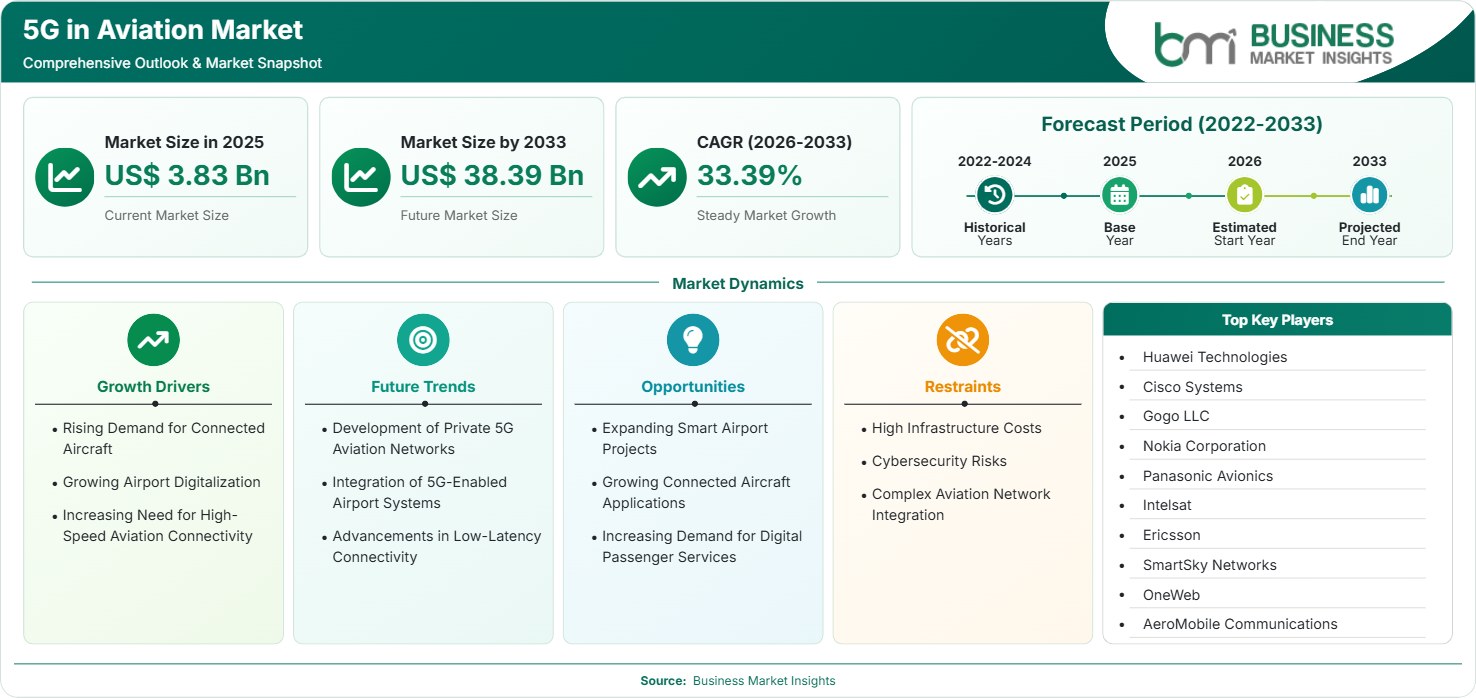
5G in Aviation Market Regional Highlights
North America 5G in Aviation Market
North America holds a 31%–34% share in 2025 and is projected to expand at a 30%–33% CAGR during 2026–2033. The region benefits from established aviation infrastructure, advanced telecommunications capabilities, and strong demand for connected aircraft and digital airport operations. The United States remains the principal contributor, while Canada provides additional opportunities through airport modernization and connectivity requirements.
- Connected aircraft requirements are encouraging airlines and technology providers to evaluate high-capacity communication architectures supporting passenger services, operational applications, aircraft data exchange, and increasingly integrated onboard digital environments.
- Airport modernization is strengthening demand for communication infrastructure capable of connecting operational assets, passenger-facing systems, security functions, ground operations, and other digitally enabled airport processes.
- Private and dedicated network architectures provide opportunities for aviation stakeholders seeking greater control over connectivity performance, application prioritization, network management, and operational communication requirements.
- The regional ecosystem supports collaboration between telecommunications providers, aviation technology companies, infrastructure suppliers, airports, airlines, and connectivity specialists, encouraging integrated rather than isolated technology deployments.
US 5G in Aviation Market
The U.S. represents approximately 78%–82% of North America's 2025 share and is projected to record a 31%–34% CAGR during 2026–2033. Airlines, airport operators, communication providers, and technology companies have broad opportunities to deploy network infrastructure supporting passenger connectivity, aircraft operations, and airport digitalization.
- Large aviation networks create demand for scalable communication solutions capable of supporting multiple airport locations, aircraft fleets, passenger services, operational systems, and technology-intensive aviation workflows.
- The competitive environment favors providers capable of combining connectivity infrastructure with managed services, network optimization, application support, and aviation-specific integration capabilities across diverse operational environments.
- Aircraft connectivity remains a major application area because passengers and operators increasingly expect consistent communication capabilities supporting digital services, information access, entertainment, and operational data exchange.
Europe 5G in Aviation Market
Europe accounts for a 25%–28% share in 2025 and is projected to expand at a 31%–34% CAGR during 2026–2033. Major aviation markets such as Germany, the United Kingdom, France, and Spain provide substantial adoption opportunities through airport modernization and connected aviation initiatives. Germany and the United Kingdom represent leading markets, while France and Spain provide attractive growth opportunities.
- Germany benefits from a substantial aviation infrastructure base and opportunities to modernize communication systems supporting airport operations, aircraft connectivity, passenger processing, and digitally coordinated ground activities.
- The United Kingdom presents opportunities for network providers through aviation digitalization, connected passenger services, airport technology modernization, and increasing requirements for flexible communication infrastructure.
- France represents an important market for connected aviation solutions, particularly where airport modernization and aircraft connectivity requirements create demand for integrated telecommunications and aviation technology capabilities.
- Spain provides growth opportunities through airport digitalization and connected passenger applications, encouraging adoption of communication architectures capable of supporting increasingly data-intensive aviation services.
Asia Pacific 5G in Aviation Market
Asia Pacific represents a 28%–31% share in 2025 and is projected to achieve the fastest expansion at a 35%–38% CAGR during 2026–2033. China, Japan, South Korea, India, Singapore, and Australia provide diverse opportunities across airport and aircraft applications. China and Japan represent leading markets, while India and Southeast Asian aviation hubs provide strong growth potential.
- China offers broad deployment potential because large aviation networks require communication infrastructure capable of supporting airport operations, aircraft connectivity, passenger services, and digitally integrated aviation environments.
- Japan and South Korea provide advanced technology environments where connected aircraft, airport automation, network modernization, and high-capacity communication systems can support sophisticated aviation applications.
- India presents substantial long-term opportunity as airport infrastructure expands and aviation stakeholders increasingly require digital systems capable of supporting operational efficiency and connected passenger experiences.
- Southeast Asian aviation hubs can benefit from integrated connectivity solutions that support passenger services, airport operations, aircraft communications, and increasingly interconnected transportation infrastructure.
Rest of World 5G in Aviation Market
South and Central America account for part of the 10%–13% Rest of World share in 2025, with regional growth supported by airport modernization, airline connectivity requirements, and digital passenger services. The broader Rest of World region is projected to expand at a 28%–31% CAGR during 2026–2033 as connectivity becomes increasingly integrated with airport operations and aircraft services.
- Brazil and Mexico provide important commercial opportunities through airport modernization, aircraft connectivity requirements, passenger services, and increasing adoption of digitally supported aviation operations.
- Gulf aviation markets present strong opportunities for advanced communication infrastructure because technologically sophisticated airports require integrated connectivity supporting passenger, operational, and aircraft-related applications.
- African aviation markets provide longer-term opportunities for modular infrastructure, managed connectivity, and scalable network solutions designed around varying airport modernization requirements and investment capabilities.
- Regional deployment strategies increasingly require partnerships because infrastructure availability, aviation ecosystem maturity, and connectivity requirements differ materially between individual countries and airport networks.