
3D Audio Market Outlook: Size, Share, Trends, Growth Analysis, Competitive Landscape & Forecast, 2026-2033

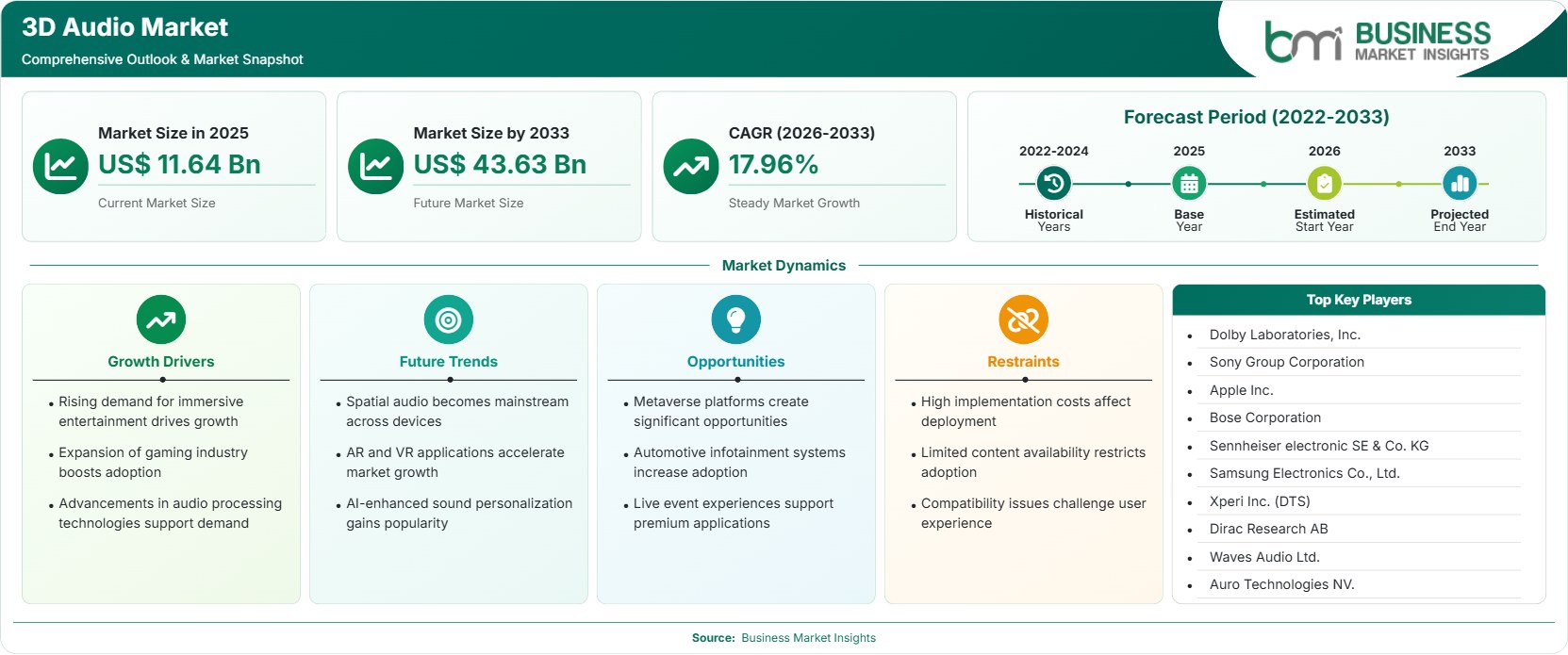
The 3D Audio Market size was valued at US$ 11.64 Billion in 2025 and is projected to reach US$ 43.63 Billion by 2033, growing at a CAGR of 17.96% during 2026–2033. Growth is supported by spatial audio adoption across gaming, streaming, XR platforms, automotive infotainment, and premium consumer electronics, while opportunities emerge from AI-driven sound personalization and immersive enterprise collaboration.

Report Coverage
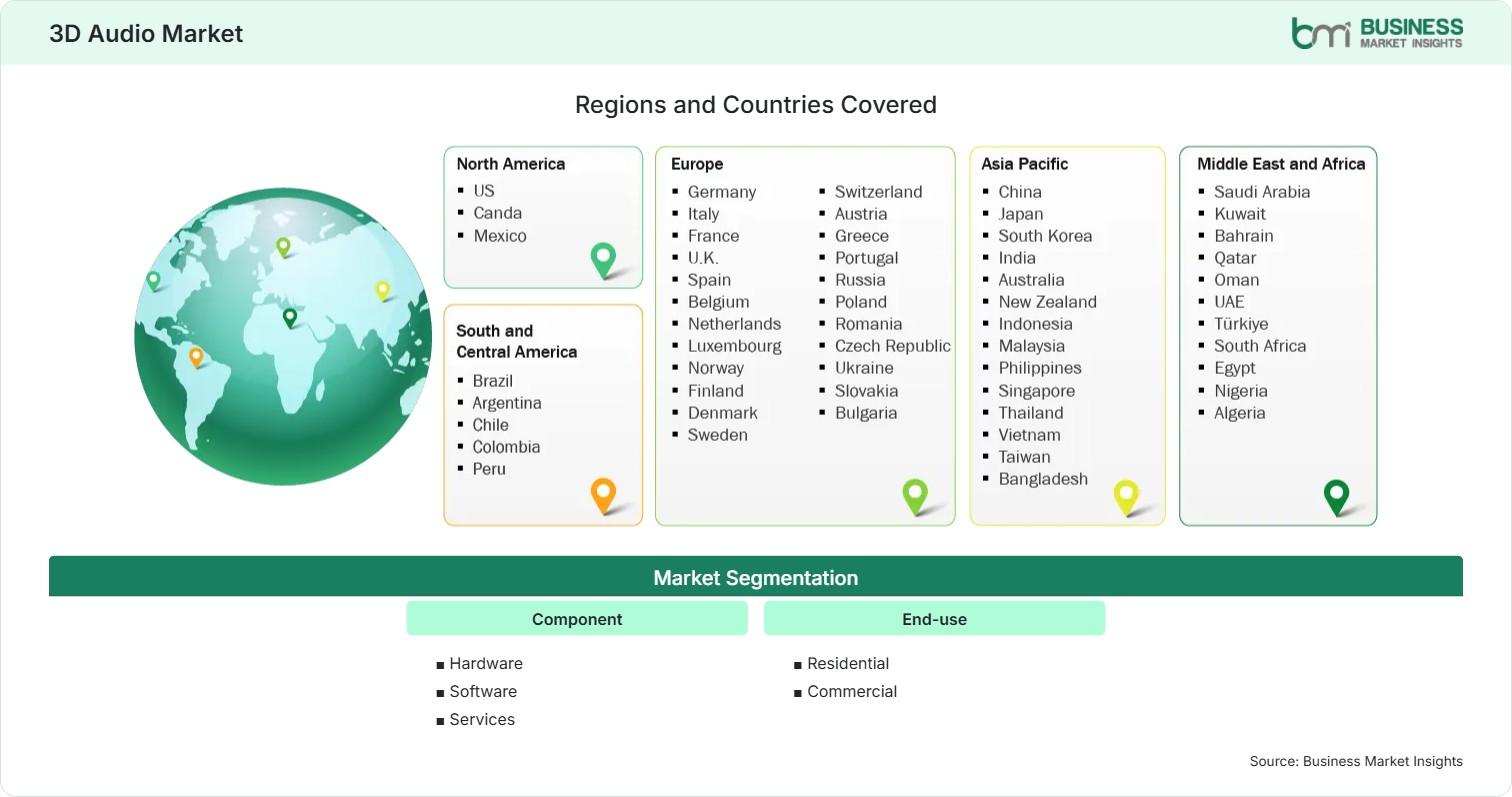
  • Component: Hardware, Software, Services
  • End-use: Residential, Commercial
US$ 11.64 Bn Market size in 2025
US$ 43.63 Bn Market Size by 2033
17.96% CAGR, 2026 - 2033
2026-2033 Forecast Period

AI Overview

3D Audio Market Summary

  • North America Region: North America holds a market share of 36%–39% in 2025, growing at a CAGR of 16.5%–18.0% during 2026–2033, supported by streaming ecosystems, gaming investments, immersive content production, automotive audio upgrades, enterprise XR adoption, and expanding deployment of object-based audio technologies across consumer and professional applications. The US market benefits from advanced entertainment infrastructure and premium device penetration, with growth at a CAGR of 16.8%–18.2%.
  • Fastest Growing Region: Asia Pacific accounts for 28%–31% share in 2025 and is forecast to expand at a CAGR of 19.5%–21.0% during 2026–2033, driven by smartphone adoption, gaming audiences, local streaming platforms, manufacturing strength, immersive media consumption, and rising investments in smart consumer electronics ecosystems.
  • Leading Segment: Hardware represents 58%–62% share in 2025 and advances at a CAGR of 16.0%–17.5% during 2026–2033, supported by premium headphones, soundbars, home theaters, automotive integration, device innovation, and increasing consumer preference for immersive entertainment experiences across channels.
  • High Growth Segment: Software captures 20%–24% share in 2025 and expands at a CAGR of 20.5%–22.0% during 2026–2033, driven by rendering engines, AI sound processing, cloud audio workflows, creator tools, real-time spatialization solutions, and growing demand from virtual environments.
  • Key Market Opportunity: Growing deployment of immersive audio across virtual collaboration, digital twins, connected vehicles, healthcare simulation, and industrial training environments creates scalable monetization opportunities for platform providers and technology developers globally.
  • Major Market Players: Dolby Laboratories, Inc.; Sony Group Corporation; Apple Inc.; Bose Corporation; Sennheiser electronic SE & Co. KG; Samsung Electronics Co., Ltd.; Xperi Inc. (DTS); Dirac Research AB; Waves Audio Ltd.; Auro Technologies NV.
Strategic Insights

3D Audio Market: Strategic Insights

3D Audio Market Strategic Framework
FREE PDF
Request your free sample
Request free sample
Stakeholder View

Key Takeaways

  • Hardware manufacturers, codec developers, platform operators, streaming services, and content studios form an increasingly integrated value chain where interoperability influences commercialization success.
  • Commercial deployments across automotive infotainment, immersive training, gaming, and collaborative digital environments offer stronger long-term monetization potential than traditional media-only applications.
  • Innovation is shifting toward AI-generated acoustics, adaptive spatial rendering, head-tracking capabilities, and personalized sound field optimization integrated directly into consumer devices.
  • Asia Pacific offers a compelling investment environment due to its large gamer population, electronics manufacturing ecosystem, and rapidly growing subscription-based entertainment services.
  • Strategic partnerships between consumer electronics brands, streaming platforms, semiconductor companies, and spatial audio software providers are accelerating ecosystem development and acquisition activity.
  • Automotive adoption is becoming a major revenue catalyst as premium vehicle brands increasingly differentiate through immersive in-cabin entertainment experiences.
Geographic Outlook

3D Audio Market Regional Highlights

North America 3D Audio Market

North America accounted for approximately 36%–39% of global revenue in 2025 and is projected to register a 16.5%–18.0% CAGR through 2033. The region maintains leadership because of high spending on gaming, premium audio equipment, subscription streaming services, and XR technologies. Strong innovation ecosystems and established entertainment industries accelerate commercialization. The 3D Audio Market share remains concentrated among technology developers and leading content distributors deploying advanced immersive formats across consumer and enterprise applications.

  • Growth of Dolby Atmos-enabled content across streaming platforms supports broader consumer adoption.
  • Strong gaming ecosystem increases demand for realistic directional audio in competitive and immersive experiences.
  • Automotive manufacturers continue integrating premium spatial audio systems within connected vehicle offerings.
  • Enterprise XR applications expand audio requirements across training, simulation, and collaboration environments.

US 3D Audio Market

The United States represents roughly 75%–80% of North American revenue and is projected to see a CAGR of 16.8%–18.2%. The strong ability to create content, advanced cloud infrastructure, and a leading position in streaming platforms drive market growth. Consumers' willingness to buy premium products is helping generate steady revenue. There are ongoing investments by audio technology companies, entertainment firms, and automobile suppliers in ecosystem development across the country.

  • Spatial audio integration across music streaming ecosystems encourages subscription differentiation.
  • Gaming publishers increasingly optimize titles for immersive sound environments.
  • Professional content studios adopt object-based audio production workflows at scale.
  • Consumer electronics replacement cycles encourage upgrades toward immersive audio-compatible devices.

Europe 3D Audio Market

The Europe region accounted for around a 24%-27% share and is estimated to grow at a CAGR of 16.0%-17.5%. Growth drivers in this region include robust auto manufacturing, high levels of audio engineering proficiency, and demand for luxury consumer electronics. Germany remains the leading country, while the Nordic countries and the UK show high penetration of spatial audio systems. Immersive entertainment, digital media production, and connected mobility applications continue driving regional demand.

  • Germany leads regional revenues with robust automotive and industrial audio innovation.
  • The United Kingdom benefits from expanding content production and gaming ecosystems.
  • Nordic countries demonstrate strong premium audio device adoption rates.
  • Automotive sound experience differentiation increasingly influences supplier investments.
  • Enterprise simulation platforms create emerging commercial demand opportunities.

Asia Pacific 3D Audio Market

The Asia Pacific market contributed 28%-31% in 2025 and is expected to grow at a 19.5%-21.0% CAGR, making it one of the fastest-growing regional markets. China, Japan, and South Korea will remain important sources of revenue, while India is expected to grow the fastest among the countries. High smartphone penetration, large gaming communities, a rising number of streaming subscriptions, and electronics manufacturing capabilities are among the factors behind the rapid adoption. The region remains central to future 3D Audio Market growth.

  • China leads production and consumption of immersive consumer audio devices.
  • Japan benefits from advanced entertainment technology and audio engineering strengths.
  • South Korea supports adoption through gaming and digital media innovation.
  • India records strong momentum from mobile entertainment and creator economies.
  • Regional electronics manufacturing lowers deployment costs and accelerates availability.

Rest of World 3D Audio Market

The Rest of World contributed a market share of around 9%–12% during 2025 and is anticipated to grow at a CAGR of 17.0%–18.5%. Digital entertainment consumption and streaming penetration are strong in South & Central America. Middle East & Africa markets get a boost from their smart cities projects, digital transformation initiatives, and rising consumer spending on premium consumer electronics. The UAE and Brazil continue to be major growth drivers, and Saudi Arabia invests significantly in digital infrastructure.

  • Brazil remains the largest Latin American opportunity for immersive audio solutions.
  • Mexico experiences growing adoption through gaming and streaming platforms.
  • UAE supports premium consumer electronics demand and smart entertainment initiatives.
  • Saudi Arabia benefits from digital economy investments and media sector expansion.
  • Enterprise training applications create incremental adoption across industrial sectors.
Global Market Geography
FREE PDF
Request your free sample
Request free sample
Segment Analysis

3D Audio Market Segmentation

Component

Component Segment covers the market 100%. The major contributor to this was Hardware. It shows the investment being made in audio devices, rendering engines, and integration services. The scope of the 3D Audio Market is expanding continuously as vendors integrate hardware devices with software capabilities. The share of Hardware is 58%–62% in 2025, whereas that of Software is at a 20.5%–22.0% CAGR.

  • Hardware: Largest revenue contributor driven by consumer electronics, automotive audio systems, immersive gaming devices, premium listening products, and growing demand for spatial audio experiences.
    • Loudspeakers: Advanced multi-channel configurations support entertainment venues, home theaters, and automotive applications requiring realistic sound positioning and enhanced acoustic immersion.
    • Headphones: Personal listening remains a prime use case as spatial audio features and head-tracking technologies improve realism across music, gaming, and professional applications.
    • Microphones/Mic: Immersive content creation requires precise sound capture technologies capable of supporting object-based and spatial audio production workflows.
    • Sound Bars: Premium home entertainment installations increasingly use spatial audio-enabled soundbars to deliver cinematic experiences without complex speaker arrangements.
  • Software: Rapidly expanding category benefiting from audio rendering engines, immersive content tools, AI-based processing, and scalable deployment across platforms.
  • Services: Consulting, integration, calibration, and audio engineering services support enterprise implementations and professional content production activities.

End-use

The residential segment captured 64%-68% market share in 2025 and is forecasted to register a CAGR of 16.5%-18.0%, driven by streaming consumption and premium devices. The commercial segment is forecast to grow at a CAGR of 18.5%-20.0% due to increasing adoption of immersive technology for training, entertainment, retail, automotive, and collaboration. 3D Audio Market Trends show the convergence of consumer and enterprise applications.

  • Residential: Demand is supported by gaming systems, smart televisions, streaming platforms, headphones, soundbars, and home entertainment upgrades focused on immersive experiences.
  • Commercial: Broad deployment across cinemas, automotive systems, XR training platforms, virtual collaboration environments, and location-based entertainment venues strengthens adoption.
Market Forces

3D Audio Market Dynamics

Key Market Drivers

Expansion of Immersive Gaming and XR Ecosystems

Spatial awareness and directional sound are integral to gaming, AR, and VR experiences. Further investment by the industry in XR hardware and audio content production ensures ever-growing demand for advanced audio solutions. Object-based sound rendering is becoming more common among developers to achieve greater realism and competitiveness. With increased consumer adoption, immersive audio is becoming an essential component rather than a luxury. The combination of low latency, better headphones, and software continues to drive commercial success in the digital entertainment industry.

Streaming Platforms Driving Spatial Audio Consumption

Immersive formats are supported by major music and video companies because they increase consumer engagement and help differentiate their premium services. The availability of spatial audio content on common devices lowers the barrier to entry for immersive technologies. Producers are investing more in immersive mastering technologies and new production processes. Catalog availability builds consumer awareness and prompts hardware upgrade decisions. This leads to better monetization prospects for technology suppliers and hardware and software developers in the growing immersive space.

Automotive Integration of Premium Audio Experiences

Automotive companies are utilizing immersive sound technology to distinguish their luxury car offerings. Connected cars are better equipped to stream media and play spatially distributed music and other entertainment features. Auto companies have partnered with codec providers and audio experts to optimize cabin acoustics. Enhanced processing capabilities enable the technology to be used across a wider range of cars. This development fuels demand for hardware and software for advanced vehicle infotainment systems.

Key Market Opportunities

Enterprise Collaboration and Digital Twin Applications

Immersive communication environments have become increasingly required for industrial training, engineering simulation, health care education, and remote collaboration. Spatial audio enhances context and interaction within virtual environments. Enterprises that embrace digital twins and mixed reality are generating further need for scalable software platforms. Investments in immersive technologies continue growing wherever productivity benefits can be observed. Long-term 3D Audio Market forecasts increasingly include enterprise applications as a revenue-generating source.

AI-Driven Personalized Sound Experiences

Artificial intelligence enables flexible audio output based on users’ preferences, surroundings, and behavior. Features that make a vendor distinctive are the ability to deliver customized acoustic settings. Machine learning, combined with spatial audio, increases localization accuracy and listener comfort. Personalization helps explain the higher price point. Computing capabilities in consumer devices have advanced enough to allow for this technology to be implemented successfully.

Emerging Market Digital Entertainment Expansion

Rapidly developing connectivity, smartphone usage, and content consumption create a favorable environment in emerging markets. Localization of content ecosystems is driving the adoption of immersive production practices. The affordability of consumer electronics continues to improve, resulting in broader coverage of the target audience. Regional streaming services are exploring ways to offer unique experiences through new audio technologies. Such developments open the door for licensing deals and partnerships.

Market Restraints and Challenges

High Implementation Costs and Ecosystem Complexity

Factor: Premium immersive audio systems frequently require specialized hardware components, advanced rendering software, high-performance processors, and professionally optimized content workflows. Impact: These requirements increase total deployment costs for consumers, content creators, and businesses. Compatibility issues across devices, platforms, and audio formats further complicate integration. Smaller organizations often face budget and technical expertise constraints, while creators must invest in new production tools and training. As a result, procurement cycles can lengthen, return-on-investment evaluations become more stringent, and adoption rates may slow despite growing demand for immersive audio experiences.

Content Availability and Standardization Limitations

Factor: The presence of multiple immersive audio standards, proprietary technologies, and competing ecosystem requirements continues to create fragmentation across the industry. Impact: Organizations may encounter interoperability challenges when deploying solutions across different platforms and devices. Limited availability of high-quality immersive content in certain regions, languages, and industry verticals further restricts user engagement. Developers and content producers often need additional resources to support multiple formats, increasing operational complexity. Until greater standardization and broader content availability are achieved, some buyers may delay investments, slowing commercialization and large-scale market adoption.

Company Analysis

Competitive Landscape

The competitive environment is characterized by platform innovation, device integration, licensing models, and ecosystem development. Ongoing 3D Audio Market analysis indicates strong competition between codec developers, hardware manufacturers, and software specialists.

Company Name

Overview

Products and Services relevant to this market

Dolby Laboratories, Inc.

Global leader in immersive sound technologies used across entertainment and devices.

Dolby Atmos, audio codecs, cinema audio systems, content production solutions.

Sony Group Corporation

Strong presence in gaming, consumer audio devices, and immersive content ecosystems.

360 Reality Audio, PlayStation audio technologies, headphones, entertainment solutions.

Apple Inc.

Integrates spatial audio capabilities across hardware and content platforms.

AirPods, Spatial Audio, streaming ecosystem integrations, audio processing technologies.

Bose Corporation

Premium audio company focused on immersive listening experiences.

Headphones, speakers, soundbars, audio enhancement technologies.

Sennheiser electronic SE & Co. KG

Professional and consumer audio specialist with global reach.

Headphones, microphones, immersive audio solutions, studio technologies.

Samsung Electronics Co., Ltd.

Major consumer electronics manufacturer with connected audio ecosystem.

TVs, soundbars, mobile devices, immersive audio integrations.

Xperi Inc. (DTS)

Develops advanced audio processing and entertainment technologies.

DTS:X, immersive sound platforms, licensing solutions.

Dirac Research AB

Specialist in digital audio optimization technologies.

Spatial audio software, room correction, automotive audio solutions.

Waves Audio Ltd.

Audio software innovator serving professional production markets.

Spatial plugins, immersive mixing tools, audio processing software.

Auro Technologies NV

Pioneer in immersive multi-dimensional sound solutions.

Auro-3D technologies, content production and playback solutions.

Trust & Transparency

Research Methodology

The market analysis combines proprietary research with secondary data from government agencies, company disclosures, regulatory filings, industry databases and expert interviews. Market estimates are validated through data triangulation, cross-market benchmarking and analyst review.

View Full Research Methodology

Questions Answered

Frequently Asked Questions

What does a 3D Audio Market Report typically evaluate?

A comprehensive Market Report assesses technology adoption, regional demand patterns, competitive positioning, segmentation performance, investment activity, and future commercialization opportunities.

How do automotive manufacturers benefit from immersive audio?

Advanced audio systems improve passenger engagement, increase perceived vehicle value, strengthen brand differentiation, and support premium infotainment strategies.

What role does AI play in spatial audio systems?

AI enhances sound personalization, room adaptation, localization accuracy, noise management, and real-time rendering efficiency, helping providers deliver differentiated user experiences.

Which end-use sector offers the strongest long-term potential?

Commercial applications are gaining momentum because automotive, enterprise XR, simulation, and location-based entertainment deployments create recurring technology and integration opportunities.

Why is immersive audio becoming important beyond entertainment?

Immersive audio improves situational awareness, communication accuracy, and realism. These benefits support enterprise training, healthcare simulation, industrial digital twins, and collaborative virtual environments.

Access the Full 3D Audio Market Report

Get segment-level forecasts, regional estimates, competitive benchmarking, company profiles and downloadable Excel datasets.

Access the full 3D Audio Market Report
350 pages PDF & Excel | 2026-08-31