
Xenon Market Outlook: Size, Share, Trends, Growth Analysis, Competitive Landscape & Forecast, 2026-2033

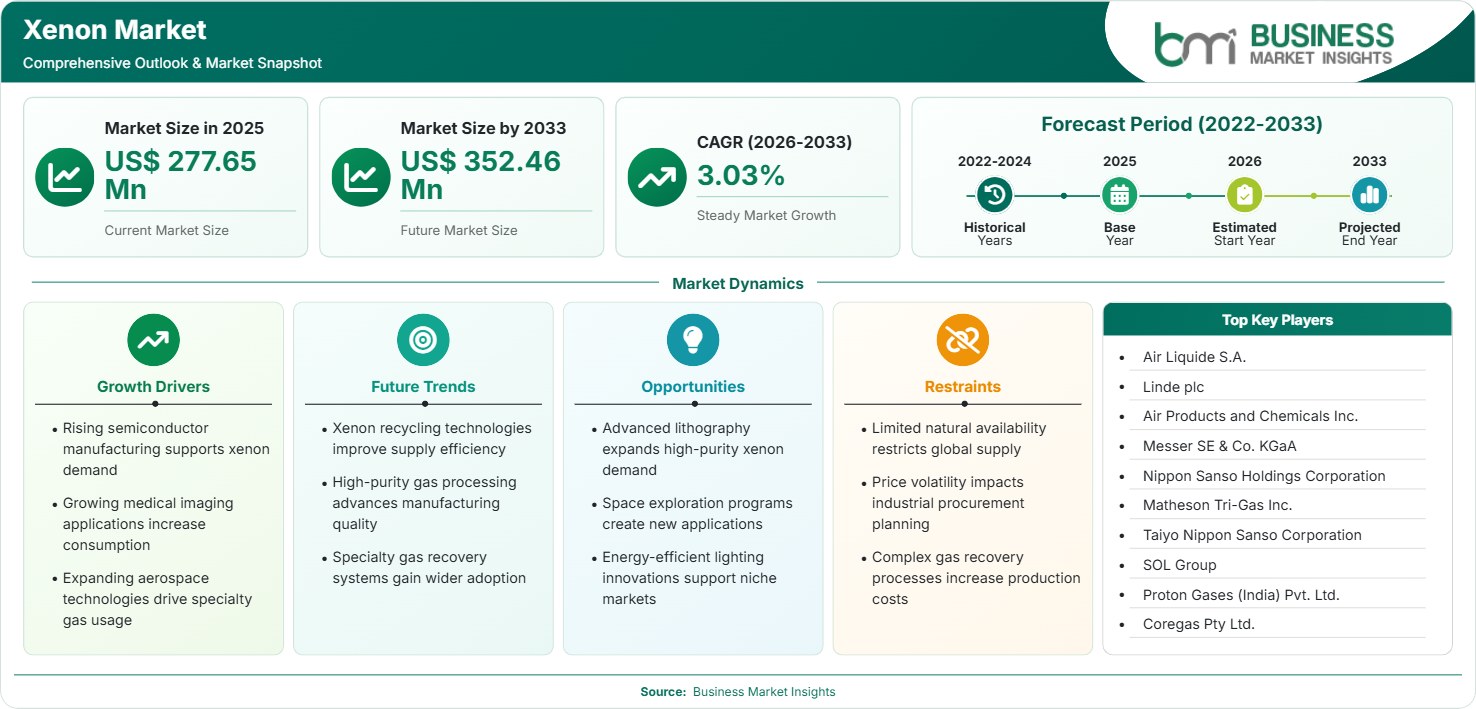
The Xenon Market size was valued at US$ 277.65 billion in 2025 and is projected to reach US$ 352.46 billion by 2033, growing at a CAGR of 3.03% during 2026–2033. Expanding semiconductor fabrication, increasing medical imaging procedures, and rising demand for specialty gases in aerospace applications continue supporting steady global market expansion.

Report Coverage
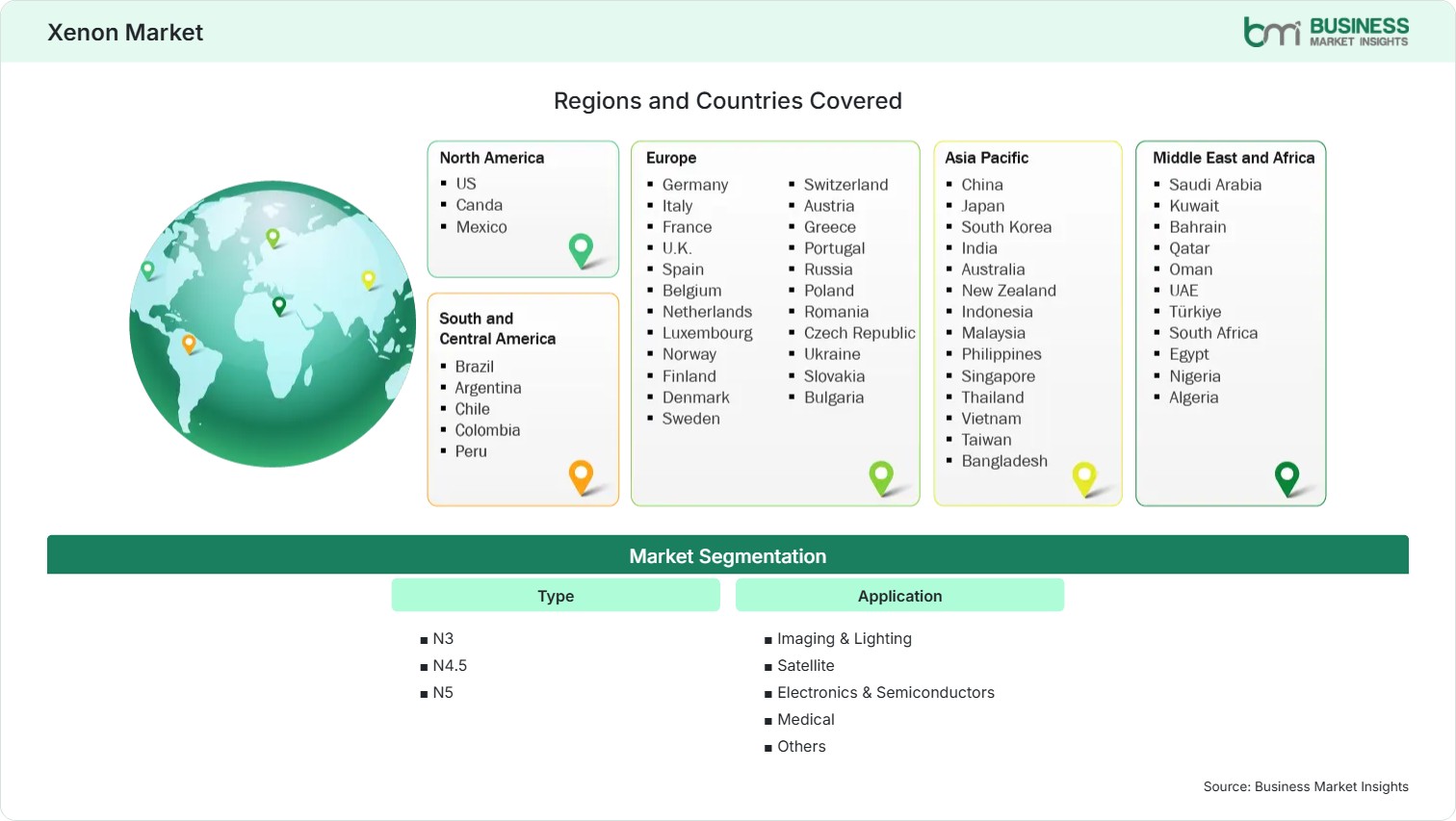
  • Type: N3, N4.5, N5
  • Application: Imaging & Lighting, Satellite, Electronics & Semiconductors, Medical, Others
US$ 277.65 Mn Market size in 2025
US$ 352.46 Mn Market Size by 2033
3.03% CAGR, 2026 - 2033
2026-2033 Forecast Period

AI Overview

Xenon Market Summary

  • North America Region: North America accounts for 30%–33% market share in 2025 and is projected to expand at a CAGR of 2.8%–3.2% during 2026–2033. Semiconductor investments, medical technology innovation, and aerospace manufacturing sustain regional demand. The U.S. remains the dominant contributor with a CAGR of 2.9%–3.3%, supported by advanced chip fabrication facilities and expanding healthcare infrastructure.
  • Fastest Growing Region: Asia Pacific represents 37%–40% market share in 2025 and is anticipated to record a CAGR of 3.4%–3.8%, driven by expanding semiconductor manufacturing, electronics production, healthcare investment, and increasing industrial gas consumption across major economies.
  • Leading Segment: N5 accounts for 44%–47% market share in 2025 and is expected to grow at a CAGR of 3.2%–3.6%, supported by rising demand for ultra-high-purity xenon in semiconductor fabrication and precision industrial applications.
  • High Growth Segment: Electronics & Semiconductors holds 34%–37% market share in 2025 and is projected to register a CAGR of 3.6%–4.0%, driven by advanced lithography technologies, wafer manufacturing, and growing investments in semiconductor fabrication plants.
  • Key Market Opportunity: Growing demand for ultra-high-purity specialty gases across semiconductor manufacturing, satellite propulsion, and advanced medical technologies continues creating attractive opportunities for global xenon suppliers.
  • Major Market Players: Air Liquide S.A., Linde plc, Air Products and Chemicals, Inc., Messer SE & Co. KGaA, Nippon Sanso Holdings Corporation, Matheson Tri-Gas, Inc., Taiyo Nippon Sanso Corporation, SOL Group, Proton Gases (India) Pvt. Ltd., and Coregas Pty Ltd.
Strategic Insights

Xenon Market: Strategic Insights

Xenon Market Strategic Framework
FREE PDF
Request your free sample
Request free sample
Stakeholder View

Key Takeaways

  • Semiconductor manufacturing remains the largest value-generating application, increasing long-term demand for ultra-high-purity xenon across advanced lithography and wafer fabrication processes.
  • Medical imaging and healthcare infrastructure expansion continue supporting stable consumption of specialty gases for diagnostic equipment and advanced medical technologies.
  • Investments in gas purification, recovery technologies, and efficient separation processes are improving supply reliability while reducing operational costs for industrial gas producers.
  • Asia Pacific presents the strongest investment opportunity due to expanding semiconductor fabrication, electronics manufacturing, and government-supported industrial development.
  • Long-term supply agreements, production capacity expansion, and strategic partnerships continue strengthening competitive positioning among leading industrial gas suppliers.
  • Increasing adoption of satellite propulsion technologies is creating additional demand for high-purity xenon across commercial and government aerospace programs.
Geographic Outlook

Xenon Market Regional Highlights

North America Xenon Market

North America accounts for 30%–33% Xenon Market share in 2025 and is projected to register a CAGR of 2.8%–3.2% during 2026–2033. Strong semiconductor manufacturing, advanced healthcare infrastructure, aerospace innovation, and well-established industrial gas supply chains continue supporting regional demand. Companies are investing in purification technologies and long-term supply agreements to strengthen supply reliability for high-value industrial applications.

  • Semiconductor fabrication plants continue increasing consumption of ultra-high-purity xenon for advanced lithography processes.
  • Healthcare providers support stable demand through expanding diagnostic imaging infrastructure and advanced medical technologies.
  • Aerospace manufacturers increasingly utilize specialty gases for satellite propulsion and research applications.
  • Industrial gas companies continue investing in production efficiency and gas recovery technologies.

US Xenon Market

The United States contributes 82%–85% of North American revenue and is expected to expand at a CAGR of 2.9%–3.3% during the forecast period. Continued semiconductor investments, expanding aerospace research, and advanced healthcare facilities support sustained demand for high-purity xenon.

  • Government incentives encourage domestic semiconductor manufacturing and specialty gas production.
  • Commercial satellite programs continue increasing xenon consumption for electric propulsion systems.
  • Healthcare modernization supports consistent utilization of specialty gases in imaging applications.
  • Industrial gas suppliers strengthen domestic production and distribution capabilities.

Europe Xenon Market

Europe represents 24%–27% market share in 2025 and is projected to grow at a CAGR of 2.7%–3.1% through 2026–2033. Strong industrial gas infrastructure, advanced electronics manufacturing, and healthcare investments continue supporting regional expansion. Germany leads regional consumption through its semiconductor and industrial manufacturing base, while Ireland records the fastest growth due to expanding pharmaceutical and electronics investments.

  • Semiconductor manufacturing supports increasing consumption of ultra-high-purity industrial gases.
  • Medical imaging modernization contributes to stable demand across hospitals and research institutions.
  • Aerospace research initiatives continue creating specialized applications for xenon technologies.
  • Sustainability investments encourage improved gas recovery and purification efficiency.

Asia Pacific Xenon Market

Asia Pacific holds 37%–40% market share in 2025 and is projected to register the fastest 3.4%–3.8% CAGR during 2026–2033. Expanding semiconductor fabrication, electronics production, healthcare infrastructure, and industrial gas manufacturing continue supporting regional demand. China remains the leading market because of its extensive electronics manufacturing base, while India records the fastest growth through semiconductor investments and industrial expansion.

  • Large-scale semiconductor fabrication facilities continue driving specialty gas demand.
  • Consumer electronics manufacturing supports sustained utilization of high-purity xenon.
  • Healthcare infrastructure development expands demand for diagnostic imaging technologies.
  • Industrial gas producers continue investing in purification facilities and regional supply networks.

Rest of World Xenon Market

The Rest of World region accounts for 5%–8% market share in 2025 and is projected to expand at a CAGR of 2.9%–3.3% through 2026–2033. Investments in industrial manufacturing, healthcare modernization, and commercial aerospace programs continue supporting gradual market expansion across Latin America, the Middle East, and Africa.

  • Brazil leads regional consumption through industrial manufacturing and healthcare investments.
  • GCC countries continue expanding aerospace and advanced industrial technology initiatives.
  • Medical imaging adoption supports consistent demand for specialty gases across emerging healthcare systems.
  • Industrial development strengthens long-term opportunities for regional gas suppliers.
Global Market Geography
FREE PDF
Request your free sample
Request free sample
Segment Analysis

Xenon Market Segmentation

Type

The type segment represents the foundation of the market, as xenon purity directly determines its suitability for semiconductor manufacturing, aerospace propulsion, medical applications, and advanced lighting technologies. It accounted for 44%–47% market share in 2025 and is projected to register a CAGR of 3.2%–3.6% during 2026–2033. Growing demand for ultra-high-purity gases continues expanding the Xenon Market scope, encouraging suppliers to enhance purification technologies and production efficiency across industrial applications.

  • N3: Commonly utilized in industrial processing, specialty lighting, and general manufacturing applications where moderate purity levels provide dependable performance while maintaining cost efficiency for large-volume industrial operations.
  • N4.5: Widely adopted across healthcare, laboratory research, electronics manufacturing, and industrial applications requiring higher purity, consistent quality, and reliable operational performance for precision-based processes.
  • N5: Represents the largest product category because of its ultra-high purity, making it essential for semiconductor fabrication, advanced lithography, aerospace propulsion systems, scientific research, and other precision industrial applications.

Application

Application diversity continues supporting market stability as high-purity xenon serves industries requiring exceptional performance, reliability, and process consistency. This segment accounted for 34%–37% market share in 2025 and is expected to expand at a CAGR of 3.6%–4.0% during 2026–2033. Current Xenon Market trends indicate growing investments in semiconductor fabrication, healthcare modernization, satellite technologies, and specialty electronics manufacturing, creating sustained demand across multiple end-use sectors.

  • Imaging & Lighting: Continues supporting stable demand through high-intensity discharge lamps, specialized lighting systems, scientific imaging equipment, and industrial applications requiring bright, consistent illumination.
  • Satellite: Gains increasing importance as electric propulsion technologies become more widely adopted for commercial satellites, space exploration missions, and orbital positioning systems requiring efficient propellant performance.
  • Electronics & Semiconductors: Represents the fastest-growing application owing to expanding semiconductor fabrication, advanced lithography equipment, precision wafer manufacturing, and increasing investment in next-generation chip production facilities.
  • Medical: Remains a significant application supported by diagnostic imaging systems, anesthesia research, medical laboratories, and healthcare facilities requiring specialty gases with exceptional purity and reliability.
Market Forces

Xenon Market Dynamics

Key Market Drivers

Rising semiconductor manufacturing supports xenon demand

The construction of additional semiconductor fabrication plants around the globe is increasing demand for ultra-high-purity xenon gas for chip manufacturing. For precision applications, semiconductor manufacturers need high quality gases for chip manufacturing in advanced lithography and plasma environments. Initiatives by governments to promote domestic semiconductor manufacturing in North America, Europe, and Asia Pacific are driving investments in fabrications plants and associated supply chains. As chips become more complex, demand for ultra-high-purity specialty gases is increasing. These developments are strengthening Xenon Market growth by creating long-term opportunities for suppliers capable of providing reliable purification, storage, and distribution solutions for semiconductor customers.

Growing medical imaging applications increase consumption

Increasing adoption of advanced medical imaging technologies continues supporting xenon consumption across healthcare and research applications. The unique properties of xenon allow it to be used in imaging procedures, diagnosis and research, and medical procedures that require highly specialized gases. Increasing healthcare spending, expansion of diagnostic facilities, and the growing demand for precision medical equipment are some of the factors driving the consumption of this chemical compound. Hospitals and research centers are upgrading their imaging capabilities in order to improve diagnostics and treatment procedures. Gas companies are increasingly concentrating on producing high-quality gases and ensuring reliable distribution channels to support healthcare applications.

Expanding aerospace technologies drive specialty gas usage

Growth in commercial space activities and satellite deployment programs is creating new demand opportunities for xenon-based propulsion technologies. Xenon is the favored propellant in electric propulsion systems due to its heavy atomic weight and good ionization characteristics. More spending on satellite communication systems, earth observation systems, and space exploration programs is leading to increased demand for specialty gases. Aerospace companies and satellite manufacturers are looking for reliable sources of xenon in order to cater to their mission demands and sustainability. This trend is leading industrial gas providers to improve their sourcing capacity as well as provide customized solutions to their aerospace clients.

Key Market Opportunities

Advanced lithography expands high-purity xenon demand

The continuous improvement of semiconductor technology creates chances for suppliers of ultra-pure xenon that is required for the complicated manufacturing process. The need for precise materials and specialty gases rises with the tendency of making smaller process nodes and more efficient products. Investment into semiconductors production facilities around the world promotes cooperation between gas suppliers and technological companies. Xenon Market Forecasts indicate that rising semiconductor complexity and increasing focus on supply chain security will support future opportunities for high-purity xenon producers with advanced purification capabilities and dependable delivery networks.

Space exploration programs create new applications

Expansion of government and private space exploration initiatives is creating additional opportunities for xenon suppliers. Satellite service providers, research bodies, and aerospace firms are opting for electric propulsion engines that make use of xenon gas for efficient performance. There is a growing demand for specialty gas due to increased satellite constellations, communication systems, and scientific missions. Firms that have invested in xenon gas production and storage capabilities for aerospace applications are poised to reap from these new applications.

Energy-efficient lighting innovations support niche markets

Although traditional lighting applications are evolving, specialized lighting technologies continue creating niche opportunities for xenon consumption. Xenon lamps that produce high levels of light continue to play a significant role in sectors like cinematographic projection, scientific equipment, automotive lighting, and other specialized lighting applications demanding high light output and color rendering. The development of more advanced technologies by manufacturers will ensure further improvements in efficiency and applications of these lamps. There is always sufficient demand in the specialized lighting segment for xenon lamps.

Market Restraints and Challenges

Limited natural availability restricts global supply

Xenon availability remains constrained because it is a rare atmospheric gas produced mainly as a by-product of industrial air separation processes. Factor: The difficulty in obtaining naturally in sufficient concentrations and having complicated extraction processes results in difficulties in increasing the volume of supplies compared to other industrial gases which are available in abundance. Impact: Supply difficulties may lead to procurement problems, increase dependence on existing suppliers, and affect supplies for high-value uses such as semiconductor manufacturing and aerospace propulsion.

Price volatility impacts industrial procurement planning

Xenon pricing remains influenced by production limitations, energy costs, processing complexity, and fluctuations in industrial gas demand. Factor: Variations in extraction costs, availability of supply, and demand in the semiconductor industry and aerospace sectors cause uncertainties for the buyers. Impact: Price variations may increase operational costs and complicate future budgets for manufacturers that depend on xenon-based processes. More industrial consumers are now using supply agreements, stock management practices, and supplier diversity to handle cost uncertainties and maintain stable supply of high-quality xenon.

Company Analysis

Competitive Landscape

The competitive environment is influenced by specialty gas production capabilities, purification technologies, supply chain reliability, and strategic partnerships with semiconductor, healthcare, and aerospace industries. Xenon Market analysis indicates that leading industrial gas companies are focusing on advanced purification systems, recovery technologies, and long-term supply agreements to strengthen their position in high-value applications requiring ultra-high-purity xenon. Companies are also expanding regional distribution networks to improve availability for critical industrial customers.

Company Name

Overview

Products and Services relevant to this market

Air Liquide S.A.

Global industrial gas company providing specialty gases and advanced solutions for semiconductor, healthcare, and industrial applications.

High-purity xenon gases, specialty gas mixtures, purification solutions, gas supply systems, and industrial gas services.

Linde plc

Leading industrial gas supplier with extensive global production and distribution capabilities.

Xenon specialty gases, ultra-high-purity gases, semiconductor gas solutions, healthcare gases, and gas management services.

Air Products and Chemicals Inc.

International industrial gas provider serving electronics, healthcare, aerospace, and manufacturing sectors.

High-purity xenon, specialty gas supply, semiconductor process gases, gas handling systems, and technical support.

Messer SE & Co. KGaA

Global industrial gas producer specializing in specialty gases and customized gas solutions.

Xenon gases, specialty gas mixtures, laboratory gases, electronic-grade gases, and distribution services.

Nippon Sanso Holdings Corporation

Industrial gas manufacturer focused on electronics, healthcare, and advanced manufacturing industries.

High-purity xenon, semiconductor gases, specialty gases, gas supply equipment, and technical solutions.

Matheson Tri-Gas Inc.

Specialty gas supplier providing advanced gas solutions for research, healthcare, and industrial applications.

Xenon gases, electronic specialty gases, calibration gases, laboratory gases, and custom gas solutions.

Taiyo Nippon Sanso Corporation

Japanese industrial gas company serving semiconductor, electronics, and healthcare industries globally.

Ultra-high-purity xenon, semiconductor process gases, specialty gases, and advanced gas delivery systems.

SOL Group

European industrial gas company offering specialty gases and technical gas solutions across multiple industries.

Xenon gases, medical gases, specialty gas mixtures, industrial gas distribution, and laboratory gas solutions.

Proton Gases (India) Pvt. Ltd.

Indian specialty gas supplier supporting industrial, research, and laboratory applications.

High-purity xenon, specialty gases, calibration gases, laboratory gas products, and customized supply solutions.

Coregas Pty Ltd

Australian industrial gas company providing specialty gases and industrial gas services.

Xenon gases, specialty gas products, laboratory gases, industrial gas supply, and customer-specific solutions.

Trust & Transparency

Research Methodology

The market analysis combines proprietary research with secondary data from government agencies, company disclosures, regulatory filings, industry databases and expert interviews. Market estimates are validated through data triangulation, cross-market benchmarking and analyst review.

View Full Research Methodology

Questions Answered

Frequently Asked Questions

What does the Xenon Market Report include?

The Market Report provides insights into market dynamics, segmentation, regional analysis, competitive developments, technology trends, supply chain factors, and future growth opportunities across key applications.

What challenges affect xenon supply?

Limited atmospheric availability, complex extraction processes, production constraints, and price fluctuations create supply challenges for industries dependent on reliable high-purity xenon availability.

Which application segment is expected to grow fastest?

Electronics and semiconductors are expected to record strong growth due to increasing chip production, advanced lithography requirements, and rising investments in semiconductor fabrication facilities worldwide.

Why is high-purity xenon important for semiconductor manufacturing?

High-purity xenon supports precision semiconductor processes by maintaining consistent performance, reducing contamination risks, and enabling advanced fabrication technologies used in next-generation electronic devices.

What factors are driving the Xenon Market?

The market is driven by increasing semiconductor manufacturing, growing medical imaging applications, expanding aerospace programs, and rising demand for ultra-high-purity specialty gases across advanced industrial sectors.

Access the Full Xenon Market Report

Get segment-level forecasts, regional estimates, competitive benchmarking, company profiles and downloadable Excel datasets.

Access the full Xenon Market Report
350 pages PDF & Excel | 2026-08-17
Similar Research

Related Market Reports