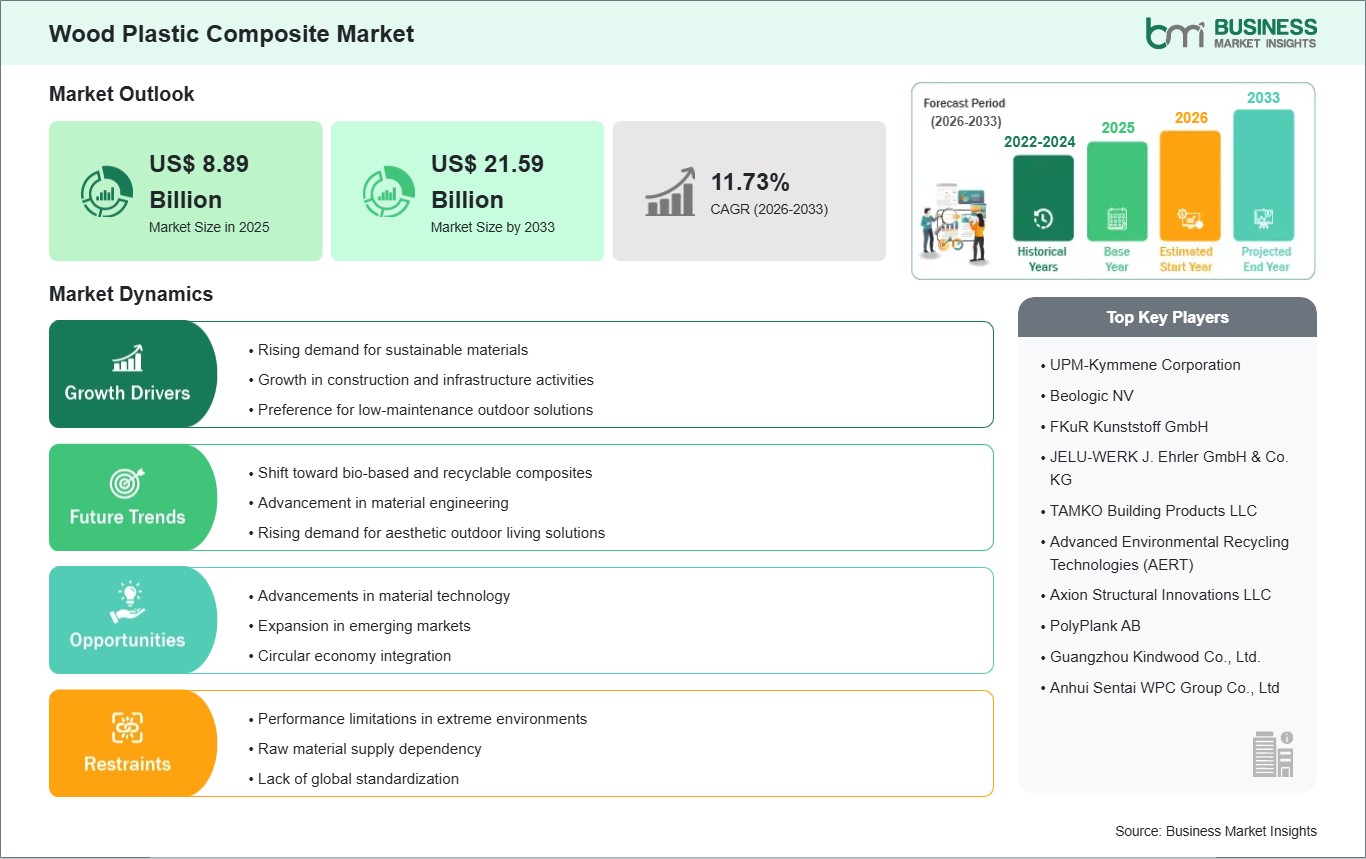
The Wood Plastic Composite Market size is expected to reach US$ 21.59 billion by 2033 from US$ 8.89 billion in 2025. The market is estimated to record a CAGR of 11.73% from 2026 to 2033.
The global market for Wood Plastic Composite (WPC) material is growing as an important segment in green building and innovative material technologies, largely influenced by the increasing trend towards green and sustainable building practices and materials. WPC materials are commonly employed in applications such as decking, fencing, and indoor and outdoor furniture, as well as in car parts and interiors due to their ability to withstand exposure to moisture, rot, and insects, as well as their ability to mimic the look and feel of wood. The market for WPC materials is mainly fueled by environmental concerns, increasing restrictions on plastic disposal, and the construction industry`s gradual move towards low-maintenance and long-life-cycle materials. On the other hand, there are certain constraints in the market, which affect its expansion. Some of the issues that affect this market are that, compared to traditional wood materials, there is a slightly higher upfront cost, which is a disadvantage in certain markets. Also, certain limitations in extreme weather conditions, such as thermal expansion in low-grade materials, might affect durability in certain markets.
Furthermore, there is a certain supply chain effect of using recycled materials, which might affect the quality of materials in certain markets. However, with advancements in technology, there is improvement in the quality of polymers, which enhances their use in various industries.

Key segments that contributed to the derivation of wood plastic composite market analysis are product and application.
The rising demand for sustainable materials is considered to be one of the most impactful trends in the global Wood Plastic Composite (WPC) market. Due to the rising awareness of environmental degradation, governments, industries, and consumers are actively looking to adopt sustainable materials to reduce environmental impact. Wood Plastic Composites, being made from recycled plastic materials, are being increasingly recognized as a viable solution to environmental problems, as they not only provide a solution to plastic waste but also help reduce the usage of wood materials, making them a sustainable material that is in line with environmental sustainability trends globally.
In addition to that, environmental regulations and corporate sustainability are also driving the market for WPC. Many construction and infrastructure projects are now incorporating materials with a lower carbon footprint and higher recycled content. This opens up a market for WPC in these sectors. Certification and green building codes are also helping to promote WPC. These codes are encouraging the use of recyclable materials, thereby increasing market penetration. Another factor that needs to be considered is the change in consumer behavior. In urban and high-income groups, consumers are becoming more environmentally conscious in their buying behavior. Homeowners and developers are looking for materials that are durable and sustainable. WPC fits the bill as an outdoor material. It can be used for decking and fencing. The changing regulatory environment and consumer behavior are increasing the market for sustainable composite materials.
In addition, advancements in material technology are having a profound effect on improving the performance profile of Wood Plastic Composites (WPC), thus enhancing their level of competitiveness with other conventional materials in construction. This is mainly attributed to the consistent improvement in polymer blending technology, which has enabled manufacturers to attain a better level of compatibility between wood and plastic materials, thus improving their internal bond and overall integrity. This has, in turn, helped to minimize certain performance-related issues, such as brittleness and density, thus enhancing the reliability of WPC materials in various applications.
However, advancements in extrusion technology have played a crucial role in enhancing the quality and production efficiency of WPC materials, thus improving their level of acceptability in various markets around the globe. This is mainly attributed to the ability of modern extrusion technology to offer precise control of temperatures and material flow, thus enhancing their quality and production efficiency. This technology is also crucial in improving production efficiency, thus enabling manufacturers to respond to the consistent increase in global demand while maintaining a consistent level of quality in their products, thus enhancing their acceptability in various markets, such as decking, cladding, and furniture.
Moreover, advances in surface coating have dramatically enhanced the durability of WPC materials in harsh weather conditions. This is because, with newer and better surface coatings, composite materials are now better protected from harsh climatic conditions, such as UV light, moisture, and extreme temperatures, thereby enhancing their lifespan and retention of visual appeal, thus making WPC a better choice for a variety of architectural and landscaping solutions in different climatic conditions around the globe.

The global wood plastic composite market is experiencing steady growth, with market size and share analysis reflecting evolving treatment preferences and competitive dynamics among key players. The report evaluates important subsegments categorized within product and application, highlighting their respective contributions to overall market performance.
By product, the polyethylene subsegment dominated the market in 2025 due to balance of cost efficiency, mechanical strength, and moisture resistance, which makes it highly suitable for outdoor and structural purposes like decking, fencing, and landscaping boards.
By application, the wood plastic building & construction subsegment dominated the market in 2025 due to strong demand for durable, low-maintenance, and sustainable materials in residential, commercial, and infrastructure projects
| Report Attribute | Details |
|---|---|
| Market size in 2025 | US$ 8.89 Billion |
| Market Size by 2033 | US$ 21.59 Billion |
| Global CAGR (2026 - 2033) | 11.73% |
| Historical Data | 2022-2024 |
| Forecast period | 2026-2033 |
| Segments Covered | By Product
|
|
Regions and Countries Covered
| |
| North America | US, Canada, Mexico |
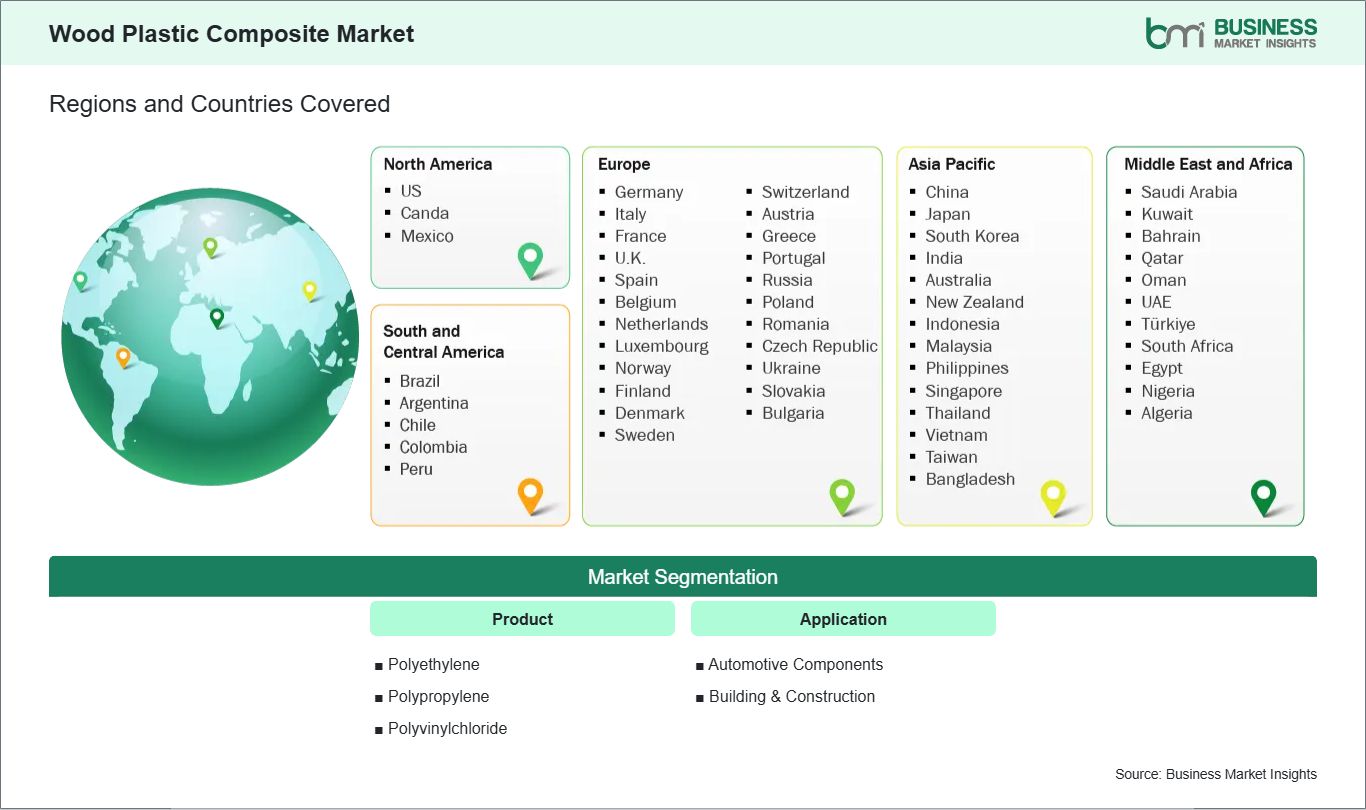
| Europe | Belgium, Austria, Finland, Denmark, Greece, Poland, Romania, Russia, Ukraine, Czech Republic, Slovakia, Bulgaria, Italy, Luxembourg, Germany, Switzerland, France, Netherlands, Norway, Portugal, Spain, Sweden, United Kingdom |
| Asia-Pacific | Australia, China, India, Japan, South Korea, Indonesia, Malaysia, Philippines, Singapore, Thailand, Vietnam, Bangladesh, New Zealand, Taiwan |
| South and Central America | Brazil, Argentina, Peru, Chile, Colombia |
| Middle East and Africa | Bahrain, Kuwait, Oman, Qatar, Saudi Arabia, United Arab Emirates, Turkiye, South Africa, Egypt, Algeria, Nigeria |
| Market leaders and key company profiles |
|
The "Wood Plastic Composite Market Size and Forecast (2022 - 2033)" report provides a detailed analysis of the market covering below areas:
The geographical scope of the wood plastic composite market report is divided into: North America, Asia Pacific, Europe, Middle East & Africa, and South & Central America. North America held the largest share in 2025.
North America is a leading player in the global market for wood plastic composite, and this is attributed to strong market demand from renovation markets, outdoor living trends, and established construction standards that prefer materials with high durability and low maintenance needs. This market is also driven by a strong culture of decking and fencing in North America, where consumers are increasingly preferring composite materials over traditional wood due to lower maintenance needs and longer lifecycles. High consumer awareness about sustainable and recycling practices is also a strong driver for wood plastic composite products in this market, especially in outdoor living and architectural applications.
Established manufacturing and distribution capabilities in this region also add to market maturity, where wood plastic composite is often incorporated into new constructions and renovation projects by builders and contractors in suburban living developments in North America. Government regulations towards deforestation and promoting recycled materials also add to market drivers in this region, though Europe is a close second with respect to sustainable building codes, North America is more commercially driven with respect to wood plastic composite adoption, especially due to lifestyle and design trends in outdoor living and acceptance of composite materials in design solutions for residential living spaces.

The wood plastic composite market is evaluated by gathering qualitative and quantitative data post primary and secondary research, which includes important corporate publications, association data, and databases. A few of the key developments in the wood plastic composite market are:
The Wood Plastic Composite Market is valued at US$ 8.89 Billion in 2025, it is projected to reach US$ 21.59 Billion by 2033.
As per our report Wood Plastic Composite Market, the market size is valued at US$ 8.89 Billion in 2025, projecting it to reach US$ 21.59 Billion by 2033. This translates to a CAGR of approximately 11.73% during the forecast period.
The Wood Plastic Composite Market report typically cover these key segments-
The historic period, base year, and forecast period can vary slightly depending on the specific market research report. However, for the Wood Plastic Composite Market report:
The Wood Plastic Composite Market is populated by several key players, each contributing to its growth and innovation. Some of the major players include:
The Wood Plastic Composite Market report is valuable for diverse stakeholders, including:
Essentially, anyone involved in or considering involvement in the Wood Plastic Composite Market value chain can benefit from the information contained in a comprehensive market report.
Please tell us your area of interest
(Market Segments/ Regions and Countries/ Companies)