
Wires and Cables Market Outlook: Size, Share, Trends, Growth Analysis, Competitive Landscape & Forecast, 2026-2033

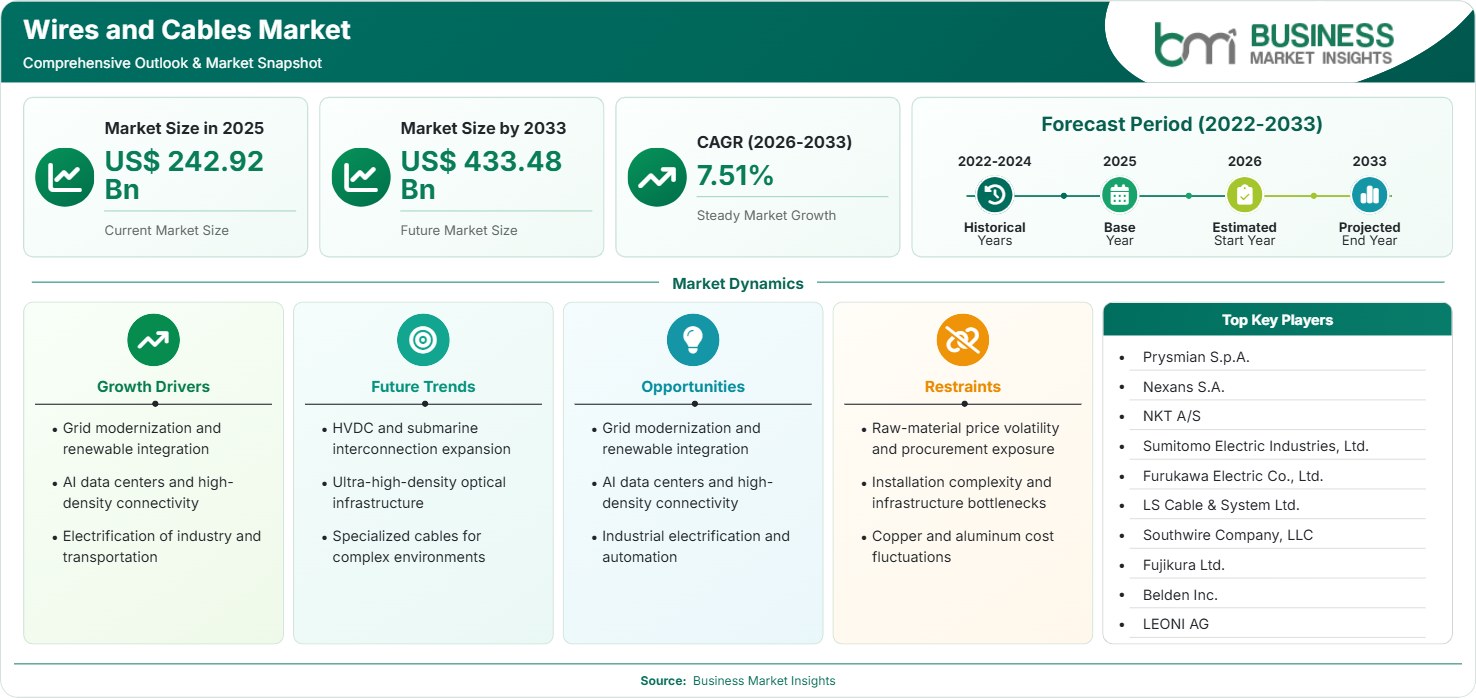
The Wires and Cables Market size was valued at US$ 242.92 Billion in 2025 and is projected to reach US$ 433.48 Billion by 2033, growing at a CAGR of 7.51% during 2026–2033, driven by grid modernization, renewable integration, data-center expansion, industrial electrification, telecommunications investment, and infrastructure replacement.

Report Coverage
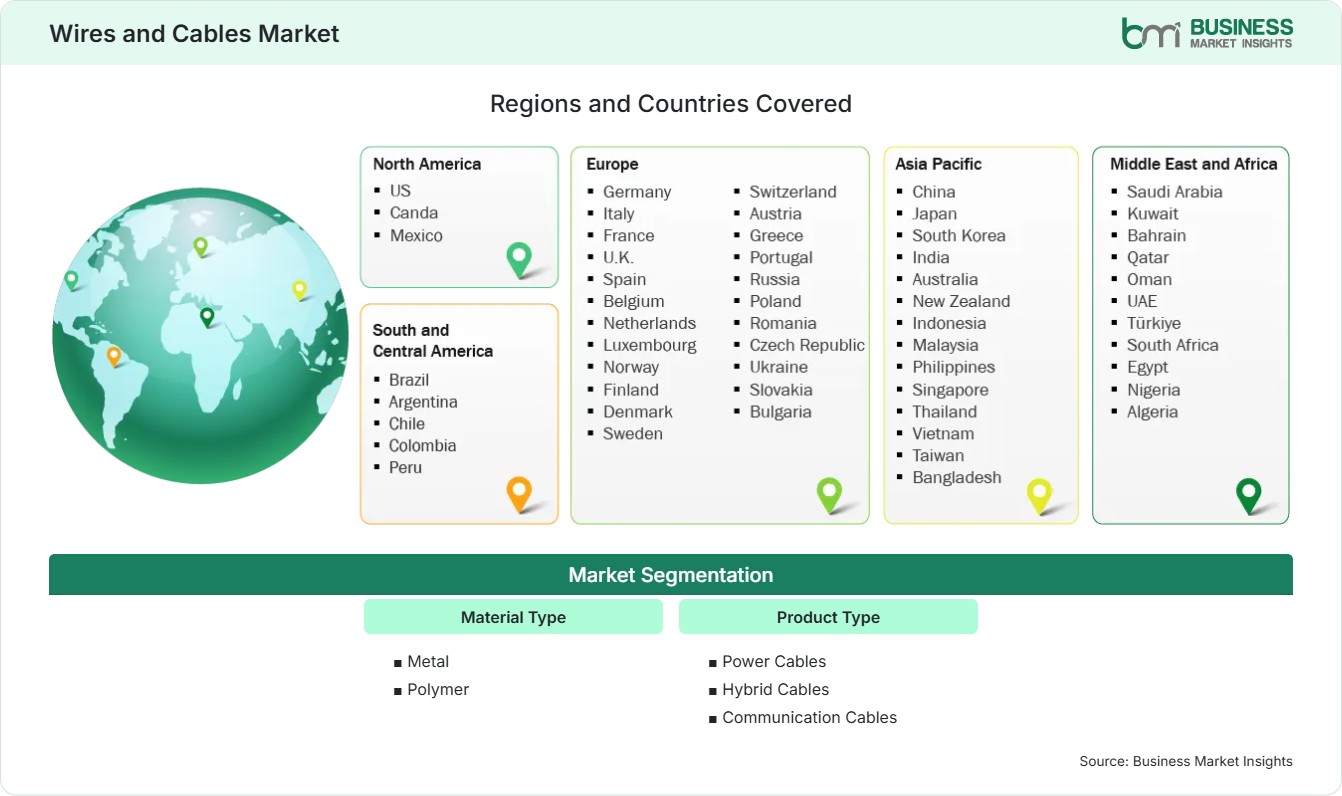
  • Material Type: Metal, Polymer
  • Product Type: Power Cables, Hybrid Cables, Communication Cables
US$ 242.92 Bn Market size in 2025
US$ 433.48 Bn Market Size by 2033
7.51% CAGR, 2026 - 2033
2026-2033 Forecast Period

AI Overview

Wires and Cables Market Summary

  • North America Region: North America holds a 24%–27% share in 2025 and is projected to grow at a 7.2%–7.8% CAGR during 2026–2033, supported by grid modernization, data-center construction, manufacturing investment, renewable integration, electrification, communications infrastructure, and replacement of aging networks. The US market is projected to grow at a 7.3%–7.9% CAGR, supported by data centers, utilities, manufacturing, renewable energy, and electrification.
  • Fastest Growing Region: Asia Pacific holds a 39%–42% share in 2025 and is projected to grow at an 8.0%–8.6% CAGR during 2026–2033, supported by industrialization, urbanization, renewable generation, telecommunications, electric mobility, manufacturing, transmission investment, and data-center development.
  • Leading Segment: Power Cables hold a 48%–52% share in 2025 and are projected to grow at a 7.5%–8.0% CAGR during 2026–2033, supported by electricity transmission, distribution modernization, renewable connections, industrial electrification, construction, and aging-grid replacement.
  • High Growth Segment: Extra-High Voltage holds an 8%–11% share in 2025 and is projected to grow at an 8.2%–8.8% CAGR during 2026–2033, supported by long-distance transmission, offshore wind, renewable evacuation, interconnectors, and rising electricity-transfer requirements.
  • Key Market Opportunity: HVDC transmission, submarine interconnectors, AI data centers, high-density optical systems, renewable evacuation, underground transmission, electric transportation, and specialized industrial infrastructure create attractive opportunities for technology-led suppliers.
  • Major Market Players: Prysmian S.p.A., Nexans S.A., NKT A/S, Sumitomo Electric Industries, Ltd., Furukawa Electric Co., Ltd., LS Cable & System Ltd., Southwire Company, LLC, Fujikura Ltd., Belden Inc., and LEONI AG.
Strategic Insights

Wires and Cables Market: Strategic Insights

Wires and Cables Market Strategic Framework
FREE PDF
Request your free sample
Request free sample
Stakeholder View

Key Takeaways

  • Cable competition is moving beyond manufacturing toward engineering, accessories, installation, testing, commissioning, maintenance, and lifecycle services, particularly for complex transmission projects.
  • HVDC, submarine interconnectors, renewable-energy evacuation, high-density optical connectivity, underground systems, and data-center infrastructure offer stronger differentiation than standardized commodity products.
  • Higher-voltage insulation, advanced XLPE, compact designs, ultra-high-count optical fiber, improved shielding, fire-resistant materials, and specialized industrial constructions are becoming important R&D priorities.
  • Asia Pacific provides a compelling investment environment because industrialization, urbanization, renewable generation, electric mobility, manufacturing, and digital infrastructure are developing simultaneously.
  • M&A and capacity expansion are helping major suppliers strengthen regional production, increase optical and low-voltage capabilities, and improve access to infrastructure customers.
Geographic Outlook

Wires and Cables Market Regional Highlights

North America Wires and Cables Market

North America represents a 24%–27% share in 2025 and is projected to grow at a 7.2%–7.8% CAGR during 2026–2033. Grid replacement, renewable integration, data centers, manufacturing investment, transportation electrification, and communications modernization support demand. The Wires and Cables Market share is reinforced by utility investment and infrastructure spending. The United States remains the largest regional demand center, while Canada contributes through transmission, renewable projects, mining electrification, construction, and telecommunications development.

  • Data-center construction is increasing requirements for medium-voltage distribution, dense optical networks, redundancy, compact routing, and scalable electrical infrastructure across hyperscale facilities.
  • Grid modernization supports replacement of aging conductors, distribution systems, transmission networks, underground routes, and resilience-focused electrical infrastructure.
  • Manufacturing investment is increasing demand for industrial power, automation, robotics, instrumentation, control, and communication cables.
  • Renewable-energy development requires additional transmission and distribution capacity, particularly where generation resources are distant from major electricity-consuming centers.

US Wires and Cables Market

The United States represents approximately 82%–86% of North American Wires and Cables Market demand and is projected to grow at a 7.3%–7.9% CAGR during 2026–2033. Data centers, utilities, renewable generation, manufacturing, construction, electric mobility, and communications are major demand sources. Increasing electricity requirements are creating additional transmission and distribution needs. Grid investment and manufacturing expansion are strengthening demand for low-, medium-, and high-voltage products alongside industrial and communications connectivity.

  • AI-oriented data centers are increasing requirements for high-capacity electrical distribution, dense optical networks, redundancy, and efficient cable routing.
  • Transmission investment creates opportunities for high-voltage systems as utilities address congestion and connect renewable generation with major demand centers.
  • Advanced manufacturing requires industrial cables for motors, robotics, automation, sensors, instrumentation, control systems, and factory communications.

Europe Wires and Cables Market

Europe represents a 20%–23% Wires and Cables Market share in 2025 and is projected to grow at a 7.1%–7.7% CAGR during 2026–2033. Germany, France, the United Kingdom, Italy, Spain, and Nordic countries provide important demand centers. Offshore wind, cross-border interconnection, electrification, energy security, and transmission reinforcement are strengthening specialized cable requirements. Germany and the United Kingdom remain major markets, while Nordic countries offer opportunities linked to renewable electricity, interconnectors, industrial electrification, and offshore energy.

  • Germany supports demand through grid reinforcement, renewable integration, industrial electrification, underground transmission, and manufacturing infrastructure.
  • The United Kingdom provides opportunities in offshore wind, HVDC connections, submarine cables, and transmission reinforcement.
  • France, Italy, and Spain support demand through renewable connections, industrial electrification, construction, interconnection, and infrastructure modernization.
  • Nordic markets benefit from offshore energy, renewable generation, cross-border electricity exchange, industrial electrification, and transmission development.

Asia Pacific Wires and Cables Market

Asia Pacific holds a 39%–42% Wires and Cables Market share in 2025 and is projected to grow at an 8.0%–8.6% CAGR during 2026–2033, making it the fastest-growing major region. China, Japan, India, South Korea, and Southeast Asia provide significant demand. Industrialization, urban development, renewable generation, telecommunications, electric mobility, manufacturing, transmission investment, and data-center construction are expanding requirements simultaneously. India and Southeast Asia offer attractive opportunities because infrastructure investment increasingly combines manufacturing localization, digitalization, renewable energy, and transportation electrification.

  • China supports demand through transmission expansion, renewable power, industrial production, telecommunications, electric mobility, and infrastructure projects.
  • India provides opportunities across renewable generation, transmission, urban construction, rail electrification, telecommunications, data centers, and manufacturing.
  • Japan combines infrastructure replacement with advanced manufacturing, offshore energy, automotive electrification, data centers, and specialized cable applications.
  • South Korea benefits from semiconductor production, shipbuilding, offshore energy, electric mobility, telecommunications, and industrial automation.

Rest of World Wires and Cables Market

Rest of World represents an 11%–14% Wires and Cables Market share in 2025 and is projected to grow at a 7.0%–8.0% CAGR during 2026–2033. South America is supported by renewable generation, mining, transmission investment, construction, and urbanization. Brazil remains an important demand center, while Chile provides opportunities associated with mining and renewable electricity. In the Middle East and Africa, Saudi Arabia, the UAE, and South Africa offer opportunities through infrastructure development, industrialization, renewable projects, construction, and digital connectivity.

South American markets require additional transmission and distribution capacity to connect renewable resources and industrial loads. Middle Eastern projects require power and communication systems for utilities, transportation, construction, renewable energy, industrial facilities, and digital infrastructure. Supplier localization, certification, installation expertise, and delivery reliability remain important competitive factors.

  • Brazil provides demand across transmission, renewable generation, construction, telecommunications, manufacturing, and infrastructure modernization.
  • Chile offers opportunities from mining electrification, solar generation, transmission expansion, and industrial projects.
  • Saudi Arabia is generating cable demand through infrastructure, renewable energy, industrial development, urban construction, transportation, and digital facilities.
  • The UAE combines commercial construction, data centers, utilities, renewable projects, transportation, and advanced infrastructure.
Global Market Geography
FREE PDF
Request your free sample
Request free sample
Segment Analysis

Wires and Cables Market Segmentation

Material Type

Metal represents a modelled 68%–72% share in 2025 and a 7.2%–7.7% CAGR during 2026–2033. Polymer materials remain essential for insulation, jacketing, flexibility, fire performance, and environmental resistance. Material selection increasingly balances conductivity, weight, thermal behavior, mechanical durability, safety, and lifecycle requirements. The Wires and Cables Market scope therefore includes both conductive and protective material technologies across infrastructure and equipment applications.

  • Metal: Copper and aluminum remain core conductors because of conductivity, established manufacturing infrastructure, mechanical performance, and suitability across electrical applications.
  • Polymer: PVC, XLPE, polyethylene, elastomers, and specialized polymers provide insulation, flexibility, fire performance, environmental resistance, and compact cable construction.

Product Type

Power Cables represent a modelled 48%–52% share in 2025 and a 7.5%–8.0% CAGR during 2026–2033. Hybrid and communication products benefit from digitalization, industrial automation, data centers, and integrated infrastructure. Product differentiation increasingly depends on capacity, bandwidth, voltage performance, density, reliability, installation efficiency, and environmental suitability. These product-level developments remain central to the Wires and Cables Market trends across infrastructure and industrial applications.

  • Power Cables: Power cables serve generation, transmission, distribution, buildings, industrial facilities, renewable projects, transportation networks, and electrification infrastructure.
  • Hybrid Cables: Hybrid cables combine power, data, signal, or control functions, reducing installation complexity across robotics, industrial equipment, transportation, and specialized infrastructure.
  • Communication Cables: Copper and fiber products support telecommunications, enterprise networks, data centers, industrial communications, high-bandwidth infrastructure, and digital connectivity.

Installation

Overhead installation represents a modelled 44%–48% Wires and Cables Market share in 2025 and a 6.9%–7.5% CAGR during 2026–2033. Underground and submarine systems are gaining importance where land constraints, environmental requirements, urban density, reliability objectives, offshore generation, and interconnection needs influence route selection. Lifecycle cost, permitting, maintenance, resilience, installation complexity, and environmental conditions determine preferred methods across transmission and distribution projects.

  • Overhead: Overhead cables remain widely deployed in transmission and distribution because they provide accessible installation, inspection, maintenance, and route expansion.
  • Underground: Underground cables serve dense urban areas and constrained corridors where land availability, visual impact, environmental considerations, and reliability requirements restrict overhead infrastructure.
  • Submarine: Submarine cables connect offshore wind farms, islands, countries, and remote generation assets, with demand increasing alongside interconnectors and offshore renewable projects.

Voltage

Medium Voltage represents a modelled 32%–36% share in 2025 and a 7.3%–7.9% CAGR during 2026–2033. High Voltage and Extra-High Voltage systems are gaining strategic importance as renewable generation and long-distance electricity transfer increase. Low Voltage remains essential across buildings, industrial facilities, appliances, and distributed systems. Voltage selection depends on transfer distance, load characteristics, safety, infrastructure design, and grid architecture.

  • Low Voltage: Low-voltage products serve buildings, appliances, commercial facilities, equipment, control systems, and distributed electrical applications.
  • Medium Voltage: Medium-voltage cables support utility distribution, renewable plants, industrial facilities, commercial infrastructure, transportation systems, and localized electricity delivery.
  • High Voltage: High-voltage cables support transmission, renewable integration, industrial networks, and infrastructure projects requiring efficient electricity transfer across longer distances.
  • Extra-High Voltage: Extra-high-voltage systems serve large transmission corridors, offshore wind connections, interconnectors, and renewable evacuation where transfer capacity is critical.

End-User

Power Transmission & Distribution represents a modelled 28%–32% Wires and Cables Market share in 2025 and a 7.7%–8.2% CAGR during 2026–2033. Construction, telecommunications, automotive, manufacturing, aerospace, oil and gas, and consumer electronics diversify demand. Electrification and digitalization increase cable intensity across facilities and equipment. Applications increasingly require products combining power delivery, data transmission, safety, durability, and environmental resistance.

  • Aerospace & Defense: Specialized lightweight, fire-resistant, EMI-resistant, and high-performance cables support avionics, defense electronics, communications, aircraft systems, and mission-critical equipment.
  • Construction: Buildings require power, fire-rated, control, security, communication, data, and low-voltage cabling across residential, commercial, industrial, and infrastructure projects.
  • IT & Telecommunication: Fiber and high-performance copper products support data centers, telecommunications, cloud infrastructure, enterprise connectivity, and high-bandwidth digital services.
  • Power Transmission & Distribution: Utilities use medium-, high-, and extra-high-voltage systems for generation connections, transmission, distribution, renewable integration, and grid modernization.
  • Oil & Gas: Specialized cables support offshore platforms, refineries, pipelines, instrumentation, control, communications, and power distribution in demanding environments.
  • Consumer Electronics: Compact wires and cables provide internal power, charging, signal, display, appliance, and connected-device connectivity.
  • Manufacturing: Industrial cables support motors, robotics, automation, control, instrumentation, sensors, machine tools, power distribution, and connected production systems.
  • Automotive: Automotive cables support power distribution, sensors, infotainment, battery systems, charging, electronic architectures, and electric drivetrains.
  • Others: Transportation, mining, marine, healthcare, renewable energy, railways, and specialized industrial facilities require reliable electrical and communication connectivity.
Market Forces

Wires and Cables Market Dynamics

Key Market Drivers

Grid Modernization and Renewable Integration

Grid modernization is strengthening demand because renewable generation, electrification, and distributed energy resources require additional transmission and distribution capacity. Utilities are upgrading their old equipment as they create more connections, underground paths, and high-voltage systems. Manufacturers are reacting to this challenge by offering insulation products that perform better thermally and can carry higher voltages. The Wires and Cables Market growth trajectory is increasingly dependent on the availability of remote renewable generation, thereby making high-capacity transmission and subsea links necessary. The Eastern Green Link 3 deal by NKT shows this trend, with 680 km of 525 kV HVDC cable with a capacity of up to 2 GW.

AI Data Centers and High-Density Connectivity

AI data centers are creating simultaneous demand for electrical distribution and optical communications. A large-scale data center needs to have an efficient power generation system along with redundancy, efficient routing, and efficient fiber connectivity. In March 2026, the company Furukawa Electric started mass production of a fiber cable with a count of 13,824 that would be used for a large-scale data center to support the AI infrastructure. It is made using ultra-high-density design technology and has double the transmission capability compared to other fibers. Its size remains under 40mm.

Electrification of Industry and Transportation

Electrification is expanding cable consumption across electric vehicles, charging infrastructure, factories, railways, buildings, renewable plants, industrial machinery, and automated production systems. Automotive architectures need cables for the battery, power electronics, sensors, charging, infotainment, and control. Factories need electricity, automation, robotics, instrumentation, and communications connectivity. Electrification in construction includes requirements for low- and medium-voltage systems in commercial and residential structures. Cable performance is now judged using metrics of thermal management, flexibility, mechanical robustness, electromagnetic interference, fire behavior, weight, and installation efficiency. The suppliers who can design their products to meet equipment needs will create value.

Key Market Opportunities

HVDC and Submarine Interconnection Expansion

Long-distance renewable transmission and cross-border electricity exchange provide major opportunities for HVDC and submarine cable suppliers. Offshore wind projects require connections between remote generation assets and mainland grids, while interconnectors improve electricity balancing and system resilience. The Wires and Cables Market Forecasts indicate that there is going to be more growth in the high voltage transmission segment, owing to the increased need for long-distance transmission from the renewable power sources. The Eastern Green Link 3 project awarded to NKT is above EUR 2.2 billion and involves about 680 km of 525 kV HVDC cables capable of carrying 2 GW of power.

Ultra-High-Density Optical Infrastructure

AI infrastructure is creating opportunities for manufacturers capable of delivering greater fiber counts within limited physical space. The requirements of hyperscale installations require high bandwidth, yet at the same time, avoiding congestion and minimizing installation complexities. Ultra-high-count cables help to achieve this through reduced pathway needs and simplified installation procedures. Furukawa Electric's 13,824-count cable shows how this can be done, while their special-purpose Mie Works facility helped to boost the production capacity of ultra-high-count optical cables. They noted that the production capacity of this range of products increased significantly, more than double as compared to fiscal year 2023.

Specialized Cables for Complex Environments

The applications, such as industrial automation, offshore energy, mining, defense, transportation, semiconductor manufacturing, and advanced manufacturing, need cables that have been manufactured for use under conditions involving heat, vibration, chemicals, water, fire, EMI, mechanical strain, and constrained spaces. There are possibilities of developing differentiated products with a higher engineering input than generic cables. The suppliers could enhance their margins by making designs specific to applications, carrying out tests, certifications, installations, and lifecycle management. As factories become more automated and infrastructure becomes more digitally connected, specialized requirements are moving deeper into equipment-level applications, creating opportunities for suppliers with strong research capabilities and technical relationships with equipment manufacturers and system integrators.

Market Restraints and Challenges

Raw-Material Price Volatility and Procurement Exposure

Factor: Copper and aluminum constitute considerable components of conductor costs, which make the companies concerned about the commodity prices, availability, inventory valuations, and timing of purchases.

Impact: Price volatility may lead to smaller margins, make it difficult to quote projects, increase capital requirements, and prompt clients to consider changing conductor specifications. Long-term infrastructure agreements increase the risks involved, since project completion is several years away from when the prices were first set. It is important for manufacturers to have efficient purchasing processes, inventory management, contract escalation, and diversified supply sources. Copper prices may also affect infrastructure security, since exposed conductors may have value in themselves.

Installation Complexity and Infrastructure Bottlenecks

Factor: There is a growing trend for large cable installation projects to involve long routes, complex permitting, dedicated ships, challenging topography, corridor limitations, marine surveying, weather windows, and stringent testing criteria.

Impact: Delays can lead to higher installation costs, delayed revenue recognition, contractual risks, and capacity constraints. Submarine cables have the same risk because special cable-laying ships and cable-burial machines need to be synchronized with environmental factors. High-voltage cables have many engineering processes before they can be deployed. This increasing difficulty makes a case for an integrated supply chain provider while also raising the capital needed and the level of risk. Customers will consider more than just cable specifications and price when choosing a supplier.

Company Analysis

Competitive Landscape

The Wires and Cables Market analysis indicates competition between diversified global manufacturers and specialized connectivity providers. Competitive advantage increasingly depends on high-voltage technology, optical density, manufacturing capacity, installation capability, raw-material management, geographic reach, certification, and infrastructure relationships.

Company Name

Overview

Products and Services relevant to this market

Prysmian S.p.A.

Global manufacturer serving energy, transmission, distribution, digital infrastructure, and industrial markets.

Power cables, HVDC, submarine systems, optical fiber, telecom cables, industrial cables, installation, and infrastructure services.

Nexans S.A.

French cable manufacturer focused on electrification, transmission, distribution, offshore systems, and advanced cable technologies.

High-voltage, submarine, land, distribution, telecom, installation, accessories, and grid solutions.

NKT A/S

Danish specialist focused on high-voltage power cable systems and offshore transmission infrastructure.

HVAC, HVDC, submarine cables, accessories, installation, service, and transmission systems.

Sumitomo Electric Industries, Ltd.

Japanese technology group serving power transmission, communications, automotive, and advanced cable applications.

HVDC cables, power cables, optical fiber, communications, automotive wiring, and engineering services.

Furukawa Electric Co., Ltd.

Japanese technology company active in energy infrastructure, communications, automotive, and advanced connectivity.

Power cables, optical fiber, high-density fiber systems, communication cables, automotive wiring, and materials.

LS Cable & System Ltd.

South Korean manufacturer serving power, telecommunications, offshore, industrial, and infrastructure markets.

Power cables, submarine systems, HVDC, optical fiber, industrial cables, and energy infrastructure solutions.

Southwire Company, LLC

U.S. manufacturer serving utilities, construction, electrical infrastructure, and industrial applications.

Building wire, utility cables, transmission products, industrial cables, and electrical infrastructure solutions.

Fujikura Ltd.

Japanese manufacturer serving energy, telecommunications, electronics, automotive, and advanced connectivity applications.

Optical fiber, communication cables, energy cables, wiring products, connectors, and specialized connectivity.

Belden Inc.

U.S. connectivity provider focused on industrial automation, networking, enterprise infrastructure, and cabling.

Ethernet, fiber, industrial cables, networking products, connectivity systems, and infrastructure solutions.

LEONI AG

German supplier serving automotive and industrial markets through wiring and cable technologies.

Automotive wiring, cable systems, harnesses, industrial cables, connectivity products, and specialized wire solutions.

Trust & Transparency

Research Methodology

The market analysis combines proprietary research with secondary data from government agencies, company disclosures, regulatory filings, industry databases and expert interviews. Market estimates are validated through data triangulation, cross-market benchmarking and analyst review.

View Full Research Methodology

Questions Answered

Frequently Asked Questions

What does the Wires and Cables Market Report include?

The report covers market size, regional dynamics, material type, product type, installation, voltage, end-user applications, competitive positioning, drivers, opportunities, restraints, trends, recent developments, and strategic growth factors through 2033.

Which installation methods offer strong future opportunities?

Underground and submarine systems provide attractive opportunities where urban density, land constraints, environmental requirements, offshore generation, interconnection needs, and reliability considerations make conventional overhead infrastructure less suitable.

How are AI data centers changing cable requirements?

AI data centers require substantial electrical capacity and extremely high-density data connectivity. This is increasing demand for high-capacity power distribution, ultra-high-count optical fiber, compact architectures, redundancy, and scalable connectivity.

Why are HVDC cables gaining strategic importance?

HVDC systems enable efficient long-distance electricity transmission and are particularly relevant to offshore wind, renewable-energy evacuation, cross-border interconnectors, and generation located far from major consumption centers.

What factors are driving demand across the industry?

Grid modernization, renewable-energy integration, data-center construction, telecommunications expansion, industrial automation, transportation electrification, manufacturing investment, and infrastructure replacement are increasing requirements for power, communication, control, and specialized cable systems.

Access the Full Wires and Cables Market Report

Get segment-level forecasts, regional estimates, competitive benchmarking, company profiles and downloadable Excel datasets.

Access the full Wires and Cables Market Report
350 pages PDF & Excel | 2026-09-02