
Viral Vaccines Market Outlook: Size, Share, Trends, Growth Analysis, Competitive Landscape & Forecast, 2026-2033

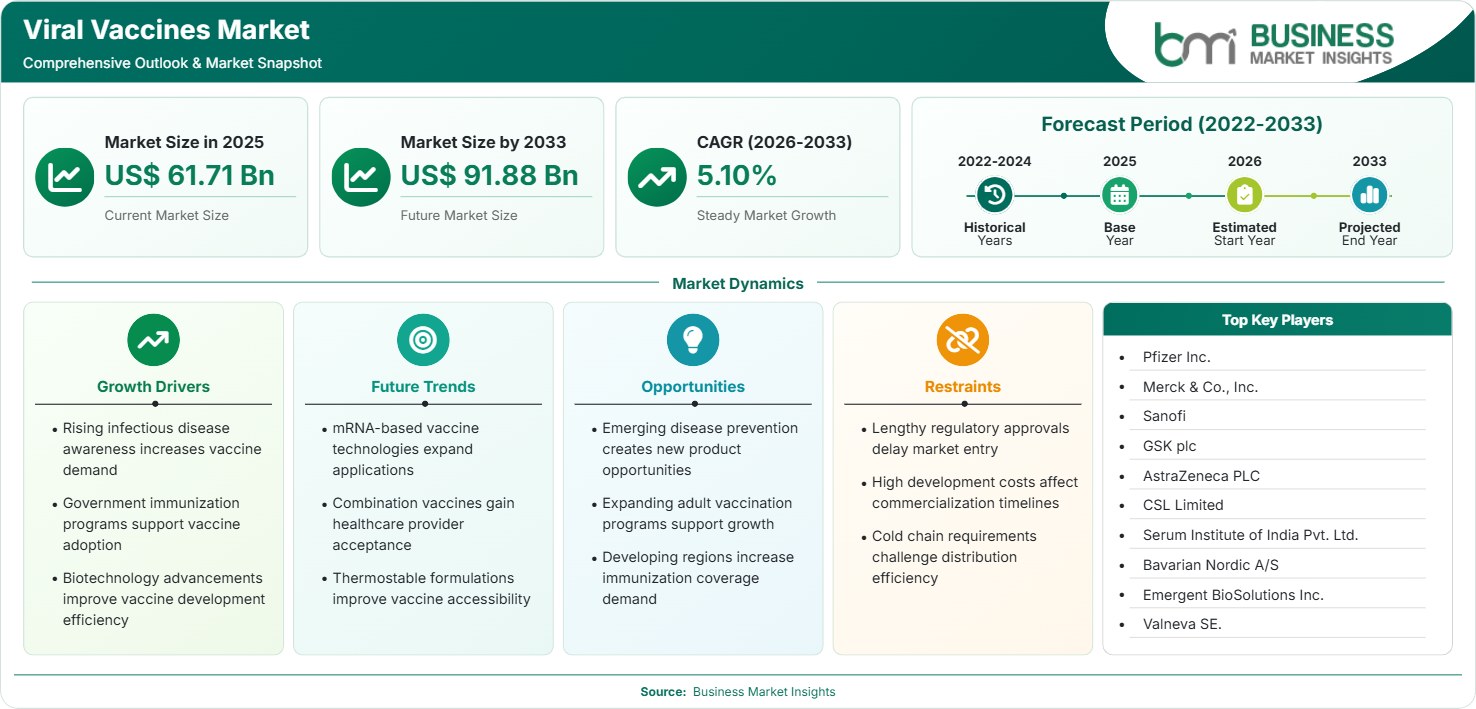
The Viral Vaccines Market size was valued at US$ 61.71 Billion in 2025 and is projected to reach US$ 91.88 Billion by 2033, growing at a CAGR of 5.1% during 2026–2033. Key drivers include immunization expansion, rising viral disease burden, adult vaccination uptake, and innovation in mRNA platforms, while opportunities stem from combination vaccines, emerging-market access, and strategic biomanufacturing investments.

Report Coverage
  • Form: Liquid, Lyophilized
  • Container Format: Vials, Prefilled Syringes
  • Biosafety Level Type: Biosafety Level 1, Biosafety Level 2, Biosafety Level 3, Biosafety Level 4
US$ 61.71 Bn Market size in 2025
US$ 91.88 Bn Market Size by 2033
5.10% CAGR, 2026 - 2033
2026-2033 Forecast Period

AI Overview

Viral Vaccines Market Summary

  • North America Region: North America holds a market share of 36%–39% in 2025, growing at a CAGR of 4.6%–5.0% during 2026–2033. Strong immunization programs, premium vaccine pricing, advanced manufacturing, and adult vaccination adoption support demand. Opportunities arise from next-generation respiratory vaccines and domestic production resilience. US market benefits from robust reimbursement frameworks, strong R&D pipelines, and a CAGR of 4.7%–5.1%.
  • Fastest Growing Region: Asia Pacific holds a market share of 24%–27% in 2025, growing at a CAGR of 6.2%–6.8% during 2026–2033. Expanding healthcare coverage, public procurement initiatives, rising birth cohorts, and local manufacturing investments accelerate adoption across multiple national immunization programs.
  • Leading Segment: Liquid holds a market share of 58%–62% in 2025, growing at a CAGR of 4.8%–5.2% during 2026–2033. Ease of administration, reduced reconstitution requirements, strong distribution networks, and established clinical acceptance sustain leadership across routine vaccination programs globally.
  • High Growth Segment: Prefilled Syringes holds a market share of 29%–33% in 2025, growing at a CAGR of 6.1%–6.7% during 2026–2033. Demand increases through dosage accuracy, safety improvements, healthcare workflow efficiency, and expanded use in adult immunization campaigns.
  • Key Market Opportunity: Expansion of thermostable formulations, regional manufacturing hubs, and combination immunization products creates opportunities to improve access, reduce logistics costs, strengthen supply security, and expand vaccination penetration globally.
  • Major Market Players: Pfizer Inc., Merck & Co., Inc., Sanofi, GSK plc, AstraZeneca PLC, CSL Limited, Serum Institute of India Pvt. Ltd., Bavarian Nordic A/S, Emergent BioSolutions Inc., Valneva SE.
Strategic Insights

Viral Vaccines Market: Strategic Insights

Viral Vaccines Market Strategic Framework
FREE PDF
Request your free sample
Request free sample
Stakeholder View

Key Takeaways

  • The value chain is becoming increasingly integrated, with manufacturers investing in upstream production, fill-finish capabilities, cold-chain logistics, and contract development partnerships to improve supply continuity.
  • Prefilled syringe adoption and biosafety-focused manufacturing environments present attractive growth opportunities because healthcare providers increasingly prioritize efficiency, safety, and vaccination accuracy.
  • Innovation is shifting toward platform technologies, thermostable formulations, and combination vaccines that reduce administration complexity while improving healthcare system productivity.
  • India, China, Indonesia, and selected Middle Eastern countries offer compelling investment cases due to expanding immunization budgets, healthcare modernization, and local production initiatives.
  • Strategic partnerships, licensing agreements, and regional manufacturing collaborations continue reshaping competitive dynamics as companies seek supply diversification and market access expansion.
  • Investments in outbreak preparedness and national vaccine security programs are creating sustained demand beyond conventional pediatric immunization schedules.
Geographic Outlook

Viral Vaccines Market Regional Highlights

North America Viral Vaccines Market

North America accounted for approximately 36%–39% of global revenue in 2025 and is projected to expand at a CAGR of 4.6%–5.0% through 2033. The region benefits from sophisticated healthcare infrastructure, broad reimbursement coverage, and strong investment in vaccine innovation. Viral Vaccines Market share remains highest in North America because of established immunization schedules, premium product adoption, and advanced manufacturing capabilities. Government preparedness programs, adult booster demand, and continuous product upgrades support long-term industry expansion.

  • Leading manufacturers maintain domestic production investments, strengthening supply-security objectives and reducing vulnerability to international disruptions while supporting innovation-focused commercialization strategies.
  • Seasonal respiratory vaccination programs continue generating recurring demand, supporting stable procurement patterns across public and private healthcare channels.
  • Research funding from federal agencies accelerates next-generation vaccine platforms, including mRNA and recombinant technologies designed for rapid response capabilities.
  • Higher healthcare expenditure supports adoption of premium formulations and specialized delivery systems that improve patient convenience and compliance.

US Viral Vaccines Market

The United States represents approximately 78%–82% of regional revenue and is expected to record a CAGR of 4.7%–5.1% during the forecast period. Strong regulatory oversight, biopharmaceutical innovation, and extensive public immunization frameworks support market depth. Demand is being reinforced by adult immunization campaigns, respiratory disease prevention strategies, and increased healthcare awareness. Robust clinical research activity and procurement capabilities position the country as a leading innovation center.

  • Strong CDC-supported vaccination recommendations continue strengthening uptake across pediatric, adult, and high-risk populations while supporting long-term procurement visibility.
  • Domestic manufacturing investments enhance resilience and provide strategic advantages for emergency preparedness and outbreak response capabilities.
  • Expanding pharmacy-based vaccination services increases accessibility and convenience, supporting higher coverage rates throughout urban and rural communities.

Europe Viral Vaccines Market

Europe accounted for approximately 27-30 percent of global revenues in 2025 and is estimated to achieve a CAGR of 4.8-5.3 percent through 2033. The presence of well-developed government healthcare establishments, along with the success of vaccination drives, increases demand in major economies. Germany is leading the regional revenue generation; however, Eastern Europe is growing faster in terms of market development. Regulatory alignment, procurement stability, and pandemic preparedness planning continue to support investments in production and supply-chain modernization.

  • Germany remains the leading market due to advanced healthcare expenditure and strong vaccine procurement programs supporting broad population coverage.
  • Poland and selected Central European countries exhibit faster growth, supported by healthcare modernization and increasing preventive-care spending.
  • Research collaborations between biotechnology firms and academic institutions continue driving innovation and commercialization opportunities regionwide.
  • European manufacturing expansion supports regional supply security and reduces dependence on external sourcing networks.

Asia Pacific Viral Vaccines Market

The Asia-Pacific region accounted for 24%–27% of global revenues in 2025 and is projected to grow at a CAGR of 6.2%–6.8% through 2033. There is high demand due to the rapid development of healthcare infrastructure, large birth cohorts, and high government spending on immunization programs. The largest market in the region is China, while India has some of the fastest growth rates. Public-private partnerships and local manufacturing investments strengthen accessibility across both established and emerging healthcare systems.

  • China benefits from extensive manufacturing capacity, strong immunization coverage initiatives, and increasing investment in advanced vaccine technologies.
  • India records accelerated expansion due to large-scale vaccination programs, export capabilities, and growing healthcare accessibility across regions.
  • Southeast Asian countries are increasing procurement budgets to improve preventive healthcare outcomes and outbreak preparedness capacity.
  • International partnerships facilitate technology transfer and strengthen domestic capabilities for commercial vaccine production.

Rest of World Viral Vaccines Market

The Rest of World region accounts for approximately 8%–11% of global revenue in 2025 and is expected to expand at a CAGR of 5.5%–6.1% during the forecast period. South and Central America benefit from expanding immunization access and procurement programs. In the Middle East and Africa, healthcare investments and vaccine-manufacturing initiatives are creating new growth avenues. Viral Vaccines Market share continues rising gradually as international partnerships improve healthcare accessibility and supply availability.

  • Brazil remains the leading South American market due to extensive public health programs and domestic production capabilities.
  • Argentina and Colombia demonstrate healthy expansion supported by preventive healthcare investment and modernized vaccination procurement approaches.
  • Saudi Arabia and the United Arab Emirates are expanding healthcare infrastructure and strategic biologics manufacturing capabilities.
  • African governments increasingly collaborate with global organizations to improve local production capacity and strengthen immunization access.
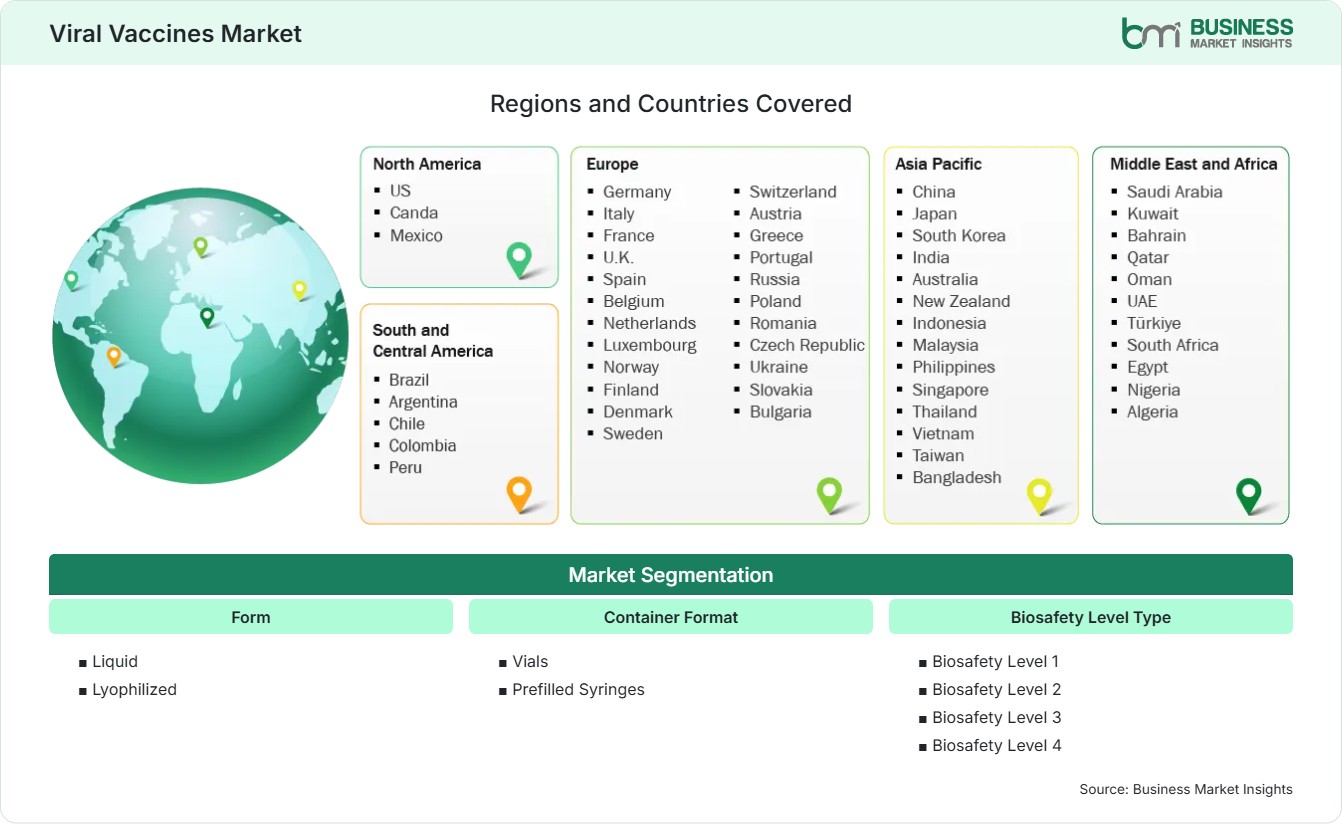
Global Market Geography
FREE PDF
Request your free sample
Request free sample
Segment Analysis

Viral Vaccines Market Segmentation

Form

Form is an important element of differentiation in storage, transport, and administration procedures. In 2025, the portion of this segment accounted for roughly 58%-62% of the market share for liquid formulations and is projected to register a CAGR of 4.8%-5.2%, while lyophilized formulations are gaining significance in challenging transport conditions. The scope of the Viral Vaccines Market is steadily increasing for manufacturers.

  • Liquid: Widely used across routine immunization programs due to simplified administration procedures, reduced preparation requirements, and compatibility with large-scale vaccination campaigns in developed healthcare systems.
  • Lyophilized: Preferred where storage stability and transportation flexibility are critical, supporting deployment in geographically dispersed populations and regions with infrastructure constraints.

Container Format

The type of container is an essential factor influencing the effectiveness of the entire healthcare process. Currently, vials remain the dominant container type, with market share ranging from 67% to 71%. Meanwhile, prefilled syringes have been experiencing the highest growth, with a CAGR of 6.1% to 6.7%. Adoption decisions increasingly reflect labor optimization, wastage reduction, and patient safety priorities.

  • Vials: Remain essential for high-volume immunization settings because they support cost-efficient procurement and large-scale distribution across public vaccination programs.
  • Prefilled Syringes: Experience increasing demand owing to dosage precision, reduced contamination risk, and improved operational efficiency in hospitals, clinics, and pharmacies.

Biosafety Level Type

The biosafety level determines the complexity of manufacturing processes, facilities, staff training, and regulatory control. The current biosafety level 2 market is leading commercial production with about 44% to 48% of market share and a CAGR of 5.0% to 5.4%. The Viral Vaccines Market trends show investments in modern containment equipment.

  • Biosafety Level 1: Supports low-risk laboratory activities, educational research, and preliminary biological investigations requiring basic containment standards.
  • Biosafety Level 2: Commonly utilized for vaccine development and production processes involving moderate-risk viral agents under structured safety protocols.
  • Biosafety Level 3: Increasingly important for specialized research involving airborne pathogens and advanced infectious disease investigations requiring enhanced containment measures.
  • Biosafety Level 4: Serves highly specialized applications focused on dangerous viral pathogens, demanding maximum containment infrastructure and stringent operational controls.
Market Forces

Viral Vaccines Market Dynamics

Key Market Drivers

Expansion of National Immunization Programs

The WHO-backed immunization programs continue to expand the reach of vaccines in both developing and developed nations. This is due to governments’ increased commitment to healthcare expenditure on preventive measures, since vaccinations are among the most cost-efficient methods of public health care. The Viral Vaccines Market growth is driven by increasing targets for adult and pediatric coverage, improved purchasing processes, and the buildup of vaccine stocks. Countries are revising their immunization schedules and adding new vaccines for respiratory and travel purposes. Disease prevention is becoming an increasingly common trend along with country preparedness efforts, leading to stable demand creation.

Advancements in Vaccine Platform Technologies

The use of mRNA, recombinant vectors, and cell culture technologies has revolutionized vaccine development in terms of efficiency. There will be faster candidate development, flexible production, and better response to any new outbreak. The Viral Vaccines Market analysis shows that platform-based innovations reduce development complexity and create differentiation in product pipelines. Automated digital production and quality monitoring ensure consistent production in the commercial environment. Investments in biotechnology infrastructure stimulate innovation across different treatment areas. With growing experience of regulatory agencies in assessing advanced vaccine technologies, the way to commercialization becomes predictable.

Growing Burden of Viral Infectious Diseases

The circulation of influenza, respiratory syncytial virus, hepatitis, and new viruses emphasizes the need for preventive medicine. Population growth, urbanization, increased travel, and demographic shifts lead to higher exposure risks in several locations. Factors that affect the Viral Vaccines Market trends include the need for routine vaccinations, boosters, and outbreak-specific vaccines. Prevention is becoming more important for healthcare institutions to reduce the costs of treating patients with infectious diseases and the resulting loss of productivity. Demand also exists due to an aging population and their need for vaccination. These factors collectively strengthen procurement requirements and encourage continued expansion of manufacturing investments worldwide.

Key Market Opportunities

Development of Combination Vaccine Products

This represents a significant opportunity, as health care providers seek streamlined immunization schedules and improved patient compliance. It is possible to provide greater convenience and minimize the burden of administering vaccines by protecting patients against multiple diseases with fewer injections. Multivalent vaccines for respiratory diseases and children are gaining prominence in Viral Vaccines Market Forecasts due to their commercial value. There is ease in logistics within healthcare facilities and improved vaccine coverage. The opportunity exists for mature and developing countries where efficiency is key. Companies that prove to be safe and cost-effective will have a competitive advantage.

Expansion of Regional Manufacturing Hubs

Initiatives for local production have become very popular in Asia, the Middle East, Africa, and Latin America. There is growing interest in securing greater healthcare sovereignty and independence from external actors. Local manufacturing offers improved supply security, facilitates technology transfer, and enhances preparedness during public health crises. Moreover, the scope for contract development, fill-finish activities, and specialized packaging is part of the existing business opportunity. Focusing on resilient supply chains, procurement organizations offer good incentives and long-term purchasing arrangements to companies, creating strategic local partnerships.

Thermostable and Next-Generation Formulations

There is ongoing research aimed at producing vaccines that are less dependent on the cold chain and offer greater product usability. These innovations bring about several benefits, especially in remote areas where the cold chain is hard to maintain. Stability will reduce waste, make transportation easier, and enhance access among underprivileged communities. This innovation aligns with the global health goal of ensuring vaccines are available to everyone. Vaccine manufacturers that innovate to increase the shelf life and logistical efficiency of their vaccines may gain an advantage. These innovations also support cost optimization across public health distribution networks.

Market Restraints and Challenges

Complex Regulatory and Manufacturing Requirements

Factor: Vaccine development requires extensive clinical validation, regulatory documentation, facility qualification, and ongoing pharmacovigilance obligations. Impact: These requirements increase development timelines, capital expenditures, and operational complexity. Manufacturers must maintain rigorous quality controls throughout production and distribution processes. Regulatory variations across jurisdictions can create additional market-entry challenges and increase compliance costs. Smaller organizations frequently face barriers related to facility investment and technical expertise. While strict oversight protects public health, the resulting financial and operational commitments may limit participation, delay commercialization timelines, and constrain the speed at which innovative products reach broader markets.

Cold-Chain Dependence and Supply Constraints

Factor: Many viral vaccines require tightly controlled storage and transportation conditions throughout their lifecycle. Impact: Distribution costs increase substantially, particularly in remote or infrastructure-constrained regions. Supply disruptions can affect product availability, procurement planning, and public immunization outcomes. Cold-chain limitations also contribute to product wastage and logistical inefficiencies. Manufacturers, distributors, and healthcare providers must invest continuously in monitoring systems, specialized equipment, and workforce training. These challenges can reduce accessibility in underserved populations and create commercialization limitations despite strong demand fundamentals and favorable public health priorities.

Company Analysis

Competitive Landscape

The competitive environment remains characterized by innovation, manufacturing scale, regional partnerships, and portfolio diversification. Viral Vaccines Market analysis highlights continued investments in advanced platforms, supply resilience, and lifecycle management.

Company Name

Overview

Products and Services relevant to this market

Pfizer Inc.

Global biopharmaceutical leader with extensive vaccine R&D and large-scale manufacturing capabilities.

COVID-19 vaccines, respiratory vaccine programs, development platforms, global distribution infrastructure.

Merck & Co., Inc.

Major vaccine producer with strong commercial presence and diversified immunization portfolio.

HPV vaccines, viral disease prevention products, research and manufacturing services.

Sanofi

Multinational healthcare company with broad vaccine operations through dedicated vaccine business.

Influenza, pediatric, travel and specialty viral vaccine offerings.

GSK plc

Leading vaccine developer with strong global immunization footprint and innovation programs.

Shingles, influenza and advanced vaccine technology platforms.

AstraZeneca PLC

Biopharmaceutical company focused on innovation, partnerships, and infectious disease prevention.

Viral vaccine development, biologics research, global commercialization capabilities.

CSL Limited

Global biotechnology group with strong vaccine manufacturing and specialty capabilities.

Influenza vaccines, plasma technologies, global production networks.

Serum Institute of India Pvt. Ltd.

One of the largest vaccine manufacturers by volume worldwide.

Pediatric vaccines, viral vaccines, contract manufacturing and global supply.

Bavarian Nordic A/S

Specialized biotechnology company focused on infectious disease prevention solutions.

Smallpox, mpox and travel-related vaccine products.

Emergent BioSolutions Inc.

Provider of public health preparedness products and manufacturing services.

Vaccine development support, manufacturing services and biodefense solutions.

Valneva SE

Specialty vaccine company focused on unmet infectious disease needs.

Travel vaccines, Lyme disease vaccine development and viral immunization programs.

Trust & Transparency

Research Methodology

The market analysis combines proprietary research with secondary data from government agencies, company disclosures, regulatory filings, industry databases and expert interviews. Market estimates are validated through data triangulation, cross-market benchmarking and analyst review.

View Full Research Methodology

Questions Answered

Frequently Asked Questions

Why are biosafety levels important in vaccine production?

Biosafety classifications determine facility requirements, containment standards, workforce protocols, and regulatory compliance obligations that influence manufacturing capabilities and operating costs.

What insights does a Viral Vaccines Market Report provide?

It evaluates market size, competitive positioning, regional demand patterns, segment performance, regulatory developments, investment trends, and future business opportunities.

How are emerging economies influencing industry expansion?

Countries across Asia, the Middle East, Africa, and Latin America are investing in manufacturing capacity, healthcare infrastructure, and immunization access, creating new commercial opportunities.

What role do prefilled syringes play in vaccine delivery?

Prefilled syringes improve dosage accuracy, reduce contamination risks, simplify administration, and enhance efficiency for healthcare providers operating large immunization programs.

What factors are driving long-term demand for viral vaccines?

Demand is supported by expanding immunization programs, aging populations, increasing awareness of preventive healthcare, outbreak preparedness initiatives, and continuous innovation in vaccine technologies.

Access the Full Viral Vaccines Market Report

Get segment-level forecasts, regional estimates, competitive benchmarking, company profiles and downloadable Excel datasets.

Access the full Viral Vaccines Market Report
350 pages PDF & Excel | 2026-08-28