
Vegetable Puree Market Outlook: Size, Share, Trends, Growth Analysis, Competitive Landscape & Forecast, 2026-2033

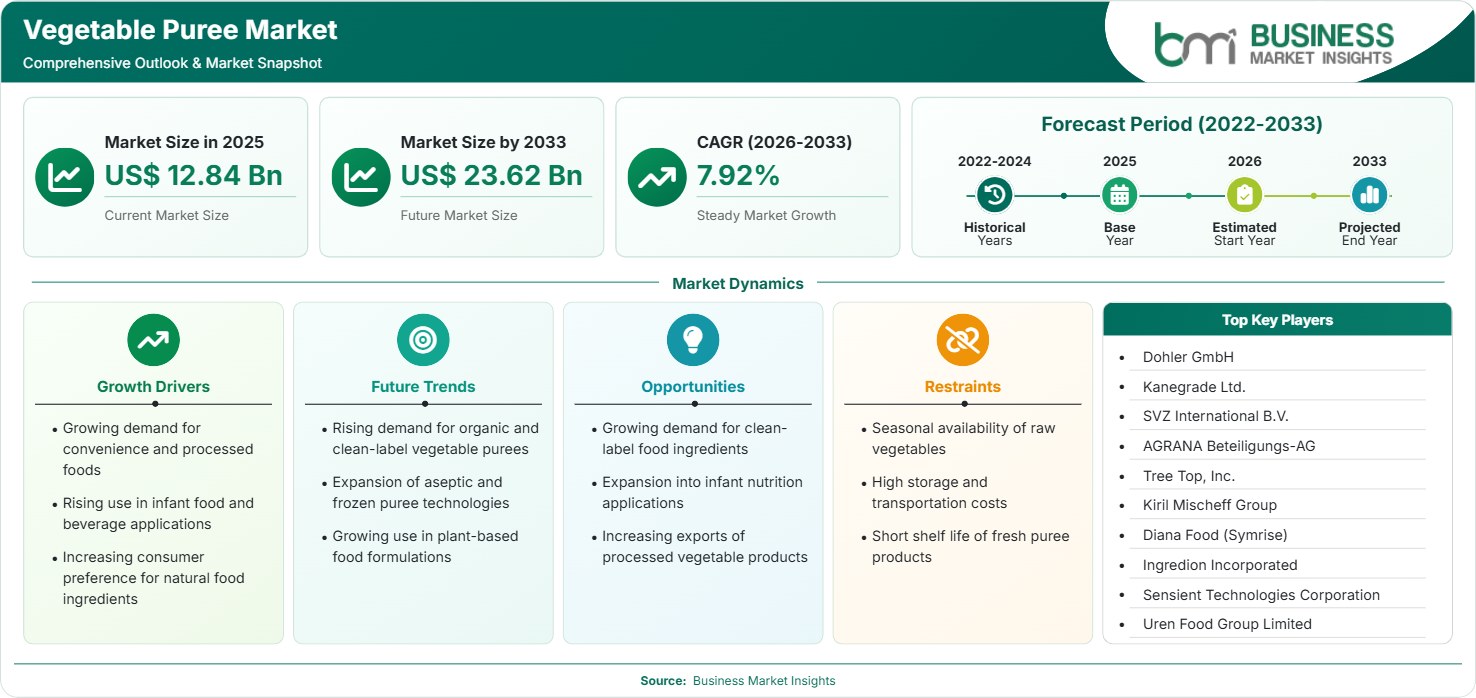
The Vegetable Puree Market size was valued at US$ 12.84 Billion in 2025 and is projected to reach US$ 23.62 Billion by 2033, growing at a CAGR of 7.92% from 2026 to 2033. Increasing demand for convenient food solutions, rising infant nutrition applications, growing clean-label preferences, and expanding processed vegetable exports are creating new opportunities across food manufacturing and ingredient supply chains.

Report Coverage
  • Type: Carrot, Spinach, Tomato, Pumpkin, Others
  • Application: Ready-to-eat/Cook Products, Infant Nutrition, Beverages, Others
  • Nature: Organic and Conventional
US$ 12.84 Bn Market size in 2025
US$ 23.62 Bn Market Size by 2033
7.92% CAGR, 2026 - 2033
2026-2033 Forecast Period

01 AI Overview

Vegetable Puree Market Summary

  • North America Region: North America holds approximately 31%–34% market share in 2025 and is projected to grow at a 7.1%–7.6% CAGR during 2026–2033. Growth is supported by strong demand for convenient meal solutions, expanding baby food consumption, rising organic ingredient adoption, and established food processing infrastructure. The U.S. remains the leading regional contributor due to high demand from food manufacturers, beverage producers, and infant nutrition companies, with an estimated 7.2%–7.7% CAGR through 2033.
  • Fastest Growing Region: Asia Pacific accounts for approximately 28%–31% market share in 2025 and is expected to expand at a 8.5%–9.1% CAGR during 2026–2033. Increasing urbanization, rising disposable income, expanding processed food industries, growing infant food demand, and improving cold chain infrastructure are accelerating regional adoption.
  • Leading Segment: Tomato puree represents approximately 27%–30% market share in 2025 and is projected to grow at a 7.5%–8.0% CAGR during 2026–2033. Wide usage in sauces, ready-to-eat meals, soups, and beverages, combined with strong industrial processing demand, supports segment leadership.
  • High Growth Segment: Infant Nutrition application represents approximately 24%–27% market share in 2025 and is forecast to expand at a 8.2%–8.8% CAGR during 2026–2033. Increasing parental focus on nutritious foods, premium baby products, and natural ingredients continues supporting growth.
  • Key Market Opportunity: Growing preference for clean-label vegetable ingredients, expansion of organic puree offerings, rising exports of processed vegetables, and increasing demand from baby food and beverage manufacturers are creating attractive opportunities for suppliers.
  • Major Market Players: Döhler GmbH, Kanegrade Ltd., SVZ International B.V., AGRANA Beteiligungs-AG, Tree Top, Inc., Kiril Mischeff Group, Diana Food (Symrise), Ingredion Incorporated, Sensient Technologies Corporation, and Uren Food Group Limited.
02 Strategic Insights

Vegetable Puree Market: Strategic Insights

Vegetable Puree Market Strategic Framework
FREE PDF
Request your free sample
Request free sample
03 Stakeholder View

Key Takeaways

  • The market ecosystem is becoming increasingly integrated, with vegetable growers, puree processors, ingredient suppliers, food manufacturers, and distribution networks collaborating to improve quality control, traceability, and supply reliability.
  • Tomato, carrot, and spinach purees provide strong growth potential due to their broad application across processed foods, beverages, infant nutrition products, and functional food categories.
  • Clean-label processing, organic certification, advanced preservation technologies, and sustainable sourcing practices are becoming important innovation priorities for manufacturers seeking differentiation.
  • Asia Pacific presents a strong investment opportunity due to expanding food processing capabilities, increasing infant nutrition demand, rising disposable income, and improving cold chain infrastructure.
  • Strategic partnerships, acquisitions, and capacity expansion initiatives are becoming common as companies seek stronger supply networks, wider geographic reach, and enhanced product portfolios.
  • Export opportunities for processed vegetable products are increasing as international food manufacturers seek reliable ingredient suppliers capable of meeting quality, safety, and sustainability requirements.
04 Geographic Outlook

Vegetable Puree Market Regional Highlights

North America Vegetable Puree Market

North America accounted for approximately 31%–34% of the global Vegetable Puree Market in 2025 and is projected to expand at a 7.1%–7.6% CAGR during 2026–2033. The region benefits from strong processed food consumption, advanced food manufacturing infrastructure, increasing demand for organic ingredients, and growing adoption of vegetable-based products in infant nutrition and beverages. The U.S. represents the largest regional contributor due to established food processing industries, premium product demand, and strong retail penetration.

  • The U.S. market is expanding through demand for convenient meals, plant-based products, premium baby foods, and vegetable-based beverages.
  • Canada is seeing higher vegetable puree adoption due to clean-label trends, organic food growth, and demand for nutritious ingredients.
  • Food manufacturers are investing in aseptic processing and freezing technologies to extend shelf life while preserving quality.
  • Rising health awareness is driving demand for vegetable-based products with fewer additives and improved nutrition across retail and foodservice channels.

US Vegetable Puree Market

The United States accounted for approximately 78%–82% of North American Vegetable Puree Market revenue in 2025 and is expected to grow at a 7.2%–7.7% CAGR through 2033. The market is supported by strong demand from baby food manufacturers, ready-to-eat meal producers, beverage companies, and foodservice operators. Growing preference for natural ingredients, increasing organic product availability, and investments in sustainable agricultural sourcing continue strengthening domestic market expansion.

  • Rising demand for convenience foods is driving puree adoption in sauces, soups, meal kits, and ready-to-eat products.
  • Infant nutrition companies are incorporating vegetable purees into premium baby foods to meet demand for natural, nutrient-rich ingredients.
  • Retail and e-commerce expansion is improving vegetable puree accessibility and supporting organic and specialty product growth.
  • Advanced processing capabilities and supplier networks help maintain quality, safety, and large-scale production efficiency.

Europe Vegetable Puree Market

Europe represented approximately 26%–29% of global revenue in 2025 and is projected to grow at a 7.0%–7.5% CAGR during 2026–2033. The region benefits from strong demand for organic foods, strict food quality standards, established processing industries, and increasing consumer interest in sustainable ingredients. Germany remains the leading market, while France and the United Kingdom demonstrate strong growth potential due to increasing adoption of clean-label foods and premium nutrition products in Vegetable Puree Market scope.

  • Germany leads regional demand with a strong food processing sector, organic market growth, and wider vegetable puree use in processed foods.
  • France expands through demand for natural ingredients, premium infant nutrition, and innovative vegetable-based products.
  • The UK sees rising vegetable puree adoption driven by demand for convenient, nutritious, and minimally processed foods.
  • European manufacturers are investing in sustainable sourcing and responsible processing to improve transparency and meet consumer expectations.
  • Food safety, traceability, and transparency regulations continue driving improvements in production standards and quality management.

Asia Pacific Vegetable Puree Market

Asia Pacific accounted for approximately 28%–31% market share in 2025 and is expected to register the fastest growth at a 8.5%–9.1% CAGR from 2026 to 2033. Rising urbanization, expanding middle-class populations, increasing infant food consumption, and improving food processing infrastructure are accelerating demand. China remains the largest regional vegetable puree market, while India demonstrates significant growth potential due to rising packaged food adoption and expanding domestic processing capabilities.

  • China leads regional demand through expanding food manufacturing, rising baby food consumption, and investment in vegetable processing facilities.
  • India is growing rapidly due to urban lifestyles, improved cold chains, rising incomes, and demand for convenient nutrition products.
  • Japan adopts vegetable purees in premium foods driven by quality ingredients, functional nutrition, and convenient meal trends.
  • Southeast Asia attracts investment through food processing growth, processed food exports, and demand for natural ingredients.
  • Regional manufacturers are focusing on sustainable sourcing and advanced processing technologies to enhance quality and competitiveness.

Rest of World Vegetable Puree Market

The Rest of World region accounted for approximately 9%–12% of global revenue in 2025 and is projected to expand at a 7.6%–8.2% CAGR during 2026–2033. South and Central America benefit from strong vegetable production capabilities and export opportunities, while the Middle East and Africa are witnessing gradual growth through improving food processing infrastructure and rising demand for packaged nutrition products. Brazil and the UAE remain important markets due to expanding food industries.

  • Brazil supports regional growth through strong agricultural production, processed food exports, and rising demand for vegetable ingredients.
  • Mexico expands through food manufacturing growth, export-focused processing, and increasing convenience food adoption.
  • Middle Eastern countries are investing in food security, processing facilities, and import diversification to improve ingredient availability.
  • South Africa develops food processing capabilities through better distribution, consumer awareness, and demand for healthier foods.
  • Growing global trade in processed vegetable products creates opportunities for export expansion and international partnerships.
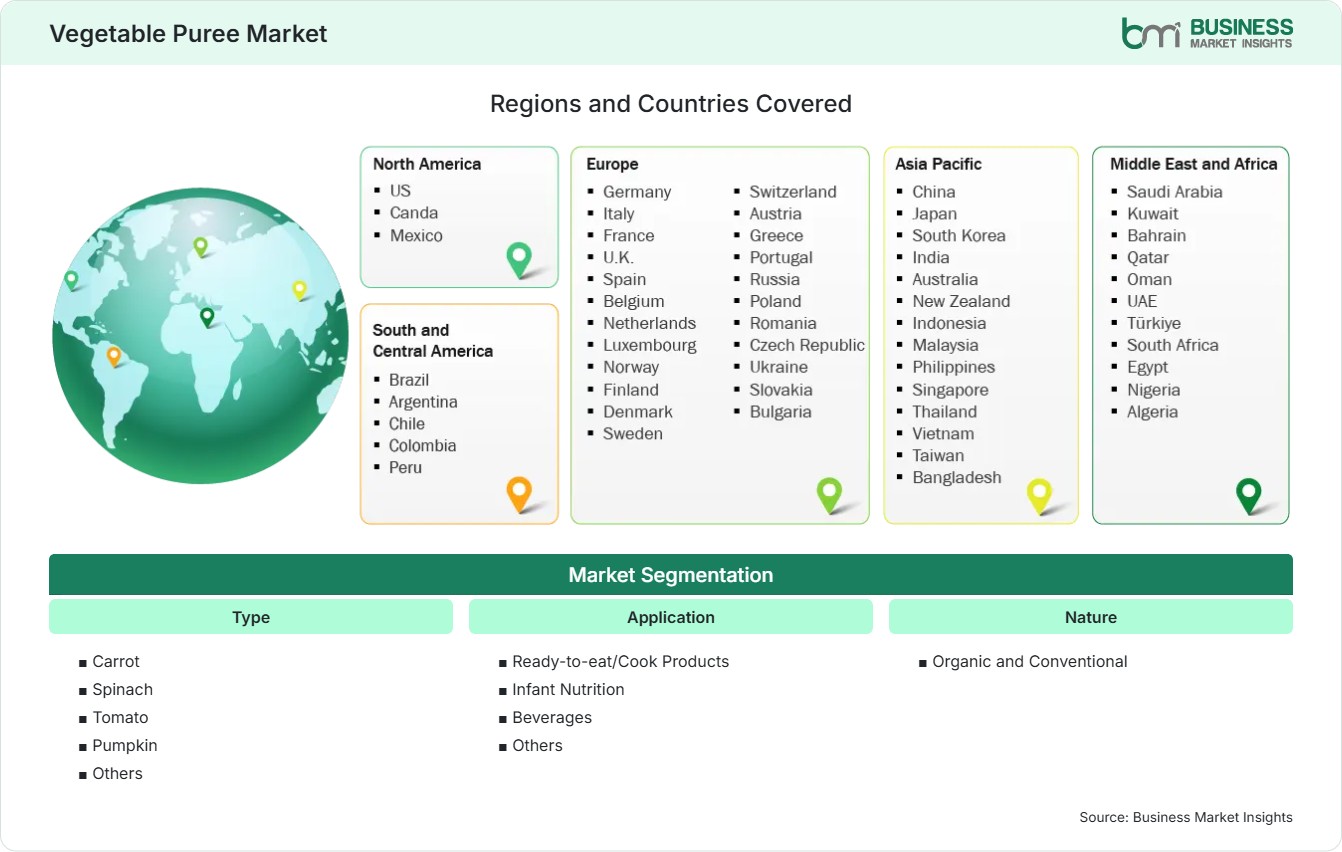
Global Market Geography
FREE PDF
Request your free sample
Request free sample
05 Segment Analysis

Vegetable Puree Market Segmentation

Type

The type category represents a core component of the Vegetable Puree Market, driven by diverse applications across processed foods, infant nutrition, beverages, and culinary products. Tomato puree held approximately 27%–30% market share in 2025 and is projected to expand at a 7.5%–8.0% CAGR during 2026–2033.

  • Carrot: Carrot puree adoption is increasing due to its nutritional profile, natural color properties, and wide usage in infant foods, beverages, sauces, and health-focused food formulations.
  • Spinach: Spinach puree demand is supported by increasing consumer interest in nutrient-rich ingredients, plant-based foods, and functional nutrition products across retail and commercial food applications.
  • Tomato: Tomato puree remains the leading segment due to extensive use in sauces, soups, ready-to-eat meals, pizza products, and beverage formulations requiring consistent flavor and texture.
  • Pumpkin: Pumpkin puree is gaining popularity through increasing demand for seasonal products, baby foods, bakery applications, and clean-label formulations featuring natural vegetable ingredients.

Application

The application segment is expanding due to increasing incorporation of vegetable purees across convenience foods, nutrition products, and beverage formulations. Infant Nutrition accounted for approximately 24%–27% Vegetable Puree market share in 2025 and is expected to register a 8.2%–8.8% CAGR during 2026–2033. Rising parental preference for natural ingredients, improved awareness of early nutrition, and increasing availability of premium baby food products are strengthening demand across developed and emerging markets.

  • Ready-to-eat/Cook Products: Vegetable puree adoption is increasing in ready meals, sauces, soups, and convenience foods as manufacturers seek efficient ingredients that improve nutritional value and simplify preparation processes.
  • Infant Nutrition: Demand continues rising due to increasing focus on healthy early childhood diets, premium baby food products, and clean-label formulations using naturally sourced vegetable ingredients.
  • Beverages: Vegetable purees are increasingly used in smoothies, functional drinks, and blended beverages as consumers seek nutrient-rich products with natural flavors and plant-based benefits.

Nature

The nature segment reflects changing consumer preferences toward organic and conventionally processed vegetable ingredients. Organic vegetable puree represented approximately 22%–25% market share in 2025 and is projected to grow at a 8.4%–8.9% CAGR during 2026–2033. Increasing clean-label demand, sustainability concerns, and consumer willingness to pay premium prices for naturally produced ingredients are encouraging manufacturers to expand organic puree portfolios in Vegetable Puree Market.

  • Organic: Organic vegetable purees are gaining traction due to rising demand for chemical-free ingredients, sustainable farming practices, transparent sourcing, and premium food product development.
  • Conventional: Conventional vegetable purees maintain significant adoption because of cost efficiency, widespread availability, established agricultural supply chains, and suitability for large-scale food manufacturing operations.
06 Market Forces

Vegetable Puree Market Dynamics

Key Market Drivers

Growing demand for convenience and processed foods

Changing lifestyles, urbanization, and increasing preference for time-saving meal solutions are driving demand for vegetable purees across processed food categories. Food manufacturers are incorporating purees into ready-to-eat meals, sauces, soups, and cooking products to improve efficiency while maintaining nutritional value. The market growth is supported by expanding food processing industries, rising demand for minimally processed ingredients, and increased adoption among foodservice operators. Improved preservation technologies, advanced packaging solutions, and efficient supply chains are enabling manufacturers to provide consistent-quality products throughout the year. These developments are also influencing Vegetable Puree Market trends, with companies focusing on healthier formulations, clean-label positioning, and convenient product formats to meet evolving consumer expectations.

Rising use in infant food and beverage applications

The need for nutritious baby foods and vegetable-based drinks is providing substantial growth avenues for puree producers. Parents have developed a preference towards healthier, nutritious, and easily consumable foods for their children. This factor is driving baby food brands to diversify their range of vegetable-based products. Vegetable purees provide essential vitamins, minerals, and naturally flavored food items. These products offer an easy formula process for producers. Beverage companies are also considering using vegetable-based mixes, functional drinks, and smoothies to meet changing health-conscious consumption trends. Increasing investments in infant nutrition research, premium baby food products, and processing techniques are driving global adoption.

Increasing consumer preference for natural food ingredients

The demand from consumers of natural ingredients that are easily identifiable and have minimum processing involved is shaping many of the product development strategies for the food products. Vegetable purees are becoming popular alternatives to artificial flavours, colours, and additives in various food products. The growing awareness of ingredient sources, sustainability, and nutritional value is prompting manufacturers to introduce more organic and clean-label vegetable purees. Companies are using sophisticated processing technologies that maintain the taste, nutrition, and natural properties of ingredients. Such trends are helping to create long-term demands for vegetable ingredients for different uses including retail, food service, and industrial applications.

Key Market Opportunities

Growing demand for clean-label food ingredients

The increasing preference for clean-label food products is creating new growth opportunities for vegetable puree manufacturers. Consumers are expecting products that are made using clean and straightforward labels that include natural ingredients and have transparent manufacturing processes, pushing food companies to substitute chemical-based ingredients with vegetable-based ingredients. The manufacturers are broadening their organic puree product range to facilitate healthy food production. Clean-label initiatives are also affecting purchasing decisions in the food industry as far as food producers prefer to work with suppliers of ingredients that have sustainable and transparent production processes.

Expansion into infant nutrition applications

The infant nutrition industry offers ample opportunities for businesses as more and more consumers emphasize quality, natural, and balanced baby foods. Vegetable purees have become indispensable components in infant meal formulation because of their easy texture, digestibility, and nutritious content. Specialized vegetable puree mixes that consist of several types of vegetables are being formulated in order to address nutritional needs and make products more attractive. The birth rate growth in select emerging economies, increased awareness regarding early child nutrition, and growing demand for premium baby foods will drive future demand. Food companies with efficient food safety, dependable sourcing channels, and formulation capability will benefit from this trend.

Increasing exports of processed vegetable products

Growing international trade of processed vegetable ingredients is opening new opportunities for puree producers to expand their geographic reach. Countries with strong agricultural production capabilities are increasing exports of processed vegetable products to meet global demand from food manufacturers and retailers. Advancements in the cold chain infrastructure, packaging, and international distribution systems are aiding the expansion into foreign markets. The export-oriented manufacturers are making efforts in securing quality certifications, sustainable agriculture alliances, and production capacities in order to comply with the international standards. Higher demand from regions having a dearth of vegetable processing facilities is also providing opportunities for suppliers with quality, affordable products and assured supplies.

Market Restraints and Challenges

Seasonal availability of raw vegetables

Factor: Vegetable puree production depends heavily on agricultural cycles, weather conditions, and seasonal availability of raw vegetables, which can create fluctuations in supply volumes and raw material pricing. Impact: Seasonal variability can increase procurement challenges, affect production schedules, and create difficulties in maintaining consistent product availability throughout the year. The suppliers require diversification, contract farming agreements, and preservation methods from the manufacturers. Quality and availability of the crops can affect the production costs and product consistency. Efficient sourcing and proper preservation will help the firms overcome seasonal problems and ensure steady production of purees.

High storage and transportation costs

Factor: Vegetable purees often require controlled storage conditions, temperature management, and specialized transportation systems to maintain quality, freshness, and safety. Impact: High logistics and cold chain expenses can increase operational costs, reduce profit margins, and create challenges for companies expanding across distant markets. Transportation complexity is particularly significant for exporters managing long-distance distribution networks. Manufacturers are addressing these challenges through improved packaging technologies, localized production facilities, and optimized supply chain management. Investments in efficient logistics infrastructure and advanced preservation methods remain important for improving cost competitiveness while ensuring product quality across regional and international markets.

07 Company Analysis

Competitive Landscape

The competitive landscape of the market is shaped by global ingredient manufacturers, food processing companies, and specialty suppliers focusing on clean-label solutions, sustainable sourcing, and customized vegetable ingredient offerings. The Vegetable Puree Market analysis highlights increasing investments in processing capabilities, organic product expansion, and supply chain optimization as companies strengthen their positions across food, beverage, and infant nutrition applications.

Company Name

Overview

Products and Services Relevant to this Market

Döhler GmbH

Global natural ingredient manufacturer providing customized food and beverage solutions with strong processing expertise.

Vegetable purees, natural ingredients, food preparations, beverage solutions, and customized formulation support.

Kanegrade Ltd.

Food ingredient supplier specializing in processed fruits, vegetables, and customized ingredient solutions.

Vegetable purees, fruit preparations, frozen ingredients, and tailored food manufacturing solutions.

SVZ International B.V.

International producer of fruit and vegetable ingredients serving global food manufacturers.

Vegetable purees, concentrates, organic ingredients, and clean-label vegetable solutions.

AGRANA Beteiligungs-AG

Global food processing company with expertise in agricultural raw material transformation.

Vegetable preparations, fruit and vegetable ingredients, and customized food applications.

Tree Top, Inc.

Food ingredient company specializing in processed fruit and vegetable-based solutions.

Vegetable purees, ingredient blends, and customized solutions for food manufacturers.

Kiril Mischeff Group

UK-based supplier offering a wide range of food ingredients to commercial customers.

Vegetable purees, processed vegetables, specialty ingredients, and foodservice solutions.

Diana Food (Symrise)

Natural ingredient provider focused on nutrition, health, and sustainable food solutions.

Vegetable ingredients, purees, natural extracts, and nutrition-focused food applications.

Ingredion Incorporated

Global ingredient solutions company supporting food innovation and product development.

Vegetable-based ingredients, texture solutions, specialty ingredients, and formulation technologies.

Sensient Technologies Corporation

Ingredient technology company providing natural colors, flavors, and functional solutions.

Vegetable extracts, natural ingredients, flavor solutions, and food application technologies.

Uren Food Group Limited

Food ingredient supplier serving manufacturers with customized food solutions.

Vegetable purees, processed ingredients, and tailored ingredient supply services.

10 Trust & Transparency

Research Methodology

The market analysis combines proprietary research with secondary data from government agencies, company disclosures, regulatory filings, industry databases and expert interviews. Market estimates are validated through data triangulation, cross-market benchmarking and analyst review.

View Full Research Methodology

11 Questions Answered

Frequently Asked Questions

How does the Vegetable Puree Market Report support business decisions?

The report provides insights into market dynamics, segmentation trends, competitive developments, regional opportunities, and growth factors, helping manufacturers, suppliers, and investors evaluate strategic opportunities within the industry.

Why is Asia Pacific becoming an important region for vegetable puree suppliers?

Asia Pacific is becoming attractive due to expanding food processing industries, rising disposable income, increasing infant nutrition demand, and improving cold chain infrastructure. Manufacturers are investing in regional production and distribution networks to capture emerging opportunities.

What role does technology play in vegetable puree production?

Advanced processing technologies, improved preservation methods, and efficient packaging solutions help maintain nutritional quality, extend shelf life, and improve production efficiency. These technologies enable manufacturers to supply consistent products across domestic and international markets.

How are organic vegetable purees gaining market acceptance?

Organic vegetable purees are gaining traction due to rising consumer interest in sustainable farming, chemical-free ingredients, transparent sourcing, and premium food products. Manufacturers are expanding certified organic offerings to address demand from health-conscious consumers.

What factors are increasing demand for vegetable puree market forecasts?

Increasing adoption of convenient food formats, rising preference for natural ingredients, and expanding applications in infant nutrition and beverages are encouraging manufacturers to increase vegetable puree production and develop diversified product portfolios.

Access the Full Vegetable Puree Market Report

Get segment-level forecasts, regional estimates, competitive benchmarking, company profiles and downloadable Excel datasets.

Access the full Vegetable Puree Market Report
350 pages PDF & Excel | 2026-08-07