Fruit Puree Market Regional Highlights
North America Fruit Puree Market
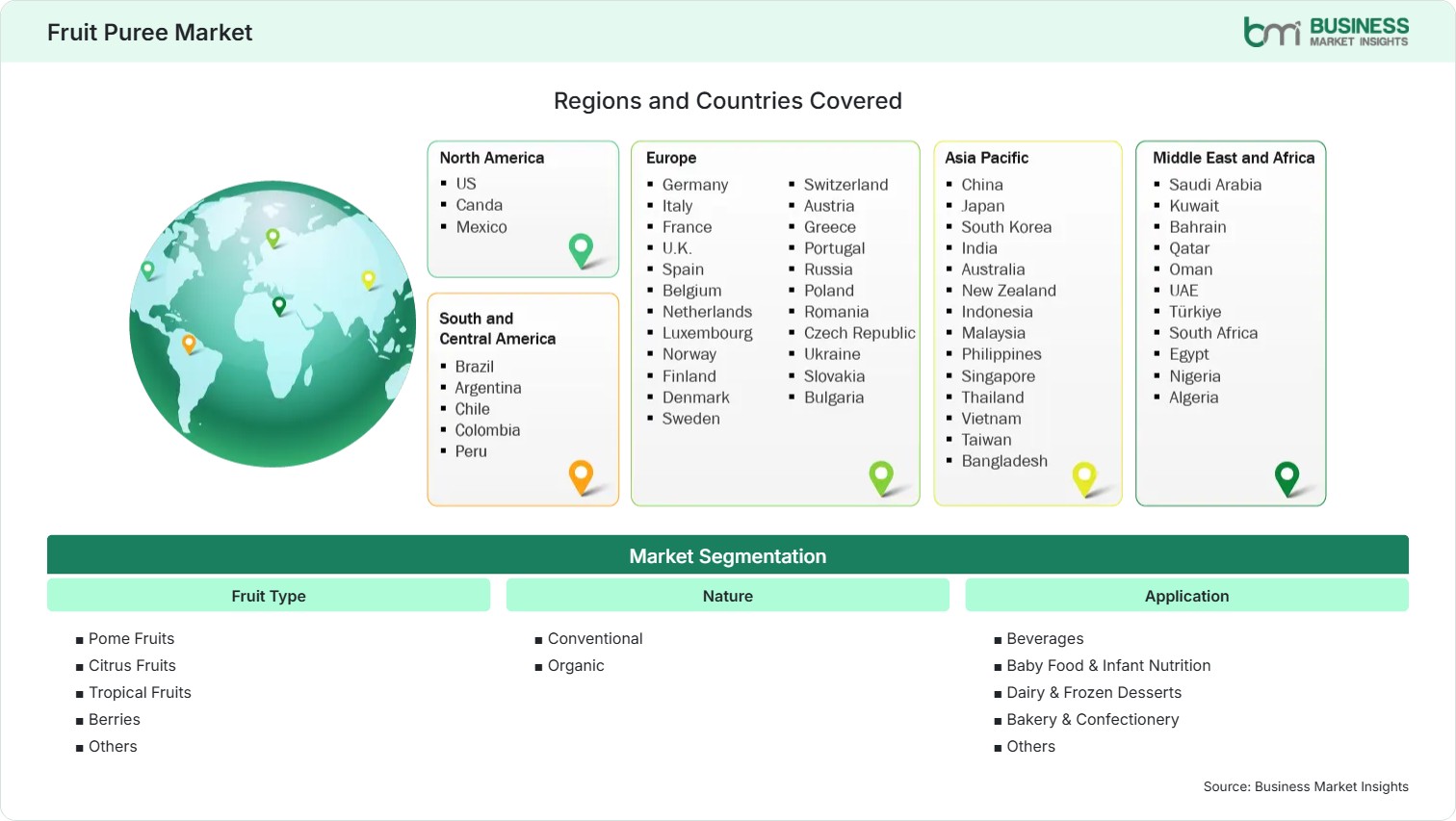
North America accounted for a 32%–35% share in 2025 and is projected to grow at a CAGR of 7.20%–7.50% during 2026–2033. The region benefits from established food processing infrastructure, strong demand for clean-label ingredients, and rising consumption of fruit-based beverages. The Fruit Puree Market share is supported by premium product launches, organic ingredient adoption, and advanced retail distribution networks across the United States and Canada.
- The United States remains the largest contributor due to strong demand for smoothies, baby foods, and functional beverages. Manufacturers are investing in innovative puree formulations with natural ingredients and extended shelf stability.
- Canada is witnessing increasing adoption of organic fruit purees due to growing consumer preference for sustainable food products. Local processors are strengthening partnerships with agricultural suppliers to improve sourcing reliability.
- Food manufacturers are adopting fruit purees as alternatives to artificial flavors and sweeteners. This transition is encouraging innovation across beverage, dairy, and confectionery applications while supporting ingredient diversification.
- Advanced processing technologies, including aseptic packaging and cold-chain improvements, are enhancing product quality. Companies are focusing on maintaining nutritional value while increasing distribution efficiency across regional markets.
US Fruit Puree Market
The US Fruit Puree Market represents approximately 75%–80% of North America revenue in 2025 and is expected to expand at a CAGR of 7.30%–7.60% between 2026–2033. Strong demand from beverage producers, infant nutrition companies, and foodservice operators supports expansion. The country demonstrates increasing preference for organic, natural, and customized fruit ingredients across multiple applications.
- Consumer interest in healthy beverages is increasing demand for fruit puree-based smoothies, juices, and functional drinks. Beverage companies are launching products featuring recognizable fruit ingredients and clean-label positioning.
- Baby food manufacturers are adopting fruit purees due to parental preference for convenient nutrition products. Companies are developing formulations with reduced additives and improved nutritional profiles.
- Retail expansion through online grocery platforms is improving accessibility of premium fruit puree products. Direct-to-consumer channels are enabling smaller brands to reach health-focused consumers.
Europe Fruit Puree Market
Europe held a 29%–32% share in 2025 and is projected to grow at a CAGR of 6.80%–7.20% during 2026–2033. France, Germany, Italy, and the United Kingdom represent key markets due to established food processing industries, organic food demand, and advanced fruit ingredient applications. The region demonstrates strong adoption of sustainable sourcing practices and premium fruit formulations.
- France supports market expansion through demand for high-quality fruit ingredients in bakery, confectionery, and beverage applications. Premium food manufacturers increasingly utilize fruit purees for natural flavor enhancement.
- Germany shows rising demand for organic fruit processing solutions due to sustainability-focused consumer behavior. Manufacturers are adopting certified sourcing methods and environmentally responsible production practices.
- The United Kingdom continues expanding through convenience food consumption and growing demand for fruit-based nutritional products. Retail innovation is supporting wider availability of puree products.
- Italy benefits from strong culinary traditions and demand for fruit ingredients in desserts, beverages, and specialty food products. Processors are focusing on preserving authentic flavors and textures.
Asia Pacific Fruit Puree Market
Asia Pacific represented a 27%–30% Fruit Puree Market share in 2025 and is expected to expand at a CAGR of 8.00%–8.40% during 2026–2033. Rising disposable income, urbanization, expanding food processing industries, and increasing health awareness are driving adoption. China, India, Japan, and South Korea are major contributors, with emerging Southeast Asian economies showing faster growth potential.
- China is experiencing increased demand through beverage innovation, processed food expansion, and rising consumption of fruit-based nutrition products. Domestic processors are improving production capacity to meet growing demand.
- India is witnessing strong growth due to expanding dairy, beverage, and baby food industries. Increasing urban lifestyles are encouraging adoption of convenient fruit-based products.
- Japan demonstrates demand for premium fruit ingredients through functional beverages and high-quality processed foods. Manufacturers emphasize product consistency, flavor preservation, and advanced processing methods.
- South Korea is benefiting from wellness trends and increasing demand for fruit-based beverages. Companies are introducing innovative formulations targeting younger consumers seeking healthy lifestyle products.
Rest of World Fruit Puree Market
South and Central America, along with the Middle East and Africa, accounted for a combined 8%–11% share in 2025 and are forecast to grow at a CAGR of 6.20%–6.70% during 2026–2033. Brazil, Mexico, UAE, and South Africa are emerging markets supported by agricultural resources, expanding food industries, and increasing consumption of processed fruit products.
Latin American countries benefit from strong fruit cultivation capabilities, enabling processors to develop export-oriented puree products. Middle Eastern markets are adopting fruit ingredients through hospitality, beverage, and nutrition sectors.
- Brazil benefits from abundant tropical fruit production and growing processing capabilities. Companies are expanding puree exports while developing value-added products for international food manufacturers.
- Mexico is experiencing demand growth through beverage applications and expanding food processing industries. Manufacturers are strengthening local supply chains to support consistent fruit ingredient availability.
- UAE markets are adopting premium fruit purees through hospitality and beverage sectors. Demand is increasing for high-quality imported and specialty fruit ingredients.
- South Africa demonstrates gradual growth through retail expansion and increasing consumer awareness of healthy food products. Local producers are improving processing infrastructure and distribution capabilities.
- Regional manufacturers are exploring localized fruit blends based on consumer preferences and climate conditions. Product innovation is supporting wider adoption across diverse food applications.