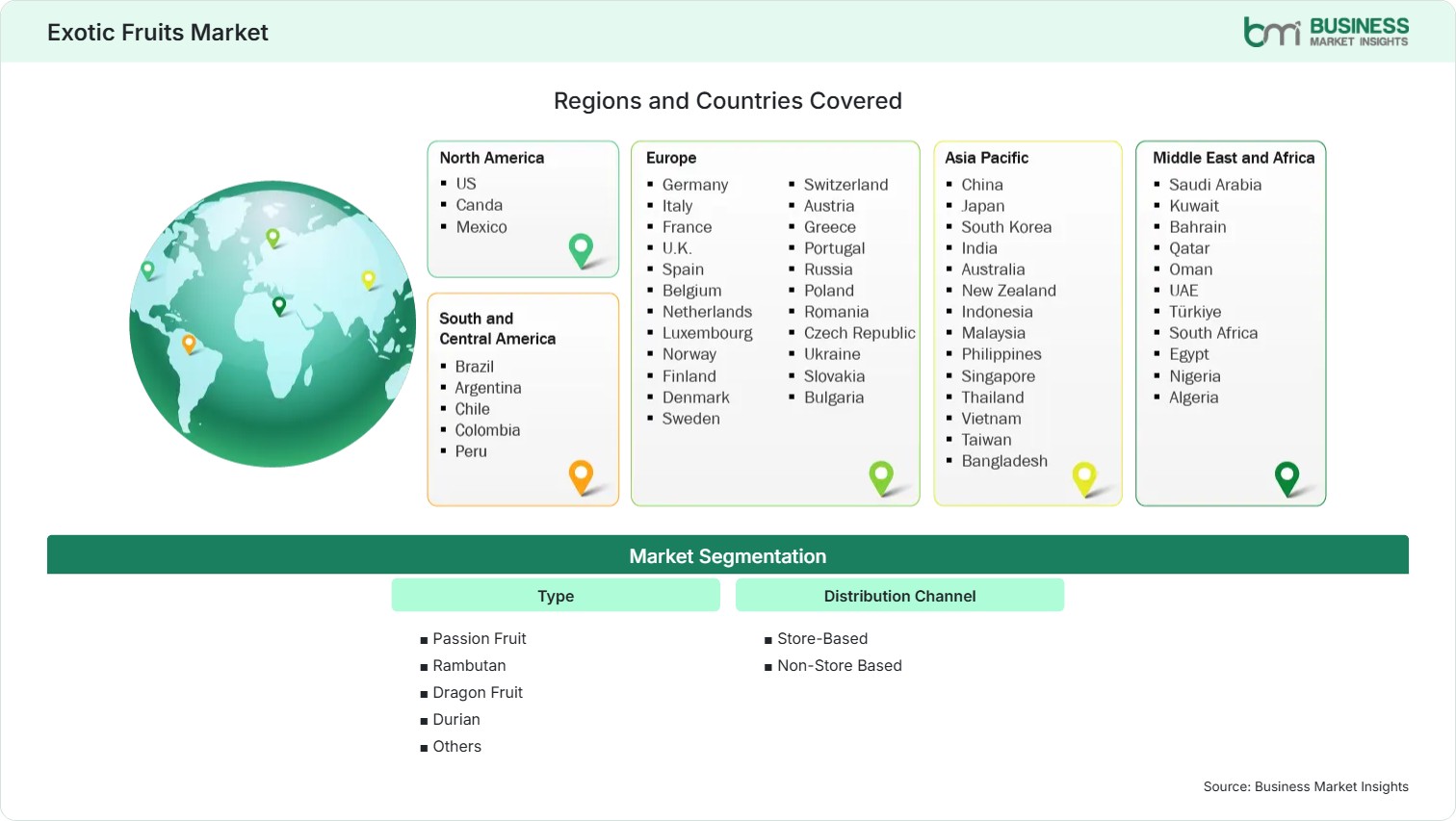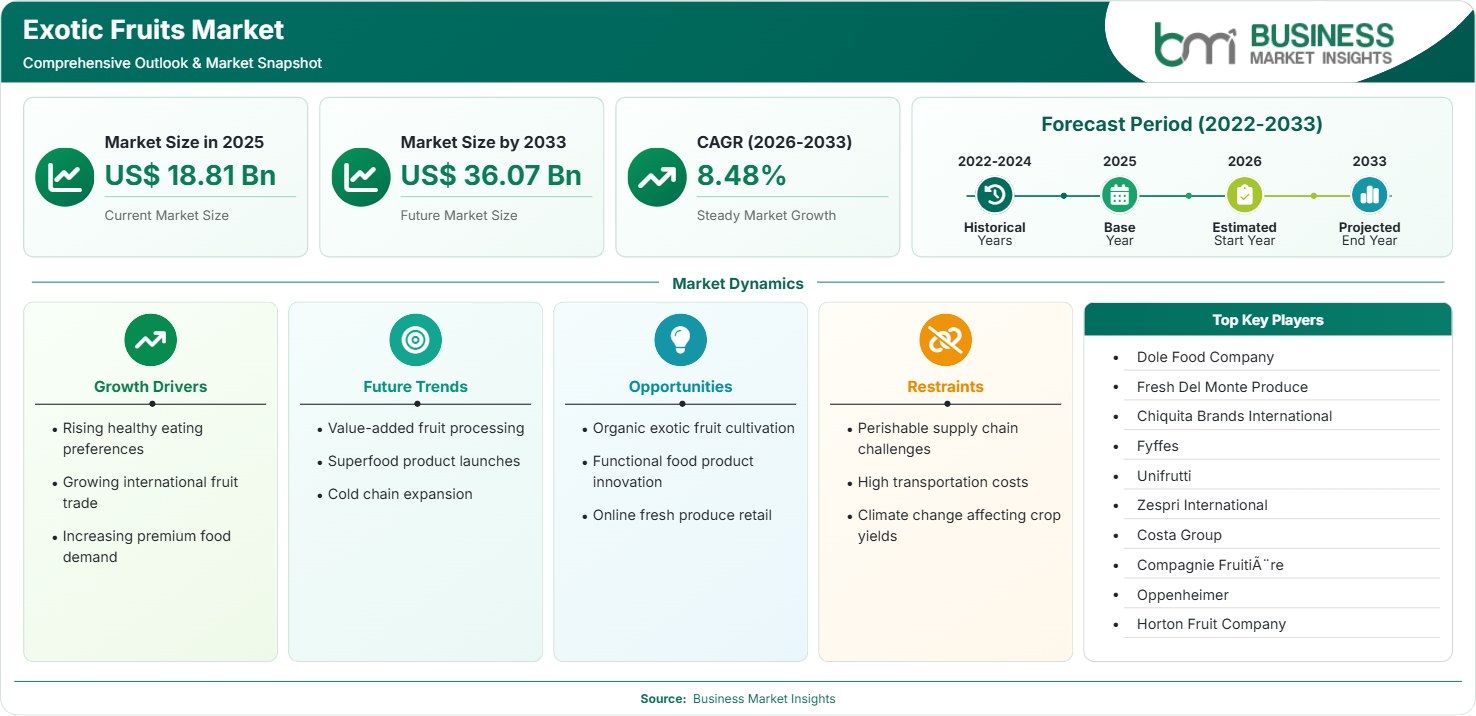
Exotic Fruits Market Regional Highlights
North America Exotic Fruits Market
North America accounted for 32%–35% of global revenue in 2025 and is projected to grow at a CAGR of 7.8%–8.4% during 2026–2033. The region benefits from increasing health-conscious consumption, diverse consumer preferences, premium grocery expansion, and growing demand for imported tropical fruits. The Exotic Fruits Market share remains concentrated in the United States due to strong retail infrastructure, multicultural demand, and expanding availability of specialty produce.
- The United States represents the largest regional market due to strong demand for dragon fruit, passion fruit, rambutan, and tropical fruit-based beverages.
- Premium grocery retailers are expanding exotic fruit selections to attract health-focused consumers seeking nutrient-rich and differentiated food products.
- Food manufacturers are increasing the use of exotic fruit ingredients in smoothies, beverages, snacks, and functional food applications.
- Improved cold-chain infrastructure is supporting longer-distance transportation and maintaining freshness across imported fruit supply chains.
US Exotic Fruits Market
The United States represents the dominant country-level market with a share of 26%–29% globally in 2025 and is projected to grow at a CAGR of 7.9%–8.5% through 2033. Rising interest in healthy eating, multicultural food trends, premium produce consumption, and functional beverages continues to support Exotic Fruits market growth. Retailers and online grocery platforms are improving accessibility of exotic fruits across major consumer markets.
- Dragon fruit and passion fruit are gaining popularity due to increasing use in smoothies, juices, and wellness-focused food products.
- Premium supermarkets are expanding imported fruit categories to meet demand for unique flavors and specialty produce experiences.
- Online grocery platforms are improving consumer access to exotic fruits through convenient delivery and expanded product availability.
Europe Exotic Fruits Market
Europe contributes 23%–26% of global revenue in 2025 and is expected to expand at a CAGR of 7.6%–8.2% during 2026–2033. Market growth is supported by increasing demand for healthy foods, multicultural consumption patterns, premium retail expansion, and rising interest in sustainable sourcing. Countries including Germany, the United Kingdom, France, and the Netherlands represent important consumption and distribution hubs.
- Germany maintains strong demand through advanced retail infrastructure and increasing consumer interest in nutritional fruit varieties.
- The United Kingdom demonstrates growth through expanding premium grocery segments and increasing demand for tropical fruit-based products.
- France benefits from strong fresh produce consumption culture and growing availability of imported exotic fruit varieties.
- European retailers are emphasizing traceability, sustainability, and ethical sourcing practices across exotic fruit supply chains.
Asia Pacific Exotic Fruits Market
Asia Pacific represents 38%–41% of global revenue in 2025 and is forecast to achieve the fastest CAGR of 9.1%–9.7% through 2033. The region benefits from favorable climatic conditions, large-scale tropical fruit production, increasing domestic consumption, and expanding export opportunities. China, India, Thailand, Vietnam, and Malaysia are key contributors to regional market development.
- China remains a major consumer market with rising demand for premium fruits, particularly durian and dragon fruit varieties.
- Thailand and Vietnam strengthen regional supply through large-scale tropical fruit cultivation and export-oriented agricultural systems.
- India is experiencing increasing cultivation of exotic fruits due to rising farmer interest and domestic demand growth.
- Regional e-commerce platforms are improving access to premium fruits across urban consumer markets.
Rest of World Exotic Fruits Market
The Rest of World segment accounts for 10%–13% of global revenue in 2025 and is projected to grow at a CAGR of 7.2%–7.8% through 2033. South America, the Middle East, and Africa are experiencing gradual adoption due to expanding urban populations, improving retail infrastructure, and rising consumer interest in premium food products.
- Brazil remains an important producer of passion fruit and other tropical varieties due to favorable agricultural conditions and export opportunities.
- Middle Eastern countries are increasing exotic fruit imports through premium retail channels and hospitality sector demand.
- African producers are expanding tropical fruit cultivation to capture export opportunities and strengthen agricultural revenues.
- Growing investment in logistics infrastructure is improving international distribution capabilities across emerging markets.