
Dehydrated Vegetable Market Outlook: Size, Share, Trends, Growth Analysis, Competitive Landscape & Forecast, 2026-2033

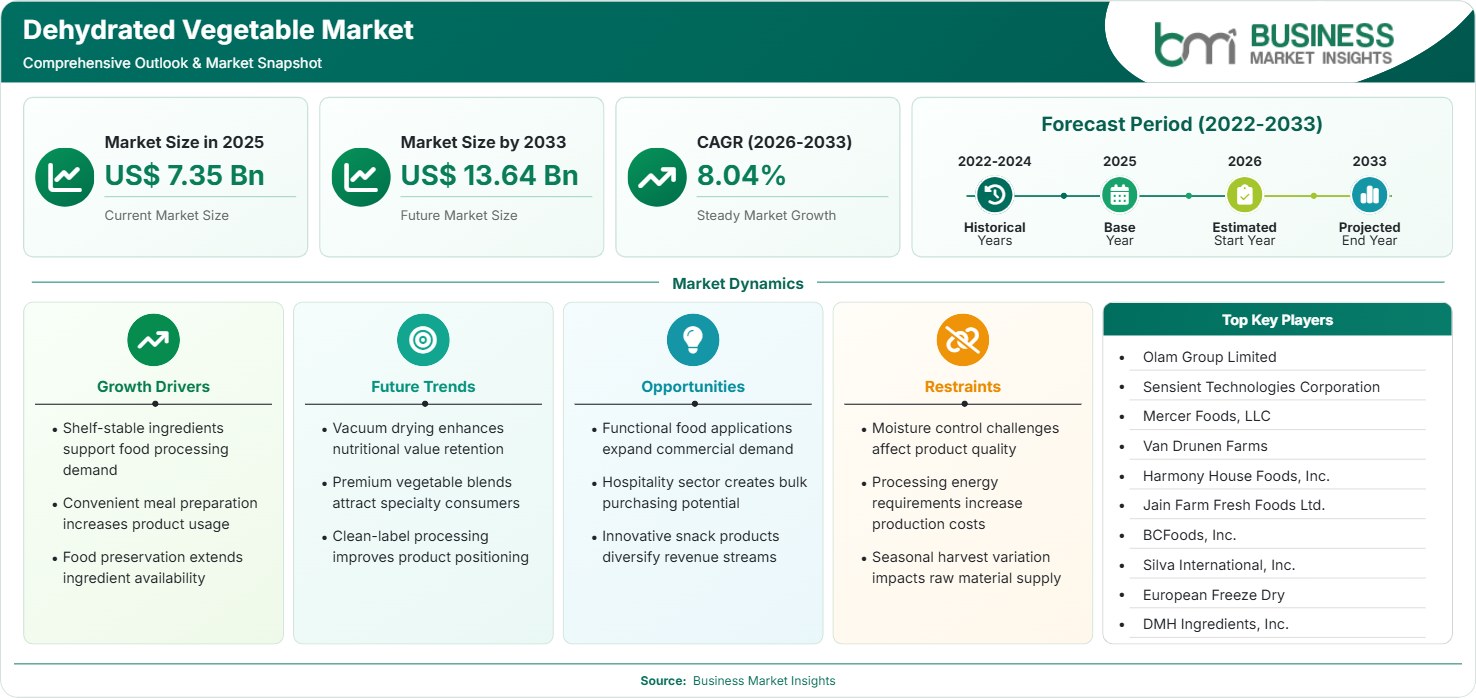
The Dehydrated Vegetable Market size was valued at US$ 7.35 billion in 2025 and is projected to reach US$ 13.64 billion by 2033, growing at a CAGR of 8.04% during 2026–2033. Increasing demand for shelf-stable food ingredients, expanding convenience food consumption, and wider adoption of dehydrated vegetables in food processing continue creating favorable growth opportunities across global markets.

Report Coverage
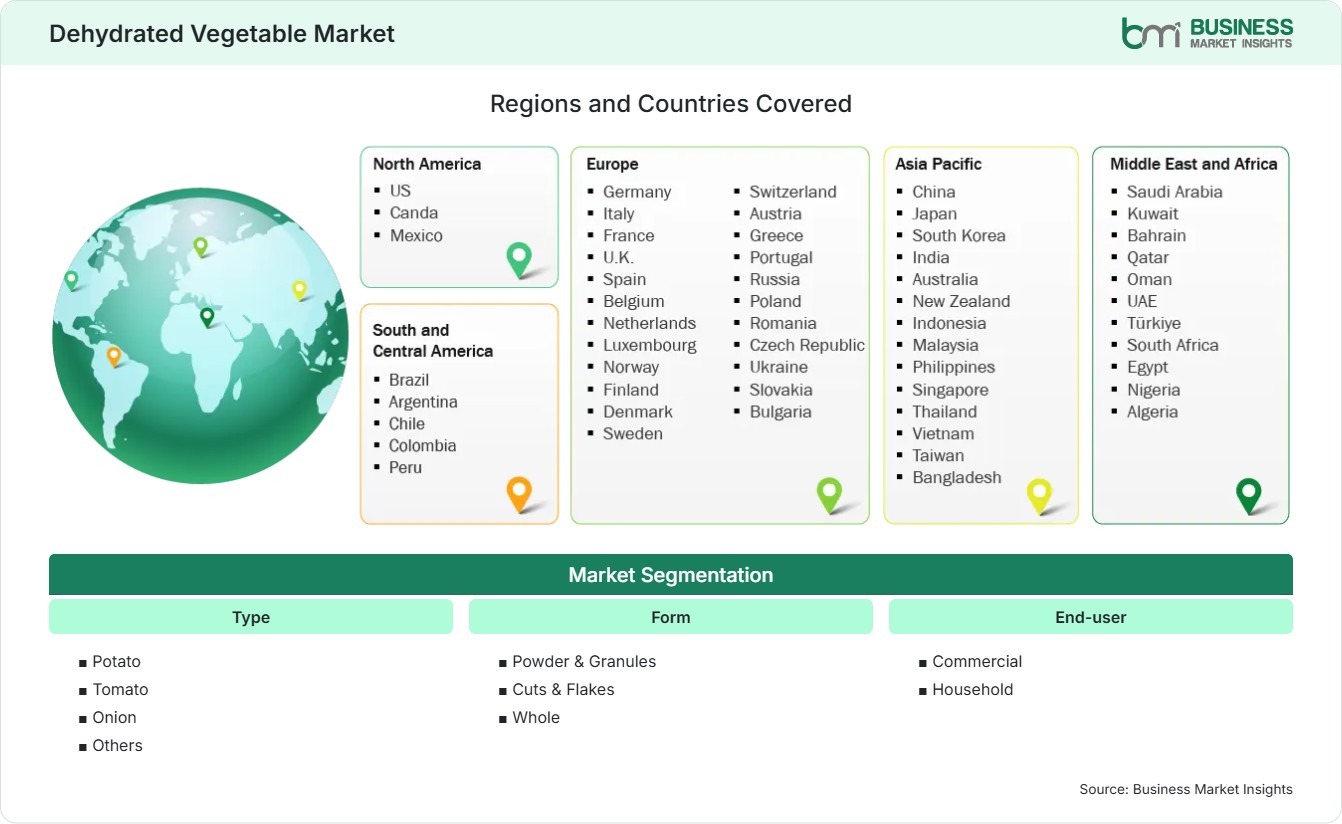
  • Type: Potato, Tomato, Onion, Others
  • Form: Powder & Granules, Cuts & Flakes, Whole
  • End-user: Commercial, Household
US$ 7.35 Bn Market size in 2025
US$ 13.64 Bn Market Size by 2033
8.04% CAGR, 2026 - 2033
2026-2033 Forecast Period

AI Overview

Dehydrated Vegetable Market Summary

  • North America Region: North America holds 31%–34% market share in 2025 and is expected to grow at a CAGR of 7.5%–8.0% during 2026–2033. Demand is supported by processed food manufacturing, growing convenience meal consumption, and investments in advanced dehydration technologies. The U.S. remains the leading market with a CAGR of 7.6%–8.1%, driven by expanding food processing capacity and increasing demand for long shelf-life ingredients.
  • Fastest Growing Region: Asia Pacific accounts for 29%–32% market share in 2025 and is projected to register the fastest CAGR of 8.8%–9.4%, supported by rapid urbanization, rising packaged food production, expanding export activities, and increasing investments in food processing infrastructure.
  • Leading Segment: Onion captures 34%–37% market share in 2025 and is forecast to expand at a CAGR of 8.1%–8.6%, owing to its extensive use in seasonings, ready meals, soups, sauces, and processed food formulations.
  • High Growth Segment: Commercial accounts for 72%–75% market share in 2025 and is anticipated to record a CAGR of 8.3%–8.8%, supported by increasing demand from food manufacturers, restaurants, catering services, and institutional kitchens.
  • Key Market Opportunity: Growing demand for clean-label ingredients, functional foods, and value-added processed products continues encouraging investment in premium dehydrated vegetable formulations and advanced preservation technologies.
  • Major Market Players: Olam Group Limited, Sensient Technologies Corporation, Mercer Foods, LLC, Van Drunen Farms, Harmony House Foods, Inc., Jain Farm Fresh Foods Ltd., BCFoods, Inc., Silva International, Inc., European Freeze Dry, and DMH Ingredients, Inc.
Strategic Insights

Dehydrated Vegetable Market: Strategic Insights

Dehydrated Vegetable Market Strategic Framework
FREE PDF
Request your free sample
Request free sample
Stakeholder View

Key Takeaways

  • Commercial food processors remain the primary consumers of dehydrated vegetables owing to consistent demand from packaged food, seasoning, and ready-meal manufacturing.
  • Onion and potato products continue accounting for significant consumption because of their versatility, long storage life, and broad application across processed food categories.
  • Manufacturers are increasingly adopting advanced dehydration technologies to improve product quality, preserve nutrients, and reduce processing losses while enhancing operational efficiency.
  • Asia Pacific presents the strongest investment opportunity as expanding food processing industries and rising urban populations continue driving ingredient demand.
  • Strategic partnerships between agricultural producers, ingredient processors, and food manufacturers are strengthening supply chain resilience and improving raw material availability.
  • Product innovation focused on clean-label, minimally processed, and premium-quality dehydrated vegetables continues creating new revenue opportunities across domestic and export markets.
Geographic Outlook

Dehydrated Vegetable Market Regional Highlights

North America Dehydrated Vegetable Market

North America accounts for 31%–34% Dehydrated Vegetable Market share in 2025 and is expected to register a CAGR of 7.5%–8.0% through 2026–2033. Strong processed food production, growing convenience food demand, and advanced food preservation technologies continue supporting regional expansion. Food manufacturers increasingly utilize dehydrated vegetables to improve production efficiency, reduce storage costs, and ensure year-round ingredient availability.

  • Processed food manufacturers continue increasing purchases of dehydrated onions, tomatoes, and potatoes for convenience food production.
  • Investments in advanced drying technologies improve product quality, flavor retention, and operational efficiency.
  • Rising consumer preference for ready-to-cook meals strengthens long-term ingredient demand across retail and foodservice sectors.
  • Sustainable packaging and efficient supply chain management continue supporting regional market competitiveness.

US Dehydrated Vegetable Market

The United States contributes 82%–85% of North American revenue and is expected to grow at a CAGR of 7.6%–8.1% during the forecast period. Expanding food processing capacity, innovation in ingredient preservation, and increasing demand for packaged convenience foods continue strengthening domestic market performance.

  • Large food manufacturers continue investing in premium dehydrated ingredients for product consistency.
  • Foodservice operators increasingly utilize dehydrated vegetables to improve inventory management and reduce waste.
  • Growing exports of processed foods continue supporting ingredient production across domestic manufacturing facilities.
  • Automation in food processing enhances production efficiency and product quality consistency.

Europe Dehydrated Vegetable Market

Europe represents 25%–28% market share in 2025 and is projected to expand at a CAGR of 7.4%–7.9% through 2026–2033. Demand is supported by strong food processing industries, increasing clean-label food production, and growing preference for natural ingredients. Germany leads regional consumption, while Poland records the fastest growth due to expanding agricultural processing and export-oriented manufacturing.

  • Food manufacturers continue emphasizing natural ingredients with extended shelf life.
  • Advanced dehydration technologies improve nutritional retention and product quality.
  • Strong retail demand supports growth in packaged soups, sauces, and seasoning blends.
  • Export-oriented food processing continues driving stable ingredient consumption.

Asia Pacific Dehydrated Vegetable Market

Asia Pacific holds 29%–32% market share in 2025 and is expected to record the fastest CAGR of 8.8%–9.4% through 2026–2033. Rising urbanization, expanding packaged food production, and increasing agricultural processing investments continue driving regional demand. China remains the leading market, while India registers the fastest growth through expanding food manufacturing and agricultural value-addition initiatives.

  • Expanding food processing industries increase consumption of dehydrated vegetable ingredients.
  • Rising exports of processed foods strengthen regional manufacturing capacity.
  • Urban lifestyle changes continue supporting convenience food production.
  • Government support for food preservation technologies encourages private investment.

Rest of World Dehydrated Vegetable Market

The Rest of World region accounts for 10%–13% market share in 2025 and is anticipated to register a CAGR of 7.8%–8.3% during 2026–2033. Food processing expansion, agricultural modernization, and increasing demand for shelf-stable ingredients continue supporting growth across South America, the Middle East, and Africa.

  • Brazil leads regional demand through expanding processed food manufacturing activities.
  • GCC countries continue investing in food security and ingredient processing infrastructure.
  • Rising retail distribution networks increase demand for packaged food ingredients.
  • Improvements in cold chain and logistics complement dehydrated ingredient adoption across emerging markets.
Global Market Geography
FREE PDF
Request your free sample
Request free sample
Segment Analysis

Dehydrated Vegetable Market Segmentation

Type

The type segment represents the largest source of product differentiation as individual vegetables are selected according to processing requirements, flavor characteristics, nutritional value, and end-use applications. It accounted for 34%–37% market share in 2025 and is expected to grow at a CAGR of 8.1%–8.6% during 2026–2033. Increasing demand from food processors, ingredient manufacturers, and ready-to-eat meal producers continues expanding the Dehydrated Vegetable Market scope across domestic and international food supply chains.

  • Potato: Widely used in instant mashed potatoes, snack products, soup mixes, bakery applications, and convenience foods because of its versatility, long shelf life, and consistent product quality.
  • Tomato: Experiences steady demand for sauces, seasonings, pasta products, ready meals, and snack formulations owing to its concentrated flavor, natural color, and extended storage capability.
  • Onion: Holds the largest consumption across processed foods, spice blends, soups, sauces, frozen meals, and foodservice applications because of its strong flavor profile and broad culinary usage.

Form

Product form significantly influences storage efficiency, processing convenience, transportation, and application flexibility across food manufacturing industries. This segment continues expanding with increasing industrial demand for standardized ingredients and accounted for 41%–44% market share in 2025, while registering a CAGR of 8.2%–8.7% during the forecast period. Current Dehydrated Vegetable Market trends indicate growing adoption of application-specific forms that improve production efficiency and product consistency.

  • Powder & Granules: Preferred for seasoning blends, soups, sauces, instant foods, beverage formulations, and processed food manufacturing because they offer excellent dispersion, long shelf life, and easy handling.
  • Cuts & Flakes: Extensively utilized in ready meals, frozen foods, dehydrated soup mixes, stuffing products, and institutional food preparation where texture retention and rapid rehydration are essential.
  • Whole: Used in premium food products, specialty culinary applications, and export markets requiring minimal processing, natural appearance, and higher product authenticity after rehydration.

End-user

End-user demand is largely influenced by food manufacturing volumes, changing dietary preferences, and the growing popularity of convenient meal solutions. The segment accounted for 72%–75% market share in 2025 and is projected to expand at a CAGR of 8.3%–8.8% through 2026–2033 as commercial food production continues increasing globally.

  • Commercial: Represents the dominant segment, supported by large-scale purchases from food processors, restaurants, catering companies, institutional kitchens, and packaged food manufacturers requiring reliable, shelf-stable vegetable ingredients.
  • Household: Continues growing steadily as consumers increasingly purchase dehydrated vegetables for home cooking, emergency food storage, outdoor recreation, and convenient meal preparation with reduced food waste.
Market Forces

Dehydrated Vegetable Market Dynamics

Key Market Drivers

Shelf-stable ingredients support food processing demand

Food processing companies have found that dehydrated vegetables are more convenient to use as they offer extended shelf life, cost-effectiveness, and consistent ingredient quality regardless of seasonality. In contrast to fresh vegetables, dehydrated products need less cooling during storage, reduce transportation wastage, and facilitate the inventory control of big food processing companies. Dehydrated vegetables can be used in soups, sauces, instant noodles, seasoning mixtures, bakery goods, and ready-meals. The rising production of packaged foods worldwide keeps supporting their demand. These factors collectively contribute to Dehydrated Vegetable Market growth, encouraging manufacturers to expand dehydration capacity and improve product quality through advanced drying technologies.

Convenient meal preparation increases product usage

Changing consumer lifestyles and growing preference for quick meal preparation continue increasing demand for dehydrated vegetables across retail and foodservice sectors. The trend towards busy lifestyles among working professionals, reduction in family sizes, and growing consumption of ready-to-eat items is prompting companies to include dehydrated vegetables in meal kits, snack products, soups, and frozen products. Dehydrated vegetables help in saving time without compromising on taste and nutritional content post rehydration. Food processing companies are also expanding their product range by offering easy-cooking solutions, driving continuous demand for dehydrated vegetables worldwide.

Food preservation extends ingredient availability

Dehydration methods have advanced to such an extent that vegetables can be made available all year round, even when they are produced seasonally. This is achieved by reducing the amount of moisture in the food, making it last longer without compromising on taste, looks, or nutritional value. Another advantage is that food industries benefit from a constant supply of ingredients regardless of the season. These advancements continue shaping Dehydrated Vegetable Market trends, enabling suppliers to meet increasing global demand from processed food manufacturers and institutional buyers.

Key Market Opportunities

Functional food applications expand commercial demand

Demand for functional foods is continually rising as customers look for products made from natural ingredients, plant-derived nutrients, and clean-label formulations. Dehydrated vegetables are finding their place in nutritional supplements, health snacks, instant drinks, and fortified foods because of the nutrients that they have and the shelf life they provide. Dehydrated Vegetable Market Forecasts indicate that expanding functional food applications will continue creating attractive opportunities for ingredient suppliers and food manufacturers across developed and emerging economies.

Hospitality sector creates bulk purchasing potential

Hotel and restaurant establishments, institutional catering facilities, airlines, and catering firms are increasingly procuring freeze-dried vegetables to enhance efficiency and minimize food waste. The convenience of shelf-stable ingredients makes management easier while ensuring high-quality output in bulk food preparations. Tourism trends, as well as developments in the hospitality and catering industries, are likely to fuel greater commercial demand in the future.

Innovative snack products diversify revenue streams

Increasing consumer demand for nutritious and convenient snack foods has compelled companies to produce new generation vegetable snacks with superior taste, texture, and nutritive content. Vegetable chips and vegetable mixes through air drying and freeze-drying have been proving popular with consumers who prefer healthy alternatives to regular snacks. The production of innovative snacks, aided with new seasonings and high-quality packaging, still provides producers with many new opportunities to generate income.

Market Restraints and Challenges

Moisture control challenges affect product quality

Maintaining optimal moisture levels throughout processing, packaging, transportation, and storage remains a significant operational challenge for manufacturers. Factor: Inadequate moisture control may lead to microbial growth, discoloration, texture deterioration, reduced shelf life, and quality inconsistencies during storage. Impact: Product spoilage, customer complaints, higher product returns, and additional quality assurance expenses can reduce profitability while affecting brand reputation. Manufacturers continue investing in advanced drying systems, moisture monitoring technologies, and high-barrier packaging materials to maintain product stability across global supply chains.

Processing energy requirements increase production costs

Dehydration processes require substantial energy for drying, temperature control, air circulation, and product stabilization, making production costs sensitive to fluctuations in electricity and fuel prices. Factor: High energy consumption increases operational expenditure and manufacturing costs, particularly for facilities using conventional drying technologies. Impact: Rising production expenses may reduce profit margins, limit pricing flexibility, and affect competitiveness in price-sensitive markets. Companies are increasingly adopting energy-efficient dehydration equipment, heat recovery systems, and renewable energy solutions to improve cost efficiency and long-term sustainability.

Company Analysis

Competitive Landscape

The market remains moderately consolidated, with leading companies focusing on product quality, sourcing capabilities, dehydration technology, and global distribution networks. Dehydrated Vegetable Market analysis indicates that manufacturers are expanding production capacity, investing in freeze-drying and air-drying technologies, and strengthening partnerships with food processors to meet rising demand for shelf-stable ingredients across foodservice, retail, and industrial applications.

Company Name

Overview

Products and Services Relevant to this Market

Olam Group Limited

Global agribusiness company with integrated sourcing, processing, and distribution operations serving food manufacturers worldwide.

Dehydrated vegetables, food ingredients, agricultural products, customized ingredient solutions, and global supply chain services.

Sensient Technologies Corporation

International ingredients manufacturer specializing in natural food ingredients and value-added vegetable products.

Dehydrated vegetable ingredients, natural colors, seasonings, flavor systems, and customized food ingredient solutions.

Mercer Foods, LLC

U.S.-based food ingredient company specializing in freeze-dried fruits and vegetables for commercial food applications.

Freeze-dried vegetables, ingredient blends, customized food ingredients, snack products, and industrial food processing solutions.

Van Drunen Farms

Leading producer of specialty dehydrated and freeze-dried vegetable ingredients for food manufacturers globally.

Air-dried vegetables, freeze-dried vegetables, vegetable powders, ingredient blends, and customized food ingredients.

Harmony House Foods, Inc.

Manufacturer supplying shelf-stable dehydrated vegetables for retail, emergency food, and foodservice markets.

Dehydrated vegetable mixes, soup ingredients, emergency food supplies, seasoning vegetables, and retail ingredient products.

Jain Farm Fresh Foods Ltd.

Indian food processing company producing dehydrated vegetables and fruit ingredients for domestic and export markets.

Dehydrated onions, garlic, vegetables, fruit ingredients, spice ingredients, and customized processing solutions.

BCFoods, Inc.

Global supplier of dehydrated vegetable ingredients with extensive sourcing and processing capabilities.

Dehydrated onions, tomatoes, peppers, herbs, vegetable powders, and food ingredient supply solutions.

Silva International, Inc.

Ingredient manufacturer serving food processors with dehydrated vegetables, herbs, fruits, and specialty ingredients.

Dehydrated vegetables, herbs, seasoning ingredients, vegetable powders, and customized ingredient systems.

European Freeze Dry

European manufacturer specializing in freeze-dried ingredients for food, nutrition, and specialty applications.

Freeze-dried vegetables, meal ingredients, premium food components, customized drying solutions, and contract manufacturing.

DMH Ingredients, Inc.

Food ingredient supplier providing dehydrated vegetables and specialty ingredients to commercial food manufacturers.

Dehydrated vegetables, vegetable flakes, powders, ingredient blends, seasoning products, and industrial ingredient distribution.

Trust & Transparency

Research Methodology

The market analysis combines proprietary research with secondary data from government agencies, company disclosures, regulatory filings, industry databases and expert interviews. Market estimates are validated through data triangulation, cross-market benchmarking and analyst review.

View Full Research Methodology

Questions Answered

Frequently Asked Questions

What does the Dehydrated Vegetable Market Report include?

The Market Report provides comprehensive insights into market size, regional performance, competitive landscape, segmentation, technological developments, investment opportunities, supply chain trends, and future growth prospects.

Which region is expected to experience the fastest growth?

Asia Pacific is projected to record the highest growth due to expanding food processing industries, rising urbanization, increasing packaged food demand, and growing investments in agricultural value-added processing.

Why are dehydrated vegetables widely used by food manufacturers?

They reduce storage costs, minimize food waste, provide year-round ingredient availability, simplify transportation, and maintain consistent quality, making them highly suitable for large-scale food processing operations.

Which vegetable type accounts for the largest market share?

Onion remains the leading segment because it is widely used in soups, sauces, seasonings, ready meals, snack products, and foodservice applications requiring consistent flavor and extended shelf life.

What factors are driving the Dehydrated Vegetable Market?

Growing demand for processed foods, increasing preference for shelf-stable ingredients, expanding convenience food consumption, and advances in food preservation technologies continue supporting long-term market expansion.

Access the Full Dehydrated Vegetable Market Report

Get segment-level forecasts, regional estimates, competitive benchmarking, company profiles and downloadable Excel datasets.

Access the full Dehydrated Vegetable Market Report
350 pages PDF & Excel | 2026-08-25
Similar Research

Related Market Reports