
Variable Frequency Drive Market Outlook: Size, Share, Trends, Growth Analysis, Competitive Landscape & Forecast, 2026-2033

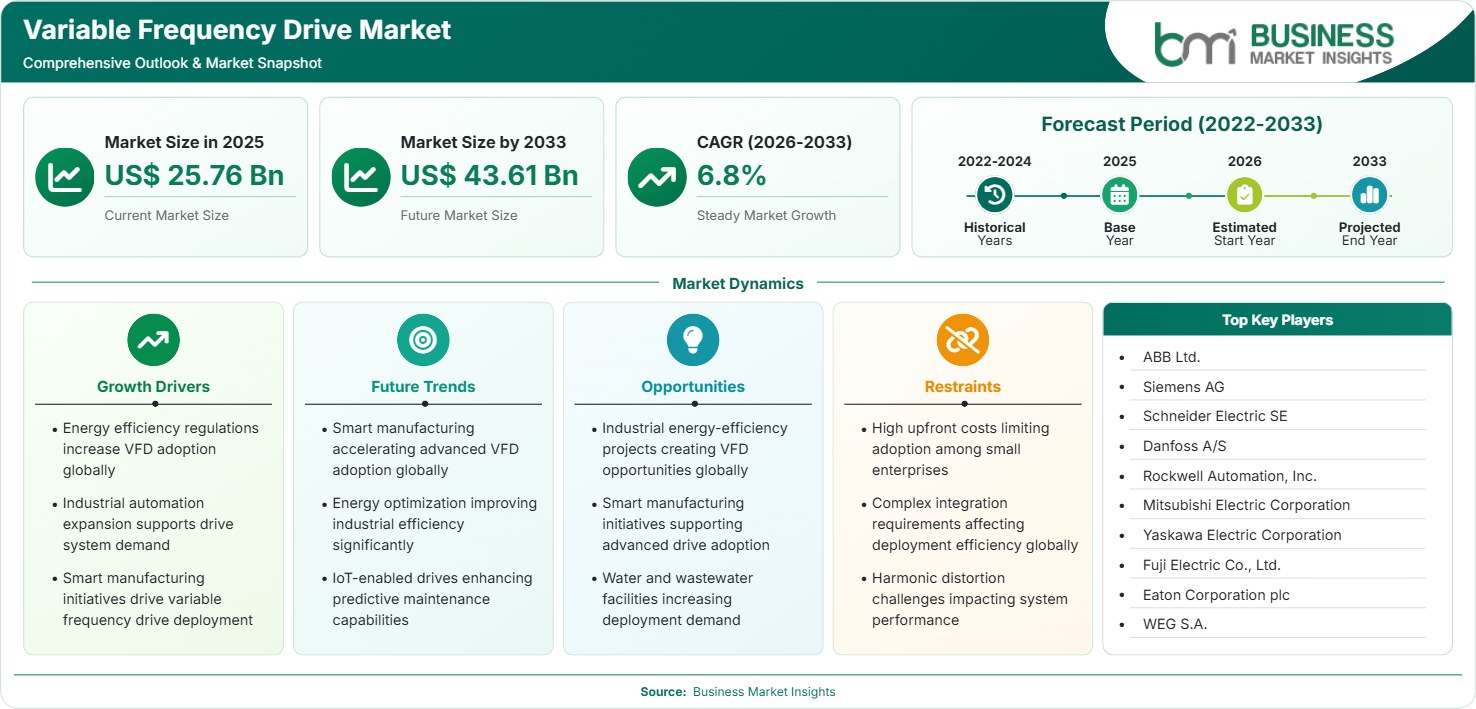
The Variable Frequency Drive Market size was valued at US$ 25.76 Billion in 2025 and is projected to reach US$ 43.61 Billion by 2033, growing at a CAGR of 6.8% during 2026–2033. Rising industrial automation, energy-efficiency mandates, smart motor controls, infrastructure modernization, and electrification programs are accelerating adoption, while digital monitoring, predictive maintenance, and industrial decarbonization create significant opportunities.

Report Coverage
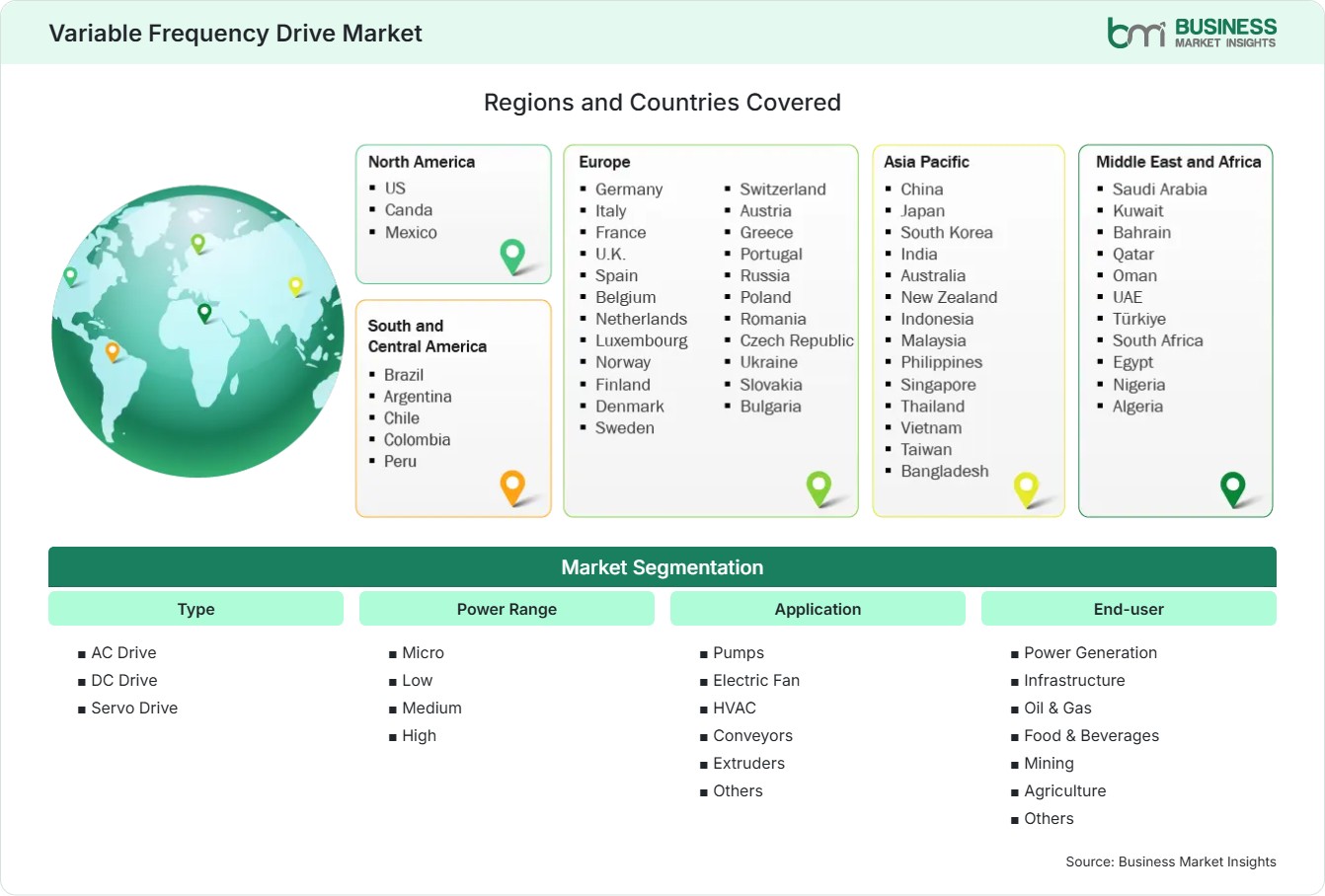
  • Type: AC Drive, DC Drive, Servo Drive
  • Power Range: Micro, Low, Medium, High
  • Application: Pumps, Electric Fan, HVAC, Conveyors, Extruders, Others
  • End-user: Power Generation, Infrastructure, Oil & Gas, Food & Beverages, Mining, Agriculture, Others
US$ 25.76 Bn Market size in 2025
US$ 43.61 Bn Market Size by 2033
6.8% CAGR, 2026 - 2033
2026-2033 Forecast Period

AI Overview

Variable Frequency Drive Market Summary

  • North America Region: North America holds a market share of 29%–32% in 2025, growing at a CAGR of 5.8%–6.2% during 2026–2033. Industrial energy-efficiency programs, modernization of water infrastructure, smart factories, data-center expansion, and motor optimization investments continue supporting adoption across manufacturing and utilities. The U.S. benefits from advanced industrial automation adoption and sustained investments, recording a CAGR of 5.7%–6.1%.
  • Fastest Growing Region: Asia Pacific accounts for a 39%–42% share in 2025 and advances at a 7.5%–8.0% CAGR through 2033. Manufacturing relocation, industrial capacity additions, urban infrastructure projects, renewable energy integration, and demand for efficient motor systems stimulate broad deployment.
  • Leading Segment: AC Drive represents a 63%–67% share in 2025 and expands at 6.6%–7.0% CAGR. Superior efficiency, compatibility with industrial motors, reliable speed control, lower maintenance requirements, and extensive usage across process industries sustain leadership.
  • High Growth Segment: HVAC holds 16%–20% Variable Frequency Drive Market share in 2025 and grows at 7.8%–8.4% CAGR. Energy-performance regulations, smart-building installations, commercial construction upgrades, occupancy-based controls, and operational cost reduction initiatives increase deployment opportunities.
  • Key Market Opportunity: Integration of intelligent drives with IIoT platforms, cloud diagnostics, digital twins, and predictive maintenance technologies creates long-term value through optimized energy consumption, reduced downtime, enhanced productivity, and lifecycle management.
  • Major Market Players: ABB Ltd., Siemens AG, Schneider Electric SE, Danfoss A/S, Rockwell Automation, Inc., Mitsubishi Electric Corporation, Yaskawa Electric Corporation, Fuji Electric Co., Ltd., Eaton Corporation plc, and WEG S.A.
Strategic Insights

Variable Frequency Drive Market: Strategic Insights

Variable Frequency Drive Market Strategic Framework
FREE PDF
Request your free sample
Request free sample
Stakeholder View

Key Takeaways

  • The semiconductor suppliers, the software providers, the automation specialists, the motor manufacturers, and the system integrators are becoming more integrated within the industry, which in turn leads to new digital service opportunities that go beyond the sale of hardware.
  • The strongest medium-term prospects for expansion lie in the areas of HVAC, water-treatment pumping systems, industrial conveyors, and renewable-energy installations because of the increasing requirements regarding energy efficiency.
  • Innovation is now moving in the direction of diagnostics powered by AI, the use of edge computing, the ability to carry out predictive maintenance, and cloud-connected monitoring systems, all of which enhance the performance and reliability of equipment.
  • India, the countries of Southeast Asia, Saudi Arabia, and some of the economies in Africa provide promising opportunities for growth due to industrial expansion, urbanization, and infrastructure investments.
  • More strategic acquisitions and partnerships are concentrating on software analytics, industrial connectivity, and smart manufacturing platforms, which supplement the existing motor-control ranges.
  • Sustainability metrics are now being taken into account when making purchases, which is prompting suppliers to show measurable decreases in their electricity usage and in their ongoing operating costs over the product's lifecycle.
Geographic Outlook

Variable Frequency Drive Market Regional Highlights

North America Variable Frequency Drive Market

North America accounts for 29%–32% of global revenue in 2025 and is projected to grow at 5.8%–6.2% CAGR through 2033. Strong industrial automation penetration, replacement of aging motor systems, and energy-efficiency programs support expansion. Variable Frequency Drive Market share remains supported by stringent efficiency standards and increasing digitalization of industrial assets.

  • Investment in smart manufacturing is causing demand for intelligent motor controls to rise in the automotive, chemicals, and consumer goods industries.
  • The modernization of water and wastewater systems promotes the use of energy-saving pump control systems.
  • Increasingly, commercial buildings are using advanced HVAC optimization technologies to meet energy performance requirements.
  • The expansion of data centers increases the demand for efficient cooling infrastructure and connected motor management systems.
  • When asset operators are buying equipment, industrial cybersecurity integration has become a key factor in their decision.

US Variable Frequency Drive Market

The United States represents approximately 73%–77% Variable Frequency Drive Market share within North America and advances at 5.7%–6.1% CAGR. Manufacturing reshoring, infrastructure investments, and energy-management initiatives encourage upgrades of motor-driven equipment across industrial facilities.

  • Efforts at the federal and state levels to improve efficiency involve the replacement of conventional motor control systems.
  • The need for conveyor optimization technologies arises as logistics and warehouse infrastructure is expanded.
  • The process industry is increasingly incorporating predictive maintenance features into its drive designs.
  • Utility operators use intelligent motor management to lower energy consumption and operational costs.

Europe Variable Frequency Drive Market

Europe holds 24%–27% Variable Frequency Drive Market share in 2025 and grows at 5.9%–6.4% CAGR. Decarbonization objectives, industrial efficiency targets, and modernization projects support sustained deployment.

  • The EU's regulations concerning energy efficiency promote their uptake in both industrial and commercial establishments.
  • Germany still holds the position of the largest market as a result of its substantial investments in manufacturing and automation.
  • Poland, together with the other economies of Eastern Europe, is showing rapid activity in the field of industrial modernization.
  • The construction of retrofits leads to the quicker acceptance of advanced energy-management technologies.
  • The integration of renewable energy leads to an increased demand for efficient auxiliary motor control systems.

Asia Pacific Variable Frequency Drive Market

Asia Pacific commands 39%–42% Variable Frequency Drive Market share in 2025 and is expected to record 7.5%–8.0% CAGR, the highest globally. Large-scale manufacturing activity, infrastructure expansion, and urbanization drive demand. China remains the leading market, while India demonstrates the strongest growth potential within the region.

  • Investment in industrial automation is still growing in China, Japan, South Korea, and India.
  • The rising cost of electricity is leading to greater use of high-efficiency motor control technologies.
  • There are considerable opportunities available in building systems as a result of infrastructure and smart-city projects.
  • The industries involved in mining, metals, and processing are increasingly using advanced drive solutions.
  • The government's efforts to promote sustainability reinforce investment in energy-optimization technologies.

Rest of World Variable Frequency Drive Market

Rest of World accounts for 8%–11% Variable Frequency Drive Market share and expands at 6.8%–7.3% CAGR. South and Central America benefit from mining, water infrastructure, and industrial modernization investments. Middle East and Africa growth is supported by diversification programs, energy projects, and expanding manufacturing capabilities.

  • Brazil continues to be a major market in the region as a result of its industrial and utility investments.
  • Saudi Arabia is promoting demand in the Middle East by means of its industrial diversification programs.
  • Mining activities in Latin America are responsible for the implementation of medium-voltage drive systems.
  • There are opportunities in the field of water desalination and treatment in the various Gulf countries.
  • The development of infrastructure enhances the chances of long-term adoption in various emerging economies.
Global Market Geography
FREE PDF
Request your free sample
Request free sample
Segment Analysis

Variable Frequency Drive Market Segmentation

Type

Type segment analysis indicates AC drives dominate with 63%–67% of the Variable Frequency Drive Market scope in 2025 and expand at 6.6%–7.0% CAGR. Demand is supported by superior efficiency, flexible speed control, and compatibility with modern industrial applications. Servo drives demonstrate higher-value applications, while DC drives continue serving specialized legacy environments.

  • AC Drive: Widely adopted across industrial and commercial facilities because of efficiency advantages, reliability, reduced maintenance requirements, and broad applicability in pumps, fans, HVAC systems, and conveyors.
  • DC Drive: Maintains relevance in established installations requiring precise speed regulation and retrofit compatibility where complete motor replacement remains economically unfavorable.
  • Servo Drive: Gains adoption in advanced automation environments demanding high precision, dynamic response, accuracy, and performance optimization.

Power Range

The medium-power category captures the largest revenue contribution with approximately 35%–39% Variable Frequency Drive Market share and grows at 6.9%–7.3% CAGR. Broad applicability across manufacturing, process industries, and infrastructure projects sustains demand. Micro and low-power variants benefit from commercial building applications.

  • Micro: Favored in compact equipment, light industrial machinery, and building automation applications emphasizing energy conservation.
  • Low: Supports HVAC installations, small pumps, and light manufacturing processes requiring dependable speed control.
  • Medium: Preferred across large manufacturing operations because of performance flexibility and operational efficiency.
  • High: Deployed in mining, power generation, and heavy industrial environments requiring substantial motor capacities.

Application

Pumps remain the leading application with a 29%–33% share and a 6.5%–6.9% CAGR due to extensive use in utilities and industrial facilities. Variable Frequency Drive Market trends increasingly favor HVAC applications because of intelligent building management adoption.

  • Pumps: Essential for water treatment, utilities, process industries, and energy-optimization initiatives.
  • Electric Fans: Enhance airflow management while reducing energy consumption in industrial and commercial environments.
  • HVAC: Benefits from building efficiency programs, smart controls, and sustainability targets.
  • Conveyors: Support logistics, warehousing, mining, and manufacturing productivity improvements.
  • Extruders: Widely used in plastics and processing industries requiring consistent speed performance.

End-user

Infrastructure represents the fastest-expanding end-user segment, supported by urbanization and modernization programs. Industrial investment, energy management priorities, and automation requirements continue strengthening demand across sectors.

  • Power Generation: Utilizes advanced motor control systems to improve auxiliary equipment efficiency and reliability.
  • Infrastructure: Supported by smart-city development, transportation projects, and water management initiatives.
  • Oil & Gas: Focuses on operational efficiency and reduced energy consumption in critical processes.
  • Food & Beverages: Requires precise motor control, hygiene compliance, and production optimization.
  • Mining: Deploys robust high-power systems capable of operating in challenging environments.
  • Agriculture: Benefits from irrigation efficiency improvements and modern farm automation technologies.
Market Forces

Variable Frequency Drive Market Dynamics

Key Market Drivers

Rising Industrial Energy Efficiency Requirements

Electric motor systems consume a substantial share of industrial electricity, making efficiency improvement a strategic priority. International energy agencies estimate motor-driven systems account for a significant portion of industrial power usage, encouraging adoption of advanced speed-control technologies. Variable Frequency Drive Market growth is heavily supported by regulations promoting energy conservation across manufacturing, utilities, and commercial infrastructure. By matching motor output with operational demand, drive systems reduce electricity consumption, improve process control, and lower maintenance expenses. The business case remains particularly attractive in water treatment, HVAC, mining, and process-manufacturing environments where energy costs represent a significant operating expense.

Acceleration of Industrial Automation Programs

Factories increasingly prioritize automation to improve productivity, consistency, and asset utilization. Advanced drive systems provide essential control capabilities required for conveyors, robotic equipment, pumps, and production lines. Integration with industrial communication protocols and analytics platforms enables real-time monitoring and optimization. As smart manufacturing adoption expands worldwide, intelligent motor control systems become critical infrastructure. Variable Frequency Drive Market growth benefits from increasing deployment of connected machinery, predictive maintenance practices, and digital manufacturing tools that require precise speed and torque management across diverse industrial applications.

Infrastructure and Water Management Investments

A great deal of resources are being assigned by governments and utility companies to water distribution networks, wastewater treatment plants, transport assets, and general public infrastructure. Since pumping systems account for a major portion of electricity use in these kinds of projects, there is a strong need for efficient motor management technologies. Today's drive solutions enable flow optimization, reduce equipment wear, and enhance operational reliability. The growing size of urban populations together with increasing worries about water scarcity are leading to more investment in this area. Long-term infrastructure development programs in the Asia Pacific region, in North America, and in the Middle East are still helping to create a favorable environment for the adoption of advanced drive technologies.

Key Market Opportunities

Expansion of Digital and Predictive Maintenance Platforms

Industrial operators increasingly seek technologies that minimize downtime and improve visibility into equipment performance. Intelligent drives integrated with sensors, analytics software, and cloud platforms enable predictive maintenance strategies. Suppliers able to combine hardware sales with recurring digital service revenues can strengthen profitability. Industrial customers gain benefits through condition monitoring, energy reporting, and performance optimization. Variable Frequency Drive Market Forecasts indicate growing demand for connected drive ecosystems as industries prioritize reliability, productivity, and operational intelligence.

Growing Demand from Smart Building Ecosystems

Commercial buildings are becoming more intelligent through the use of integrated energy management systems. HVAC equipment, ventilation systems, pumps, and airflow devices are increasingly making use of variable-speed control technology to achieve their sustainability goals. Since building owners want solutions that will cut down on operating costs at the same time as enhancing occupant comfort, this has led to greater acceptance of such systems. The regulatory requirements concerning energy performance also help to promote their adoption. Suppliers who are expanding their partnerships with building automation providers can take advantage of the opportunities available in the commercial real estate sector, in hospitals, at airports, in educational campuses, and in mixed-use developments.

Emergence of Electrified Industrial Processes

Strategies aimed at decarbonizing industry promote greater electrification in the areas of manufacturing, mining, and utility operations. Since electric equipment usually needs sophisticated motor control to function at its best, this is a key requirement. Making investments in the integration of renewable power, electric process technologies, and energy-efficiency measures leads to new ways of deploying these solutions. The potential opportunity goes beyond simply replacing equipment to include full digital powertrain solutions. Companies that provide scalable platforms incorporating analytics and energy-management features will be able to take advantage of the changing focus on industrial sustainability.

Market Restraints and Challenges

High Initial Capital Costs for Advanced Systems

The advanced drive systems involve the use of complex power electronics, software features, and connectivity options, which in turn lead to higher acquisition costs. As a result, small and medium-sized enterprises may postpone their modernization initiatives even though they are aware of the energy-saving advantages. Due to budget limitations, the period over which equipment is replaced is often lengthened, especially in industries where costs are a major concern. Additional installation requirements, the need for engineering services, and the necessity of staff training can also increase project expenses. Even though the savings over the lifetime of the system are appealing, the initial investment still affects purchasing decisions and causes slower adoption among some end-user groups.

Integration Complexity in Legacy Facilities

Many industrial facilities operate aging motors, mechanical systems, and control architectures lacking compatibility with modern digital technologies. Retrofitting can require extensive engineering modifications, temporary operational disruptions, and additional testing procedures. Compatibility concerns involving communication protocols, cybersecurity standards, and electrical infrastructure increase implementation complexity. Organizations may postpone projects where integration risks outweigh short-term operational benefits. These challenges are especially relevant in mature industrial facilities with long-established production environments.

Company Analysis

Competitive Landscape

Variable Frequency Drive Market analysis indicates competition is shaped by technology innovation, global channel networks, digital service capabilities, and industry-specific expertise.

Company Name

Overview

Products and Services relevant to this market

ABB Ltd.

Global automation and electrification leader with extensive industrial and utility presence.

Low-voltage and medium-voltage drives, digital monitoring, motor solutions, lifecycle services.

Siemens AG

Major industrial technology company serving manufacturing, infrastructure, and energy sectors.

SINAMICS drives, automation software, motion control solutions, industrial connectivity.

Schneider Electric SE

Energy management and industrial automation specialist with global reach.

Altivar drives, smart motor control, energy management platforms, building solutions.

Danfoss A/S

Recognized provider of energy-efficient drive technologies across industries.

VLT and VACON drives, HVAC solutions, digital performance optimization services.

Rockwell Automation, Inc.

Focuses on connected enterprise and smart manufacturing technologies.

PowerFlex drives, automation controls, industrial software and analytics platforms.

Mitsubishi Electric Corporation

Broad industrial automation portfolio with strong Asia presence.

Variable speed drives, motion control systems, factory automation products.

Yaskawa Electric Corporation

Specialist in motion control and industrial automation technologies.

AC drives, servo systems, robotics integration and control platforms.

Fuji Electric Co., Ltd.

Industrial equipment manufacturer serving infrastructure and process industries.

Low-voltage drives, power electronics, energy management solutions.

Eaton Corporation plc

Power management company supporting industrial and commercial sectors.

Adjustable frequency drives, electrical systems, industrial power solutions.

WEG S.A.

Global motor and automation supplier with growing international presence.

Variable frequency drives, electric motors, automation and control products.

Trust & Transparency

Research Methodology

The market analysis combines proprietary research with secondary data from government agencies, company disclosures, regulatory filings, industry databases and expert interviews. Market estimates are validated through data triangulation, cross-market benchmarking and analyst review.

View Full Research Methodology

Questions Answered

Frequently Asked Questions

What does a Variable Frequency Drive Market Report typically analyze?

It evaluates market size, competitive positioning, technology developments, regional demand patterns, segmentation trends, regulatory impacts, investment opportunities, and forecast growth prospects.

What factors influence purchasing decisions among industrial users?

Energy savings potential, compatibility with existing systems, digital monitoring capabilities, cybersecurity features, reliability, maintenance requirements, and total lifecycle cost are major evaluation factors.

Which region presents the strongest long-term opportunity?

Asia Pacific offers the strongest growth potential because of industrialization, infrastructure investments, manufacturing expansion, and increasing implementation of energy-efficiency regulations.

How does a Variable Frequency Drive reduce operating costs?

It adjusts motor speed according to actual load requirements, reducing electricity consumption, minimizing mechanical wear, improving process control, and extending equipment lifespan.

What industries generate the highest demand for advanced motor control technologies?

Power generation, manufacturing, water treatment, HVAC, mining, food processing, and oil and gas industries represent the largest demand centers because motor-driven systems are critical to operational efficiency and energy management.

Access the Full Variable Frequency Drive Market Report

Get segment-level forecasts, regional estimates, competitive benchmarking, company profiles and downloadable Excel datasets.

Access the full Variable Frequency Drive Market Report
350 pages PDF & Excel | 2026-11-03
Similar Research

Related Market Reports