Market Summary
Executive Summary and Global Market Analysis
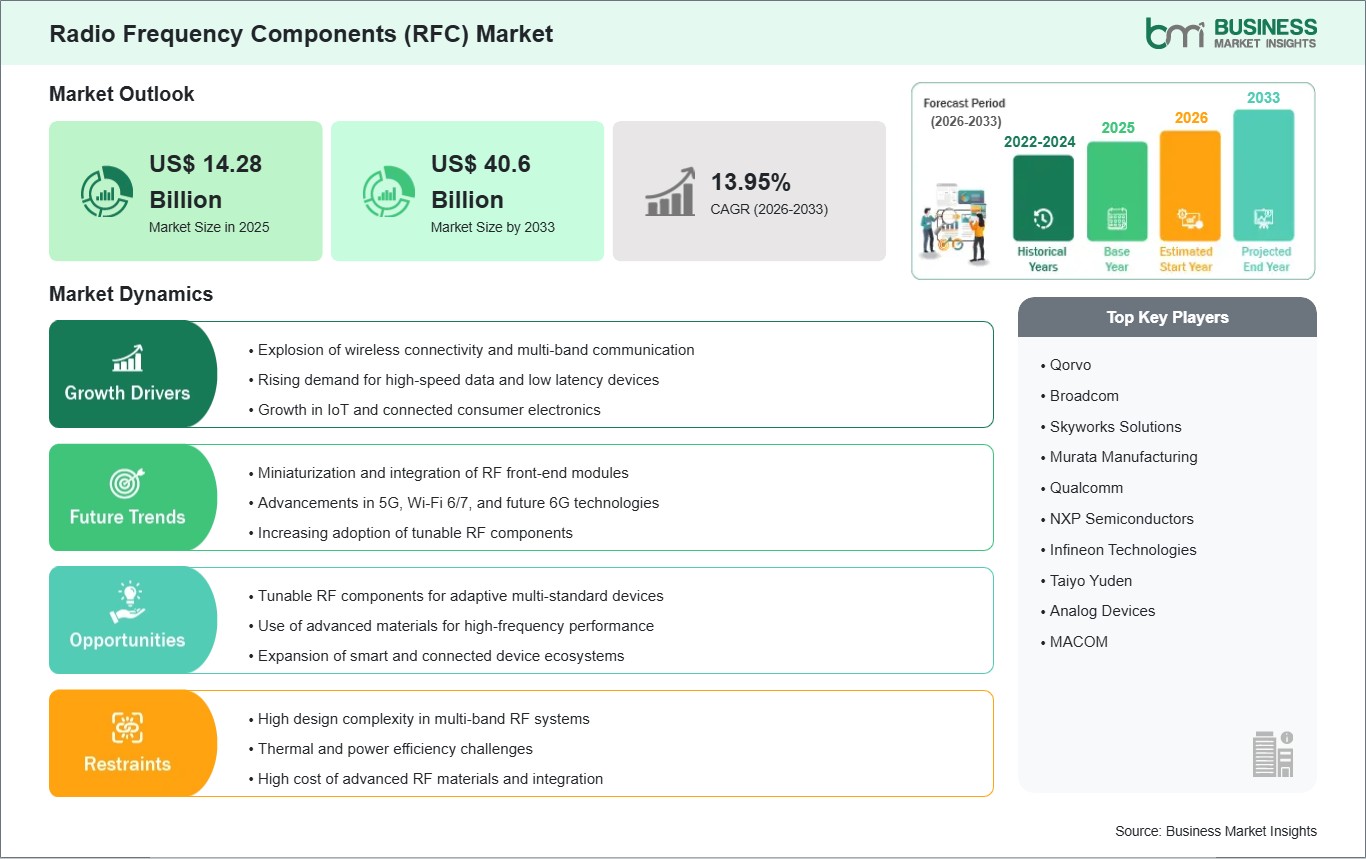
The global RFC market for consumer electronics is driven by rapid wireless connectivity growth and smart device penetration. RFC modules enable wireless communication, frequency filtering, power amplification, and antenna switching for 4G, 5G, Wi‑Fi, and Bluetooth across smartphones, tablets, GPS devices, laptops, and smart TVs.
Rising demand for higher data speeds, lower latency, and seamless connectivity drives investment in RFC innovations for performance, power efficiency, and tunability. Competitive strategies focus on power efficiency, noise suppression, heat tolerance, and integration. Partnerships with OEMs enable tailored RFC solutions. Spectrum agility, device coexistence, and advanced materials support high-frequency operation, making RFC essential for next-generation consumer electronics connectivity.
Segment Analysis
Radio Frequency Components (RFC) Market Segmentation
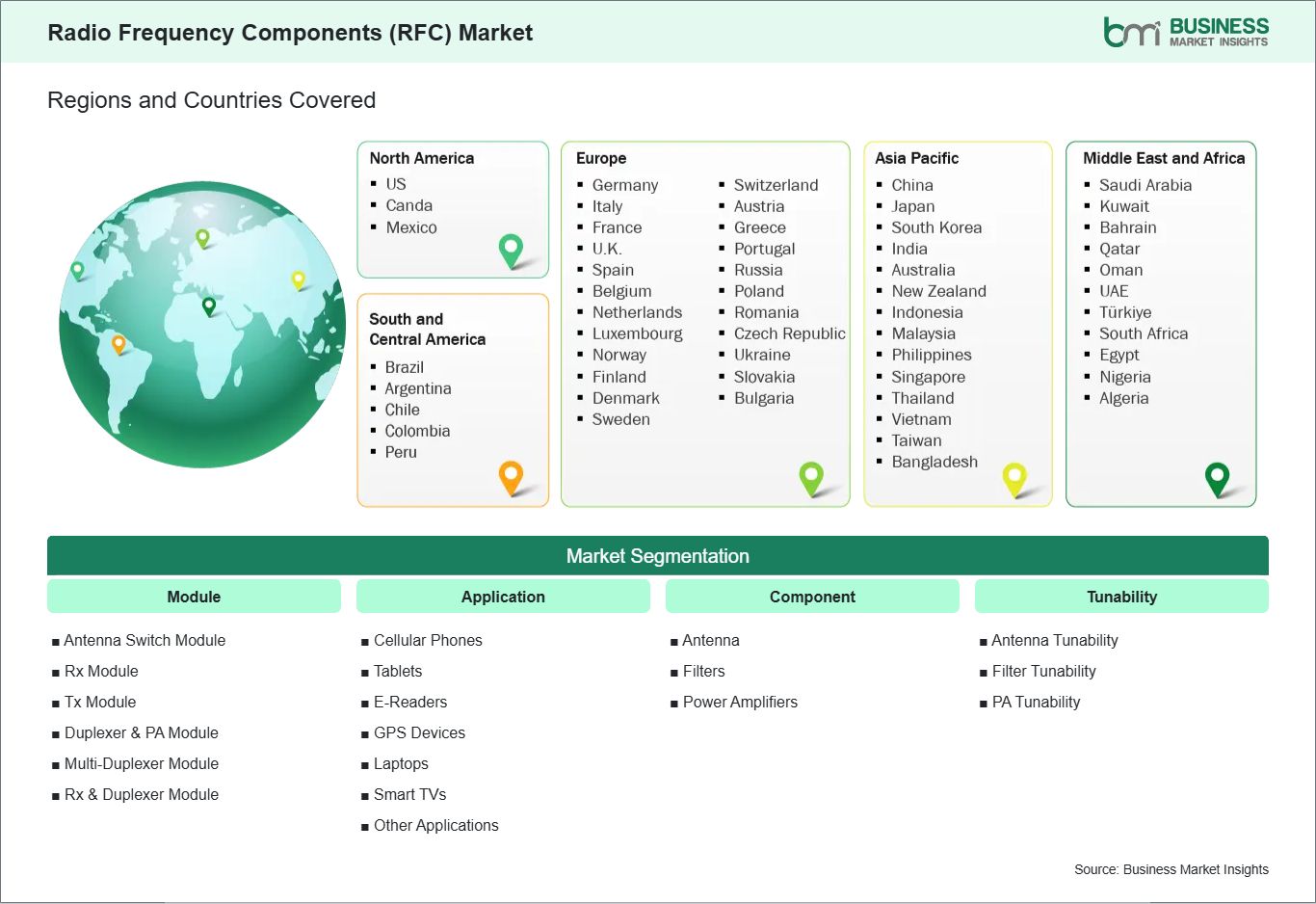
Key segments that contributed to the derivation of the radio frequency components (RFC) market for consumer electronics analysis are module, application, component, tunability, and material.
- By module, the radio frequency components market for consumer electronics is segmented into antenna switch module, Rx module, Tx module, duplexer & PA module, multi‑duplexer module, and Rx & duplexer module. The Duplexer & PA Module segment dominated the market in 2025.
- In terms of application, the radio frequency components market for consumer electronics is segmented into cellular phones, tablets, e‑readers, GPS devices, laptops, smart TVs, and other applications. The cellular phones segment dominated the market in 2025.
- By component, the radio frequency components market for consumer electronics is segmented into antennas, filters, and power amplifiers. The filters segment dominated in 2025.
- By tunability, the radio frequency components market for consumer electronics is segmented into antenna tunability, filter tunability, and PA tunability. The antenna tunability segment dominated the market in 2025.
- By material, the radio frequency components market for consumer electronics is segmented into silicon, silicon germanium, gallium arsenide, indium phosphide, and gallium nitride. The silicon dominated the market in 2025.
Market Forces
Radio Frequency Components (RFC) Market Drivers and Opportunities
Explosion of Wireless Connectivity and Multi‑Band Communication
Growth is driven by 4G LTE, 5G NR, Wi‑Fi 6/7, and upcoming 6G standards. Devices require high-speed data, low latency, and seamless connectivity across multiple frequency bands, relying on RFC modules like duplexers, multi‑duplexers, and PAs. Carrier aggregation and increased HD video streaming, real-time communication, and IoT adoption intensify RF performance demands.
Consumer demand for sleek form factors and long battery life drives investment in tunable antennas, filters, and PAs for efficiency and miniaturization.
Tunable RF Components for Adaptive and Multi‑Standard Devices
Tunable RF components support adaptive performance across diverse frequencies and communication standards. They enable dynamic frequency adjustment, improved spectral efficiency, and reduce BOM costs. Supporting software-defined radio (SDR) architectures extends device lifecycle and reduces inventory risks. Advanced materials like GaN and SiGe enable high-frequency operation with enhanced linearity and power handling.
Size and Share Analysis
Radio Frequency Components (RFC) Market Size and Share Analysis
The Radio Frequency Components (RFC) Market for Consumer Electronics demonstrates steady growth, with size and share analysis highlighting evolving trends and competitive dynamics among key players. The report examines subsegments categorized within module, application, component, tunability, and material, offering insights into their contribution to overall market performance.
By module, the duplexer & PA module subsegment dominated the market in 2025, driven by the essential role these modules play in combining transmit/receive paths while delivering required amplification across multiple frequency bands in advanced wireless devices.
By application, the cellular phones subsegment dominated the market in 2025, driven by high global smartphone adoption and multi‑band connectivity requirements.
By component, the filters subsegment dominated the market in 2025, driven by critical need to maintain signal fidelity and reduce interference across dense spectrums.
By tunability, the antenna tunability subsegment dominated the market in 2025, driven by demand for frequency agility across evolving wireless standards.
By material, the silicon subsegment dominated the market in 2025, driven by its cost‑effectiveness, mature manufacturing ecosystem, and broad adoption in high‑volume consumer devices.
Report Coverage
Radio Frequency Components (RFC) Market Report Coverage and Deliverables
The "Radio Frequency Components (RFC) Market for Consumer Electronics Size and Forecast (2022 - 2033)" report provides a detailed analysis of the market covering below areas:
- Radio Frequency Components (RFC) Market for Consumer Electronics size and forecast at global, regional, and country levels for all the key market segments covered under the scope
- Radio Frequency Components (RFC) Market for Consumer Electronics trends, as well as drivers, restraints, and opportunities
- Radio Frequency Components (RFC) Market for Consumer Electronics analysis covering key trends, global and regional framework, major players, regulations, and recent developments
- Industry landscape and competition analysis covering market concentration, heat map analysis, prominent players, and recent developments for the Radio Frequency Components (RFC) Market for Consumer Electronics
- Detailed company profiles, including SWOT analysis
Geographic Insights
Radio Frequency Components (RFC) Market Geographic Insights
The geographical scope of the Radio Frequency Components (RFC) Market for Consumer Electronics report is divided into North America, Asia Pacific, Europe, Middle East & Africa, and South & Central America. North America held the largest share in 2025.
North America is supported by high adoption of premium devices, early deployment of advanced wireless standards, and substantial R&D investments by chipset and module designers. The U.S. also serves as a key innovation center for tunable RF technologies and material innovation, enabling ecosystem partnerships that influence global supplier strategies. Asia Pacific also dominates the market due to strong presence of consumer electronics manufacturers, expansive 5G rollouts, and high shipments of smartphones and other connected devices from countries such as China, South Korea, and India. China, in particular, serves as both a major production hub and a large end‑use market, driving demand for RF components with advanced integration and multi‑band support.
In Europe, the RFC market is bolstered by strong consumer demand for connected devices and investments in smart infrastructure, though regulatory focus on spectrum allocation and harmonization influences component design requirements. Emerging markets in Latin America and Middle East & Africa show growing potential, driven by expanding cellular penetration and increasing use of tablets, smart TVs, and IoT devices though infrastructure constraints and cost‑sensitivity limit near‑term growth.
Across all regions, trends toward higher frequency operations, multi‑band integration, and miniaturization shape competitive dynamics and investment priorities, positioning the RFC market as a foundational segment in the broader consumer electronics ecosystem.
Industry Activity
Recent Developments
The Radio Frequency Components (RFC) Market for Consumer Electronics is evaluated by gathering qualitative and quantitative data post primary and secondary research, which includes important corporate publications, association data, and databases. A few of the key developments in the radio frequency components (RFC) market for consumer electronics are:
- In August 2025, Qorvo announced expansion of its multi‑band RF filter portfolio for 5G and Wi‑Fi 7 consumer devices, aimed at enhancing tunable filtering performance across next‑generation wireless bands.
- In January 2025, Broadcom introduced an integrated duplexer & PA module targeting high‑performance 5G handsets, supporting expanded spectrum aggregation.
Trust & Transparency
Research Methodology
The market analysis combines proprietary research with secondary data from government agencies, company disclosures, regulatory filings, industry databases and expert interviews. Market estimates are validated through data triangulation, cross-market benchmarking and analyst
review.
View Full Research Methodology
Key Sources Referred:
International Telecommunication Union (ITU)3rd Generation Partnership Project (3GPP)National Institute of Standards and Technology (NIST)Federal Communications Commission (FCC), USAEuropean Conference of Postal and Telecommunications Administrations (CEPT)Consumer Technology Association (CTA / CEA)