Market Summary
Executive Summary and Global Market Analysis
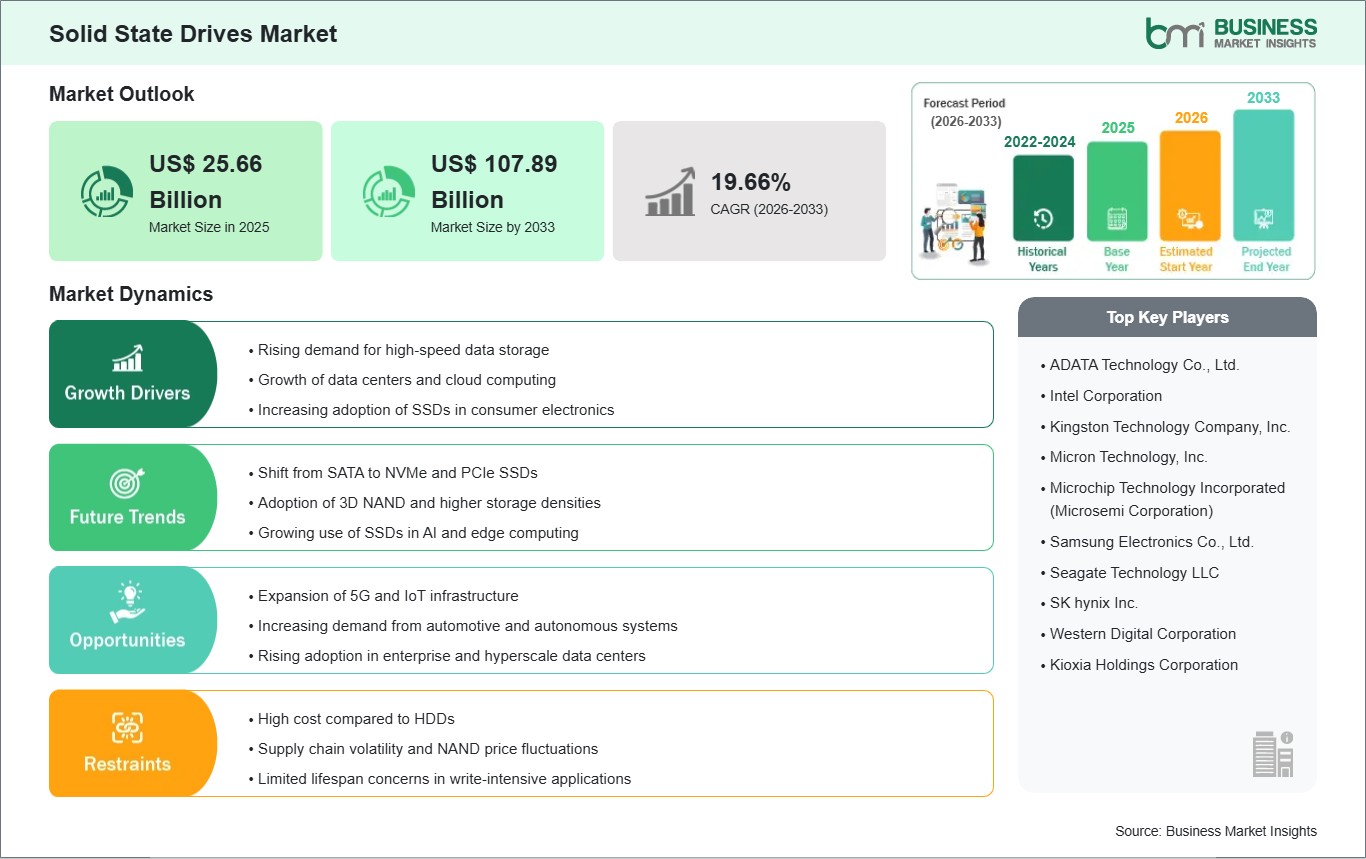
Solid State Drives (SSDs) are non-volatile storage devices that use integrated circuit assemblies, specifically NAND flash memory, to store data persistently. Unlike traditional Hard Disk Drives (HDDs), SSDs have no moving mechanical parts, relying instead on a sophisticated controller to manage data across silicon chips. This architecture enables near-instantaneous boot times, extreme read/write speeds, and superior physical durability, making them the standard for modern high-performance computing, from mobile devices to massive AI data centers. Market expansion in 2026 is primarily attributed to the explosive demand for Generative AI infrastructure, which requires high-density NAND to feed GPUs, and the massive PC refresh cycle driven by the end-of-life for Windows 10. Furthermore, the integration of PCIe 5.0 and 6.0 interfaces, which double bandwidth to support ultra-fast data transfer, is substantially improving the performance of modern storage arrays.
However, several challenges can restrain market growth: high ASP (Average Selling Price) volatility due to the cyclical nature of NAND bit supply can lead to sudden cost spikes for OEMs. Stringent regulatory hurdles regarding data privacy and encryption standards (like FIPS 140-3) lengthen the time-to-market for government and enterprise-grade drives. Additionally, the industry faces constraints due to a global memory shortage crisis in 2026, where manufacturing capacity is being reallocated away from consumer electronics toward high-margin AI components (like HBM), leading to potential supply bottlenecks and price increases for the broader market.
Despite these hurdles, the market holds immense opportunities in the universal mandate for green data centers, where SSDs are favored over HDDs for their significantly lower power consumption. The expansion of Edge Computing nodes in 5G networks and the development of PLC (Penta-Level Cell) NAND, which aims to further increase storage density while lowering cost-per-gigabyte, are expected to create significant opportunities for market growth.
Segment Analysis
Solid State Drives Market Segmentation
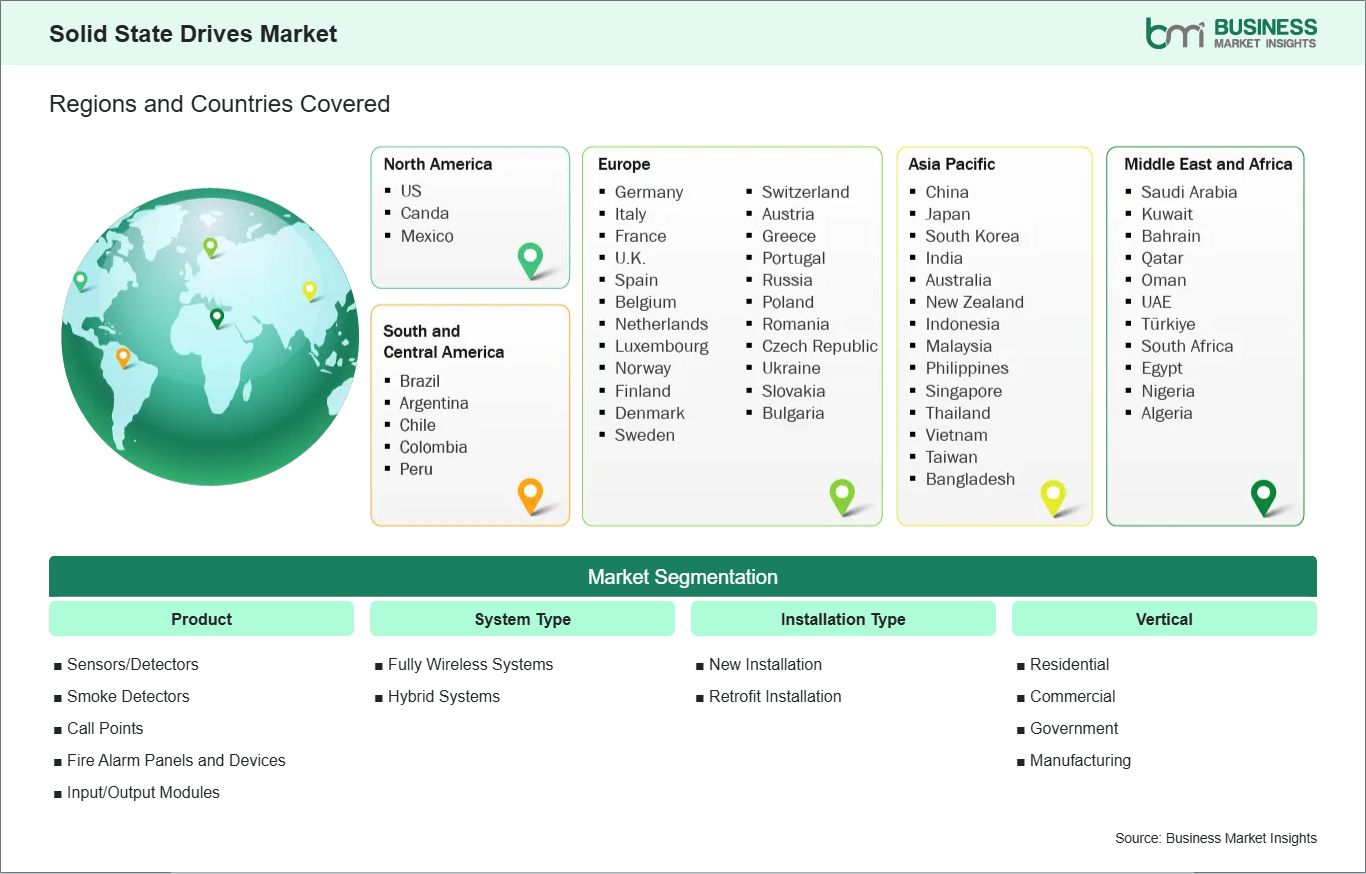
Key segments that contributed to the derivation of the Solid State Drives market analysis are type, technology, storage, and end user.
- By Type, the market is segmented into External and Internal.
- By Technology, the market is divided into Single-Level Cell, Multi-Level Cell, and Triple-Level Cell.
- By Storage, the market is categorized into Under 500 GB, 500 GB - 1 TB, 1 TB - 2 TB, and Above 2 TB.
- By End User, the market is segmented into Industrial, Automotive, Enterprise, and Client.
Market Forces
Solid State Drives Market Drivers and Opportunities
Advancing Data-Intensive Workloads and Infrastructure Modernization
The primary driver for the Solid State Drives (SSD) Market is the massive surge in data-intensive applications, specifically generative AI training and real-time big data analytics. As of 2026, enterprises and hyperscale data centers are aggressively transitioning from legacy hard disk drives (HDDs) to high-speed NVMe flash storage to eliminate I/O bottlenecks that stall powerful GPU clusters. This "AI arms race" requires storage solutions capable of sub-millisecond latency and massive throughput to feed data-hungry models. Furthermore, the global shift toward Industry 4.0 and edge computing is a non-discretionary driver; ruggedized, high-endurance SSDs are essential for 5G base stations, autonomous vehicles, and smart manufacturing hubs that operate in harsh environments. Additionally, the mainstreaming of PCIe Gen5 and Gen6 protocols, which double bandwidth over previous generations, is compelling a systemic hardware refresh across the gaming and professional workstation sectors. Together, these factors ensure that high-performance NAND flash is now the foundational utility for the modern, decentralized digital economy.
High-Density QLC Adoption and Liquid-Cooled Storage
A significant high-value opportunity lies in the rapid adoption of Quad-Level Cell (QLC) and emerging Penta-Level Cell (PLC) NAND for enterprise-grade "warm" and "cold" storage. As QLC achieves cost-per-terabyte parity with traditional HDDs, there is a burgeoning market for ultra-high-capacity drives (ranging from 60TB to 240TB) that offer superior power efficiency and rack density for archival and content delivery networks. There is also a major growth frontier in the development of liquid-cooled and fanless SSD architectures. As AI servers move toward direct-to-chip cooling to manage extreme thermal loads, the opportunity for storage manufacturers to integrate native liquid-cooling interfaces is expanding, allowing for higher sustained performance in compact footprints. Furthermore, the rise of Computational Storage, where data processing occurs directly on the drive controller, presents an opportunity to reduce data movement and power consumption in distributed AI inference tasks. Manufacturers who focus on "sovereign flash" solutions for secure government data and those pioneering recycled NAND programs are positioned to lead the market`s next sustainability-focused evolution.
Size and Share Analysis
Solid State Drives Market Size and Share Analysis
The Solid State Drives market demonstrates steady growth, with size and share analysis revealing evolving trends and competitive positioning among key players. The report further examines subsegments categorized within are type, technology, storage, and end user, offering insights into their contribution to overall market performance.
Based on type, the Internal subsegment holds a significant market share. Internal SSDs are indispensable for the Client and Enterprise sectors, serving as the primary storage medium for laptops, gaming consoles, and server racks. A notable trend in 2026 is the surge in the External subsegment, which is registering a higher growth rate. This expansion is driven by the "portable workstation" movement, where remote professionals and content creators require high-speed, ruggedized storage for 8K video editing and massive AI datasets on the go.
Report Coverage
Solid State Drives Market Report Coverage and Deliverables
The "Solid State Drives Market Size and Forecast (2022 - 2033)" report provides a detailed analysis of the market covering below areas:
- Solid State Drives market size and forecast at global, regional, and country levels for all the key market segments covered under the scope
- Solid State Drives market trends, as well as market dynamics such as drivers, restraints, and key opportunities
- Solid State Drives market analysis covering key market trends, global and regional framework, major players, regulations, and recent market developments
- Industry landscape and competition analysis covering market concentration, heat map analysis, prominent players, and recent developments for the Solid State Drives market
- Detailed company profiles, including SWOT analysis
Geographic Insights
Solid State Drives Market Geographic Insights
The geographical scope of the Solid State Drives market report is divided into five regions: North America, Asia Pacific, Europe, Middle East and Africa, and South and Central America.
The Asia-Pacific Solid State Drives Market is segmented into China, Japan, South Korea, India, Australia, New Zealand, Indonesia, Malaysia, the Philippines, Singapore, Thailand, Vietnam, Taiwan, Bangladesh, and the Rest of Asia. This region is emerging as the fastest-growing market globally. The expansion is primarily fueled by rapid digitalization and the proliferation of "5G Infrastructure" and "Smart City" initiatives that require low-latency, high-throughput storage. China and South Korea lead the regional growth, supported by a burgeoning IT sector and the widespread adoption of cloud-centric solutions among enterprises, which necessitate massive scaling of NVMe-based flash storage to manage complex data traffic.
Growth is further bolstered by a significant shift toward Quad-Level Cell (QLC) NAND technology among data center operators looking to reduce the total cost of ownership while maximizing storage density. The integration of advanced controller designs and EDSFF form factors into enterprise servers, alongside the rising demand for high-capacity portable SSDs for content creators in the post-pandemic digital economy, solidifies Asia-Pacific as a critical hub for innovation and the future scaling of the SSD industry.
Industry Activity
Recent Developments
The Solid State Drives market is evaluated by gathering qualitative and quantitative data post primary and secondary research, which includes important corporate publications, association data, and databases. A few of the key developments in the Solid State Drives market are:
- In September 2025, Samsung Electronics America unveiled the 9100 PRO Series SSDs, featuring blazing-fast speeds and its largest capacity to date. Designed to deliver next-generation performance, these drives offer the ultimate storage solution for demanding digital workloads. The 9100 PRO SSD leverages PCIe® 5.0 technology to achieve sequential read/write speeds of up to 14,800/13,400 MB/s, moving data twice as fast as the previous generation. This launch sets a new benchmark in SSD capacity and performance, driving innovation and competition in the high-capacity SSD market.
- In November 2024, Western Digital announced that it had released several new Flash storage solutions from its SanDisk® and WD_BLACK™ brands, offering enhanced speed, reliability, and capacity for professionals, creators, and consumers. The expanded SanDisk portfolio includes high-performance, durable portable SSDs designed for handling large amounts of data on the go. The launches strengthen innovation and competition in the SSD market, providing more advanced storage solutions for a diverse set of digital storage needs.
Trust & Transparency
Research Methodology
The market analysis combines proprietary research with secondary data from government agencies, company disclosures, regulatory filings, industry databases and expert interviews. Market estimates are validated through data triangulation, cross-market benchmarking and analyst
review.
View Full Research Methodology
Key Sources Referred:
World Bank - Global Trade IndicatorsWorld Trade Organization (WTO)International Monetary Fund (IMF)International Trade Administration (ITA)Company websiteCompany annual reportsCompany investor presentations