Market Summary
Executive Summary and Global Market Analysis
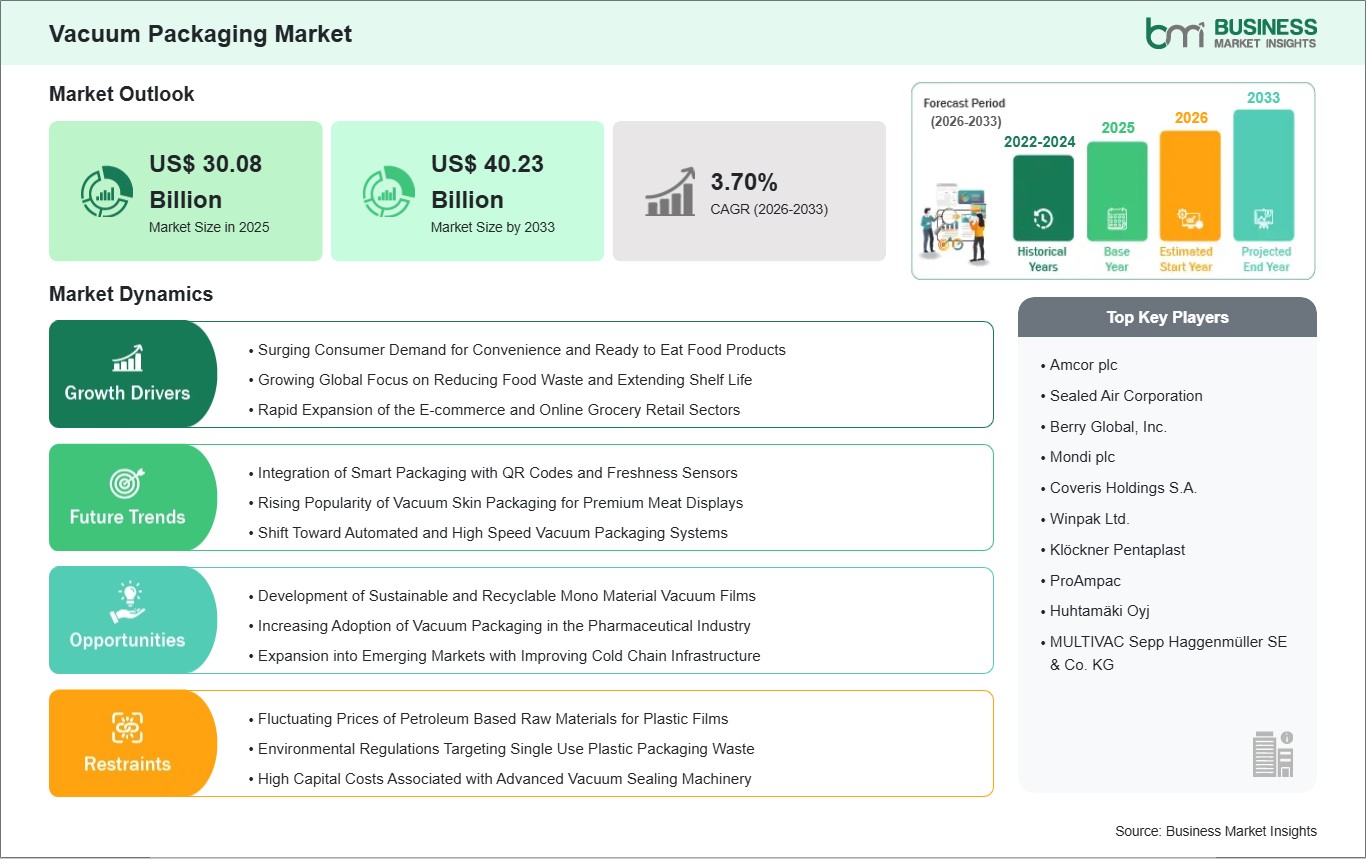
The global market for vacuum packaging is currently witnessing a period of robust growth, primarily driven by its indispensable nature in terms of food preservation and safety. This is because vacuum packing creates an environment that is devoid of oxygen, which in turn slows down the deterioration of perishables. This is highly beneficial in terms of reducing food waste and improving logistics. In terms of raw materials used in this market, plastic is still the dominant player owing to its superior properties. Flexible packaging in terms of bags and pouches is also witnessing maximum demand owing to their operational efficiency. In addition to this, this market is also witnessing traction in terms of healthcare industry demand.
The current areas of innovation in the industry are two-fold: sustainability and automation. The industry is shifting rapidly towards recyclable mono-materials to solve the sustainability problem associated with plastics, whereas the addition of high-speed automated machinery is enhancing the speed of manufacturing. Currently, the industry is dominated by the North American region due to high consumer expenditure and the maturity of the retail infrastructure. Although the industry faces challenges such as raw material price fluctuations and high equipment costs, the long-term outlook is favorable. The continuous growth in the e-commerce sector and the need for a convenient lifestyle guarantee the importance of vacuum packaging in the future supply chain.
Segment Analysis
Vacuum Packaging Market Segmentation
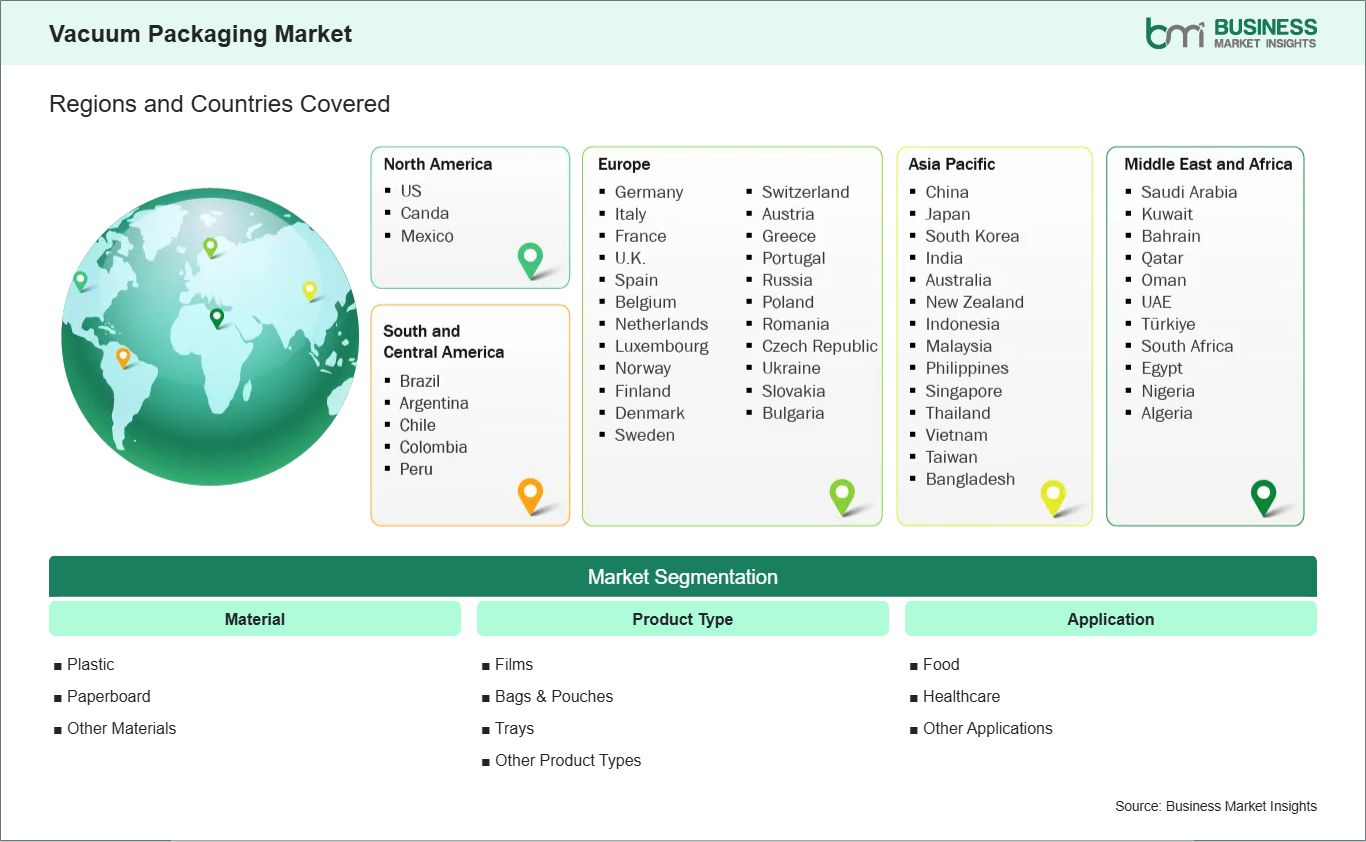
Key segments that contributed to the derivation of the Vacuum Packaging market analysis are material, product type, and application.
- By material, the Vacuum Packaging market is segmented into Plastic, Paperboard, and Other materials. The Plastic segment dominated the market in 2025.
- By product type, the Vacuum Packaging market is segmented into Films, Bags & Pouches, Trays, and Other product types. The Bags & Pouches segment dominated the market in 2025.
- By application, the Vacuum Packaging market is segmented into Food, Healthcare, and Other applications. The Food segment dominated the market in 2025.
Market Forces
Vacuum Packaging Market Drivers and Opportunities
Surging Consumer Demand for Convenience and Ready to Eat Food Products
The fast pace of modern lifestyles has significantly influenced the purchasing behavior of consumers, resulting in a significant rise in the consumption of processed and ready-to-eat foods. Vacuum packaging plays a crucial role in this change, enabling producers to offer consumers high-quality, pre-defined quantities of food that are fresh for a long period of time. This is possible since this technology removes oxygen from the packaging, thus preventing the oxidation of fats and vitamins, so that the original taste and texture of the food are maintained until it is delivered to consumers.
Furthermore, the rise of sous vide cooking in both commercial kitchens and households has further solidified the role of vacuum-sealed formats. This culinary technique relies on the precise temperature control enabled by airtight bags, driving demand for specialized, heat-resistant vacuum materials. As food processors continue to innovate with a wider variety of ethnic and gourmet ready-meals, the reliance on vacuum packaging as a primary preservation method is intensifying. The ability to stack these slim, flexible packages efficiently in retail displays and home refrigerators also enhances their appeal, making them a cornerstone of the modern convenience-driven food economy.
Development of Sustainable and Recyclable Mono Material Vacuum Films
Sustainability has become a non-negotiable requirement in the packaging industry, prompting a massive wave of innovation in material science. Historically, high-barrier vacuum packaging relied on complex multi-layer structures that were difficult to recycle because they combined different types of plastics and resins. The current opportunity lies in the transition toward mono-material films, which utilize advanced polymer engineering to achieve the same oxygen and moisture barrier properties within a single, recyclable material stream. These innovations allow companies to meet the increasingly stringent requirements of a circular economy while satisfying consumer demand for eco-friendly products.
The commercialization of these sustainable materials is being accelerated by corporate commitments to zero-waste goals and government-imposed plastic taxes. New generations of polyethylene-based and bio-derived films are being engineered to withstand the mechanical stresses of the vacuuming process without losing their protective integrity. By adopting these green solutions, brands can significantly reduce their environmental footprint and avoid the reputational risks associated with non-recyclable waste. As the technology matures and the cost of sustainable resins becomes more competitive, these eco-friendly vacuum formats are expected to capture a substantial portion of the market, moving the industry toward a more responsible and transparent future.
Size and Share Analysis
Vacuum Packaging Market Size and Share Analysis
The global Vacuum Packaging market is experiencing steady growth, with market size and share analysis reflecting evolving treatment preferences and competitive dynamics among key players. The report evaluates important subsegments categorized within material, product type, and application, highlighting their respective contributions to overall market performance.
By material, the Plastic subsegment dominated the market in 2025 due to its exceptional barrier properties against moisture and oxygen, combined with high flexibility and transparency. Its ability to conform to irregular product shapes while maintaining a hermetic seal is essential for ensuring long-term shelf stability.
By product type, the Bags & Pouches subsegment dominated the market in 2025 because of its versatility and efficiency in high-volume production lines. These formats offer superior sealing integrity and lightweight characteristics, which significantly reduce transportation costs and material waste compared to more rigid alternatives.
By application, the Food subsegment dominated the market in 2025 due to the critical global requirement for extending the shelf life of perishable items like meat, poultry, and dairy. Vacuum sealing effectively inhibits aerobic bacterial growth, maintaining nutritional value and flavor without the need for chemical preservatives.
Report Coverage
Vacuum Packaging Market Report Coverage and Deliverables
The "Vacuum Packaging Market Size and Forecast (2022 - 2033)" report provides a detailed analysis of the market covering below areas:
- Vacuum Packaging market size and forecast at the regional and country levels for segments covered under the scope
- Vacuum Packaging market trends, as well as drivers, restraints, and opportunities
- Vacuum Packaging market analysis covering key trends, regional framework, major players, regulations, and recent developments
- Industry landscape and competition analysis covering market concentration, heat map analysis, prominent players, and recent developments for the Vacuum Packaging market
- Detailed company profiles, including SWOT analysis
Geographic Insights
Vacuum Packaging Market Geographic Insights
The geographical scope of the Vacuum Packaging market report is divided into: North America, Asia Pacific, Europe, Middle East & Africa, and South & Central America. North America held the largest share in 2025.
North America stands as the dominant force in the global vacuum packaging market, a position sustained by a massive food processing industry and high levels of consumer disposable income. The United States, in particular, is a major hub for technological innovation in packaging, with many of the world’s leading material science companies headquartered in the region. The widespread preference for packaged meat, poultry, and dairy products, combined with an advanced retail landscape that includes extensive cold chain logistics, creates a consistent and high-volume demand for vacuum-sealed solutions. Furthermore, the region’s strict food safety regulations mandate the use of high-quality packaging to prevent contamination and ensure public health.
Beyond the food sector, the North American healthcare and pharmaceutical industries contribute significantly to market leadership. The demand for vacuum-packaged medical kits and sterile supplies is high, supported by a well-funded healthcare system and a focus on minimizing hospital-acquired infections. Additionally, the rapid growth of e-commerce and direct-to-consumer food delivery services in North America has necessitated the use of durable, lightweight vacuum packaging that can withstand the rigors of transit. As the region moves toward more sustainable practices, the early adoption of bio-based and recyclable films by major North American retailers is setting a global standard, further cementing its position as the primary driver of market value and technical advancement.
Industry Activity
Recent Developments
The Vacuum Packaging market is evaluated by gathering qualitative and quantitative data post primary and secondary research, which includes important corporate publications, association data, and databases. A few of the key developments in the Vacuum Packaging market are:
- In January 2026, Amcor, announced that it would showcase its FreshCase® vacuum packaging technology and full Moda vacuum system at IPPE 2026, aimed at extending shelf life, reducing food waste, and improving operational efficiency in protein packaging.
- In December 2024, Amcor, announced the demonstration of its Moda vacuum packaging solutions, including AI-enabled bagging and rotary vacuum systems, designed to reduce material waste and enhance automation in food processing operations.
- In November 2025, Sealed Air, announced ongoing strategic transformation efforts, including expanding its food and retail packaging portfolio (including vacuum packaging under its CRYOVAC® brand) to drive growth and adapt to changing consumer demand for packaged foods.
Trust & Transparency
Research Methodology
The market analysis combines proprietary research with secondary data from government agencies, company disclosures, regulatory filings, industry databases and expert interviews. Market estimates are validated through data triangulation, cross-market benchmarking and analyst
review.
View Full Research Methodology
Key Sources Referred:
American Chemistry Council (ACC)International Council of Chemical Associations (ICCA)European Chemical Industry Council (Cefic)China National Packaging Industry Association (CNPIA)Indian Institute of Packaging (IIP)Japan Packaging Institute (JPI)Gulf Petrochemicals and Chemicals Association (GPCA)Company WebsitesCompany Annual ReportsCompany Investor Presentations