
UV Stabilizers Market Outlook: Size, Share, Trends, Growth Analysis, Competitive Landscape & Forecast, 2026-2033

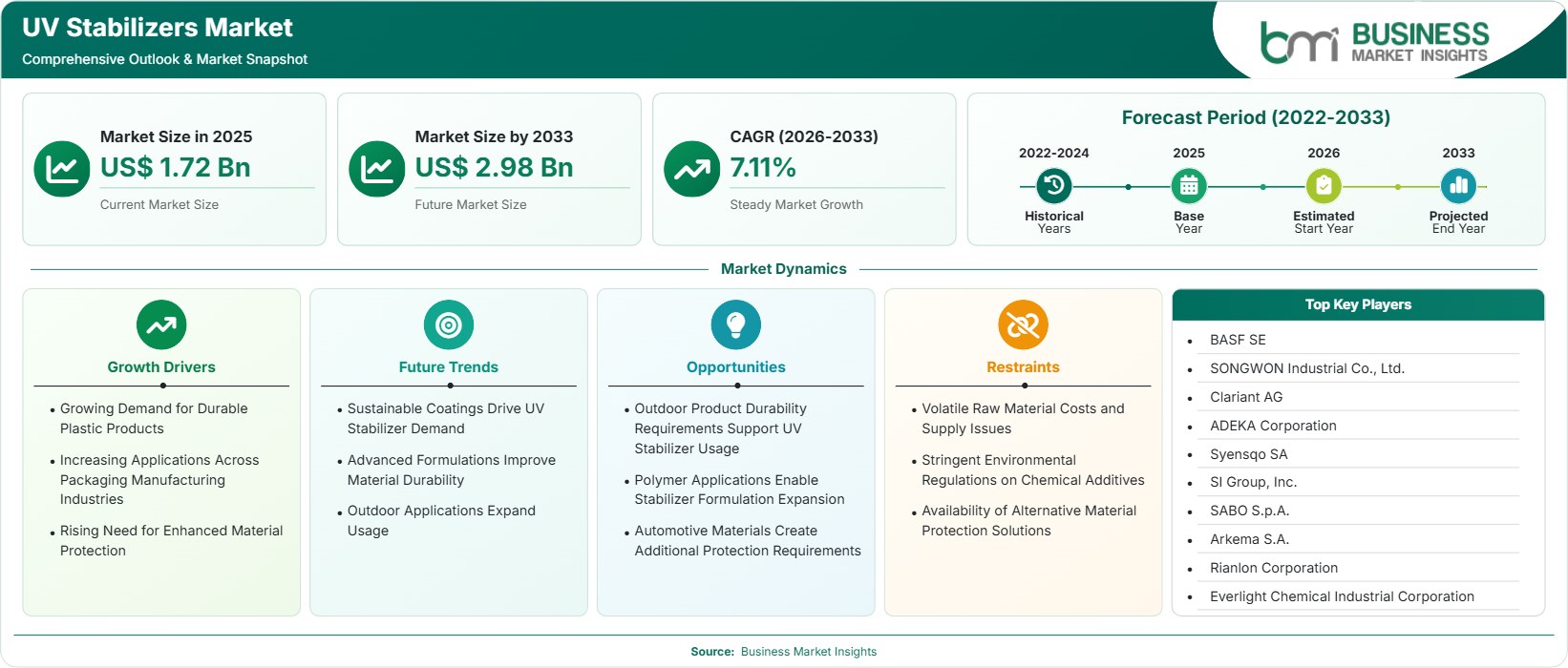
The UV Stabilizers Market size was valued at US$ 1.72 Billion in 2025 and is projected to reach US$ 2.98 Billion by 2033, growing at a CAGR of 7.11% during 2026–2033. Demand is being supported by durable polymer applications, outdoor infrastructure investments, lightweight automotive materials, agricultural film adoption, and opportunities in sustainable additives, recycled plastics, and high-performance packaging solutions.

Report Coverage
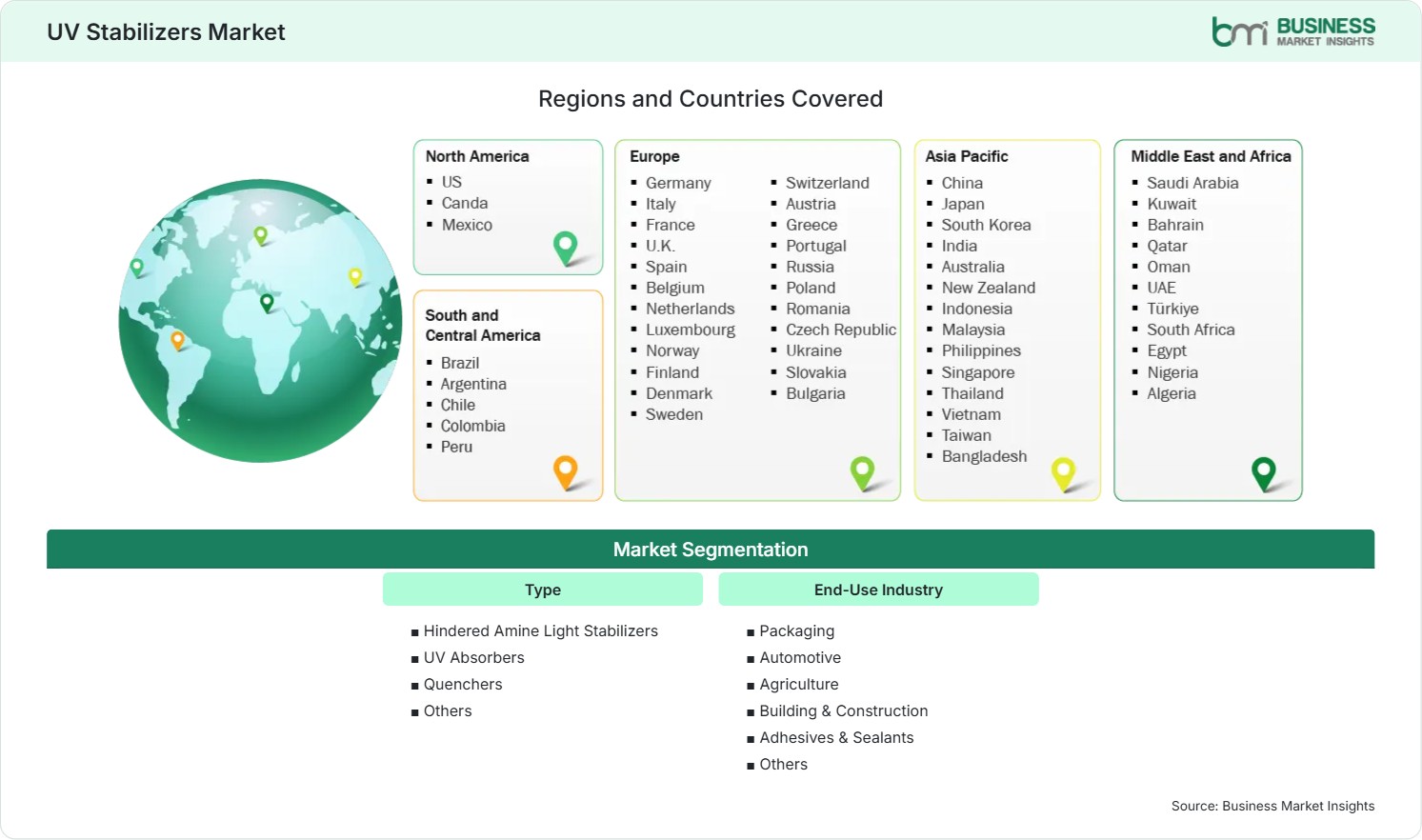
  • Type: Hindered Amine Light Stabilizers , UV Absorbers, Quenchers, Others
  • End-Use Industry: Packaging, Automotive, Agriculture, Building & Construction, Adhesives & Sealants, Others
US$ 1.72 Bn Market size in 2025
US$ 2.98 Bn Market Size by 2033
7.11% CAGR, 2026 - 2033
2026-2033 Forecast Period

AI Overview

UV Stabilizers Market Summary

  • North America Region: Holds a market share of 28%–31% in 2025, growing at a CAGR of 5.8%–6.3% during 2026–2033. Strong automotive plastics demand, advanced packaging consumption, and infrastructure refurbishment support adoption, while circular materials and specialty polymer innovations create opportunities across end-use industries globally. US market benefits from packaging modernization, engineered plastics demand, and additive innovation, advancing at 5.9%–6.4% CAGR.
  • Fastest Growing Region: Asia Pacific holds a UV Stabilizers Market share of 39%–42% in 2025, growing at a CAGR of 8.4%–8.9% during 2026–2033. Expanding manufacturing output, infrastructure development, agricultural film consumption, and rising polymer processing capacities accelerate consumption while domestic production investments strengthen regional competitiveness.
  • Leading Segment: Hindered Amine Light Stabilizers (HALS) account for a 42%–45% share in 2025 and are expected to expand at 7.4%–7.9% CAGR. Superior long-term weatherability, compatibility with polyolefins, and growing use in automotive and construction applications support sustained demand worldwide.
  • High Growth Segment: Packaging holds 28%–31% share in 2025 and is projected to expand at 8.0%–8.6% CAGR. E-commerce growth, flexible packaging innovation, food protection requirements, and recycled-content compatibility increasingly drive investment in advanced stabilization technologies.
  • Key Market Opportunity: Commercialization of UV-stable recycled polymers enables manufacturers to improve durability, comply with sustainability targets, support circular economy initiatives, enhance material performance, and differentiate premium outdoor applications globally.
  • Major Market Players: BASF SE, SONGWON Industrial Co., Ltd., Clariant AG, ADEKA Corporation, Syensqo SA, SI Group, Inc., SABO S.p.A., Arkema S.A., Rianlon Corporation, Everlight Chemical Industrial Corporation.
Strategic Insights

UV Stabilizers Market: Strategic Insights

UV Stabilizers Market Strategic Framework
FREE PDF
Request your free sample
Request free sample
Stakeholder View

Key Takeaways

  • The value chain increasingly integrates additive suppliers, polymer producers, compounders, and converters, improving customization capabilities and accelerating application-specific product development.
  • Packaging and agricultural film applications offer the strongest volume upside as UV exposure management becomes critical for product longevity and performance consistency.
  • R&D activity is shifting toward multifunctional stabilizers that combine UV protection with thermal stability and enhanced compatibility for recycled materials.
  • Asia Pacific presents the most compelling investment opportunity due to large-scale polymer manufacturing capacity expansions and infrastructure-led materials demand.
  • Strategic acquisitions and portfolio expansions among specialty chemical companies continue to improve market access, geographic reach, and technology depth.
  • Sustainability objectives are driving demand for low-emission formulations and stabilizers designed specifically for circular polymer systems.
Geographic Outlook

UV Stabilizers Market Regional Highlights

North America UV Stabilizers Market

North America represented approximately 28%–31% of the UV Stabilizers Market share in 2025 and is projected to advance at a CAGR of 5.8%–6.3% through 2033. Demand remains concentrated in packaging, automotive components, and construction materials. Strong innovation capabilities, widespread use of engineered plastics, and high replacement demand for outdoor infrastructure support consumption. Regulatory focus on durability and lifecycle performance continues encouraging adoption of advanced stabilization technologies across industrial and consumer applications.

  • Packaging producers increasingly adopt high-performance additive systems to enhance weather resistance and maintain product appearance during prolonged outdoor exposure.
  • Automotive lightweighting strategies continue supporting polymer utilization, increasing requirements for extended UV protection in exterior and interior components.
  • Infrastructure refurbishment programs stimulate demand for stabilized building products, roofing materials, and weather-resistant construction applications.
  • Sustainability targets encourage development of stabilizer solutions compatible with recycled resins and circular material strategies.

US UV Stabilizers Market

The United States accounts for approximately 72%–76% of regional demand and is expected to expand at 5.9%–6.4% CAGR through 2033. High consumption of specialty plastics, strong packaging innovation, and robust construction activity underpin market expansion. Domestic manufacturers continue prioritizing product longevity and performance optimization. Industrial automation and advanced material development support sustained demand across diverse end-use sectors.

  • Growth in flexible packaging strengthens demand for additive technologies that maintain durability and visual quality.
  • Expansion of engineered plastics applications increases consumption in transportation and industrial equipment.
  • Continued investment in specialty chemicals manufacturing enhances domestic supply capabilities.
  • Recycled-content targets encourage adoption of advanced stabilization systems across packaging formats.

Europe UV Stabilizers Market

Europe held approximately 24%–27% share in 2025 and is expected to register a CAGR of 6.2%–6.8% through 2033. Germany remains the largest regional market, while Eastern European manufacturing hubs show faster expansion. Sustainability regulations, circular economy policies, and durable construction requirements support adoption. The region benefits from advanced material science expertise and a mature specialty chemicals ecosystem.

  • Germany leads regional consumption through automotive, industrial manufacturing, and specialty polymer applications.
  • Poland and selected Eastern European countries represent faster-growing opportunities, supported by manufacturing investments.
  • Regulatory emphasis on recyclability supports innovation in additive technologies for circular materials.
  • Construction modernization programs strengthen demand for weather-resistant polymer solutions.

Asia Pacific UV Stabilizers Market

The Asia Pacific region holds a market share of 39% to 42% and is the fastest-growing region in the UV Stabilizers Market, with a CAGR of 8.4% to 8.9%. China has the highest consumption, whereas India and Southeast Asia offer great opportunities for growth. Improved plastic processing capabilities, infrastructure development, and agricultural advancements fuel continuous demand. Rising domestic manufacturing and export activity strengthen regional consumption patterns.

  • China remains the largest market due to extensive polymer production and downstream manufacturing activities.
  • India demonstrates strong momentum from infrastructure, packaging, and agricultural film demand.
  • Southeast Asian economies benefit from growing foreign direct investment in specialty chemicals.
  • Industrialization supports rising use of weather-resistant materials across construction applications.
  • Export-oriented manufacturing increases demand for high-performance polymer additives.

Rest of World UV Stabilizers Market

Rest of World accounts for around 8%-10% of total global demand in 2025 and is estimated to exhibit a CAGR of 7.0%-7.6% during 2024-2033. South & Central America are witnessing growth from agricultural film applications and packaging demand. Whereas, the Middle East & Africa markets are driven by infrastructural investments, greenhouse agriculture, and polymer conversion activities.

  • Brazil remains the leading Latin American market supported by agricultural and packaging applications.
  • Mexico benefits from manufacturing expansion and integration with North American value chains.
  • Saudi Arabia demonstrates increasing specialty chemical investments and polymer production capabilities.
  • UAE and South Africa show opportunities linked to construction and infrastructure development.
  • Rising food security initiatives support greenhouse and agricultural film consumption.
Global Market Geography
FREE PDF
Request your free sample
Request free sample
Segment Analysis

UV Stabilizers Market Segmentation

Type

The segment accounted for most of the industry's demand due to continuous innovation in additive chemistry. The segment held around 42% to 45% market share in 2025 and is expected to grow at 7.4% to 7.9% CAGR. The selection of products depends on the nature of the polymers, outdoor exposure, and service-life requirements. UV Stabilizers Market scope within advanced plastics continues to expand.

  • Hindered Amine Light Stabilizers (HALS): Preferred across polyolefins and construction materials due to long-term protection efficiency, weatherability enhancement, and compatibility with demanding outdoor applications.
  • UV Absorbers: Widely utilized in packaging, coatings, and transparent polymer systems where preservation of appearance and color stability remains critical.
  • Quenchers: Employed in specialized formulations requiring energy dissipation mechanisms and enhanced resistance against ultraviolet-induced degradation.

End-Use Industry

End-use Demand continues to diversify across industries. The packaging segment held the highest market share, 28%–31% in 2025, and is estimated to grow at a CAGR of 8.0%–8.6%. The UV Stabilizers Market trends show growing preference for durable packaging materials, lighter automobiles, and weather-resistant building materials.

  • Packaging: Demand is supported by flexible packaging growth, product protection requirements, and increasing use of recycled-content polymer structures.
  • Automotive: Lightweighting initiatives and durability standards encourage broader adoption in interior and exterior polymer components.
  • Agriculture: Greenhouse coverings, mulching films, and irrigation materials increasingly require enhanced ultraviolet protection performance.
  • Building & Construction: Roofing, façade systems, and outdoor materials utilize stabilizers to improve service life and reduce maintenance.
  • Adhesives & Sealants: Formulators employ advanced additives to maintain performance characteristics under prolonged environmental exposure.
Market Forces

UV Stabilizers Market Dynamics

Key Market Drivers

Growing Demand for Durable Polymer Applications

Polymer-based sectors have also continued to emphasize durability and weather resistance. There is also an increasing trend in the automobile industry to replace metals with lightweight plastics, while those in packaging are seeking ways to improve the durability of their products. According to industry trends in polymer manufacturing, as reported by major chemical organizations, there is also a continuous rise in the consumption of durable plastics in transportation, packaging, and infrastructure. The UV Stabilizers market growth depends on the use of engineering plastics and durable polymers, as these additives prevent discoloration and other UV-induced effects. The rise in infrastructure investments in major economies boosts the demand for such products that can maintain performance under challenging environmental conditions.

Rising Agricultural Film and Greenhouse Utilization

Globally, agricultural modernization has increased the demand for film materials, greenhouses, netting systems, and irrigation materials. Places with high levels of sunlight have been forced to seek advanced stabilization methods to enhance their mechanical strength and transparency. The increase in demand for food production and investments in controlled-environment agriculture encourage the use of polymer materials that can resist UV radiation. Durability has become a factor in the agricultural sector because premature degradation leads to replacement costs and productivity losses. Long-term investment in agricultural productivity enhancements continues to strengthen demand for specialized stabilization technologies that extend operational life and improve material reliability.

Expansion of Infrastructure and Construction Activities

Infrastructural development initiatives increase demand for outdoor polymers. The roofing industry, geomembranes, facades, and construction plastics need better protection against ultraviolet damage. Asset owners are increasingly concerned about the overall cost-efficiency of their built-environment assets, evaluating performance over the life cycle rather than initial material costs. This will lead to a preference for high-quality stabilization methods, which can provide longer life cycles. The UV Stabilizers Market trends and drivers will be augmented by increased investment in the construction of residences, businesses, and industrial facilities in developing nations. The heightened regulatory attention to sustainability and durability targets is set to drive the use of sophisticated additives designed to reduce lifecycle maintenance needs.

Key Market Opportunities

UV-Stable Recycled Polymer Solutions

The incorporation of recycled material into plastics offers numerous opportunities for additives producers. Recycled plastics usually need performance improvements to reach parity with virgin plastics. UV stabilizer technology is one solution that helps address the problem and promote the circular economy. Many producers now work with recyclers to create specialized formulas for recycled products. UV Stabilizers Market Forecasts indicate increasing demand from companies in the packaging, construction, and consumer goods sectors that aim to pursue sustainable development. These companies have the opportunity to earn premiums and meet customers’ environmental targets without sacrificing product durability or performance expectations.

Advanced Stabilizers for Electric Vehicle Components

Electric vehicles incorporate increasing amounts of engineered plastics and lightweight composite materials. Exposure of exterior trims, charging infrastructure, and under-hood components to environmental stresses creates demand for advanced protection technologies. Thermal stabilizers, which exhibit both superior thermal stability and UV resistance, offer definite advantages. Automakers need components that last longer, maintain low maintenance costs, and improve appearance. Additive formulations for use in electric vehicles present an opportunity for growth. Manufacturers with application expertise can capitalize on the new transportation environment and rising production volumes in the electric vehicle market.

Growth in High-Performance Packaging Formats

Higher-grade packaging types are more demanding regarding protection from external elements. Food, healthcare, and industrial packaging firms seek materials that help their products maintain appearance and functionality over time. The growth of e-commerce is placing more demands on performance. Novel stabilization techniques that provide transparency, recyclability, and robustness allow for differentiation. With the introduction of novel films and multi-layer constructions, demand for specialized additives is bound to grow. Investments in packaging innovation in Asia Pacific and North America offer growth potential for suppliers of delivering tailored stabilization solutions.

Market Restraints and Challenges

Raw Material Price Volatility

Factor: The prices of specialty chemical raw materials remain sensitive to changes in energy prices, supply shortages, and geopolitics. Impact: Production costs are highly volatile, affecting margins and pricing strategies across the value chain. It is tough for manufacturers to maintain margins while delivering their products under customer contracts over the long term. Any increase in production costs results in delays in purchasing products from converters and compounders. Small companies are more vulnerable to volatility due to limited purchasing power. High-quality products remain in demand despite volatility, affecting capacity investment decisions and influencing investment planning across the industry.

Regulatory and Formulation Complexity

Factor: Increased regulations on environmental, safety, and chemical compliance add to the cost of developing and certifying products. Impact: The time required to commercialize the product may increase due to costs associated with testing, formulation, and certification. Regional regulations further complicate matters for international manufacturers. Customers require more and more information about sustainability, compatibility, and performance. All of these factors result in increased research and development costs and delayed product entry into the market. Compliance is beneficial for the product’s quality and safety, and achieving regulatory alignment across multiple jurisdictions presents a continuing challenge for both established producers and emerging competitors.

Company Analysis

Competitive Landscape

UV Stabilizers Market analysis indicates competition is shaped by product performance, application expertise, global distribution networks, and innovation in sustainable additive technologies.

Company Name

Overview

Products and Services relevant to this market

BASF SE

Global chemical leader with extensive polymer additives portfolio and strong presence across industrial markets.

Tinuvin, Chimassorb, UV absorbers, HALS additives, formulation support and technical services.

SONGWON Industrial Co., Ltd.

Major stabilization solutions supplier serving plastics, packaging, automotive and industrial sectors.

SONGSORB UV absorbers, HALS technologies, polymer stabilizers and application development services.

Clariant AG

Specialty chemicals provider focused on performance additives and sustainable material solutions.

UV protection additives, polymer stabilizers, formulation optimization and customer support.

ADEKA Corporation

Japanese specialty chemicals producer with strong additives and polymer enhancement capabilities.

HALS, UV absorbers, polymer performance additives and material stabilization solutions.

Syensqo SA

Advanced materials and specialty chemicals company serving transportation and industrial applications.

Specialty additives, polymer protection systems and performance material technologies.

SI Group, Inc.

Global additives manufacturer with broad expertise in polymer performance solutions.

Stabilizers, antioxidants, UV protection additives and formulation support.

SABO S.p.A.

Specialist producer focused on polymer additives and advanced stabilization technologies.

HALS products, UV absorbers, specialty additives and technical consulting.

Arkema S.A.

Multinational materials company serving construction, packaging and industrial markets.

Performance additives, specialty materials and polymer enhancement solutions.

Rianlon Corporation

China-based additive manufacturer with expanding international customer base.

UV stabilizers, antioxidants and customized polymer additive systems.

Everlight Chemical Industrial Corporation

Specialty chemical supplier serving coatings, plastics and industrial applications.

UV absorbers, performance additives and polymer protection technologies.

Trust & Transparency

Research Methodology

The market analysis combines proprietary research with secondary data from government agencies, company disclosures, regulatory filings, industry databases and expert interviews. Market estimates are validated through data triangulation, cross-market benchmarking and analyst review.

View Full Research Methodology

Questions Answered

Frequently Asked Questions

What does the UV Stabilizers Market Report primarily evaluate?

The Market Report assesses market size, competitive positioning, regional demand patterns, technology trends, segment performance, and future growth opportunities across end-use industries.

How are sustainability trends influencing adoption?

Manufacturers increasingly seek stabilizers that support recycled polymers, improve durability, and reduce replacement frequency, aligning with circular economy and resource-efficiency objectives.

Which region offers the highest growth potential?

Asia Pacific presents the strongest opportunity due to rapid industrialization, expanding plastics processing capacity, infrastructure development, and growing demand across packaging and agriculture.

What is the most widely used product type in the industry?

Hindered Amine Light Stabilizers (HALS) remain the leading category because they provide efficient long-term protection and strong compatibility with multiple polymer systems.

What factors are creating demand for UV stabilizers in packaging?

Packaging converters require longer product life, color stability, and resistance to sunlight exposure. Growth in flexible packaging and recycled plastics further increases demand for advanced stabilization technologies.

Access the Full UV Stabilizers Market Report

Get segment-level forecasts, regional estimates, competitive benchmarking, company profiles and downloadable Excel datasets.

Access the full UV Stabilizers Market Report
350 pages PDF & Excel | 2026-09-04