Market Summary
Executive Summary and Global Market Analysis
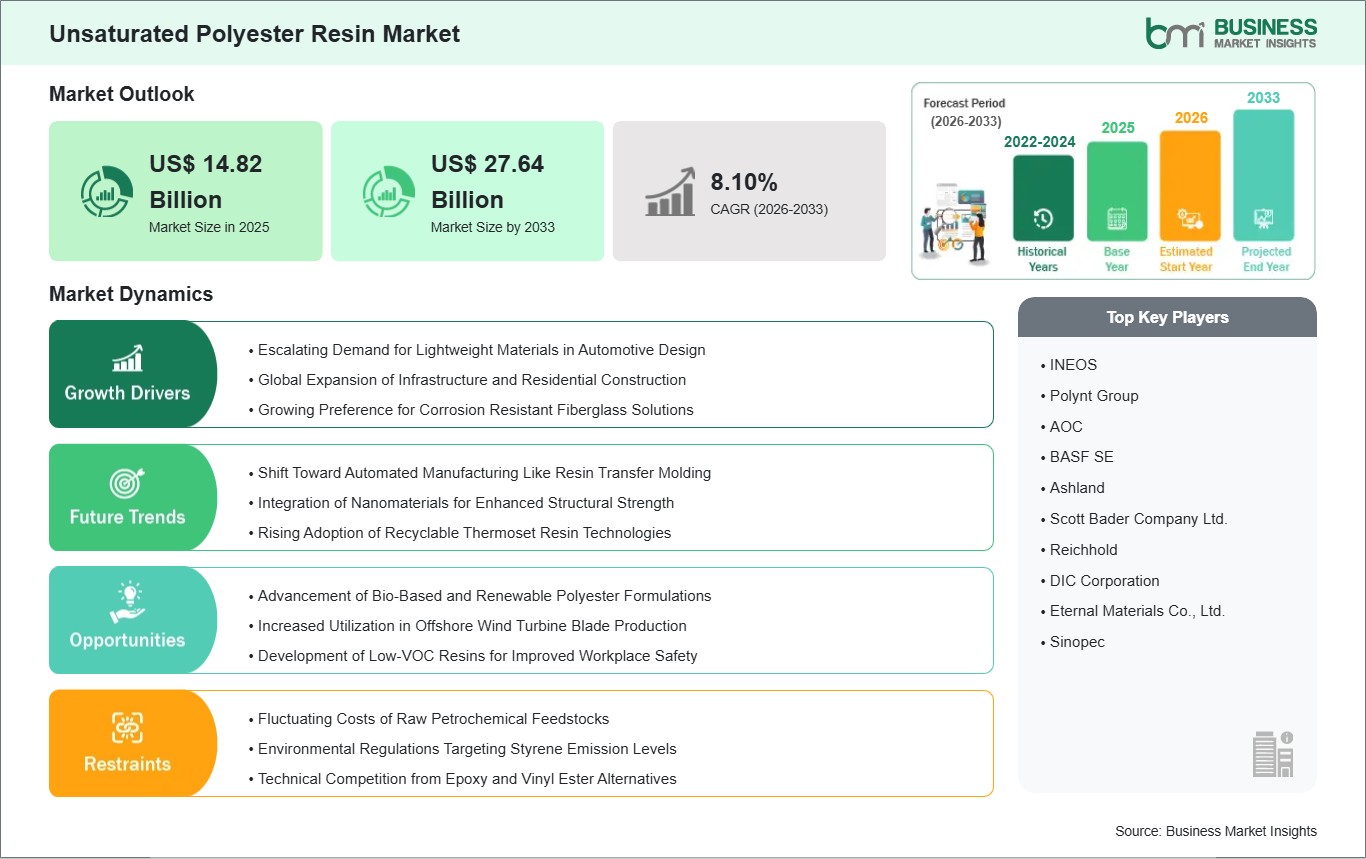
The unsaturated polyester resin market serves as a cornerstone of the global composites industry, providing the essential matrix for reinforced plastics used in diverse sectors. The market is primarily supported by the construction and transportation industries, where the demand for high strength-to-weight ratios and corrosion resistance is constant. Orthophthalic resins remain the most widely used type due to their versatility and economic efficiency, while isophthalic resins are preferred for applications requiring higher chemical resistance and thermal stability. The industry is currently characterized by a push toward technical innovation, particularly in reducing the environmental impact of resin production and application.
Strategic growth is being driven by the global transition to renewable energy, particularly in the manufacturing of large-scale wind turbine blades, and the ongoing modernization of urban infrastructure. While the market must navigate challenges such as the volatility of raw material prices and strict emissions standards, the development of low-styrene and bio-based alternatives offers a robust path for expansion. The integration of advanced processing techniques like pultrusion and automated infusion is also improving manufacturing efficiency. Overall, the market remains vital to industrial development, with a clear trajectory toward more sustainable and high-performance material solutions that align with modern engineering requirements.
Segment Analysis
Unsaturated Polyester Resin Market Segmentation
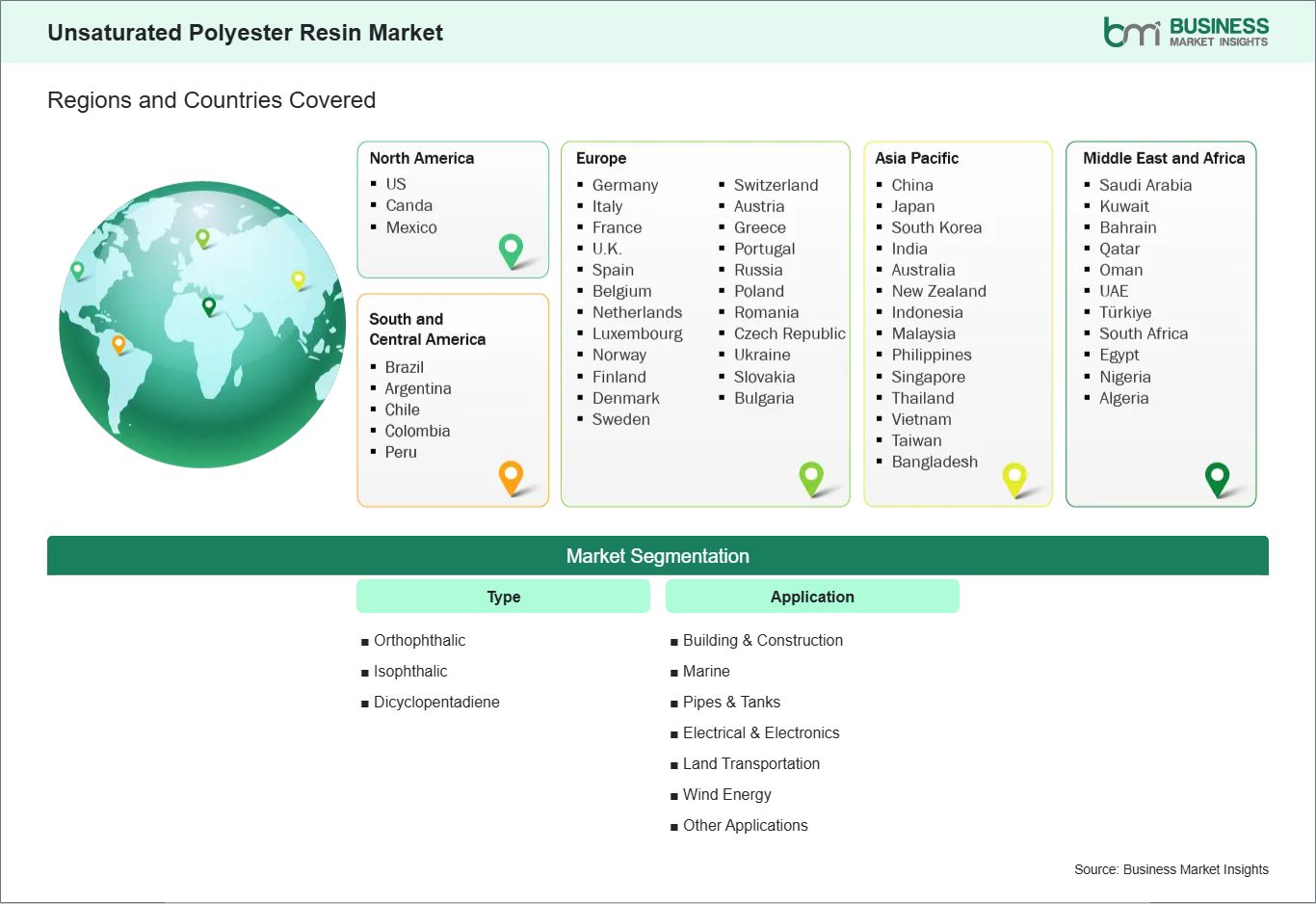
Key segments that contributed to the derivation of the Unsaturated Polyester Resin market analysis are type and application.
- By type, the Unsaturated Polyester Resin market is segmented into Orthophthalic, Isophthalic, and Dicyclopentadiene. The Orthophthalic segment dominated the market in 2025.
- By application, the Unsaturated Polyester Resin market is segmented into Building & Construction, Marine, Pipes & Tanks, Electrical & Electronics, Land Transportation, Wind Energy, and Other The Building & Construction segment dominated the market in 2025.
Market Forces
Unsaturated Polyester Resin Market Drivers and Opportunities
Escalating Demand for Lightweight Materials in Automotive Design
The automotive industry is currently witnessing a major shift that is primarily aimed at enhancing fuel efficiency and addressing the range requirements of electric vehicles. Unsaturated Polyester Resin is playing a vital role in this revolution by making it possible to manufacture Glass Reinforced Plastic parts that can greatly reduce vehicle weight without compromising safety. It is possible to integrate many parts made of metal into a single component using these resins, making the assembly process simpler and reducing weight. By reducing the curb weight of cars and trucks, these materials are directly contributing to making these vehicles more fuel-efficient and environmentally friendly.
Beyond simple weight reduction, these resins provide exceptional resistance to impact and environmental degradation, such as road salt and moisture. This durability ensures that vehicle components maintain their aesthetic and structural qualities over a long service life. The versatility of polyester resins also allows for high-quality surface finishes, which are essential for body panels and exterior trim. As the industry continues to move away from heavy traditional metals, the reliance on high-performance resin systems for structural and semi-structural applications becomes a fundamental aspect of modern automotive engineering and design.
Advancement of Bio-Based and Renewable Polyester Formulations
The main area of focus within material science has shifted to sustainability, and as such, unsaturated polyester resins made from renewable biological sources are developing as a main type of formulation. These novel formulations use plant-based glycols in addition to natural oils to displace traditional petroleum-derived glycols, while still providing the same characteristics and properties as the petroleum-derived versions, therefore reducing environmental impact. There are currently trends all over the world for the movement towards circular economies, and companies need to be able to reduce their carbon intensity of manufacturing to stay competitive. By using bio-based resins, companies will be able to meet the new stringent requirements for green building certification and increase their market share by appealing to a growing customer base of eco-conscious consumers interested in sustainable sourcing.
The technical performance of these renewable resins has improved to the point where they can successfully compete with conventional fossil-fuel-based products. They offer comparable mechanical strength, thermal stability, and moisture resistance, making them suitable for demanding applications in construction and consumer goods. Furthermore, the development of these materials often involves lower energy consumption during the synthesis process, providing an additional layer of environmental benefit. As research continues to refine these bio-polymers, they represent a significant path forward for the industry to decouple its growth from volatile petrochemical markets while addressing long-term ecological goals.
Size and Share Analysis
Unsaturated Polyester Resin Market Size and Share Analysis
The global Unsaturated Polyester Resin market is experiencing steady growth, with market size and share analysis reflecting evolving treatment preferences and competitive dynamics among key players. The report evaluates important subsegments categorized within type and application highlighting their respective contributions to overall market performance.
By type, the Orthophthalic subsegment dominated the market in 2025 due to its superior cost-to-performance ratio and versatility. Its high compatibility with standard glass fiber reinforcements makes it the primary choice for mass-produced composite items where moderate chemical and thermal resistance are sufficient.
By application, the Building & Construction subsegment dominated the market in 2025 because of the massive volume required for infrastructure projects. Its extensive use in producing roof tiles, bathroom fixtures, and translucent panels provides a durable, lightweight, and weather-resistant alternative to traditional heavy building materials.
Report Coverage
Unsaturated Polyester Resin Market Report Coverage and Deliverables
The "Unsaturated Polyester Resin Market Size and Forecast (2022 - 2033)" report provides a detailed analysis of the market covering below areas:
- Unsaturated Polyester Resin market size and forecast at the regional and country levels for segments covered under the scope
- Unsaturated Polyester Resin market trends, as well as drivers, restraints, and opportunities
- Unsaturated Polyester Resin market analysis covering key trends, regional framework, major players, regulations, and recent developments
- Industry landscape and competition analysis covering market concentration, heat map analysis, prominent players, and recent developments for the Unsaturated Polyester Resin market
- Detailed company profiles, including SWOT analysis
Geographic Insights
Unsaturated Polyester Resin Market Geographic Insights
The geographical scope of the Unsaturated Polyester Resin market report is divided into: North America, Asia Pacific, Europe, Middle East & Africa, and South & Central America. North America held the largest share in 2025.
North America maintains a leading position in the unsaturated polyester resin market, supported by a highly developed industrial base and a significant concentration of composite material manufacturers. The region benefits from a robust construction sector that extensively utilizes resin-based products for residential and commercial building components. Furthermore, the presence of a sophisticated automotive and aerospace supply chain drives the continuous need for advanced lightweight materials. The regional market is also characterized by a strong emphasis on research and development, leading to the early adoption of innovative resin formulations that meet high performance and safety standards.
The dominance of North America is further reinforced by substantial investments in renewable energy infrastructure, particularly wind farms that require massive quantities of high-durability resins. Regulatory frameworks in the region encourage the shift toward low-emission products, prompting manufacturers to lead the way in sustainable chemical technologies. Additionally, the well-established distribution networks and the availability of diverse petrochemical feedstocks provide a stable foundation for market operations. As the region continues to prioritize infrastructure renewal and green manufacturing, the demand for high-quality unsaturated polyester resins is expected to remain strong, ensuring North America’s continued influence on global market trends and technological standards.
Industry Activity
Recent Developments
The Unsaturated Polyester Resin market is evaluated by gathering qualitative and quantitative data post primary and secondary research, which includes important corporate publications, association data, and databases. A few of the key developments in the Unsaturated Polyester Resin market are:
- In January 2025, Polynt Group, announced the availability of updated Life Cycle Assessment (LCA) data for unsaturated polyester resins in collaboration with other European manufacturers, highlighting reduced global warming potential and improved sustainability metrics for UPR production.
- In February 2025, Scott Bader Company Ltd., announced the launch of new 100% bio-based resin formulations (Crestafire® Bio range), derived from sugarcane waste, targeting sustainable composite applications and reduced environmental impact in transportation sectors.
- In 2025, Cefic UP/VE Sector Group (with companies including INEOS Composites, Polynt, and Scott Bader), completed a detailed Life Cycle Inventory study for unsaturated polyester resins, enabling manufacturers and users to better quantify emissions and environmental footprint across production processes.
Trust & Transparency
Research Methodology
The market analysis combines proprietary research with secondary data from government agencies, company disclosures, regulatory filings, industry databases and expert interviews. Market estimates are validated through data triangulation, cross-market benchmarking and analyst
review.
View Full Research Methodology
Key Sources Referred:
American Chemistry Council (ACC)International Council of Chemical Associations (ICCA)European Chemical Industry Council (Cefic)China Petroleum and Chemical Industry Federation (CPCIF)Indian Chemical Council (ICC)Japan Chemical Industry Association (JCIA)Brazilian Chemical Industry Association (ABIQUIM)Company WebsitesCompany Annual ReportsCompany Investor Presentations