
Thermochromic Materials Market Outlook: Size, Share, Trends, Growth Analysis, Competitive Landscape & Forecast, 2026–2033

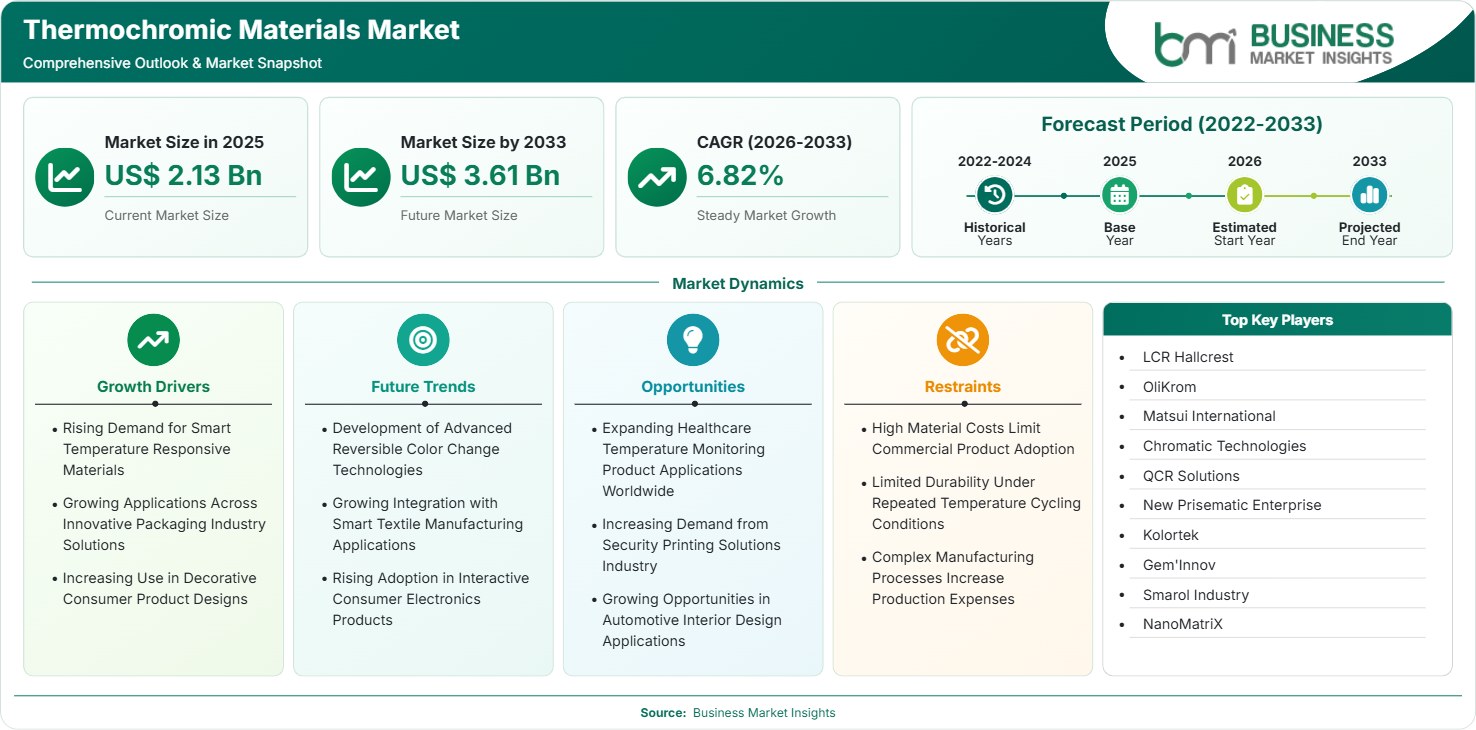
The Thermochromic Materials Market size was valued at US$ 2.13 billion in 2025 and is projected to reach US$ 3.61 billion by 2033, growing at a CAGR of 6.82% during 2026–2033. Rising adoption of smart temperature-responsive materials, expanding intelligent packaging applications, increasing security printing demand, and innovative consumer product designs are supporting market opportunities.

Report Coverage
  • Product: Reversible, Irreversible
  • Application: Packaging, Printing, Consumer Goods, Textiles & Apparel, Others
US$ 2.13 Bn Market size in 2025
US$ 3.61 Bn Market Size by 2033
6.82% CAGR, 2026 - 2033
2026-2033 Forecast Period

AI Overview

Thermochromic Materials Market Summary

  • North America Region: North America holds a market share of 31%–34% in 2025 and is expected to grow at a CAGR of 6.3%–6.8% during 2026–2033. Demand is supported by smart packaging innovation, security printing applications, advanced consumer products, and technology adoption across industries. The United States remains a major contributor due to strong packaging and specialty material industries, supporting growth at a CAGR of 6.4%–6.9%.
  • Fastest Growing Region: Asia Pacific accounts for 34%–37% of the market in 2025 and is projected to expand at a CAGR of 7.2%–7.8% through 2033. Expanding manufacturing activities, consumer product innovation, packaging development, and increasing adoption of smart materials are driving regional growth.
  • Leading Segment: Reversible thermochromic materials represent 68%–72% of demand in 2025 and are expected to grow at a CAGR of 6.9%–7.4% through 2033. Their reusable temperature-responsive properties support adoption across packaging, consumer goods, and printing applications.
  • High Growth Segment: Healthcare temperature monitoring applications are projected to grow at a CAGR of 7.5%–8.0% during 2026–2033, driven by increasing demand for visual indicators, monitoring solutions, and smart diagnostic products.
  • Key Market Opportunity: Expansion of healthcare monitoring solutions, security printing technologies, automotive interiors, and intelligent packaging applications is creating opportunities for manufacturers developing advanced thermochromic solutions.
  • Major Market Players: LCR Hallcrest, OliKrom, Matsui International, Chromatic Technologies, QCR Solutions, New Prisematic Enterprise, Kolortek, Gem'Innov, Smarol Industry, NanoMatriX.
Strategic Insights

Thermochromic Materials Market: Strategic Insights

Thermochromic Materials Market Strategic Framework
FREE PDF
Request your free sample
Request free sample
Stakeholder View

Key Takeaways

  • The ecosystem includes specialty pigment manufacturers, formulation developers, packaging companies, printing solution providers, and end-use brands collaborating to commercialize smart material applications.
  • Packaging, security printing, healthcare monitoring, and consumer goods represent attractive application areas due to increasing demand for interactive and functional products.
  • Innovation is shifting toward improved durability, enhanced color-changing accuracy, advanced encapsulation methods, and integration with smart product designs.
  • Asia Pacific presents strong investment potential due to expanding manufacturing bases, rising consumer markets, and increasing adoption of advanced materials.
  • Companies are strengthening market positions through technology partnerships, application expansion, product customization, and investments in specialized thermochromic solutions.
  • Growing demand for differentiated consumer experiences is encouraging brands to incorporate temperature-responsive features into packaging, textiles, and decorative products.
Geographic Outlook

Thermochromic Materials Market Regional Highlights

North America Thermochromic Materials Market

North America represents 31%–34% of global demand in 2025 and is projected to grow at a CAGR of 6.3%–6.8% through 2033. The region benefits from advanced packaging industries, established printing capabilities, and increasing adoption of smart materials. The United States remains the primary contributor due to strong demand from consumer products and specialty applications.

  • Packaging companies are increasing adoption of thermochromic indicators to improve consumer engagement and product differentiation.
  • Security printing applications are expanding due to demand for authentication features and anti-counterfeit solutions.
  • Consumer product manufacturers are incorporating color-changing materials into innovative designs and promotional applications.
  • Research activities are supporting development of durable and high-performance thermochromic formulations.

US Thermochromic Materials Market

The United States represents a significant North American market supported by advanced packaging technologies, specialty printing industries, and consumer product innovation. Increasing demand for interactive packaging and authentication solutions is encouraging adoption of thermochromic materials. The country benefits from strong research capabilities, established manufacturing infrastructure, and increasing investment in smart material applications.

  • Food and beverage packaging companies are exploring temperature-responsive indicators for improved product interaction.
  • Security printing industries are adopting thermochromic technologies for authentication and verification applications.
  • Consumer brands are using smart materials to create differentiated product experiences.

Europe Thermochromic Materials Market

Europe accounts for 23%–26% of global demand in 2025 and is expected to expand at a CAGR of 6.1%–6.6% through 2033. Germany, France, and the United Kingdom remain important markets due to advanced packaging industries, technology innovation, and demand for sustainable product differentiation. The region continues supporting adoption across commercial applications.

  • Packaging manufacturers are developing interactive solutions using temperature-sensitive materials for consumer engagement.
  • Printing companies are expanding use of thermochromic inks for security and decorative applications.
  • Automotive companies are exploring smart interior designs using temperature-responsive materials.
  • Material developers are focusing on improving durability and environmental performance.

Asia Pacific Thermochromic Materials Market

Asia Pacific holds 34%–37% of global demand in 2025 and is projected to achieve a CAGR of 7.2%–7.8% through 2033. China, Japan, South Korea, and India represent key markets due to expanding manufacturing activities, consumer product growth, and packaging innovation. Increasing industrial adoption is strengthening regional opportunities.

  • Growing packaging production is increasing demand for smart indicators and interactive labeling solutions.
  • Consumer electronics and lifestyle product manufacturers are exploring decorative thermochromic applications.
  • Regional printing industries are adopting advanced materials for security and promotional purposes.
  • Increasing manufacturing investments are supporting local thermochromic material development.

Rest of World Thermochromic Materials Market

The Rest of World region represents 7%–10% of global demand in 2025 and is forecast to grow at a CAGR of 6.5%–7.0% through 2033. Latin America, Middle East, and Africa are gradually adopting smart materials through packaging modernization, consumer product development, and industrial innovation. Growing technology awareness supports regional expansion.

  • Latin American packaging industries are adopting smart labeling technologies for product differentiation.
  • Middle Eastern consumer markets are increasing demand for innovative decorative applications.
  • Healthcare development is supporting interest in temperature monitoring solutions.
  • Regional distributors are improving access to specialty material technologies.
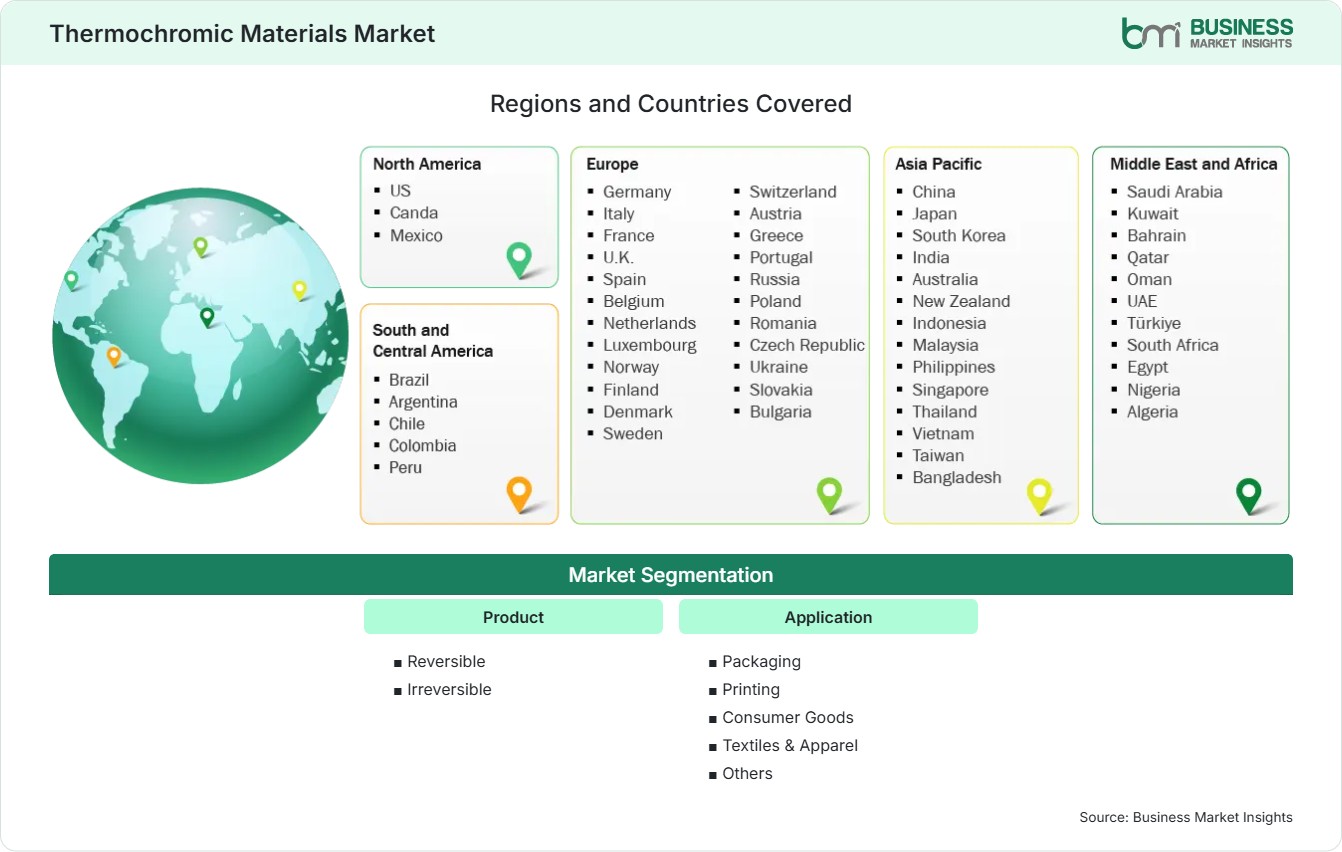
Global Market Geography
FREE PDF
Request your free sample
Request free sample
Segment Analysis

Thermochromic Materials Market Segmentation

Product

The product segment is expanding as industries increasingly adopt temperature-responsive materials for interactive packaging, security printing, and consumer applications. Reversible thermochromic materials represent the dominant category due to repeated usability and broader application compatibility. The Thermochromic Materials Market scope continues expanding through innovations focused on durability, improved color transition accuracy, and integration into advanced product designs.

  • Reversible: Widely adopted due to repeated color-changing capability, making them suitable for packaging indicators, consumer products, textiles, and temperature monitoring applications.
  • Irreversible: Used in applications requiring permanent temperature exposure indication, including safety labels, monitoring solutions, and specialized industrial identification systems.

Application

The application segment is influenced by increasing demand for interactive materials, smart product experiences, and functional indicators across multiple industries. Packaging remains a significant application due to growing adoption of intelligent labels and temperature-sensitive solutions. The Thermochromic Materials Market trend reflects increasing integration of these materials into consumer goods, printing technologies, and specialized monitoring applications.

  • Packaging: Increasingly used for smart labels, freshness indicators, and interactive packaging solutions that enhance consumer engagement and product information visibility.
  • Printing: Applied in security printing, promotional materials, and specialty graphics requiring color-changing effects and authentication features.
  • Consumer Goods: Adoption is increasing in decorative products, toys, electronics accessories, and lifestyle products seeking enhanced user interaction.
  • Textiles & Apparel: Used in temperature-responsive clothing, fashion products, and innovative textile designs offering dynamic visual effects.
Market Forces

Thermochromic Materials Market Dynamics

Key Market Drivers

Rising Demand for Smart Temperature Responsive Materials

The growing trend in intelligent materials is driving increased applications of thermochromic technology across packaging, consumer goods, healthcare, and other industries. The use of such materials makes it possible to develop intelligent products without the need for electronic parts and, therefore, at lower costs. Manufacturers are now working to enhance precision in color and reaction time, as well as stability, to expand commercial applications. The Thermochromic Materials Market growth is driven by increasing demand for intelligent product functions and greater adoption of functional materials across industries. Companies are working to enhance the technology behind pigments and the encapsulation of thermochromic materials to improve performance under various conditions.  Increasingly popular connected products are paving the way for a wider application of thermochromic materials. This trend will be conducive to suppliers manufacturing reliable temperature-sensitive materials.

Growing Applications Across Innovative Packaging Industry Solutions

The increasing use of smart packaging technology has led to a rise in demand for thermochromic materials that provide visual cues and enhance consumer interactions. Packaging companies are looking at temperature-sensitive technologies to monitor freshness, differentiate products, and communicate with the brand. Such materials enable companies to design packaging solutions that provide real-time visual responses without complex electronics. The Thermochromic Materials Market trend is being driven by increased demand for functional packaging, sustainable solutions, and better consumer engagement strategies. Manufacturers of food, beverages, pharmaceuticals, and specialty products are looking at thermochromic materials to improve packaging performance.  Improvements in pigment stability and printing compatibility are enabling increased use in the packaging industry.

Increasing Use in Decorative Consumer Product Designs

Manufacturers of consumer goods are now using thermochromic materials for decorative applications to enhance aesthetics. The use of materials in products such as promotional, lifestyle, toy, electronic accessory, and custom items is attributed to their ability to change appearance with temperature. Manufacturers are benefiting from the ability to develop differentiated products and increased consumer interactions through the adoption of these materials. The Thermochromic Materials Market report identifies increasing opportunities for manufacturers to capitalize on the creative product development and consumer experience. Better formulations are being developed, which ensure consistent color change and substrate compatibility. Growing consumer interest in unique designs has pushed firms to experiment with new areas beyond industrial use.

Key Market Opportunities

Expanding Healthcare Temperature Monitoring Product Applications Worldwide

Applications in healthcare are an emerging growth avenue owing to the rising need for easy and visual temperature monitoring devices. Thermochromic technology can enable temperature indicators, medical labels, and monitoring devices where quick identification adds value. The healthcare industry and medical manufacturers are looking for affordable solutions that make monitoring easier and more efficient by avoiding the use of sophisticated electronic devices. The Thermochromic Materials Market Forecast states that the increasing development of healthcare infrastructure and the need for monitoring devices will create many opportunities. Firms developing reliable, durable materials will gain many benefits from increased medical applications. Product innovations based on enhanced sensitivity and reliability will facilitate growth in the medical industry.

Increasing Demand from Security Printing Solutions Industry

Security printing applications represent another sphere where opportunities for further development exist, as there is increased demand for more effective authentication technologies. There are various thermochromic solutions that can be used to provide visual authentication on labels, documents, packages, and branded goods. The growing number of counterfeit cases is prompting the adoption of specialized printing technologies with specific identifiers. Manufacturers are developing thermochromic inks and coatings with enhanced security properties and printing performance. The growing trend of using authentication techniques across industries creates additional opportunities for suppliers of special materials. The growing demand for security packaging and identification systems will enable the acceptance of the described technologies in business and industrial environments.

Growing Opportunities in Automotive Interior Design Applications

Thermochromic material technology is being explored by automobile companies to enhance interior designs. The thermochromic material can be employed to develop interactive surfaces that respond to temperature changes. The growing preference for personalized and advanced interior design in the automotive industry is driving the search for new materials. The material's performance in durability, temperature sensing, and compatibility with other automotive materials is important. Growth in premium cars, along with the need for a unique experience, is opening up new markets for thermochromic materials. Companies that develop thermochromic material that performs well in automobiles can take advantage of this in the future.

Market Restraints and Challenges

High Material Costs Limit Commercial Product Adoption

Factor: Thermochromic materials require specialized pigments, encapsulation processes, and advanced manufacturing techniques that increase production expenses compared with conventional materials. Impact: Higher costs can restrict adoption among price-sensitive industries and limit large-scale commercialization across certain consumer applications. Manufacturers are focusing on improving production efficiency, optimizing raw material usage, and developing cost-effective formulations to overcome pricing challenges. However, maintaining performance quality while reducing costs remains a key challenge. Companies are investing in research and process improvements to make thermochromic technologies more accessible. Expanding applications and increasing production volumes may gradually improve cost competitiveness across commercial markets.

Limited Durability Under Repeated Temperature Cycling Conditions

Factor: Repeated exposure to temperature changes can affect color performance, response consistency, and operational lifespan of thermochromic materials. Impact: Reduced durability may limit adoption in applications requiring long-term reliability, including industrial, automotive, and reusable consumer products. Manufacturers are developing improved formulations, protective coatings, and advanced encapsulation methods to enhance material stability. Testing and quality improvements are becoming essential to ensure performance across different environmental conditions. Companies capable of improving durability while maintaining responsive characteristics can strengthen market competitiveness. Addressing lifecycle limitations remains important for expanding adoption into demanding applications requiring repeated temperature exposure.

Company Analysis

Competitive Landscape

The competitive environment is shaped by pigment innovation, advanced formulation capabilities, application-specific product development, and expansion into smart material applications. The Thermochromic Materials Market analysis highlights that leading companies are focusing on improving temperature responsiveness, durability, customization capabilities, and integration across packaging, printing, consumer goods, and specialty applications.

Company Name

Overview

Products and Services Relevant to this Market

LCR Hallcrest

Specialist manufacturer providing temperature-sensitive indicators and thermochromic solutions for industrial and consumer applications.

Thermochromic labels, temperature indicators, color-changing materials, and customized temperature monitoring solutions.

OliKrom

Innovative materials company developing smart pigments and color-changing technologies for multiple industries.

Thermochromic pigments, smart coatings, temperature-responsive materials, and specialty color solutions.

Matsui International

Printing technology company providing advanced inks and coatings for commercial and industrial applications.

Thermochromic inks, specialty printing solutions, functional coatings, and color-changing printing technologies.

Chromatic Technologies

Developer of intelligent packaging and color-changing material solutions for commercial applications.

Thermochromic inks, smart packaging indicators, temperature-responsive technologies, and customized solutions.

QCR Solutions

Specialty materials provider focused on innovative color-changing technologies and application development.

Thermochromic products, temperature-sensitive solutions, specialty pigments, and customized material systems.

New Prisematic Enterprise

Manufacturer specializing in color-changing materials and innovative pigment technologies.

Thermochromic pigments, specialty inks, coatings, and temperature-responsive product solutions.

Kolortek

Color technology company supplying specialty pigments and functional color solutions.

Thermochromic pigments, photochromic materials, color-changing additives, and specialty pigment solutions.

Gem'Innov

Materials innovation company developing advanced functional and smart material technologies.

Thermochromic solutions, smart pigments, specialty materials, and application-focused innovations.

Smarol Industry

Producer of smart color materials serving industrial and consumer product applications.

Thermochromic pigments, temperature-responsive materials, coatings, and customized smart material solutions.

NanoMatriX

Nanotechnology-focused company developing advanced material solutions for specialty applications.

Functional pigments, smart materials, nanotechnology-based solutions, and advanced thermochromic technologies.

Trust & Transparency

Research Methodology

The market analysis combines proprietary research with secondary data from government agencies, company disclosures, regulatory filings, industry databases and expert interviews. Market estimates are validated through data triangulation, cross-market benchmarking and analyst review.

View Full Research Methodology

Questions Answered

Frequently Asked Questions

What does the Thermochromic Materials Market report indicate about future competition?

The report indicates that competition will focus on material durability, pigment innovation, customization capabilities, and expansion into emerging applications. Companies developing reliable temperature-responsive solutions and strengthening partnerships with packaging, printing, and consumer product industries are expected to improve their competitive positioning.

Why are smart packaging solutions creating new opportunities for thermochromic materials?

Smart packaging solutions are creating opportunities because brands increasingly require interactive features, freshness indicators, and enhanced consumer communication. Thermochromic materials provide simple visual responses that improve packaging functionality while supporting product differentiation and customer engagement.

How are advanced pigment technologies influencing thermochromic material adoption?

Advanced pigment technologies are improving adoption by enhancing color accuracy, temperature sensitivity, durability, and application flexibility. Manufacturers are developing improved formulations and encapsulation techniques to overcome performance limitations and support broader commercial use across different industries.

Which applications present the strongest opportunity in the market?

Smart packaging, healthcare monitoring, security printing, consumer goods, and automotive interior applications represent strong opportunities. These sectors require innovative materials that improve user interaction, authentication capabilities, product visibility, and functional performance.

What factors are improving Thermochromic Materials Market return on investment?

Increasing demand for smart packaging, security printing, consumer product innovation, and healthcare monitoring applications is improving return on investment. Thermochromic materials provide visual temperature responses, product differentiation, and functional benefits, creating value across multiple industries seeking interactive and advanced material solutions.

Access the Full Thermochromic Materials Market Report

Get segment-level forecasts, regional estimates, competitive benchmarking, company profiles and downloadable Excel datasets.

Access the full Thermochromic Materials Market Report
350 pages PDF & Excel | 2026-08-21
Similar Research

Related Market Reports