
Tangential Flow Filtration Market Outlook: Size, Share, Trends, Growth Analysis, Competitive Landscape & Forecast, 2026–2033

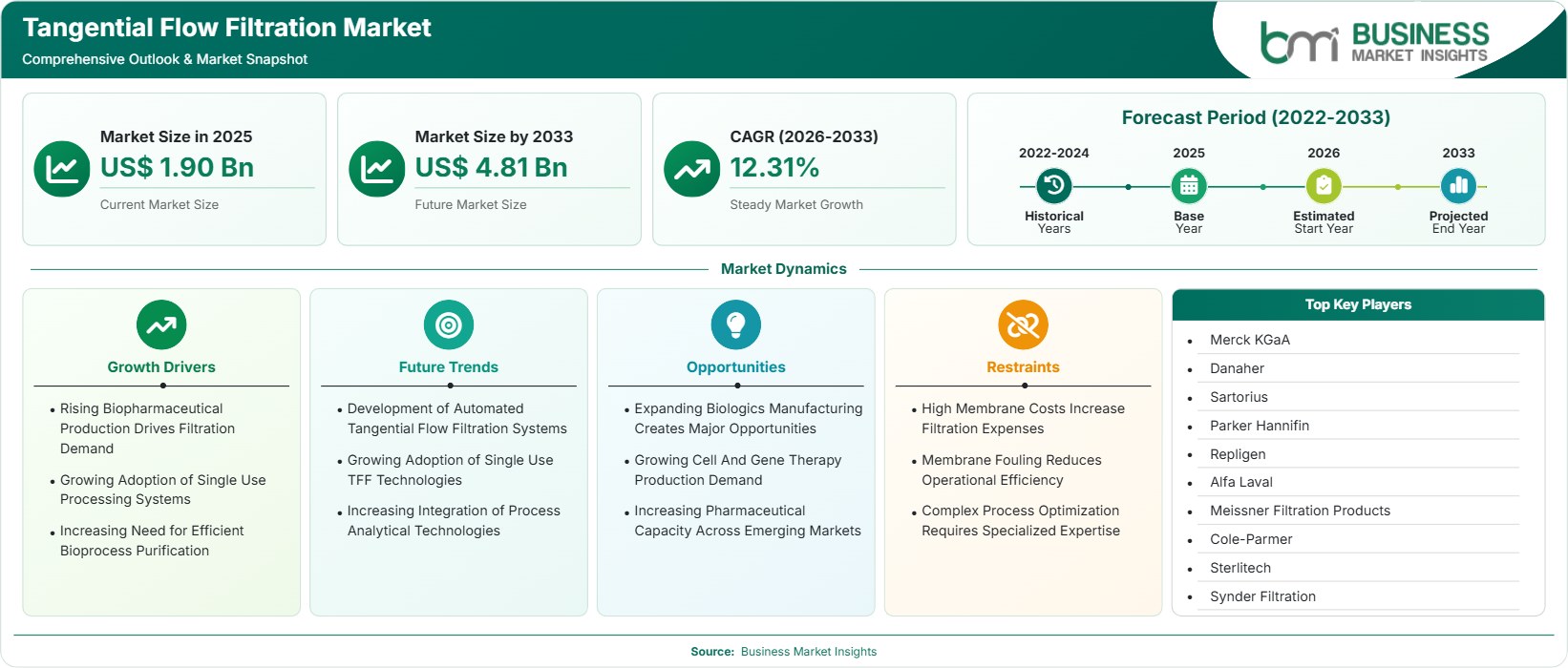
The Tangential Flow Filtration Market size was valued at US$ 1.90 billion in 2025 and is projected to reach US$ 4.81 billion by 2033, growing at a CAGR of 12.31% during 2026–2033, driven by expanding biologics production, broader single-use processing, purification intensity, and rising CDMO capacity, while cell and gene therapies create attractive opportunities for scalable downstream filtration and automation.

Report Coverage
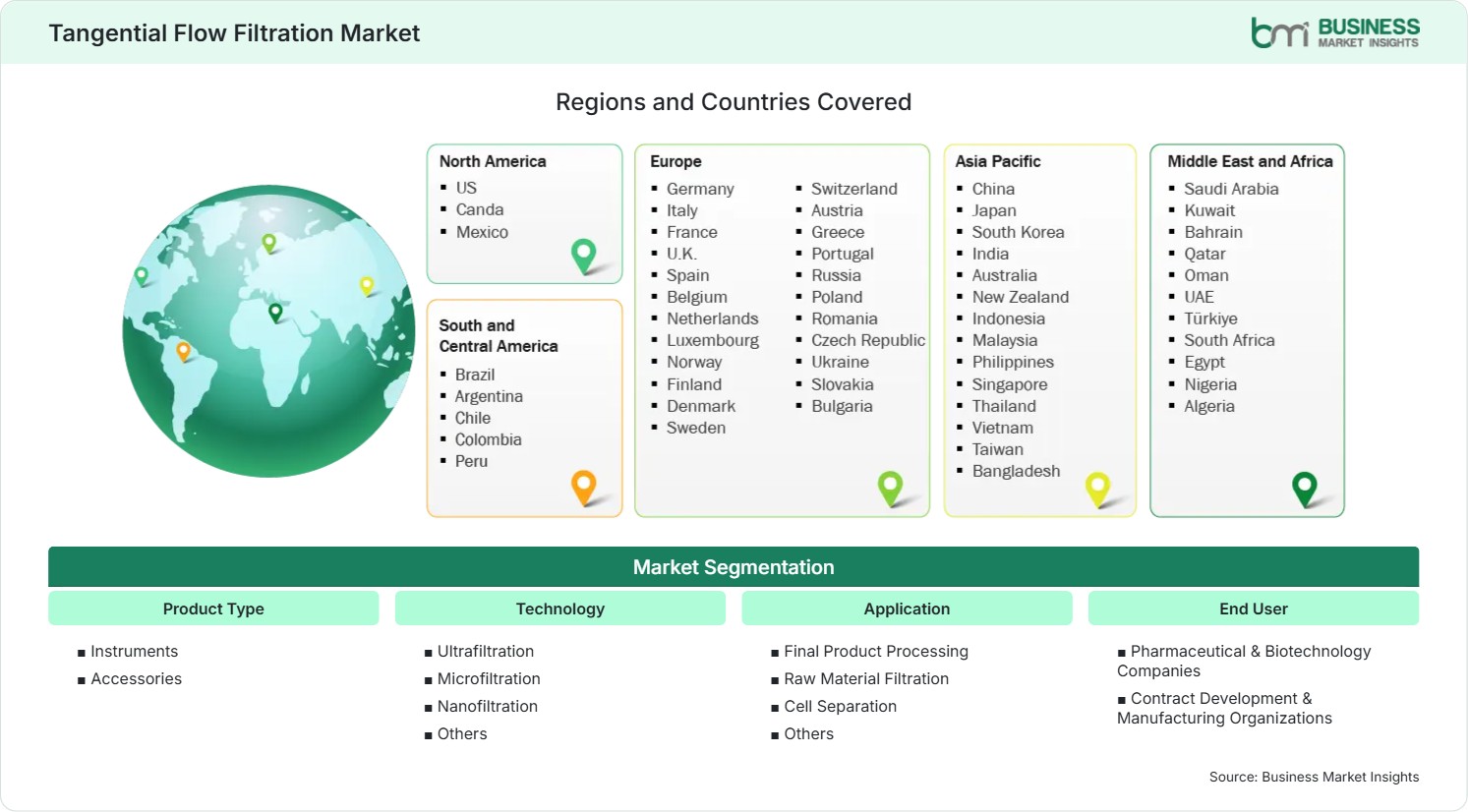
  • Product Type: Instruments, Accessories
  • Technology: Ultrafiltration, Microfiltration, Nanofiltration, Others
  • Application: Final Product Processing, Raw Material Filtration, Cell Separation, Others
  • End User: Pharmaceutical & Biotechnology Companies, Contract Development & Manufacturing Organizations
US$ 1.90 Bn Market size in 2025
US$ 4.81 Bn Market Size by 2033
12.31% CAGR, 2026 - 2033
2026-2033 Forecast Period

AI Overview

Tangential Flow Filtration Market Summary

  • North America Region: North America holds a 37%–40% share in 2025, growing with a CAGR of 11%–13%, influenced by biologics capacity expansion, mature downstream processing, strong CDMO utilization, automation investment, and demand for closed processing are reinforcing filtration purchases and creating opportunities in scalable purification workflows across commercial facilities. The U.S. Tangential Flow Filtration Market outlook indicates sustained adoption, supported by biologics pipelines, CDMO expansion, and automated downstream processing, with a 11%–13% CAGR during 2026–2033.
  • Fastest Growing Region: Asia Pacific holds a 22%–25% share in 2025, growing with a CAGR of 13%–15%, supported by expanding biologics manufacturing, increasing CDMO capacity, localization initiatives, rising vaccine production, technology transfer, and broader adoption of flexible downstream processing platforms across emerging markets.
  • Leading Segment: Ultrafiltration holds a 54%–58% share in 2025, advancing at a CAGR of 12%–14%, supported by protein concentration, buffer exchange, monoclonal antibody purification, scalable membrane performance, and increasing demand for efficient downstream bioprocessing across commercial and clinical manufacturing workflows.
  • High Growth Segment: Cell Separation holds an 8%–11% share in 2025, expanding at a CAGR of 15%–17%, driven by cell and gene therapy development, perfusion processing, viral vector workflows, high-density cultures, and demand for gentle, scalable separation technologies supporting advanced therapy manufacturing.
  • Key Market Opportunity: Investment is shifting toward integrated filtration platforms combining membranes, automation, sensors, single-use flow paths, and process analytics, creating opportunities for suppliers that reduce validation burden while improving process consistency, scalability, and technology transfer.
  • Major Market Players: Merck KGaA, Danaher Corporation, Sartorius AG, Parker-Hannifin Corporation, Repligen Corporation, Alfa Laval AB, Meissner Filtration Products, Inc., Cole-Parmer Instrument Company, LLC, Sterlitech Corporation, and Synder Filtration, Inc.
Strategic Insights

Tangential Flow Filtration Market: Strategic Insights

Tangential Flow Filtration Market Strategic Framework
FREE PDF
Request your free sample
Request free sample
Stakeholder View

Key Takeaways

  • The value chain is moving toward integrated filtration ecosystems in which membranes, pumps, sensors, tubing, automation, and process controls are specified together rather than purchased as isolated components.
  • Downstream purification remains the central commercial application, while cell separation and advanced therapy workflows create additional upside because they demand precise retention, gentle processing, and scalable concentration.
  • Product development is increasingly focused on single-use assemblies, automated pressure management, improved membrane chemistry, lower hold-up volumes, and digital process monitoring that can support reproducible technology transfer.
  • Asia Pacific offers the strongest expansion case because new biologics facilities can incorporate modern filtration architectures without the replacement constraints associated with mature manufacturing infrastructure.
  • Investment decisions increasingly favor suppliers capable of supporting the full process lifecycle, including application development, membrane screening, validation support, equipment integration, and post-installation technical service.
  • Competitive differentiation is shifting toward process economics and application expertise, making membrane performance, consumable availability, system flexibility, and manufacturing support important factors alongside equipment functionality.
Geographic Outlook

Tangential Flow Filtration Market Regional Highlights

North America Tangential Flow Filtration Market

North America accounts for a 37%–40% share in 2025 and is projected to expand at an 11%–13% CAGR through 2033. Mature biologics manufacturing, established CDMO infrastructure, advanced research capabilities, and widespread single-use adoption sustain regional demand.

  • The U.S. represents approximately 96%–98% of North American demand, supported by extensive biologics manufacturing, advanced therapy development, process intensification, and continued investment in domestic pharmaceutical production infrastructure.
  • Canada provides a smaller but strategically relevant market, with demand centered on biotechnology research, vaccine development, contract manufacturing, and specialized purification workflows requiring scalable filtration equipment.
  • Strong demand for automated TFF platforms is linked to tighter process control requirements, particularly where manufacturers seek repeatable concentration and diafiltration performance across clinical and commercial production.
  • Leading regional procurement priorities increasingly include closed processing, single-use compatibility, membrane availability, validation support, and integration with digital manufacturing systems.

US Tangential Flow Filtration Market

The U.S. represents 96%–98% of North American demand in 2025 and is projected to grow at an 11%–13% CAGR through 2033. Domestic biologics investment and advanced manufacturing localization support sustained equipment and consumables demand.

  • Large-scale biologics facilities increasingly require scalable downstream platforms that can support multiple molecules, campaign changes, and commercial production while maintaining consistent process parameters.
  • CDMO expansion strengthens demand for flexible filtration configurations because outsourced manufacturers must accommodate diverse client processes, molecule characteristics, batch sizes, and validation requirements.
  • Advanced therapy development is broadening TFF utilization beyond conventional protein processing toward cell harvesting, viral vector concentration, and specialized separation workflows.

Europe Tangential Flow Filtration Market

Europe holds a 24%–27% Tangential Flow Filtration Market share in 2025 and is expected to advance at a 10%–12% CAGR through 2033. Germany, the United Kingdom, France, and Switzerland remain leading markets, while Ireland and Belgium offer strong high-growth manufacturing opportunities.

  • Germany remains a major bioprocessing hub, with established pharmaceutical manufacturing and engineering capabilities supporting demand for reusable systems, single-use platforms, and advanced membrane technologies.
  • The United Kingdom and France benefit from biotechnology investment, research activity, and growing requirements for scalable purification systems across biologics and advanced therapy programs.
  • Ireland and Belgium offer high-growth opportunities as biologics manufacturing clusters expand, creating demand for downstream process equipment and validated filtration consumables.
  • European sustainability priorities are encouraging suppliers to improve material efficiency, reduce process waste, and develop lifecycle strategies for single-use filtration components.

Asia Pacific Tangential Flow Filtration Market

Asia Pacific holds a 22%–25% share in 2025 and is forecast to grow at a 13%–15% CAGR through 2033. China, Japan, South Korea, and India lead regional demand, while Singapore offers strong high-growth potential.

  • China is expanding domestic biologics and CDMO capabilities, increasing demand for scalable filtration systems, membranes, and purification technologies supporting commercial production.
  • South Korea is strengthening large-scale biologics manufacturing, creating opportunities for high-capacity TFF systems integrated into modern, automated downstream facilities.
  • India is expanding pharmaceutical and biotechnology manufacturing capabilities, supporting demand for cost-efficient systems, consumables, membrane technologies, and technical services.
  • Japan remains a mature biopharmaceutical market where high process reliability, validation, automation, and membrane consistency influence purchasing decisions.
  • Singapore's specialized manufacturing ecosystem provides a high-value opportunity for advanced filtration platforms supporting regional biologics and cell therapy production.

Rest of World Tangential Flow Filtration Market

South and Central America hold a smaller portion of global demand, with Brazil and Mexico leading regional activity. Investment in local pharmaceutical production and vaccine capacity is creating gradual demand for scalable purification systems.

Middle East and Africa remain developing markets, with the strongest opportunities concentrated in countries establishing biologics, vaccine, and pharmaceutical manufacturing capabilities.

  • Brazil leads South American demand through its pharmaceutical manufacturing base, biotechnology activity, and increasing interest in domestic production of complex biological products.
  • Mexico benefits from proximity to North American supply chains and expanding pharmaceutical manufacturing, creating opportunities for filtration equipment used in process development and production.
  • Saudi Arabia and the United Arab Emirates are developing life sciences infrastructure, supporting demand for modern downstream processing and pharmaceutical manufacturing technologies.
  • South Africa provides a strategic entry point for African biomanufacturing initiatives, particularly where vaccine, biologics, and technology-transfer programs require scalable filtration capabilities.
Global Market Geography
FREE PDF
Request your free sample
Request free sample
Segment Analysis

Tangential Flow Filtration Market Segmentation

Product Type

Product Type is led by Instruments, representing an estimated 56%–60% share in 2025 and growing at a 12%–14% CAGR through 2033. Demand reflects system automation, single-use adoption, process scalability, and equipment integration across biopharmaceutical downstream operations.

  • Instruments: Instruments support controlled concentration, diafiltration, and separation workflows, with purchasing increasingly favoring modular systems that simplify scale-up, automation, validation, and integration with process monitoring.
  • Single-use: Single-use instruments reduce cleaning requirements and cross-batch contamination exposure, making them attractive for multiproduct facilities, clinical manufacturing, advanced therapies, and rapidly changing production campaigns.
  • Reusable: Reusable instruments remain relevant for established commercial facilities requiring durable equipment, standardized operating procedures, and economical operation across recurring high-volume manufacturing campaigns.
  • Accessories: Accessories include tubing, pumps, sensors, connectors, housings, and process-control components that improve system integration, enable configuration flexibility, and support reliable filtration performance across different process scales.

Technology

Technology is led by Ultrafiltration, accounting for an estimated 54%–58% Tangential Flow Filtration Market share in 2025 and advancing at a 12%–14% CAGR through 2033. Broad use in protein concentration and purification supports sustained demand across bioprocess workflows.

  • Ultrafiltration: Ultrafiltration concentrates proteins and biomolecules while enabling diafiltration, making it central to antibody purification, recombinant protein processing, and other downstream applications requiring controlled molecular retention.
  • Microfiltration: Microfiltration supports cell removal, clarification, and particulate separation, with adoption expanding where high-throughput processing and efficient upstream-downstream interfaces are required.
  • Nanofiltration: Nanofiltration enables finer molecular separation and specialized purification, supporting applications where conventional membrane cutoffs cannot provide the required selectivity or contaminant reduction.

Application

Application demand is concentrated in Final Product Processing, estimated at 39%–43% share in 2025 and growing at 12%–14% CAGR through 2033. Its importance reflects intensive purification, concentration, and formulation requirements across biologics manufacturing.

  • Final Product Processing: Final product processing requires reliable concentration and purification before downstream formulation, making filtration performance, product recovery, process consistency, and membrane selection critical purchasing factors.
  • API Filtration: API filtration supports purification and concentration of active biological ingredients, requiring validated membrane performance, controlled pressure conditions, and high recovery to protect product economics.
  • Protein Purification: Protein purification uses selective membrane separation for concentration and buffer exchange, with demand influenced by growing biologics pipelines and increasingly complex molecule characteristics.
  • Vaccine & Antibody Processing: Vaccine and antibody processing requires scalable concentration, clarification, and purification steps, encouraging adoption of flexible TFF systems capable of supporting different production campaigns.
  • Raw Material Filtration: Raw material filtration protects downstream processes by controlling particulate and microbial loads, strengthening the need for dependable prefiltration and media-management solutions.
  • Media & Buffer Filtration: Media and buffer filtration improves process consistency by removing contaminants before use, supporting closed manufacturing strategies and reducing downstream filtration burden.
  • Prefiltration: Prefiltration reduces particulate loading on subsequent membranes, extending operational stability and helping manufacturers maintain throughput during demanding purification campaigns.
  • Cell Separation: Cell separation supports harvesting and perfusion applications, with growing relevance in advanced therapies and high-density cultures where gentle processing and controlled cell retention are essential.

End User

Pharmaceutical & Biotechnology Companies remain the dominant end-user group, representing an estimated 70%–74% share in 2025 and expanding at a 12%–14% CAGR through 2033. CDMOs provide the strongest incremental demand through flexible multi-product manufacturing.

  • Pharmaceutical & Biotechnology Companies: These users deploy TFF across development, clinical, and commercial workflows, prioritizing validated performance, process scalability, reliable consumable supply, and integration with established manufacturing infrastructure.
  • Contract Development & Manufacturing Organizations (CDMOs): CDMOs favor flexible systems capable of rapid product changeovers, multiple batch scales, and diverse molecule processing, making modular single-use filtration particularly attractive.
Market Forces

Tangential Flow Filtration Market Dynamics

Key Market Drivers

Rising Biopharmaceutical Production Drives Filtration Demand

Increasing pipelines of biologics drive the number and complexity of downstream purification processes, thereby enhancing the value of membranes for concentration and separation operations. The Tangential Flow Filtration Market forecast reveals that there will be growing demand due to the fact that current facilities need to have filtration systems that can retain their product yield while being able to adjust to varying process volumes and different molecule properties. TFF technology is ideal for such processing since its membrane can support constant cross-flow, thus minimizing cake build-up compared to dead-end filtration technology. This makes it possible to perform concentration and diafiltration in one process step. The growing importance of intensified production processes means that there is increasing demand for systems that can handle higher volumes of work inside limited plant space.

Growing Adoption of Single-Use Processing Systems

The rise of single-use processing is changing the way equipment is specified by reducing cleaning needs, decreasing changeover time, and facilitating multiproduct manufacturing. Within filtration, there are disposable flow paths and membrane devices that could facilitate the facility design process as well as make the use of reusable equipment less burdensome. This trend is especially applicable to clinical manufacturing and CDMOs, where flexibility of campaigns rather than full utilization of equipment is more beneficial. Disposable processes now also have sensors incorporated into them and can be automatically controlled. This describes another notable Tangential Flow Filtration Market trend, which is that of integrated, flexible, and digitally monitored processing.

Increasing Need for Efficient Bioprocess Purification

In today’s biopharmaceutical processing, there is an increased focus on the importance of recovery, purification, capacity, and cycle time. As such, filtration should be performed under controlled pressures without compromising the selective properties of the membrane while avoiding product loss. Intensification trends are driving up productivity per unit area in facilities, leading to more membrane systems that have predictable flux and scalability. Automated operations also help to increase predictability through control of flow rate, pressure, conductivity, and process endpoint parameters. This leads to decreased operator dependence and improved technology transfer from the laboratory to manufacturing operations. The Tangential Flow Filtration Market growth is tied to this trend.

Key Market Opportunities

Expanding Biologics Manufacturing Creates Major Opportunities

The establishment of new biologics manufacturing plants creates the need for full filtration systems and not just membrane technologies. The vendor firms have the chance to generate additional revenue by bundling the developmental, production, single-use assemblies, membrane technologies, sensors, and technical services. The greenfield projects offer even better opportunities since filtration technologies are incorporated into the facility design prior to commissioning. The vendor firms that offer membrane screening, scaling up, validation, and technology transfer services get the chance to become strategic partners and not equipment sellers.  Localization would open up possibilities in terms of regional service centers and technical laboratories.

Growing Cell and Gene Therapy Production Demand

Production for cell and gene therapy products is increasing the applications landscape since these processes commonly have the need for specific cell manipulation steps, such as concentration, washing, and viral vector purification. TFF processes could be used for all of these steps whenever a controlled level of shear, recovery, and separation is necessary. The possibilities go beyond commercial-scale manufacture into process development, clinical scale-up, and technology transfer operations. Suppliers can stand out via different hollow fiber designs, small volume equipment, disposables, and automation that is geared towards biological samples.

Increasing Pharmaceutical Capacity Across Emerging Markets

Growing pharmaceutical manufacturing centers are presenting business opportunities to vendors who can provide a system that scales well without complicating the system with existing infrastructure issues. Modern facilities have been looking more at providing systems that are modular, use single-use processing, provide remote assistance, and standard validation packs. Manufacturing programs in various regions have also encouraged technology transfers and local manufacturing of vaccines and biologics, requiring more downstream purification. Suppliers can take advantage of this market through the sale of equipment along with training, membrane qualifications, and process development services.

Market Restraints and Challenges

High Membrane Costs Increase Filtration Expenses

Factor: Specialized membrane materials, validation of manufacturing processes, sterilized packing, and performance testing may contribute to higher costs of consumables, especially in the case of very pure biopharmaceutical processes. Impact: Higher cost of membranes will create additional financial pressure on operations budgets and will force clients to maximize membrane life or look for other process configurations. There will be a conflict between the frequency of membrane changeovers and the reliability of the process. As a result, suppliers have to prove improvements in throughput, recoveries, membrane lifetime, and process reliability to justify increased prices. The restriction would be most pertinent to price-sensitive emerging economies and manufacturers still in their developmental stages, even if technical effectiveness is always the primary concern.

Membrane Fouling Reduces Operational Efficiency

Factor: Membrane fouling is a problem that may arise due to the buildup of solid particles, proteins, aggregates, or cellular material on the filter surface, thereby lowering the flux rate and raising the pressure needs. Impact: Reduced filtration efficiency means that the process will take longer, leading to lower productivity levels. Fouling also affects the scaling of the process, as laboratory conditions may not reflect the commercial feed stream conditions. This makes it necessary for manufacturers to develop an efficient pretreatment procedure, proper membrane selection, cross-flow speed, and effective cleaning procedures. Monitoring helps to detect poor performance early enough, although the use of more sensors increases the complexity of systems.

Company Analysis

Competitive Landscape

The Tangential Flow Filtration Market analysis indicates competition is increasingly based on integrated bioprocess capabilities rather than standalone filtration hardware. Vendors differentiate through membrane portfolios, automation, single-use compatibility, application expertise, global support, and the ability to support scale-up from development through commercial production.

Company Name

Overview

Products and Services relevant to this market

Merck KGaA

Global science and technology company with a substantial bioprocessing portfolio serving pharmaceutical and biotechnology manufacturers.

TFF systems, membrane technologies, single-use processing components, filtration solutions, and downstream bioprocessing support.

Danaher Corporation

Diversified life sciences company with strong capabilities across bioprocessing, filtration, purification, and process technologies.

Bioprocess filtration platforms, membrane technologies, purification systems, process equipment, and integrated manufacturing solutions.

Sartorius AG

Global bioprocessing specialist focused on scalable technologies supporting development and commercial biologics production.

TFF systems, membrane cassettes, single-use assemblies, filtration consumables, process monitoring, and bioprocess services.

Parker-Hannifin Corporation

Industrial technology provider with specialized bioscience filtration and automated bioprocessing capabilities.

Automated TFF systems, pumps, sensors, single-use flow paths, filtration assemblies, and process-control equipment.

Repligen Corporation

Bioprocess-focused company specializing in technologies that support upstream and downstream manufacturing workflows.

TFF systems, hollow-fiber filters, membrane products, fluid management technologies, and purification solutions.

Alfa Laval AB

Global separation technology provider serving pharmaceutical, biotechnology, and industrial processing applications.

Membrane filtration systems, separation equipment, process technologies, and solutions supporting biopharmaceutical manufacturing.

Meissner Filtration Products, Inc.

Specialized filtration manufacturer serving critical pharmaceutical and bioprocessing applications.

Hollow-fiber TFF filters, capsules, cartridges, single-use assemblies, membrane products, and filtration support.

Cole-Parmer Instrument Company, LLC

Laboratory and process equipment supplier offering filtration technologies across research and bioprocessing workflows.

TFF systems, membranes, crossflow filtration equipment, pumps, tubing, accessories, and laboratory filtration products.

Sterlitech Corporation

Filtration technology supplier focused on laboratory and process-development applications across multiple industries.

TFF systems, cassettes, ultrafiltration membranes, crossflow products, sample concentration, purification, and diafiltration solutions.

Synder Filtration, Inc.

Membrane technology company providing separation solutions for pharmaceutical and industrial applications.

Ultrafiltration, nanofiltration, membrane modules, filtration systems, and specialized separation technologies.

Trust & Transparency

Research Methodology

The market analysis combines proprietary research with secondary data from government agencies, company disclosures, regulatory filings, industry databases and expert interviews. Market estimates are validated through data triangulation, cross-market benchmarking and analyst review.

View Full Research Methodology

Questions Answered

Frequently Asked Questions

What does the Tangential Flow Filtration Market Report indicate about future competition?

The report indicates that competition will increasingly center on integrated platforms, membrane performance, automation, single-use compatibility, technical support, and lifecycle economics. Suppliers capable of supporting development through commercial manufacturing should have stronger opportunities to deepen customer relationships.

Why are emerging biopharmaceutical manufacturing hubs creating new opportunities?

New facilities can incorporate modular, single-use, and automated filtration systems without extensive legacy constraints. This supports faster technology transfer, flexible production, simplified facility design, and localized manufacturing of biologics, vaccines, and advanced therapies.

How are advanced membrane technologies influencing adoption?

Advanced membranes are improving selectivity, throughput, recovery, and process consistency. Improvements in pore structures, membrane materials, hollow-fiber configurations, and cassette designs allow manufacturers to tailor filtration performance to increasingly complex biological feed streams.

Which applications present the strongest opportunity in the market?

Protein purification, vaccine and antibody processing, cell separation, and advanced therapy workflows represent strong opportunities. These applications require controlled concentration, purification, cell retention, and scalable membrane performance across development and manufacturing environments.

What factors are improving Tangential Flow Filtration Market return on investment?

Increasing biologics production, demand for efficient downstream purification, broader single-use processing, and CDMO expansion are improving return on investment. TFF systems can consolidate concentration and diafiltration functions while supporting scalable production, process flexibility, and reduced operational complexity.

Access the Full Tangential Flow Filtration Market Report

Get segment-level forecasts, regional estimates, competitive benchmarking, company profiles and downloadable Excel datasets.

Access the full Tangential Flow Filtration Market Report
350 pages PDF & Excel | 2026-08-24
Similar Research

Related Market Reports