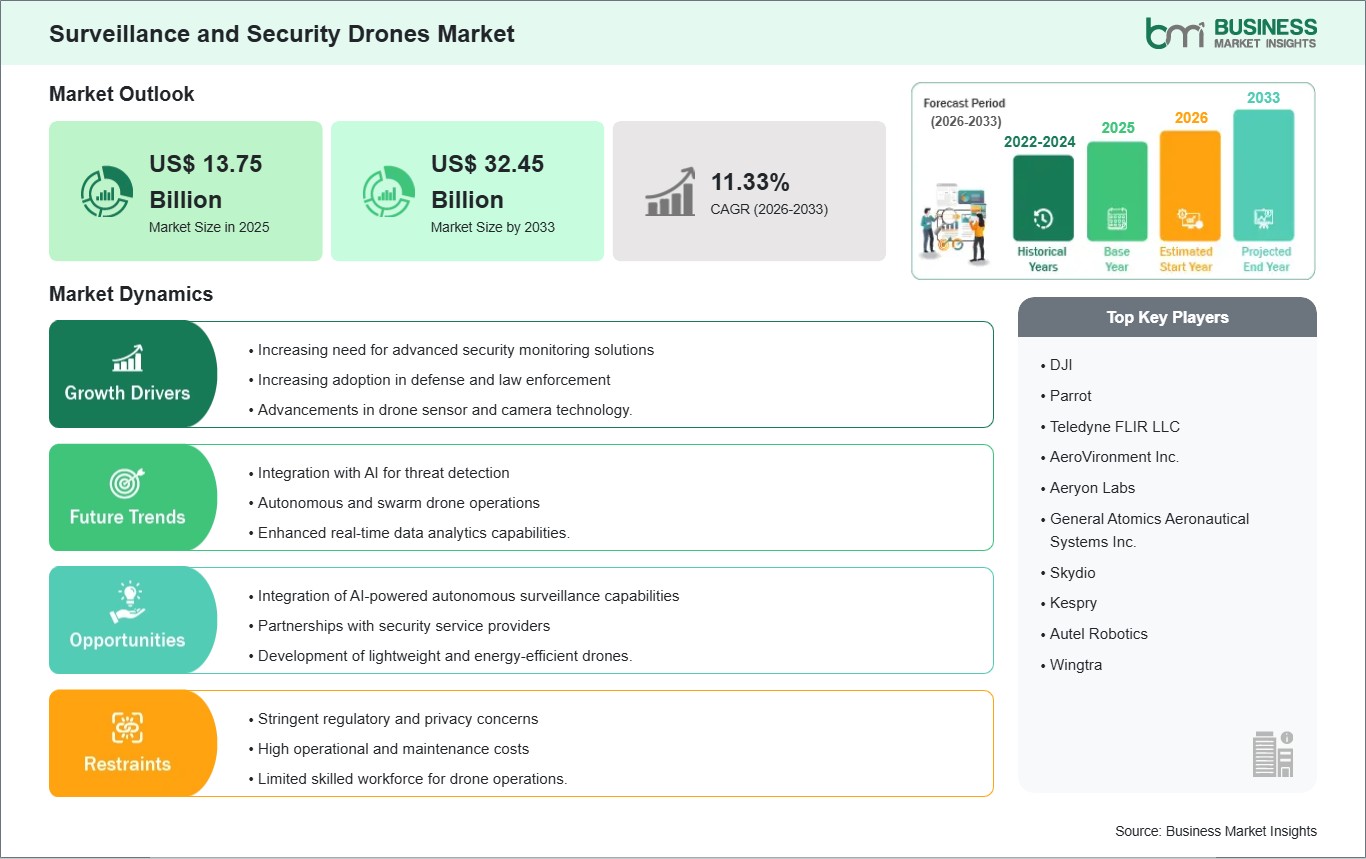
The Surveillance and Security Drones Market size is expected to reach US$ 32.45 billion by 2033 from US$ 13.75 billion in 2025. The market is estimated to record a CAGR of 11.33% from 2026 to 2033.
The global market for surveillance and security drones is growing quickly as organizations place more importance on aerial monitoring solutions for better situational awareness and threat detection. These drones are widely used in defense, law enforcement, border control, and protection of critical infrastructure. Their ability to provide real-time intelligence, high-resolution images, and quick deployment is a key factor in this trend. Technological advancements like AI-powered object recognition, thermal imaging, and autonomous navigation are improving how efficiently these drones operate and how accurately decisions are made. The market is also gaining from the integration of drones with command-and-control systems, which allows for smooth data transmission and centralized monitoring. Regulatory frameworks are slowly adapting to support controlled drone operations, which encourages broader use in commercial and public safety areas. Moreover, the increasing demand for affordable alternatives to traditional surveillance methods, like manned patrols and fixed camera systems, is helping the market grow.
Companies are working on developing drones with longer flight times, greater payload capacity, and better cybersecurity features to meet complex security needs. Partnerships between drone makers, software developers, and government agencies are boosting innovation. As global security concerns increase, surveillance drones are becoming an essential part of modern security systems.

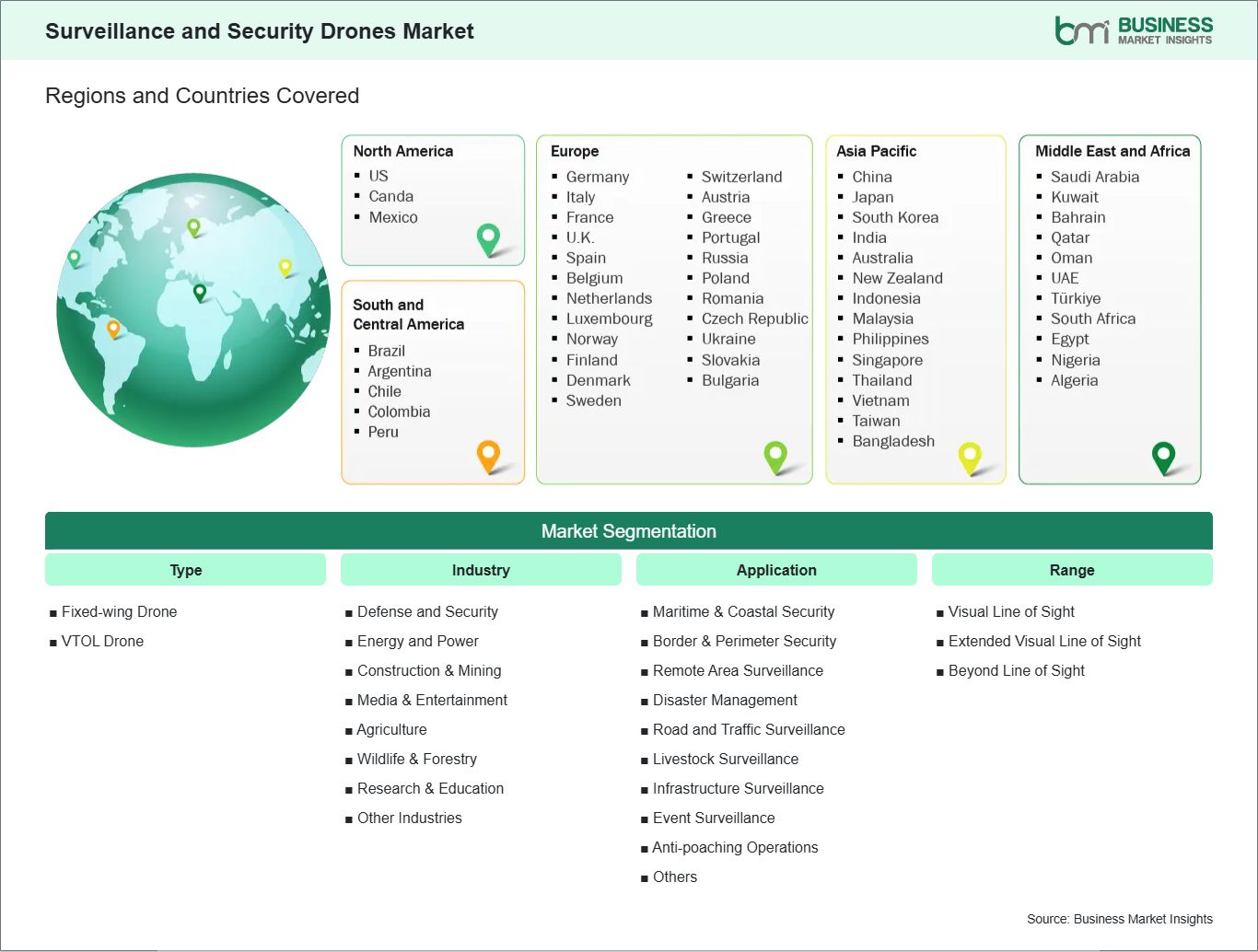
Key segments that contributed to the derivation of the surveillance & security drones market analysis are type, industry, application, range, MTOW, endurance, connection type, propulsion, and mode of operation.
The global market for surveillance and security drones is growing quickly. This growth is driven by the rising demand for effective security monitoring solutions in various sectors. Organizations are turning to drone-based surveillance to improve situational awareness, speed up response times, and cover areas that traditional systems find hard to monitor. Drones come equipped with high-resolution cameras, thermal imaging, and real-time data transmission. This makes them a cost-effective and efficient option compared to fixed surveillance setups. Concerns about public safety, infrastructure security, and border monitoring are pushing demand even further. Drones allow for continuous aerial monitoring of large and complex areas, like industrial sites, critical infrastructure, and public gatherings. Their ability to gather real-time information and be deployed quickly in emergencies enhances security operations and reduces the risks that come with human involvement.
Technological improvements are also boosting the use of surveillance drones worldwide. Better battery life, longer flight times, and improved sensor integration enable drones to operate for extended periods with greater accuracy. Plus, new communication systems ensure smooth data transfer, allowing security teams to make quick, informed decisions. Together, these factors support the ongoing growth of the global surveillance and security drones market.
The use of AI-powered autonomous surveillance is creating significant opportunities in the global surveillance and security drones market. Artificial intelligence allows drones to perform complex tasks like object detection, facial recognition, and behavior analysis without constant human control. This automation improves operational efficiency and allows for continuous monitoring with minimal manual intervention, making drone-based surveillance more scalable and reliable. AI-driven analytics also enable drones to process large amounts of visual and sensor data in real time, identifying anomalies and potential threats more effectively than traditional systems. Machine learning algorithms keep improving detection accuracy by learning from past data, which boosts predictive capabilities and supports proactive security measures. This level of intelligence changes drones from simple monitoring tools to effective decision-support systems.
Additionally, combining AI with autonomous navigation technologies allows drones to carry out pre-programmed patrols, adjust to changing environments, and work with other security systems. Integration with cloud platforms and IoT networks allows centralized control and data sharing, improving coordination across security operations. As AI technology continues to advance, its use in surveillance drones is expected to drive innovation, efficiency, and widespread adoption in the global market.
The surveillance & security drones market demonstrates steady growth, with size and share analysis highlighting evolving trends and competitive dynamics among key players. The report examines subsegments categorized within type, industry, application, range, MTOW, endurance, connection type, propulsion, and mode of operation, offering insights into their contribution to overall market performance.
By Type, the VTOL drone subsegment dominated the market in 2025, driven by its flexibility in both takeoff and landing and ability to operate in confined areas.
Based on Industry, the defense and security subsegment dominated the market in 2025, owing to increased demand for border surveillance, intelligence gathering, and national security operations.
On the Basis of Application, the border & perimeter security subsegment dominated the market in 2025, supported by rising geopolitical tensions and need for continuous monitoring.
By Range, the VLOS (visual line of sight) subsegment dominated the market in 2025, due to regulatory compliance and ease of deployment.
By MTOW, the <25 kilograms subsegment dominated the market in 2025, propelled by its widespread use in commercial and lightweight defense applications.
Based on Endurance, the <2 hours subsegment dominated the market in 2025, driven by cost efficiency and suitability for short-duration missions.
On the Basis of Connection Type, the untethered drones subsegment dominated the market in 2025, owing to their mobility and operational flexibility.
By Propulsion, the electric subsegment dominated the market in 2025, supported by lower emissions, reduced noise, and cost efficiency.
By Mode of Operation, the remotely piloted subsegment dominated the market in 2025, due to reliability and regulatory acceptance.
| Report Attribute | Details |
|---|---|
| Market size in 2025 | US$ 13.75 Billion |
| Market Size by 2033 | US$ 32.45 Billion |
| Global CAGR (2026 - 2033) | 11.33% |
| Historical Data | 2022-2024 |
| Forecast period | 2026-2033 |
| Segments Covered | By Type
|
|
Regions and Countries Covered
| |
| North America | US, Canada, Mexico |
| Europe | Belgium, Austria, Finland, Denmark, Greece, Poland, Romania, Russia, Ukraine, Czech Republic, Slovakia, Bulgaria, Italy, Luxembourg, Germany, Switzerland, France, Netherlands, Norway, Portugal, Spain, Sweden, United Kingdom |
| Asia-Pacific | Australia, China, India, Japan, South Korea, Indonesia, Malaysia, Philippines, Singapore, Thailand, Vietnam, Bangladesh, New Zealand, Taiwan |
| South and Central America | Brazil, Argentina, Peru, Chile, Colombia |
| Middle East and Africa | Bahrain, Kuwait, Oman, Qatar, Saudi Arabia, United Arab Emirates, Turkiye, South Africa, Egypt, Algeria, Nigeria |
| Market leaders and key company profiles |
|
The "Surveillance and Security Drones Market Size and Forecast (2022 - 2033)" report provides a detailed analysis of the market covering below areas:
The geographical scope of the Surveillance and Security Drones Market report is divided into North America, Asia Pacific, Europe, Middle East & Africa, and South & Central America. North America held the largest share in 2025.
North America dominates the surveillance and security drones market, supported by significant investments in defense modernization, homeland security, and advanced law enforcement technologies. The United States leads in deploying drones for border surveillance, disaster response, and urban security, leveraging sophisticated analytics and integrated monitoring systems to enhance operational effectiveness.
Asia Pacific is a rapidly growing region, with countries such as China, India, Japan, and South Korea increasing adoption for public safety, infrastructure monitoring, and defense applications. Government initiatives to strengthen border security and manage large populations are driving demand for scalable and cost-efficient drone solutions.
Europe emphasizes regulatory compliance, privacy protection, and technological innovation, with countries like Germany, France, and the UK adopting drones for law enforcement, environmental monitoring, and critical infrastructure surveillance. Integration with smart city frameworks is further supporting regional growth.
The Middle East and Africa are emerging markets where drones are increasingly used for border control, oil and gas infrastructure monitoring, and security operations in remote areas. Investments in security infrastructure are encouraging adoption despite regulatory challenges. South and Central America are witnessing steady growth, particularly in Brazil, Mexico, and Argentina, where drones are used for crime prevention, agricultural surveillance, and disaster management.
Regional adoption is influenced by evolving regulations and the need for cost-effective security solutions.

The Surveillance and Security Drones Market is evaluated by gathering qualitative and quantitative data post primary and secondary research, which includes important corporate publications, association data, and databases. A few of the key developments in the spatial light Modulator market are:
The Surveillance and Security Drones Market is valued at US$ 13.75 Billion in 2025, it is projected to reach US$ 32.45 Billion by 2033.
As per our report Surveillance and Security Drones Market, the market size is valued at US$ 13.75 Billion in 2025, projecting it to reach US$ 32.45 Billion by 2033. This translates to a CAGR of approximately 11.33% during the forecast period.
The Surveillance and Security Drones Market report typically cover these key segments-
The historic period, base year, and forecast period can vary slightly depending on the specific market research report. However, for the Surveillance and Security Drones Market report:
The Surveillance and Security Drones Market is populated by several key players, each contributing to its growth and innovation. Some of the major players include:
The Surveillance and Security Drones Market report is valuable for diverse stakeholders, including:
Essentially, anyone involved in or considering involvement in the Surveillance and Security Drones Market value chain can benefit from the information contained in a comprehensive market report.
Please tell us your area of interest
(Market Segments/ Regions and Countries/ Companies)