Market Summary
Executive Summary and Global Market Analysis
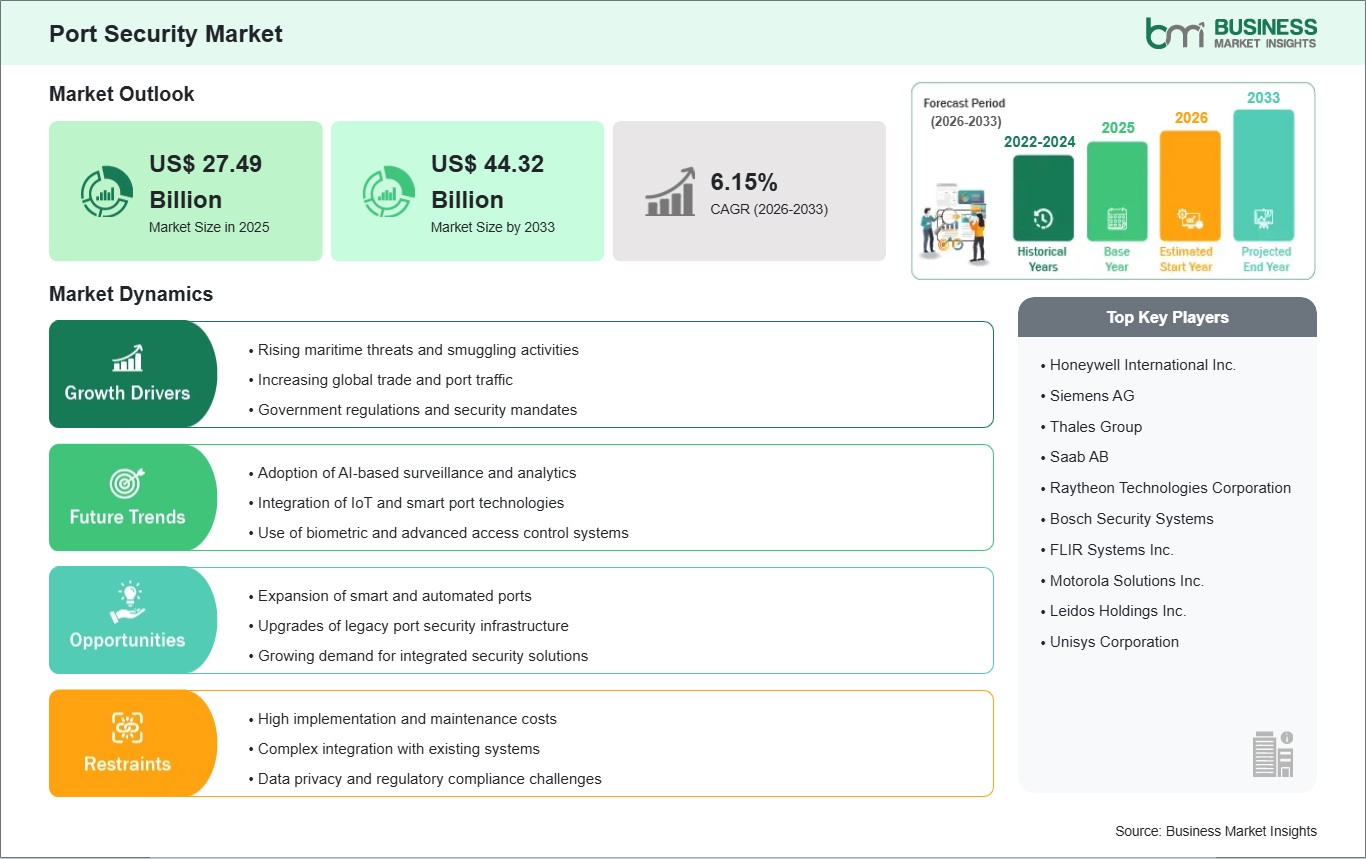
Port security refers to the comprehensive framework of physical, electronic, and procedural measures designed to safeguard maritime transportation hubs from threats such as terrorism, smuggling, and unauthorized access. This ecosystem utilizes an integrated array of surveillance systems, physical access controls, and advanced screening technologies to protect critical infrastructure and maintain the fluid movement of global trade. The technology is fundamental to national security and global supply chain resilience, ensuring the integrity of vessels, cargo, and personnel within high-traffic maritime environments. Market expansion is being propelled by escalating geopolitical tensions, the rising requirement for maritime domain awareness, and substantial institutional investment in smart port modernization projects.
However, several factors may restrain market progression. The high capital intensity associated with deploying wide-area surveillance networks and sophisticated screening hardware remains a significant hurdle for smaller port authorities and facilities in developing regions. The industry also faces technical challenges regarding the integration of diverse security technologies into unified command-and-control platforms, which often leads to interoperability constraints and data silos. Additionally, the increasing digitalization of port operations has expanded the attack surface for cyber threats, necessitating complex and ongoing investments in network security and data protection. These hurdles, compounded by a persistent shortage of specialized technical personnel to operate and maintain advanced electronic systems, increase operational complexity and total cost of ownership.
Despite these hurdles, the market outlook remains favorable. Opportunities are emerging through the adoption of artificial intelligence and digital twin technologies, which enable real-time virtual modeling of port activities for predictive threat assessment and emergency simulation. The expansion of autonomous vessel traffic management systems is gaining traction, enhancing the efficiency of maritime surveillance and collision avoidance. Furthermore, the growth of automated gate systems, utilizing biometrics and high-speed scanning, aligns with global mandates for increased throughput and stringent regulatory compliance. Collectively, these innovations position the port security industry for sustained long-term development as a critical component of the global security architecture.
Segment Analysis
Port Security Market Segmentation
Key segments that contributed to the derivation of the Port Security market analysis are type and services.
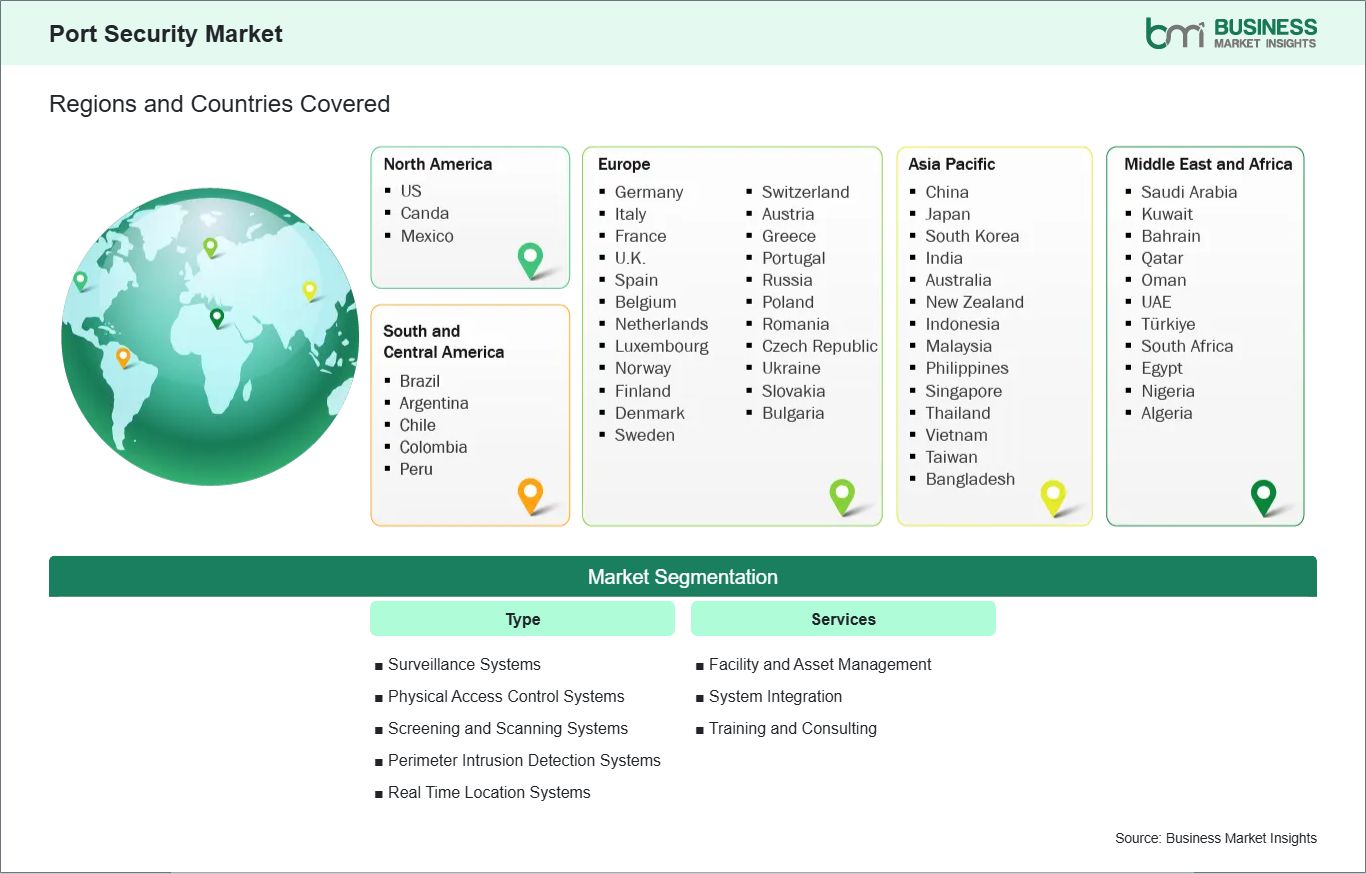
- By Type, the market is segmented into Surveillance Systems, Physical Access Control Systems, Screening and Scanning Systems, Perimeter Intrusion Detection Systems, and Real‑Time Location Systems.
- By Services, the market is divided into Facility and Asset Management, System Integration, and Training and Consulting.
Market Forces
Port Security Market Drivers and Opportunities
Rising Threats to Maritime Infrastructure and Regulatory Mandates
The port security market is being driven by the increasing need to safeguard global maritime infrastructure against terrorism, smuggling, piracy, and cyberattacks. Ports serve as critical nodes in international trade, handling vast volumes of cargo and passengers, making them vulnerable to physical and digital threats. Governments worldwide are enforcing stricter regulations and compliance standards, such as the International Ship and Port Facility Security (ISPS) Code, to ensure robust protection of assets and personnel. The rising incidence of illicit trafficking, including narcotics and counterfeit goods, is amplifying demand for advanced surveillance, screening, and access control systems. Additionally, the expansion of global trade and modernization of port facilities are reinforcing adoption, as operators seek integrated solutions that combine physical security with cybersecurity. Collectively, regulatory mandates, growing threat landscapes, and infrastructure expansion are propelling sustained growth in the global port security market, positioning it as a cornerstone of maritime safety and international commerce.
Rising Adoption of Smart Technologies and Integrated Security Solutions
Opportunities in the port security market are expanding through the integration of smart technologies, digital platforms, and eco‑friendly innovations. IoT‑enabled sensors, AI‑driven analytics, and drone surveillance are creating new pathways for adoption, offering real‑time monitoring, predictive threat detection, and rapid incident response. Cloud‑based platforms are gaining traction, enabling centralized control and data sharing across multiple terminals, improving efficiency and resilience. The growing emphasis on cybersecurity is opening lucrative opportunities, as ports increasingly rely on digital systems for cargo tracking, customs clearance, and logistics management. Integration of biometric access control, automated screening, and smart perimeter protection is also driving innovation, aligning with global goals for safe and efficient trade. Furthermore, the expansion of green ports and sustainable shipping practices is encouraging vendors to develop eco‑friendly security solutions that minimize environmental impact. Vendors who focus on cost‑effective, interoperable, and digitally enabled systems are well‑positioned to capture growth. The convergence of smart functionality, cybersecurity, and sustainability underscores a transformative trajectory for the global port security market.
Size and Share Analysis
Port Security Market Size and Share Analysis
The Port Security market demonstrates steady growth, with size and share analysis revealing evolving trends and competitive positioning among key players. The report examines subsegments categorized within type and services, offering insights into their contribution to overall market performance.
Based on Type, the Surveillance Systems subsegment holds the primary market presence. These systems are indispensable for monitoring port facilities, detecting threats, and ensuring situational awareness. The Physical Access Control Systems subsegment is essential for regulating entry and exit points, safeguarding restricted areas, and preventing unauthorized access. The Screening and Scanning Systems subsegment anchors demand in cargo and passenger security, ensuring compliance with international safety standards. The Perimeter Intrusion Detection Systems subsegment is critical for protecting port boundaries against breaches. The Real‑Time Location Systems subsegment supports tracking of assets, personnel, and vehicles, enhancing operational efficiency and security.
Report Coverage
Port Security Market Report Coverage and Deliverables
The "Port Security Market Size and Forecast (2022 - 2033)" report provides a detailed analysis of the market covering below areas:
- Market size and forecast at global, regional, and country levels for all market segments covered under the scope
- Market trends, as well as drivers, restraints, and opportunities
- Market analysis covering key trends, global and regional framework, major players, and recent developments
- Market concentration, heat map analysis, prominent players, and recent developments
- Detailed company profiles, including SWOT analysis
Geographic Insights
Port Security Market Geographic Insights
The geographical scope of the Port Security market report is divided into five regions: North America, Asia Pacific, Europe, Middle East & Africa, and South & Central America.
North America maintains a preeminent position within the global industry, a standing solidified by the aggressive modernization of coastal infrastructure and the pervasive integration of Smart Port architectures. The regional landscape is characterized by high-density investments in the United States and Canada, where the transition toward Digitized Customs and Cargo Security has become a strategic priority for ensuring supply chain resilience. This market leadership is further supported by significant federal mandates and a sophisticated regulatory environment, with the region accounting for approximately 35% of the global market share in port security systems as of the current year.
Technological progression in the United States and Canada is largely driven by a decisive shift toward AI-Driven Threat Detection and Automated Inspection Workflows. These advanced systems utilize machine learning at the edge to perform real-time anomaly detection, advanced facial recognition, and automated alert generation, enabling security personnel to identify risks with unprecedented speed and accuracy. Furthermore, the region is witnessing an increasing utilization of Unmanned Aerial Vehicles (UAVs) and Autonomous Underwater Vehicles (AUVs) for continuous perimeter surveillance and hull inspections. This focus on Intelligent Safeguarding allows North American ports to achieve a reduction in operational accidents and human-related safety risks by significant margins while simultaneously enhancing the throughput of containerized freight.
Industry Activity
Recent Developments
The Port Security market is evaluated by gathering qualitative and quantitative data post primary and secondary research, which includes important corporate publications, association data, and databases. A few of the key developments in the Port Security market are:
- In January 2026, Nuctech Company Limited launched NucMind 2.0, an AI-powered intelligent customs inspection platform designed to enhance cargo screening, risk analysis, and automated decision-making at ports and border checkpoints. The platform improves security inspection efficiency by integrating advanced image recognition, intelligent target detection, and data-driven supervision to strengthen port and customs security operations.
- In April 2024, Smiths Detection launched the SDX 10060 XDi, an advanced X-ray scanner powered by X-ray Diffraction (XRD) technology, designed to enhance security screening with highly accurate material discrimination and substance identification. The solution helps airports, customs agencies, and logistics operators detect explosives, narcotics, and contraband more efficiently while improving high-volume baggage and parcel screening operations.
Trust & Transparency
Research Methodology
The market analysis combines proprietary research with secondary data from government agencies, company disclosures, regulatory filings, industry databases and expert interviews. Market estimates are validated through data triangulation, cross-market benchmarking and analyst
review.
View Full Research Methodology
Key Sources Referred:
World Bank & Global Trade Indicators World Trade Organization (WTO) International Monetary Fund (IMF) International Trade Administration (ITA) Company Websites Company Annual Reports Company Investor Presentations