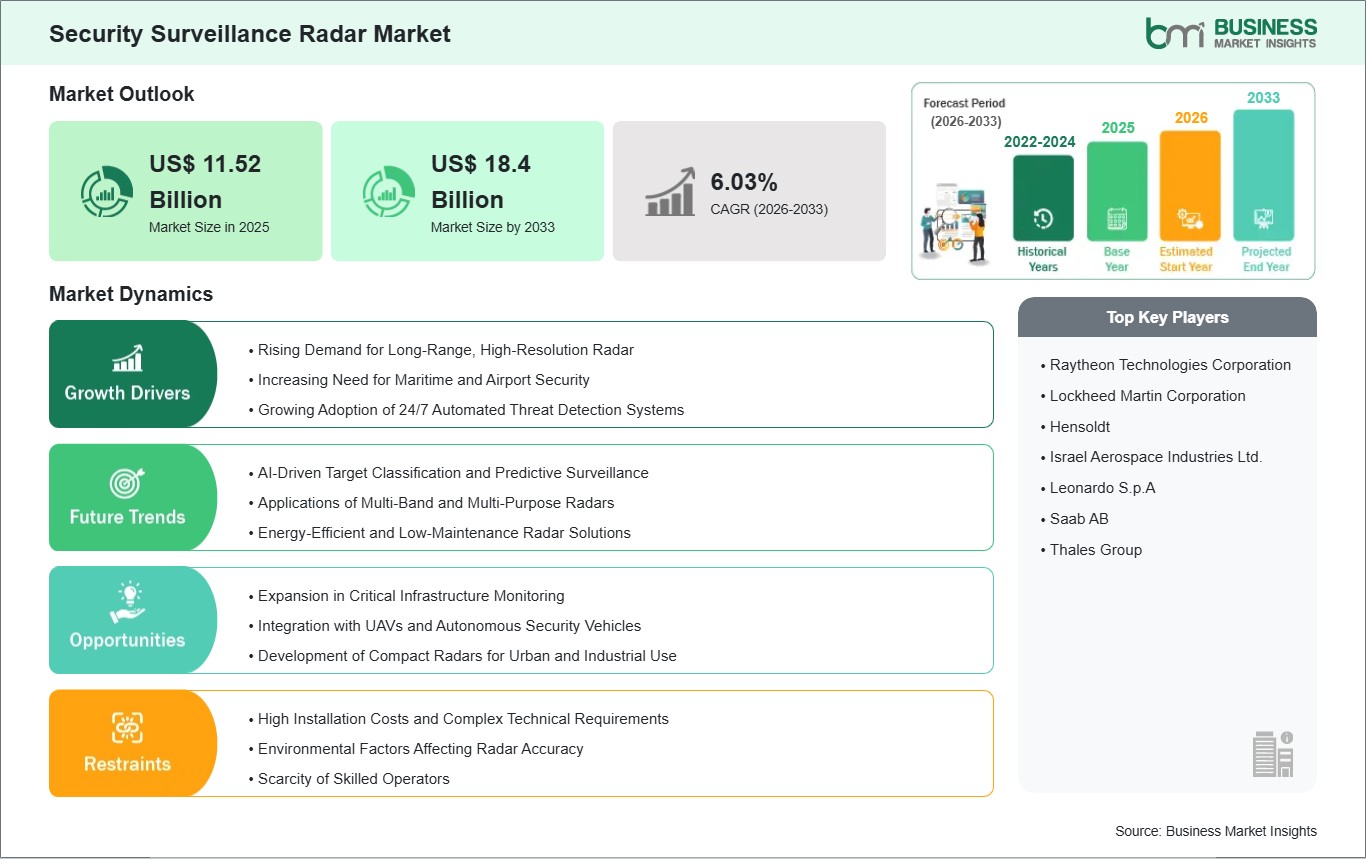
The Security Surveillance Radar Market size is expected to reach US$ 18.4 billion by 2033 from US$ 11.52 billion in 2025. The market is estimated to record a CAGR of 6.03% from 2026 to 2033.
The global security surveillance radar market is witnessing significant growth due to increasing efforts by various countries and organizations to strengthen their focus on security surveillance radar systems. Security surveillance radar systems are being increasingly deployed in various military bases, airports, sea ports, borders, and other critical areas to ensure security against airborne and surface threats. One of the major factors driving this market is the increasing need for real-time situational awareness in response to emerging security threats.
Various governments and defense organizations are increasingly adopting radar systems for their military and security applications due to their high detection accuracy, range extension, and ability to integrate with other surveillance systems such as electro-optical systems. Solid-state radar systems, digital beamforming, and software-defined radar systems have significantly improved the overall detection capabilities of surveillance radar systems. These systems have also minimized maintenance complexities.
However, due to increasing security threats from drones and unmanned aerial systems (UAS), organizations are increasingly adopting radar systems for detecting low-altitude threats. These radar systems are being increasingly deployed for counter-UAS operations. However, various organizations are facing technical and logistical problems in integrating advanced radar systems with their existing infrastructure.

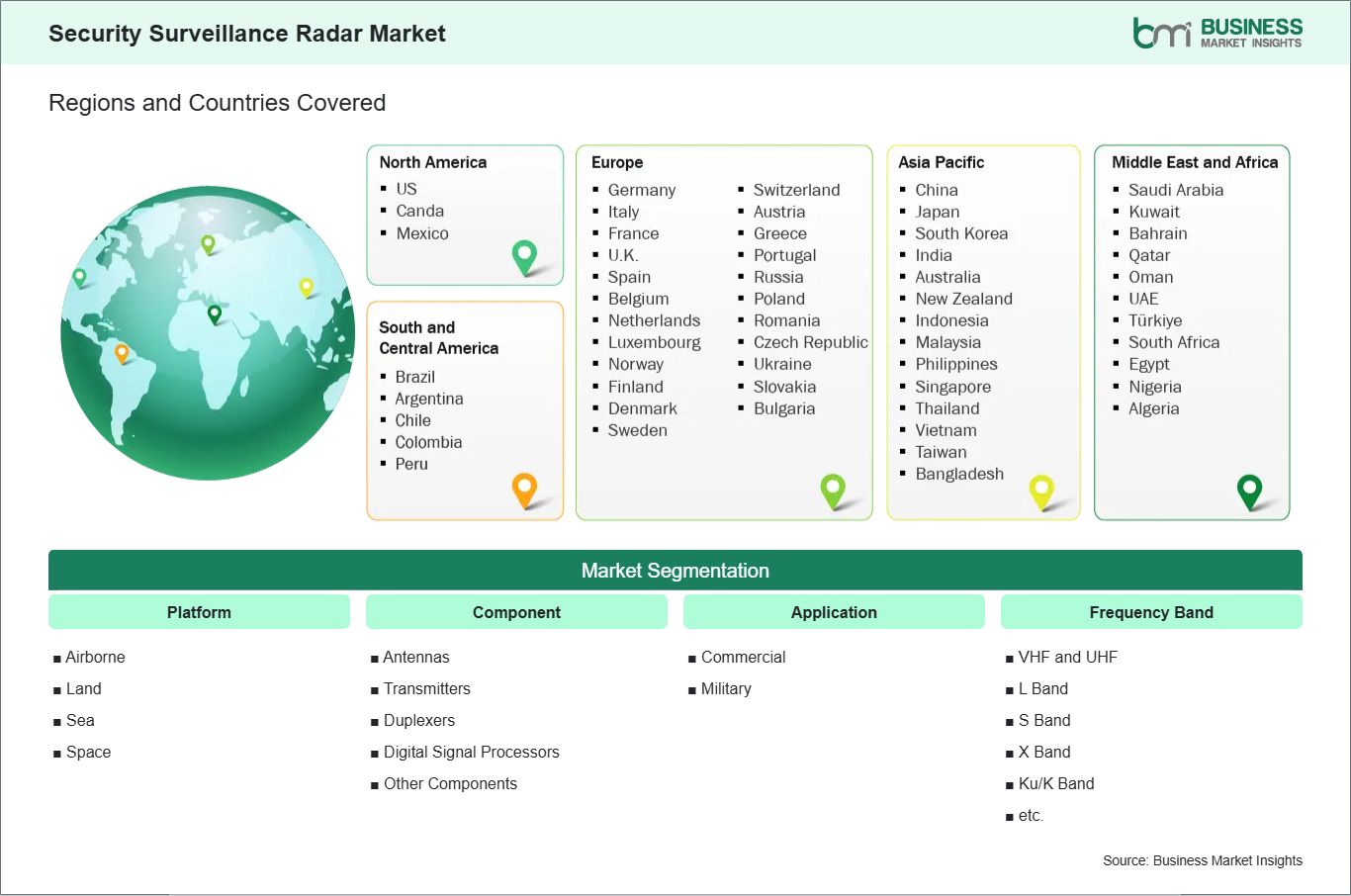
Key segments that contributed to the derivation of the security surveillance radars market analysis are platform, component, application, frequency band, range, and radar.
The market for security surveillance radar is being driven by the increasing need for radar that can identify and track objects at long ranges with outstanding clarity. Modern radar technology has made tremendous advancements in resolution, accuracy, and detection speeds, allowing organizations to achieve a state of heightened situational awareness. As the need for security continues to change, radar technology has become a necessity to help organizations achieve their security goals.
Organizations are increasingly relying on radar solutions that can perform reliably in all conditions, including challenging weather, low visibility, and complex operational environments. The ability to continuously monitor large areas in real-time enhances decision-making, reduces response times, and strengthens overall operational effectiveness. As the complexity and speed of potential threats increase, the demand for radars with longer range and sharper resolution continues to rise, driving growth across the market.
Advances in radar integration, including digital signal processing and AI-assisted analytics, are further improving system capabilities. These developments allow operators to track multiple targets simultaneously, classify objects accurately, and derive actionable insights from radar data. Consequently, market expansion is not solely driven by coverage needs but also by the growing emphasis on intelligence-led security and precise threat management.
Security surveillance radars are increasingly being deployed to protect critical infrastructure such as airports, seaports, power generation facilities, and industrial complexes. Continuous monitoring of these assets has become a priority for organizations seeking to prevent unauthorized access, sabotage, and other potential risks. This trend presents a significant opportunity for radar providers to offer solutions that combine extensive detection range with real-time monitoring and actionable intelligence.
Integration with other security technology tools is also increasing the value of using radar technology, such as when it is integrated with cameras, drones, and response systems. This has enabled the development of multi-layered security systems that are more effective. The increasing complexity of potential security threats has also increased the need for sophisticated radar technology that will provide comprehensive security to infrastructure.
The continued investment in modernizing and improving infrastructure security will continue to drive demand for more advanced radar technology. This will provide long-term growth prospects for manufacturers as organizations focus more on improving infrastructure security, such as when they are upgrading outdated security systems. Advanced surveillance radars will continue to provide more security and growth prospects.
The security surveillance radars market is experiencing steady growth, with market size and share analysis reflecting evolving treatment preferences and competitive dynamics among key players. The report evaluates important subsegments categorized within platform, component, application, frequency band, range, and radar, highlighting their respective contributions to overall market performance.
By platform, the airborne subsegment dominated the Surveillance Radar market in 2025. This is driven by growing defense modernization efforts, which prioritize airborne systems for their ability to cover large areas, quickly detect targets, and perform multiple missions. These radars use advanced signal processing and AESA technologies, enhancing situational awareness for military and strategic operations and making airborne platforms central to modern defense and border security.
Based on components, antennas subsegment dominated the market in 2025. Their prominence comes from their essential role in radar transmission and reception, with innovations like gallium-nitride (GaN) front-ends improving detection range and reliability. High demand for robust antenna systems across airborne, land, sea, and space platforms reinforces their leading position.
In terms of application, the military subsegment was the largest in 2025. This is due to substantial defense spending and continued investment in radar systems for border defense, airspace monitoring, and battlefield surveillance. Rising global security challenges have further strengthened the demand for military-grade radars, making defense applications a key revenue driver.
By frequency band, X-band subsegment dominated the market in 2025. Their widespread adoption in naval and air-defense systems is due to their high resolution and accuracy over medium to long ranges, making them ideal for tactical surveillance, target tracking, and early warning across defense and security operations.
Based on range, long-range subsegment led the market in 2025. They are crucial for strategic early warning, air-defense, and wide-area monitoring, as they detect distant threats and provide extended situational awareness, particularly in national defense and aerospace applications.
By radar dimension, 2-D subsegment held the largest share in 2025. Although 3-D and 4-D radars are increasingly adopted, 2-D radars remain widely used due to their simplicity and effectiveness in traditional monitoring tasks.

| Report Attribute | Details |
|---|---|
| Market size in 2025 | US$ 11.52 Billion |
| Market Size by 2033 | US$ 18.4 Billion |
| Global CAGR (2026 - 2033) | 6.03% |
| Historical Data | 2022-2024 |
| Forecast period | 2026-2033 |
| Segments Covered | By Platform
|
|
Regions and Countries Covered
| |
| North America | US, Canada, Mexico |
| Europe | Belgium, Austria, Finland, Denmark, Greece, Poland, Romania, Russia, Ukraine, Czech Republic, Slovakia, Bulgaria, Italy, Luxembourg, Germany, Switzerland, France, Netherlands, Norway, Portugal, Spain, Sweden, United Kingdom |
| Asia-Pacific | Australia, China, India, Japan, South Korea, Indonesia, Malaysia, Philippines, Singapore, Thailand, Vietnam, Bangladesh, New Zealand, Taiwan |
| South and Central America | Brazil, Argentina, Peru, Chile, Colombia |
| Middle East and Africa | Bahrain, Kuwait, Oman, Qatar, Saudi Arabia, United Arab Emirates, Turkiye, South Africa, Egypt, Algeria, Nigeria |
| Market leaders and key company profiles |
|
The "Security Surveillance Radars Market Size and Forecast (2022 - 2033)" report provides a detailed analysis of the market covering below areas:
The geographical scope of the Security Surveillance Radars market report is divided into five regions: North America, Asia Pacific, Europe, Middle East & Africa, and South & Central America. The Security Surveillance Radars market in North America is expected to grow during the forecast period.
The North American region dominates the global market for security surveillance radars. This can be attributed to the robust defense setup, advanced technology, and focus on homeland security. In the North American region, the US is considered to be a major player in the development and use of radar technology for both military and civilian use. In the region, security organizations are focused on installing advanced radar technology to secure their assets, including airspace over major cities, ports, and military installations. In this regard, organizations and defense institutions have come together to develop advanced radar technology that offers enhanced target discrimination, sensor integration, and analysis. This has been necessitated by the development of advanced threats, including unmanned air vehicles, fast-moving maritime targets, and stealth technology, which require advanced technology to detect and track targets.
In the North American region, surveillance radar technology has been integrated with other technologies, including long-range cameras, lidar, and threat response technology, to offer end-to-end awareness of large perimeters and assets. Additionally, the focus on border control and counter-terror initiatives has further strengthened the need for robust radar technology that can be used in different environments, including deserts and cities.

The security surveillance radars market is evaluated by gathering qualitative and quantitative data post primary and secondary research, which includes important corporate publications, association data, and databases. A few of the key developments in the security surveillance radars market are:
The Security Surveillance Radar Market is valued at US$ 11.52 Billion in 2025, it is projected to reach US$ 18.4 Billion by 2033.
As per our report Security Surveillance Radar Market, the market size is valued at US$ 11.52 Billion in 2025, projecting it to reach US$ 18.4 Billion by 2033. This translates to a CAGR of approximately 6.03% during the forecast period.
The Security Surveillance Radar Market report typically cover these key segments-
The historic period, base year, and forecast period can vary slightly depending on the specific market research report. However, for the Security Surveillance Radar Market report:
The Security Surveillance Radar Market is populated by several key players, each contributing to its growth and innovation. Some of the major players include:
The Security Surveillance Radar Market report is valuable for diverse stakeholders, including:
Essentially, anyone involved in or considering involvement in the Security Surveillance Radar Market value chain can benefit from the information contained in a comprehensive market report.
Please tell us your area of interest
(Market Segments/ Regions and Countries/ Companies)