Market Summary
Executive Summary and Global Market Analysis
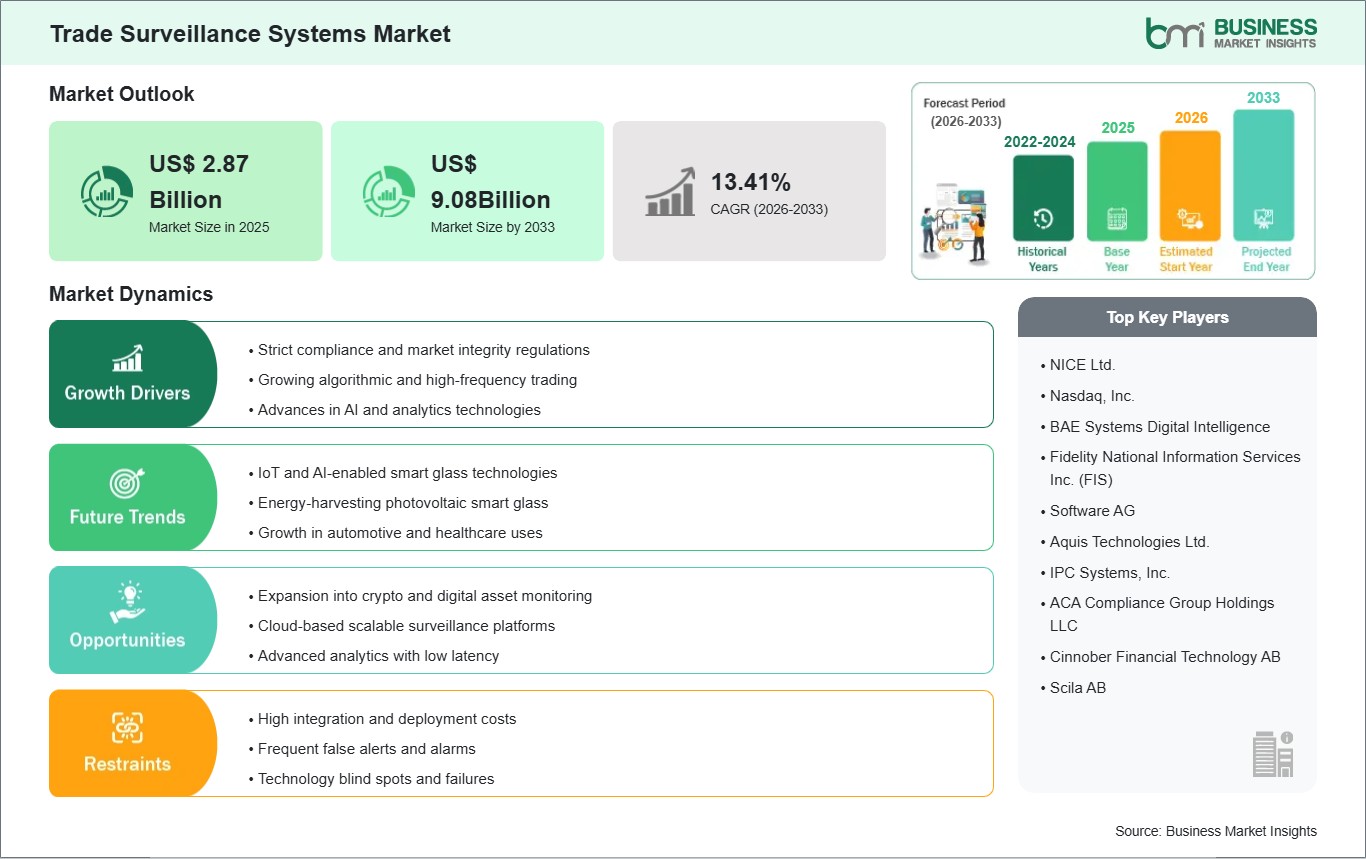
A Trade Surveillance System is a critical compliance platform that enables financial institutions, exchanges, and regulators to monitor trading activity and detect market abuse. These systems process large volumes of real-time and historical data, including orders, executions, and communications, to identify suspicious patterns such as insider trading, wash trading, spoofing, and layering. The market is expected to expand due to increased demand for AI-driven market abuse detection, the growth of algorithmic and high-frequency trading, and the integration of cryptocurrency and digital assets into regulated portfolios.
However, several challenges can restrain market growth, as high integration complexity with legacy front- and back-office systems remains a major barrier to modernization for many established institutions. Stringent data privacy regulations, such as GDPR, limit the ability of firms to pool and analyze global trade data holistically, creating potential surveillance "blind spots." Additionally, the industry faces constraints due to a global shortage of specialized data science talent capable of tuning complex machine learning models to reduce "false positives," which currently account for a significant portion of compliance officer workloads.
Despite these hurdles, the market holds immense opportunities in the universal mandate for cross-asset class surveillance and the accelerating deployment of behavioral biometrics to track employee intent. The expansion of tokenized real-world assets (RWA) and the development of integrated trade-and-comm surveillance (merging voice and text data with trade logs) are expected to create significant opportunities for market growth.
Segment Analysis
Trade Surveillance Systems Market Segmentation
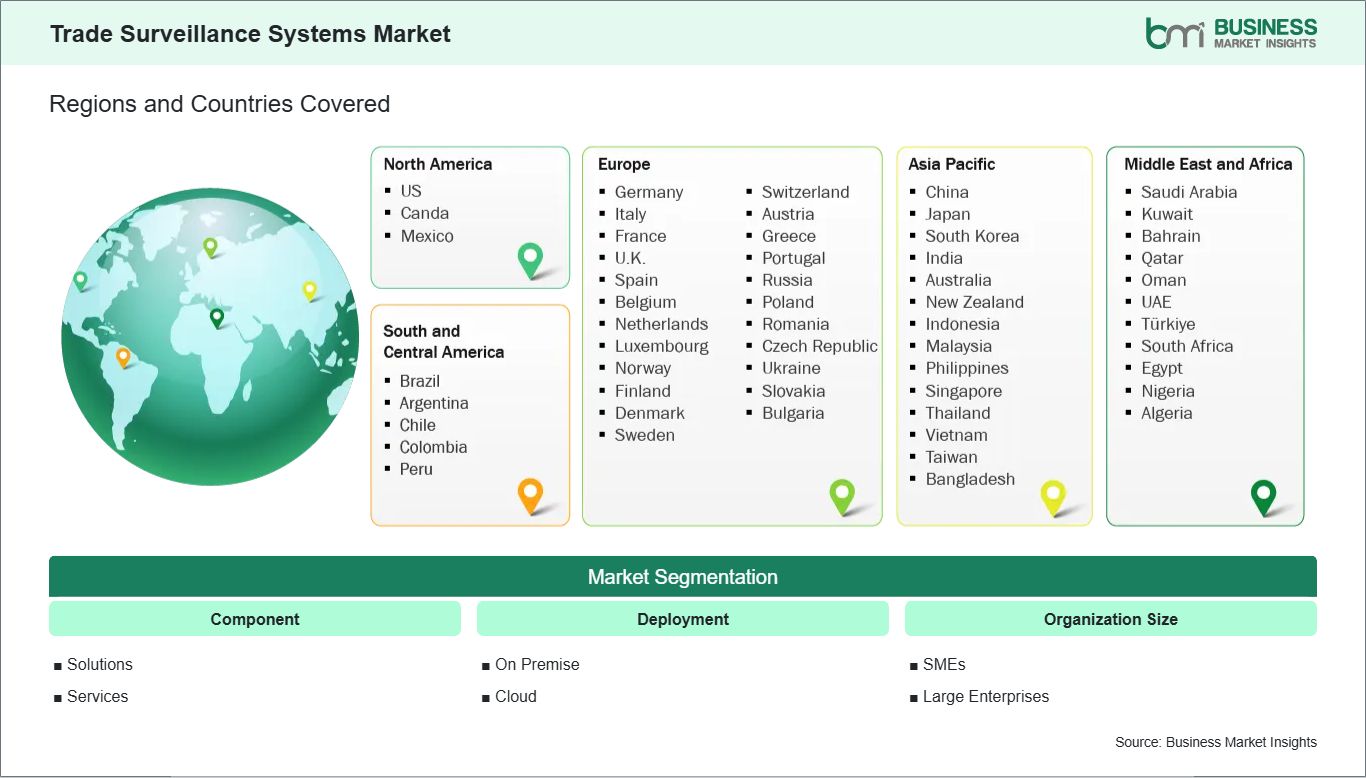
Key segments that contributed to the derivation of the Trade Surveillance Systems market analysis are component, deployment, and organization size.
- By Component, the market is segmented into Solutions and Services.
- By Deployment, the market is divided into On Premise and Cloud.
- By Organization Size, the market is categorized into SMEs and Large Enterprises.
Market Forces
Trade Surveillance Systems Market Drivers and Opportunities
Advancing Regulatory Vigilance and Algorithmic Trading Complexity
The primary driver for the Trade Surveillance Systems Market is the intensifying global pressure from regulators to eliminate market abuse, insider trading, and fraudulent activities within increasingly complex financial ecosystems. As of 2026, the market is expanding strongly as financial institutions face non-discretionary mandates to monitor high-frequency and algorithmic trading volumes that execute in milliseconds. This momentum is further amplified by the rapid digitalization of capital markets, which has led to a surge in cross-asset trading, spanning equities, derivatives, FX, and commodities, necessitating integrated surveillance systems that can correlate data across disparate venues. Furthermore, the strengthening of regulatory frameworks, such as the evolution of MiFID II in Europe and stricter SEC/CFTC enforcement in the U.S., has turned audit-ready reporting and real-time monitoring into a vital operational requirement. Governments are increasingly delivering a consistent message: compliance programs must be technology-enabled to keep pace with modern "spoofing" and "layering" schemes, ensuring that market integrity remains a foundational pillar of global economic stability.
AI-Driven Behavioral Analytics and Digital Asset Oversight
A significant high-value opportunity lies in the convergence of Trade Surveillance with Artificial Intelligence (AI) and Machine Learning (ML) to reduce the burden of false positives and identify subtle manipulation patterns. By moving beyond static, rules-based alerts, next-generation AI platforms can perform contextual behavioral analysis, learning from historical data to adapt to new forms of market misconduct that traditional systems might miss. There is also a major growth frontier in the expansion of Surveillance for Crypto and Digital Assets, including NFTs and tokenized securities. As these assets move into the mainstream financial architecture, specialized tools are required to monitor blockchain transactions and decentralized finance (DeFi) platforms. Furthermore, the shift toward Cloud-Based and Hybrid Deployment models presents an opportunity for operational agility, allowing firms to scale their surveillance capacity instantly during periods of extreme market volatility. Manufacturers and vendors who focus on "explainable AI", providing transparent decision-making logs to satisfy regulator scrutiny, and those offering integrated communication surveillance (ecomms and voice) are positioned to lead the most innovative segments of the compliance landscape.
Size and Share Analysis
Trade Surveillance Systems Market Size and Share Analysis
The Trade Surveillance Systems market demonstrates steady growth, with size and share analysis revealing evolving trends and competitive positioning among key players. The report further examines subsegments categorized within component, deployment, and organization size, offering insights into their contribution to overall market performance.
Based on component, the Solutions subsegment holds a significant market share, representing the industry benchmark for real-time anomaly detection and compliance automation. Solutions are indispensable for the Banking sector, where they provide the high-throughput processing and AI-driven pattern recognition required to screen complex global trades. A notable trend is the surge in the Services subsegment, which is registering a higher CAGR as firms increasingly seek specialized expertise for system integration and managed compliance. Services are becoming essential for mid-tier firms that lack in-house data science talent, providing a data-driven path to optimizing surveillance strategies without the overhead of maintaining proprietary hardware.
Report Coverage
Trade Surveillance Systems Market Report Coverage and Deliverables
The "Trade Surveillance Systems Market Size and Forecast (2022 - 2033)" report provides a detailed analysis of the market covering below areas:
- Trade Surveillance Systems market size and forecast at global, regional, and country levels for all the key market segments covered under the scope
- Trade Surveillance Systems market trends, as well as market dynamics such as drivers, restraints, and key opportunities
- Trade Surveillance Systems market analysis covering key market trends, global and regional framework, major players, regulations, and recent market developments
- Industry landscape and competition analysis covering market concentration, heat map analysis, prominent players, and recent developments for the Trade Surveillance Systems market
- Detailed company profiles, including SWOT analysis
Geographic Insights
Trade Surveillance Systems Market Geographic Insights
The geographical scope of the Trade Surveillance Systems market report is divided into five regions: North America, Asia Pacific, Europe, Middle East & Africa, and South & Central America.
The Asia-Pacific Trade Surveillance Systems Market is segmented into China, Japan, South Korea, India, Australia, Singapore, and the Rest of Asia. This region is the fastest-growing market globally, with projections indicating robust growth as it moves toward a significantly larger market size in the coming years. The growth is primarily driven by the rapid expansion of electronic trading venues and major regulatory reforms in emerging economies such as India and China. Singapore remains a key innovation hub, particularly in the surveillance of digital assets and cryptocurrency exchanges, which are increasingly being incorporated into regulated financial frameworks.
Growth is further bolstered by a significant shift toward cloud-native SaaS delivery and the adoption of AI/ML-powered anomaly detection, which helps institutions reduce false positives and compliance costs. The integration of real-time behavioral analytics and the rising demand for unified platforms that can correlate activity across equities, derivatives, and crypto venues solidify Asia-Pacific as a critical hub for the future scaling of the Trade Surveillance industry.
Industry Activity
Recent Developments
The Trade Surveillance Systems market is evaluated by gathering qualitative and quantitative data post primary and secondary research, which includes important corporate publications, association data, and databases. A few of the key developments in the Trade Surveillance Systems market are:
- In January 2026, LSEG launched Trade Surveillance, a solution designed to help market participants detect and investigate potential market abuse and financial crime more efficiently. The platform offers multi-asset and FX-specific surveillance, leveraging LSEG’s proprietary technology and extensive market data. This launch is a key development for the trade surveillance market, as it strengthens compliance capabilities and operational efficiency for financial institutions.
- In October 2025, Eventus collaborated with Huron | Treliant to enhance trade surveillance capabilities for financial institutions worldwide. The partnership combines Eventus’ Validus platform expertise with Huron | Treliant’s compliance and operational consulting, enabling optimized surveillance frameworks, improved signal quality, and stronger regulatory alignment, representing a key development for Trade Surveillance Systems adoption and technology advancement.
Trust & Transparency
Research Methodology
The market analysis combines proprietary research with secondary data from government agencies, company disclosures, regulatory filings, industry databases and expert interviews. Market estimates are validated through data triangulation, cross-market benchmarking and analyst
review.
View Full Research Methodology
Key Sources Referred:
World Bank - Global Trade IndicatorsWorld Trade Organization (WTO)International Monetary Fund (IMF)International Trade Administration (ITA)Company websiteCompany annual reportsCompany investor presentations