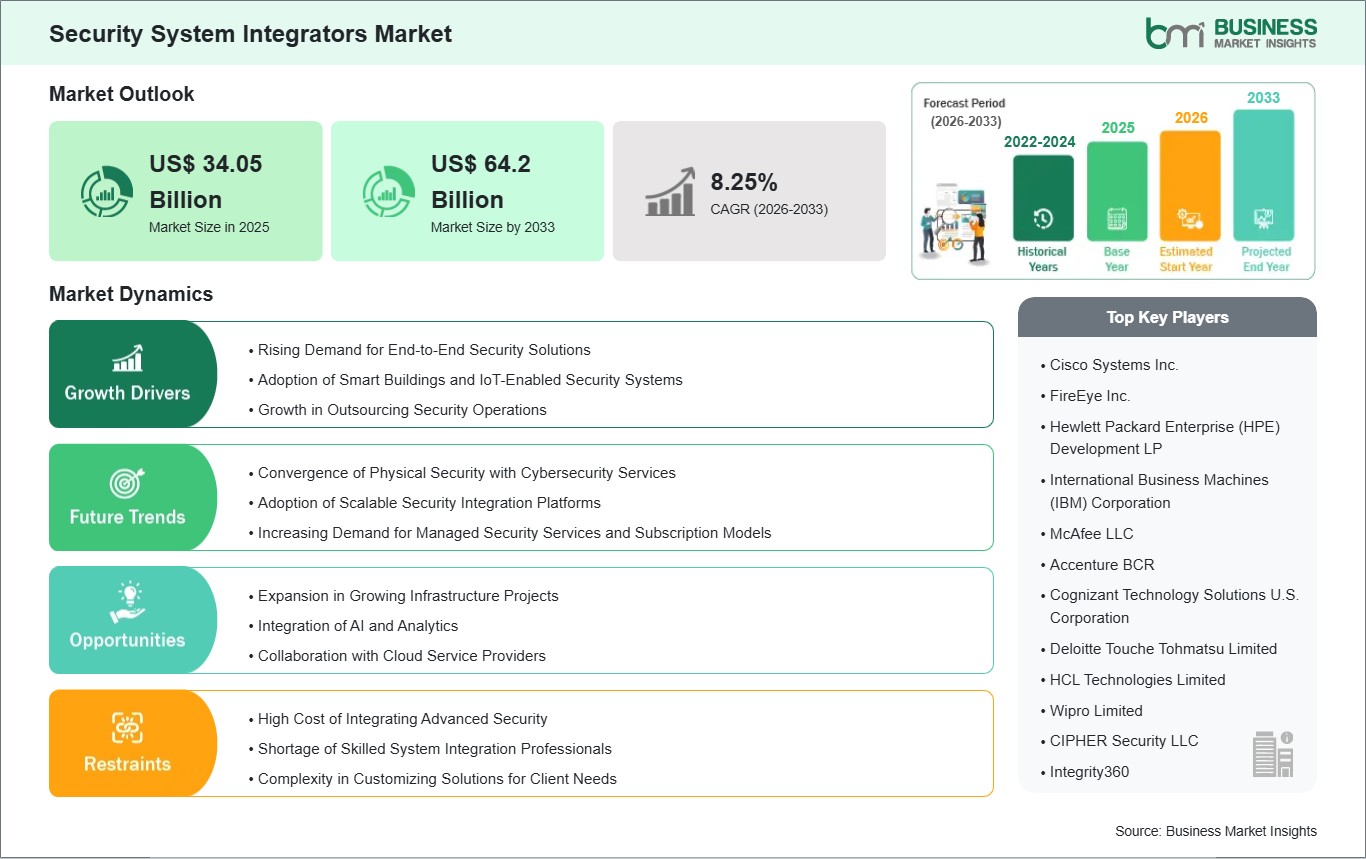
The Security System Integrators Market size is expected to reach US$ 64.2 billion by 2033 from US$ 34.05 billion in 2025. The market is estimated to record a CAGR of 8.25% from 2026 to 2033.
The market for security system integrators is growing as more organizations want solutions that bring together hardware, software, and managed services on one platform. These integrators are key in planning, setting up, and maintaining security systems, such as surveillance cameras, access control, intrusion detection, video analytics, perimeter protection, and cybersecurity. Integrating these tools helps businesses run more smoothly, improve awareness, and make sure different security technologies work well together.
As physical and digital threats overlap, companies need systems that combine traditional security with advanced analytics, cloud monitoring, and real-time alerts. Integrators fill this need by offering solutions tailored to each organization and adapting to new threats. The move toward smart infrastructure in buildings, transportation, critical facilities, and government sites is also driving demand for integrators who can design scalable and future-ready security systems.
Companies with many locations want centralized control, automated alerts, and proactive risk management. The growth of IoT devices and AI-based security has made it even more important to have integrators who can set up and improve these systems. Still, challenges remain, especially when connecting new solutions to older equipment and managing systems from different vendors. Budget limits in some sectors can also slow down the adoption of advanced security systems.

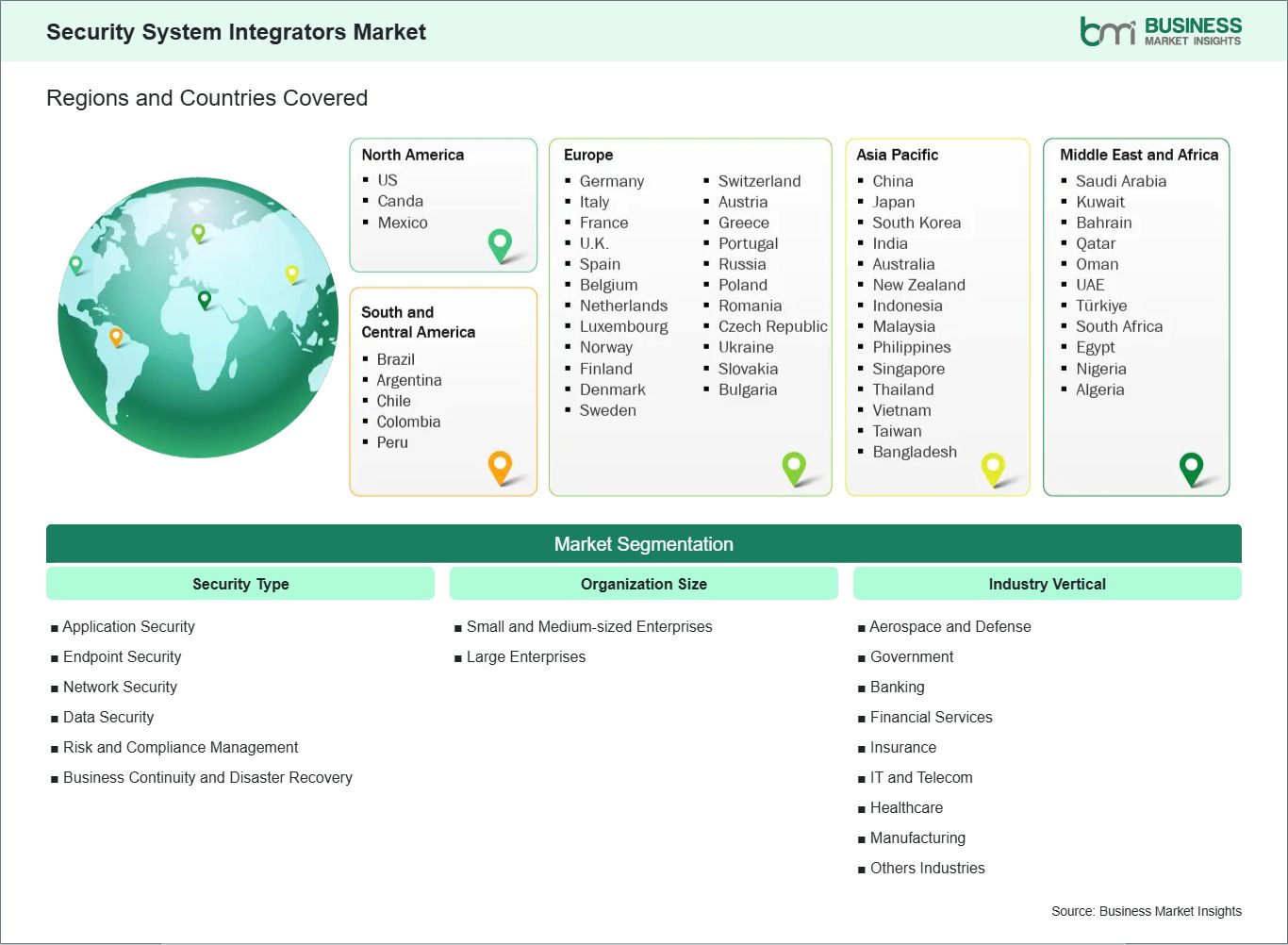
Key segments that contributed to the derivation of the security system integrators market analysis are security type, organization size, and industry vertical.
The global market for security system integrators is being driven by increasing demand for comprehensive, end-to-end security solutions. Organizations across industries are seeking fully integrated systems that combine surveillance, access control, intrusion detection, and monitoring into a single platform. The need for cohesive security frameworks has risen due to growing threats to physical and digital assets, prompting companies to adopt integrated solutions that simplify management and enhance overall protection.
End-to-end solutions offer the advantage of centralizing control and analytics, allowing operators to monitor multiple security layers through a unified interface. This reduces operational complexity and improves response times during incidents. As organizations recognize the efficiency and reliability of integrated systems, demand for system integrators capable of designing, deploying, and maintaining these solutions continues to grow steadily.
Recent advances like AI-powered video analytics, cloud management, and IoT connectivity have made integrated security solutions even more effective. These tools help security system integrators create flexible solutions that meet each organization’s needs, from spotting threats in real time to managing risks before they happen. Because they offer broad coverage, advanced features, and greater efficiency, end-to-end security solutions are driving growth in the market.
The expansion of infrastructure projects worldwide is creating significant opportunities for security system integrators. Large-scale developments such as commercial complexes, transportation hubs, industrial facilities, and smart cities require sophisticated security solutions to ensure safety, compliance, and operational efficiency. The increasing complexity of these projects presents opportunities for integrators to provide customized solutions that meet diverse security needs.
Integration of security systems into infrastructure projects enables real-time monitoring, efficient access control, and proactive threat management. System integrators can leverage advanced technologies to design flexible, scalable, and interoperable security frameworks that adapt to evolving project requirements. By offering solutions that combine hardware, software, and services, integrators add significant value to infrastructure projects, enhancing both safety and operational performance.
The growing emphasis on infrastructure resilience and risk mitigation is driving long-term demand for integrated security solutions. Investments in modernization and expansion of commercial, industrial, and urban facilities are expected to sustain opportunities for system integrators to deliver high-value services. As infrastructure projects become more technologically advanced and security-focused, integrators are well-positioned to play a pivotal role in ensuring comprehensive protection and operational continuity.

The security system integrators market is experiencing steady growth, with market size and share analysis reflecting evolving treatment preferences and competitive dynamics among key players. The report evaluates important subsegments categorized within are security type, organization size, and industry vertical, highlighting their respective contributions to overall market performance.
By security type, the application security subsegment dominated the Security System Integrators market in 2025. This leadership is driven by the increasing need for robust identity and access management solutions, web filtering, and application whitelisting across enterprises to protect against evolving cyber threats. Organizations are prioritizing application security to safeguard sensitive data and ensure regulatory compliance, making it a key revenue driver for system integrators.
Based on organization size, the large enterprises subsegment dominated the Security System Integrators market in 2025. Large enterprises are increasingly adopting comprehensive security integration services due to their complex IT infrastructures and higher exposure to cybersecurity risks.
In terms of industry vertical, the banking, financial services, and insurance (BFSI) subsegment dominated the market in 2025. The strong demand from this sector is driven by the critical need for data protection, fraud prevention, and regulatory compliance. Security system integrators provide tailored solutions to meet the stringent security requirements of BFSI institutions, making this vertical a major contributor to market growth.
| Report Attribute | Details |
|---|---|
| Market size in 2025 | US$ 34.05 Billion |
| Market Size by 2033 | US$ 64.2 Billion |
| Global CAGR (2026 - 2033) | 8.25% |
| Historical Data | 2022-2024 |
| Forecast period | 2026-2033 |
| Segments Covered | By Security Type
|
|
Regions and Countries Covered
| |
| North America | US, Canada, Mexico |
| Europe | Belgium, Austria, Finland, Denmark, Greece, Poland, Romania, Russia, Ukraine, Czech Republic, Slovakia, Bulgaria, Italy, Luxembourg, Germany, Switzerland, France, Netherlands, Norway, Portugal, Spain, Sweden, United Kingdom |
| Asia-Pacific | Australia, China, India, Japan, South Korea, Indonesia, Malaysia, Philippines, Singapore, Thailand, Vietnam, Bangladesh, New Zealand, Taiwan |
| South and Central America | Brazil, Argentina, Peru, Chile, Colombia |
| Middle East and Africa | Bahrain, Kuwait, Oman, Qatar, Saudi Arabia, United Arab Emirates, Turkiye, South Africa, Egypt, Algeria, Nigeria |
| Market leaders and key company profiles |
|
The "Security System Integrators Market Size and Forecast (2022 - 2033)" report provides a detailed analysis of the market covering below areas:
The geographical scope of the Security System Integrators market report is divided into five regions: North America, Asia Pacific, Europe, Middle East & Africa, and South & Central America. The Security System Integrators market in North America is expected to grow during the forecast period.
North America is the leading market for security system integrators. This is due to advanced technology, strong regulations, and widespread use of modern security solutions in both public and private sectors. The United States, in particular, has a high demand for integrated security systems, especially among businesses, government buildings, and critical infrastructure. Many experienced integrators in the region offer complete services, from designing and installing systems to ongoing maintenance and management. They are skilled at combining traditional security with digital tools like AI, predictive analytics, and cloud-based platforms.
Organizations here focus on making sure different technologies work well together under one management system. Regulations on data protection, building safety, and infrastructure also encourage the use of integrated solutions to reduce risk and stay compliant. Integrators are also important in smart city projects, where connected security systems help keep cities safe and improve services. The region’s focus on new technology and early adoption of innovative solutions means integrators can offer customized and flexible security systems for many industries.

The security system integrators market is evaluated by gathering qualitative and quantitative data post primary and secondary research, which includes important corporate publications, association data, and databases. A few of the key developments in the security system integrators market are:
The Security System Integrators Market is valued at US$ 34.05 Billion in 2025, it is projected to reach US$ 64.2 Billion by 2033.
As per our report Security System Integrators Market, the market size is valued at US$ 34.05 Billion in 2025, projecting it to reach US$ 64.2 Billion by 2033. This translates to a CAGR of approximately 8.25% during the forecast period.
The Security System Integrators Market report typically cover these key segments-
The historic period, base year, and forecast period can vary slightly depending on the specific market research report. However, for the Security System Integrators Market report:
The Security System Integrators Market is populated by several key players, each contributing to its growth and innovation. Some of the major players include:
The Security System Integrators Market report is valuable for diverse stakeholders, including:
Essentially, anyone involved in or considering involvement in the Security System Integrators Market value chain can benefit from the information contained in a comprehensive market report.
Please tell us your area of interest
(Market Segments/ Regions and Countries/ Companies)