
Supersonic Jet Market Outlook: Size, Share, Trends, Growth Analysis, Competitive Landscape & Forecast, 2026–2033

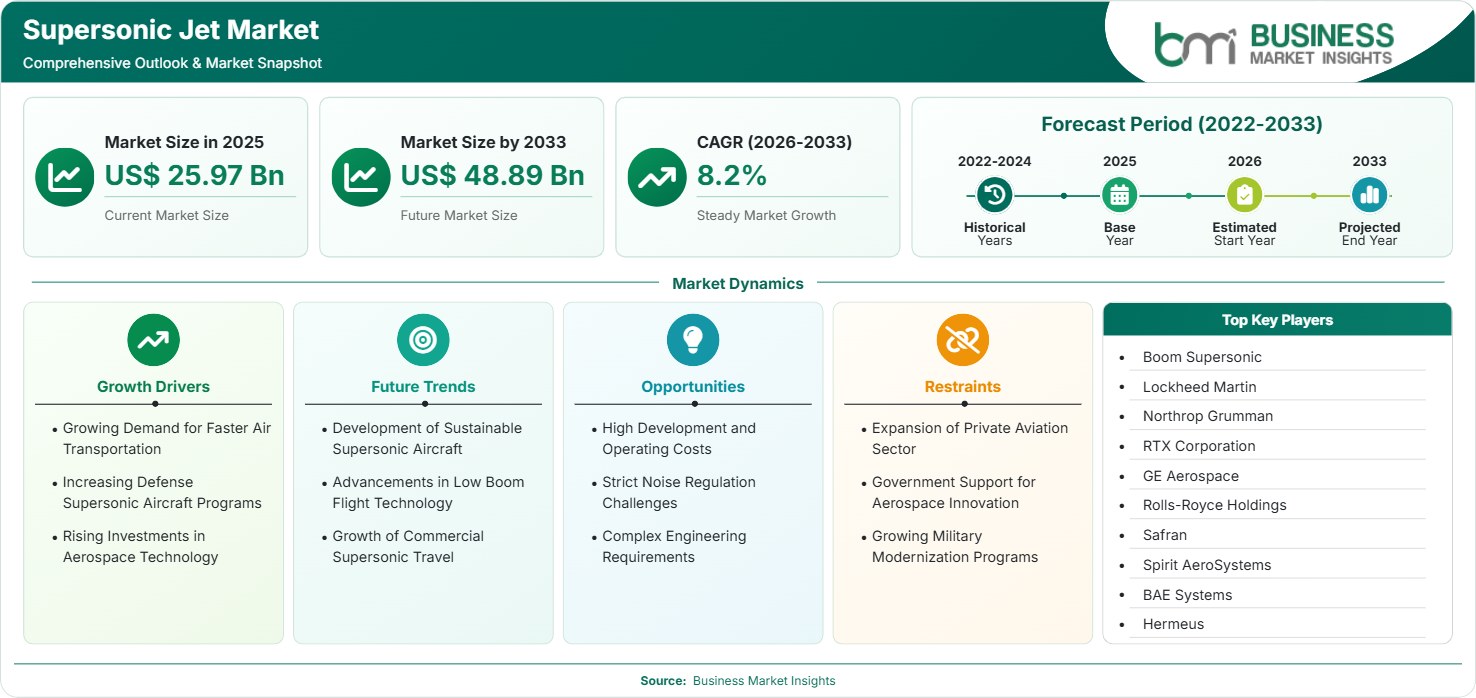
The Supersonic Jet Market size was valued at US$ 25.97 billion in 2025 and is projected to reach US$ 48.89 billion by 2033, growing at a CAGR of 8.2% during 2026–2033, driven by aerospace innovation, defense modernization, next-generation aircraft development, and increasing demand for reduced travel times.

Report Coverage
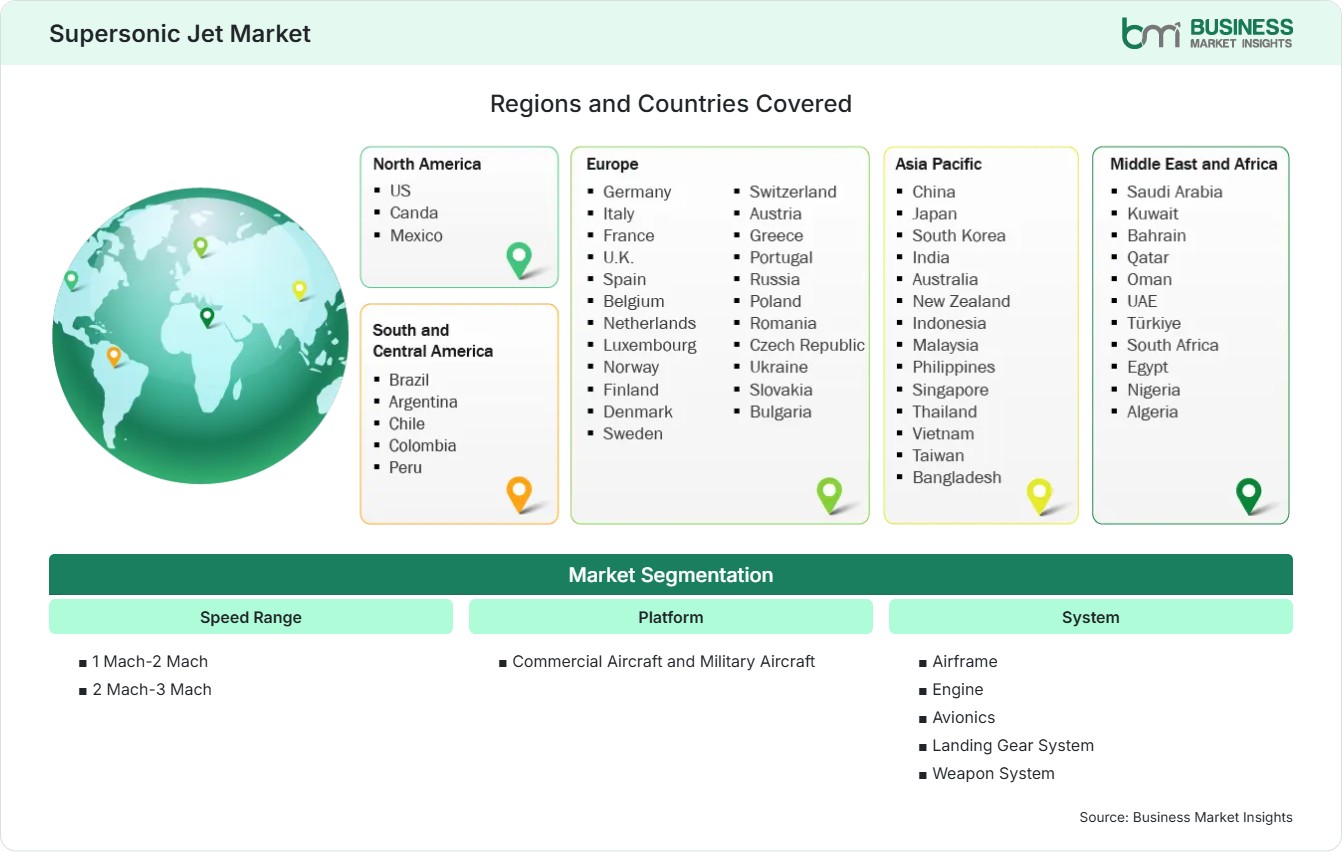
  • Speed Range: 1 Mach-2 Mach, 2 Mach-3 Mach
  • Platform: Commercial Aircraft and Military Aircraft
  • System: Airframe, Engine, Avionics, Landing Gear System, Weapon System
US$ 25.97 Bn Market size in 2025
US$ 48.89 Bn Market Size by 2033
8.2% CAGR, 2026 - 2033
2026-2033 Forecast Period

AI Overview

Supersonic Jet Market Summary

  • North America Region: North America holds 39%–42% share in 2025, growing with a CAGR of 8%–10% influenced by defense aircraft programs, commercial supersonic development, aerospace research investments, and advanced propulsion technologies. The US market demonstrates strong adoption with a CAGR of 8%–10% from 2026–2033, supported by military modernization and private aviation demand.
  • Fastest Growing Region: Asia Pacific holds 21%–24% share in 2025, growing with a CAGR of 10%–12% driven by rising air travel demand, defense expenditure growth, aerospace manufacturing expansion, and increasing investments in advanced aircraft technologies across emerging economies.
  • Leading Segment: Military aircraft holds 56%–59% share in 2025, growing with a CAGR of 8%–10% supported by defense modernization programs, strategic air capabilities, combat aircraft upgrades, and government investments in high-speed aviation platforms.
  • High Growth Segment: Commercial aircraft holds 20%–23% share in 2025, growing with a CAGR of 10%–12% driven by private aviation demand, business travel recovery, new aircraft development programs, and investments in faster passenger transportation solutions.
  • Key Market Opportunity: Development of sustainable propulsion technologies, advanced materials, and low-noise supersonic aircraft designs creates opportunities for manufacturers to address commercial aviation demand while improving operational efficiency and regulatory compliance.
  • Major Market Players: Boom Supersonic, Lockheed Martin, Northrop Grumman, RTX Corporation, GE Aerospace, Rolls-Royce Holdings, Safran, Spirit AeroSystems, BAE Systems, and Hermeus.
Strategic Insights

Supersonic Jet Market: Strategic Insights

Supersonic Jet Market Strategic Framework
FREE PDF
Request your free sample
Request free sample
Stakeholder View

Key Takeaways

  • Supersonic aviation value chains are evolving through collaboration among aircraft manufacturers, propulsion developers, defense contractors, material suppliers, and aerospace technology providers.
  • Military applications remain a major opportunity area as governments prioritize advanced aircraft capabilities, strategic mobility, and next-generation defense systems.
  • Innovation focus is shifting toward efficient propulsion technologies, composite materials, digital engineering, and low-emission aircraft designs to overcome traditional supersonic limitations.
  • North America provides a strong investment environment due to established aerospace capabilities, defense spending, and commercial supersonic aircraft development initiatives.
  • Aerospace companies are increasing strategic partnerships and technology collaborations to accelerate certification, production readiness, and market entry for advanced supersonic platforms.
Geographic Outlook

Supersonic Jet Market Regional Highlights

North America Supersonic Jet Market

North America accounted for 39%–42% share in 2025 and is projected to grow at a CAGR of 8%–10% during 2026–2033. The region benefits from strong aerospace infrastructure, defense investments, advanced manufacturing capabilities, and significant research activity. The United States remains the dominant contributor due to military aircraft programs and commercial supersonic development efforts.

  • Defense modernization programs are increasing the demand for advanced high-speed aircraft platforms and propulsion technologies.
  • Aerospace companies are investing in commercial supersonic aircraft development through innovative engineering approaches.
  • Government research initiatives support advancements in aviation materials, propulsion efficiency, and aircraft performance.
  • Private aviation demand is encouraging the development of faster business aircraft solutions.

US Supersonic Jet Market

The US represented 35%–38% supersonic jet market share in 2025 and is expected to grow at a CAGR of 8%–10% between 2026 and 2033. The market benefits from established aerospace manufacturers, military aircraft investments, and increasing private sector participation in commercial supersonic aviation development.

  • Defense agencies are funding advanced aircraft programs requiring high-speed flight capabilities.
  • Aerospace companies are developing new aircraft designs focused on speed, efficiency, and passenger experience.
  • Private aviation operators are showing interest in reduced travel times for long-distance routes.
  • Advanced manufacturing technologies are supporting lightweight aircraft component production.

Europe Supersonic Jet Market

Europe accounted for 24%–27% share in 2025 and is forecast to expand at a CAGR of 7%–9% from 2026 to 2033. The region benefits from aerospace engineering expertise, defense modernization programs, and aviation technology research. France, the United Kingdom, and Germany remain leading markets, while Italy and Spain demonstrate growth potential, with CAGRs of 8%–10%.

  • European aerospace companies are investing in advanced aircraft technologies and propulsion research.
  • Defense organizations are upgrading aviation capabilities through modernization programs.
  • Research institutions are developing solutions for efficient and sustainable high-speed flight.
  • Regulatory compliance is influencing the development of quieter supersonic aircraft technologies.

Asia Pacific Supersonic Jet Market

Asia Pacific held 21%–24% share in 2025 and is expected to expand at a CAGR of 10%–12% between 2026 and 2033. China, Japan, India, and South Korea are driving regional supersonic jet market growth through defense investments, aerospace manufacturing expansion, and increasing aviation technology capabilities.

  • Defense spending growth is supporting the procurement of advanced military aircraft technologies.
  • Regional aerospace industries are increasing investment in aircraft research and manufacturing.
  • Rising business aviation demand is encouraging interest in faster transportation solutions.
  • Government aviation programs are supporting domestic aerospace innovation initiatives.

Rest of World Supersonic Jet Market

Rest of World accounted for 8%–11% share in 2025 and is projected to grow at a CAGR of 7%–9% during 2026–2033. Defense investments, aviation infrastructure expansion, and demand for advanced aircraft capabilities influence the markets in Latin America, the Middle East & Africa.

  • Middle Eastern countries are investing in aviation technologies through defense and aerospace development programs.
  • Latin American markets are exploring advanced aircraft solutions for future aviation requirements.
  • Defense modernization initiatives are supporting demand for specialized aircraft platforms.
  • Aerospace partnerships are improving regional access to advanced aviation technologies.
Global Market Geography
FREE PDF
Request your free sample
Request free sample
Segment Analysis

Supersonic Jet Market Segmentation

Speed Range

The Speed Range segment accounted for the complete market ecosystem in 2025, with 1 Mach-2 Mach aircraft representing the leading category due to wider defense and commercial development applications. The segment is projected to expand at a CAGR of 8%–10% between 2026 and 2033, supported by advancements in propulsion and aerodynamics and increasing demand for efficient, high-speed aviation platforms.

  • 1 Mach-2 Mach: Aircraft operating within this range represent the majority of current supersonic development programs due to achievable engineering requirements and broader operational suitability across commercial and defense applications.
  • 2 Mach-3 Mach: Higher-speed aircraft in this range are gaining attention for specialized defense missions and advanced aviation programs requiring enhanced speed capabilities, improved propulsion technologies, and optimized aerodynamic performance.

Platform

The Platform segment represented the overall Supersonic Jet Market landscape in 2025, with military aircraft maintaining the largest adoption share due to defense modernization initiatives and strategic aviation requirements. The segment is projected to grow at a CAGR of 8%–10% between 2026 and 2033, supported by government investments, aircraft replacement programs, and commercial aviation innovation.

  • Commercial aircraft: Commercial supersonic aircraft development is advancing through private aerospace investments, improved propulsion systems, and demand for faster business and passenger transportation solutions.
  • Military aircraft: Military platforms remain central to supersonic aviation due to defense requirements for rapid response, advanced combat capabilities, and strategic operational advantages.
  • Combat: Combat aircraft applications require high-speed performance, advanced maneuverability, and integrated weapons capabilities, supporting continued defense investment in next-generation supersonic platforms.
  • Multirole: Multirole aircraft adoption is increasing as defense organizations seek flexible platforms capable of performing multiple missions while maintaining high-speed operational capabilities.

System

The System segment includes airframe, engine, avionics, landing gear system, and weapon system components supporting aircraft performance, safety, and mission capability. The segment is projected to grow at a CAGR of 8%–10% between 2026 and 2033, driven by advances in materials, propulsion, digital avionics, and defense technology.

  • Airframe: Airframe systems are evolving through lightweight composites and aerodynamic improvements designed to enhance aircraft speed, durability, and fuel efficiency.
  • Engine: Engine technologies are advancing through improved propulsion efficiency, thermal management, and performance optimization for next-generation supersonic aircraft.
  • Avionics: Avionics systems are incorporating advanced navigation, communication, and mission management technologies to improve aircraft operational effectiveness.
  • Landing Gear System: Landing gear systems are being developed with lightweight materials and enhanced durability requirements to support high-performance aircraft operations.
  • Weapon System: Weapon systems support military supersonic platforms through advanced targeting, integration, and mission capabilities for defense applications.
Market Forces

Supersonic Jet Market Dynamics

Key Market Drivers

Growing Demand for Faster Air Transportation

The rising demand for faster journeys over long distances is prompting investors to return to supersonic aviation technology. Factors driving market growth include the growing demand for supersonic jets among business aviation customers, high-net-worth passengers, and commercial airlines seeking faster connections to distant airports worldwide. In this respect, aerospace manufacturers are now designing planes that prioritize efficiency, comfort, and reliability. The Supersonic Jet Market trends show greater attention to the development of innovative propulsion technologies, lightweight construction materials, and aerodynamics. With the expansion of global aviation networks, solutions are being developed to counter traditional constraints such as higher fuel burn rates, emissions, and operating costs.

Increasing Defense Supersonic Aircraft Programs

The drive towards upgrading their capabilities in terms of supersonic aircraft is being intensified among the leading military markets as part of defense modernization programs. The government is investing in high-speed aircraft programs to improve its capability to achieve air superiority and greater flexibility. There is a need for aircraft that have greater speed and maneuverability to meet the emerging needs in security. Supersonic aircraft development programs have been gaining support from military budgets, research programs, and partnerships among aerospace firms and government bodies.

Rising Investments in Aerospace Technology

Growing investments in aerospace research and technological development are fostering innovation in supersonic aircraft programs. Aerospace firms are working to develop advanced composites, digital engineering techniques, intelligent design software powered by artificial intelligence, and propulsion technologies to enhance the performance of their aircraft. Research institutions and aerospace firms are joining hands to overcome the technical challenges of supersonic flight. Investments in manufacturing technologies and testing technologies are being made to help in commercializing the future generation aircraft. Improved aircraft design has become the focus of the industry in recent times.

Key Market Opportunities

Expansion of Private Aviation Sector

The development of private aviation presents an opportunity for manufacturers of supersonic planes to tap into markets where there is a need for faster travel. The travelers in the business aviation category are increasingly desiring quick travel time, increased productivity, and better connectivity to different parts of the world. The producers of supersonic planes are designing their products with the needs of the executives who will be using them in mind. There is a growing market opportunity as private airlines seek the next generation of aircraft.

Government Support for Aerospace Innovation

Government funding for aerospace innovation is opening up opportunities through research funding, technology development, and aviation modernization. There is collaboration between the government and aerospace firms to improve national aviation capabilities and take the lead in technology. The development of supersonic airplanes is facilitated through such programs because there is a need for much research and certification. According to supersonic jet market forecasts, policy attention to aerospace innovation will lay the groundwork for firms that pursue high-speed aviation innovations.

Growing Military Modernization Programs

With the advent of modernization initiatives in military establishments, opportunities have emerged for supersonic aircraft suppliers as countries enhance their fleets with cutting-edge technology. Countries are equipping themselves with advanced aircraft platforms to enhance operational preparedness and effectiveness. Aerospace firms supplying engines, electronics, structural design, and integrated systems are likely to benefit from military procurement schemes. Growing demand for the capabilities of multi-role and combat aircraft is motivating manufacturers to build advanced supersonic aircraft.

Market Restraints and Challenges

High Development and Operating Costs

Factor: Supersonic aircraft development requires substantial investment in research, engineering, testing, certification, and specialized manufacturing processes.

Impact: High costs of development and operation can hinder market entry, make aircraft more expensive, and impede their adoption. The manufacturers have to make substantial investments in advanced materials, engines, and certification to make their aircraft feasible. The cost of operation related to fuel burn, maintenance, and specific infrastructural demands poses another problem. These financial restrictions will confine the usage of such aircraft mainly to the military and high-end civil aviation sectors until technological progress makes them cheaper.

Strict Noise Regulation Challenges

Factor: Stringent noise regulations and restrictions on supersonic flight operations create certification challenges for aircraft manufacturers.

Impact: Regulatory restrictions may hinder commercialization and limit supersonic flight paths. Boom noise remains a major concern for the authorities when assessing the feasibility of future supersonic transport systems. The manufacturers have been developing aerodynamic solutions and noise-reduction technologies to overcome these problems. Conformity to changing aviation standards necessitates much testing in cooperation with regulatory bodies.

Company Analysis

Competitive Landscape

The Supersonic Jet Market analysis highlights competition among aerospace manufacturers, defense contractors, propulsion technology providers, and aircraft component suppliers. Companies are focusing on advanced propulsion systems, lightweight materials, military contracts, and the development of commercial supersonic aircraft to strengthen their market positioning.

Company Name

Overview

Products and Services relevant to this market

Boom Supersonic

Aerospace company developing next-generation commercial supersonic aircraft.

Supersonic passenger aircraft development and aviation technologies.

Lockheed Martin

A defense aerospace company producing advanced aircraft systems.

Military aircraft, aerospace systems, and advanced aviation technologies.

Northrop Grumman

Aerospace and defense technology provider.

Military aircraft systems, aerospace structures, defense solutions.

RTX Corporation

Aerospace technology company specializing in propulsion and systems.

Aircraft engines, avionics, and defense aerospace technologies.

GE Aerospace

Aircraft engine manufacturer supporting global aviation.

Advanced propulsion systems and aerospace engine technologies.

Rolls-Royce Holdings

Aerospace company developing advanced propulsion solutions.

Aircraft engines, propulsion systems, aerospace technologies.

Safran

Aerospace supplier providing aircraft systems and components.

Engines, avionics, landing systems, aerospace components.

Spirit AeroSystems

Aircraft structures manufacturer supporting global aerospace programs.

Airframes, aerostructures, aircraft components.

BAE Systems

Defense company providing advanced aerospace technologies.

Military aircraft systems, defense electronics, and aviation solutions.

Hermeus

Aerospace company developing high-speed aircraft technologies.

Supersonic aircraft development and advanced propulsion systems.

Industry Activity

Recent Developments

May 2026

Hermeus achieved the first unmanned supersonic flight of its Quarterhorse Mk 2.1 aircraft, reaching Mach 1.21 during testing. The milestone represents a significant advancement in privately developed supersonic aircraft development.

September 2025

RTX Corporation (Pratt & Whitney) continued development of next-generation propulsion technologies through Pratt & Whitney’s GATORWORKS initiatives, including new engine concepts for advanced military aircraft applications. These initiatives are expected to advance propulsion efficiency and performance for future military aviation platforms.

September 2025

GE Aerospace demonstrated rotating detonation combustion (RDC) technology through testing of missile-scale and dual-mode ramjet engines. The technology is expected to support the development of more efficient and high-performance propulsion systems for advanced aerospace and defense applications.

January 2024

NASA & Lockheed Martin progressed the X-59 Quest quiet supersonic aircraft program with the public unveiling of the aircraft and continued ground testing activities. The program is expected to advance low-noise supersonic flight technology and support the future of commercial supersonic aviation.

Trust & Transparency

Research Methodology

The market analysis combines proprietary research with secondary data from government agencies, company disclosures, regulatory filings, industry databases and expert interviews. Market estimates are validated through data triangulation, cross-market benchmarking and analyst review.

View Full Research Methodology

Questions Answered

Frequently Asked Questions

How does the Supersonic Jet Market Report support aerospace stakeholders?

The report provides an analysis of market trends, technology developments, regional opportunities, competitive strategies, and application segments. Aerospace manufacturers, investors, and suppliers can use these insights to evaluate growth opportunities and technology priorities.

What opportunities exist for commercial supersonic aviation?

Commercial aviation opportunities are emerging through premium passenger travel, business aviation, and reduced-duration international routes. Companies developing efficient aircraft designs, sustainable propulsion solutions, and regulatory-compliant platforms are positioned to benefit from future commercial adoption.

Which platform segment dominates the Supersonic Jet Market?

Military aircraft currently represent the dominant platform segment due to sustained defense investments, modernization programs, and demand for high-speed strategic capabilities. Combat and multirole aircraft applications continue receiving government support across major aerospace markets.

How are aerospace companies addressing supersonic aircraft noise challenges?

Aerospace companies are developing improved aerodynamic designs, advanced engine technologies, and noise reduction approaches to minimize sonic boom impacts. These innovations aim to support regulatory compliance and enable broader adoption of future commercial supersonic aviation.

What factors are accelerating the development of supersonic aircraft?

Development is accelerating due to advancements in propulsion technology, lightweight composite materials, digital engineering, and the growing demand for faster air transportation. Defense modernization programs and private aerospace investments are also supporting research into efficient and commercially viable supersonic aircraft platforms.

Access the Full Supersonic Jet Market Report

Get segment-level forecasts, regional estimates, competitive benchmarking, company profiles and downloadable Excel datasets.

Access the full Supersonic Jet Market Report
350 pages PDF & Excel | 2026-07-31