
Subsea Trencher Market Outlook: Size, Share, Trends, Growth Analysis, Competitive Landscape & Forecast, 2026-2033

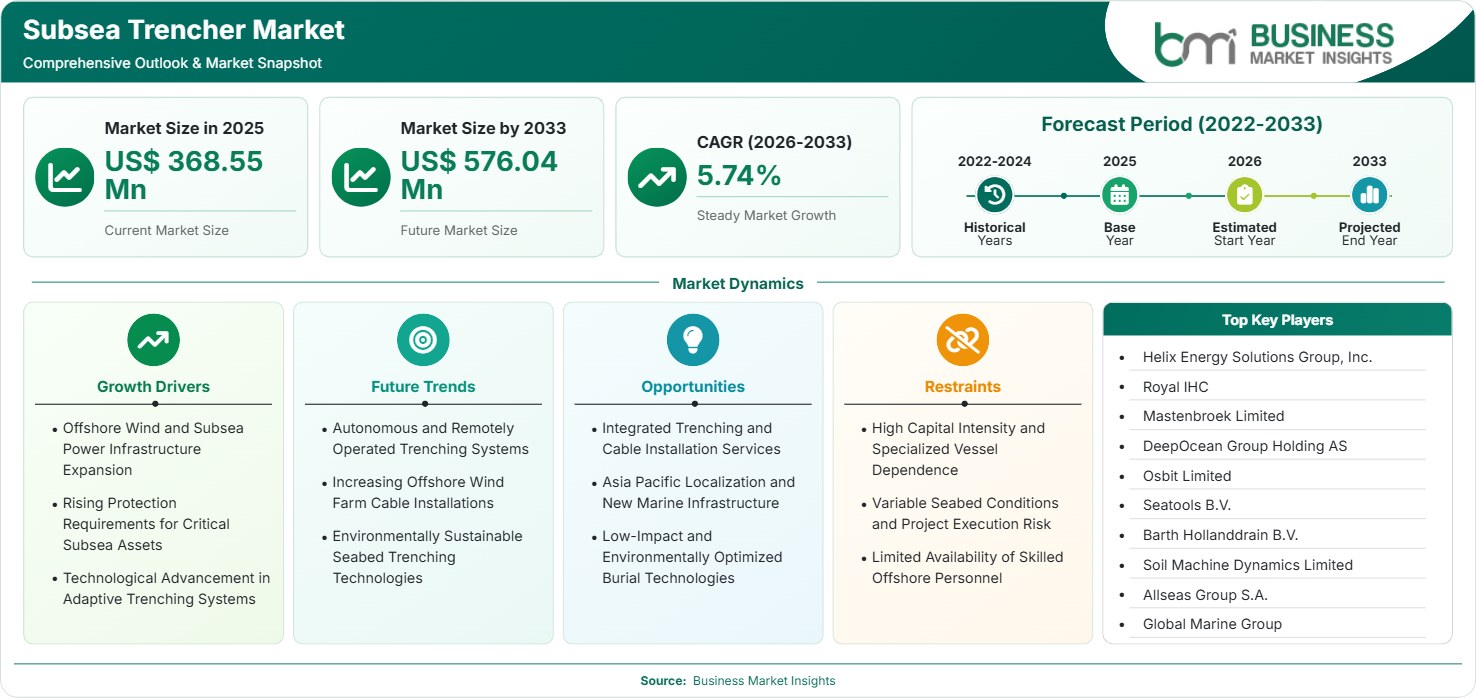
The Subsea Trencher Market size was valued at US$ 368.55 Million in 2025 and is projected to reach US$ 576.04 Million by 2033, growing at a CAGR of 5.74% during 2026–2033, driven by offshore wind expansion, subsea cable protection, pipeline integrity, digital trenching, and deepwater infrastructure investment.

Report Coverage
  • Type: Jet, Mechanical
  • Application: Pipeline Burial, Cable Burial, Umbilical Burial
US$ 368.55 Mn Market size in 2025
US$ 576.04 Mn Market Size by 2033
5.74% CAGR, 2026 - 2033
2026-2033 Forecast Period

AI Overview

Subsea Trencher Market Summary

  • North America Region: North America holds a subsea trencher market share of 19%–22% in 2025, growing at a CAGR of 5.1%–5.8%, supported by offshore energy development, Gulf of Mexico pipelines, subsea power infrastructure, cable resilience programs, and specialized vessel investment.
  • Fastest Growing Region: Asia Pacific holds a 15%–18% share in 2025 and is projected to expand at a CAGR of 6.8%–7.6%, supported by offshore wind, interconnectors, telecommunications cables, coastal industrialization, deepwater energy projects, and expanding marine engineering capabilities across China, Japan, South Korea, India, and Southeast Asia.
  • Leading Segment: Jet trenchers account for a 55%–59% share in 2025 and are projected to grow at a CAGR of 5.4%–6.0%, supported by efficient sediment fluidization, rapid cable burial, adaptable deployment, lower mechanical cutting requirements, and extensive use across offshore wind and power cable projects.
  • High Growth Segment: Cable Burial represents a 37%–41% share in 2025 and is projected to expand at a CAGR of 6.2%–7.0%, driven by offshore wind connections, subsea interconnectors, telecommunications expansion, rising cable density, seabed hazards, resilience requirements, and increased investment in long-distance power transmission infrastructure.
  • Key Market Opportunity: Rising offshore wind capacity, submarine power links, data-center connectivity, and cable resilience requirements are creating opportunities for intelligent trenchers integrating real-time seabed sensing, automated depth control, predictive maintenance, and low-impact burial technologies.
  • Major Market Players: Helix Energy Solutions Group, Inc.; Royal IHC; Mastenbroek Limited; DeepOcean Group Holding AS; Osbit Limited; Seatools B.V.; Barth Hollanddrain B.V.; Soil Machine Dynamics Limited; Allseas Group S.A.; Global Marine Group;
Strategic Insights

Subsea Trencher Market: Strategic Insights

Subsea Trencher Market Strategic Framework
FREE PDF
Request your free sample
Request free sample
Stakeholder View

Key Takeaways

  • The value chain is consolidating seabed surveys, geotechnical analysis, trenching, laying, burial confirmation, inspection, and intervention to enhance efficiencies within projects.
  • Burial of cables provides the best growth prospects because offshore wind farms, telecommunications, and subsea interconnectors need protection from interference.
  • Innovations are taking shape in the form of adaptive trenching via hybrid systems combining cutting and jetting, sensors, autonomy, and digitization.
  • There are good prospects of investment in Asia Pacific due to offshore wind, subsea transmission, telecommunications, and development of marine infrastructure.
  • Investments in dedicated vessels and trenching equipment have enhanced offshore installation capabilities.
  • Equipment reliability, digital monitoring, and burial performance are emerging as important competitive factors.
Geographic Outlook

Subsea Trencher Market Regional Highlights

North America Subsea Trencher Market

North America represents a 19%–22% share in 2025 and is projected to grow at a CAGR of 5.1%–5.8% through 2033. The US remains the principal demand center, while Canada contributes specialized offshore engineering opportunities. Gulf Coast capabilities in marine construction, ROV operations, and subsea services provide a strong operational ecosystem for trenching equipment deployment and maintenance.

  • Offshore pipeline integrity programs are sustaining demand for trenching, intervention, and seabed protection services, particularly where aging infrastructure requires reinforcement or route modification.
  • Offshore wind development along the US Atlantic coast creates longer-term demand for cable burial equipment, although permitting schedules and project economics can influence annual procurement cycles.
  • Gulf of Mexico contractors provide established vessel, ROV, engineering, and subsea service capabilities that support equipment utilization across pipeline and cable-related projects.

US Subsea Trencher Market

The US accounts for 62%–68% of North America's 2025 demand and is projected to expand at a CAGR of 5.0%–5.7%. Gulf Coast engineering expertise strengthens deployment capabilities, while Atlantic offshore wind creates future cable-burial demand. Project timing remains influenced by permitting, financing, vessel availability, and regulatory requirements affecting offshore construction schedules.

  • Gulf of Mexico infrastructure supports specialized trenching requirements for pipelines, flowlines, and subsea systems, creating recurring demand for equipment capable of operating across diverse seabed conditions.
  • Atlantic offshore wind projects provide a longer-term growth avenue for cable burial equipment as developers require reliable export and inter-array cable protection.
  • US subsea contractors increasingly value integrated trenching, ROV, survey, and intervention capabilities that reduce mobilization complexity and improve offshore project coordination.

Europe Subsea Trencher Market

Europe holds a leading 35%–39% share in 2025 and is projected to grow at a CAGR of 5.7%–6.4%. The region benefits from mature offshore wind, dense subsea cable networks, North Sea energy infrastructure, and established engineering expertise.

  • Offshore wind expansion is increasing requirements for high-capacity cable burial and specialized trenching systems capable of handling complex seabed conditions and environmentally constrained routes.
  • The North Sea remains a technology hub, with European contractors investing in trenchers, cable vessels, rock installation, and integrated protection solutions.
  • Germany's grid expansion and offshore wind connections are strengthening demand for specialized cable burial equipment and precision seabed intervention.
  • The Netherlands benefits from a concentration of marine engineering companies, offshore contractors, and equipment specialists supporting regional and international projects.

Asia Pacific Subsea Trencher Market

Asia Pacific accounts for a 15%–18% share in 2025 and is projected to record the fastest regional growth at a CAGR of 6.8%–7.6%. China, Japan, and South Korea lead current industrial capabilities, while India and Southeast Asia offer emerging opportunities. Japan is projected at 6.9%–7.6% CAGR and India at 7.2%–8.0%, supported by offshore renewable energy, subsea telecommunications, interconnection, and marine infrastructure expansion.

  • China combines extensive offshore engineering capabilities with expanding renewable energy and subsea infrastructure requirements, creating opportunities for high-throughput trenching technologies.
  • Japan's island geography supports demand for subsea power connections, telecommunications infrastructure, and cable protection systems requiring specialized marine installation capabilities.
  • India is developing new subsea infrastructure capabilities as data connectivity and offshore energy investment increase, creating opportunities for local partnerships and specialized marine equipment.

Rest of World Subsea Trencher Market

South and Central America represent approximately 8%–11% of 2025 demand, with a projected CAGR of 5.5%–6.3%, supported by offshore oil and gas, subsea pipelines, and telecommunications infrastructure. Brazil remains the leading regional opportunity due to deepwater energy activity and sophisticated offshore engineering requirements, while Mexico contributes pipeline and subsea construction demand.

  • Brazil's deepwater offshore developments support demand for advanced trenching and seabed intervention capabilities that can operate in technically demanding environments.
  • Mexico's offshore infrastructure creates recurring requirements for pipeline protection, intervention, and specialized subsea construction equipment.
  • Saudi Arabia and the UAE offer opportunities through offshore energy infrastructure and subsea pipeline development, with procurement often favoring experienced international contractors.
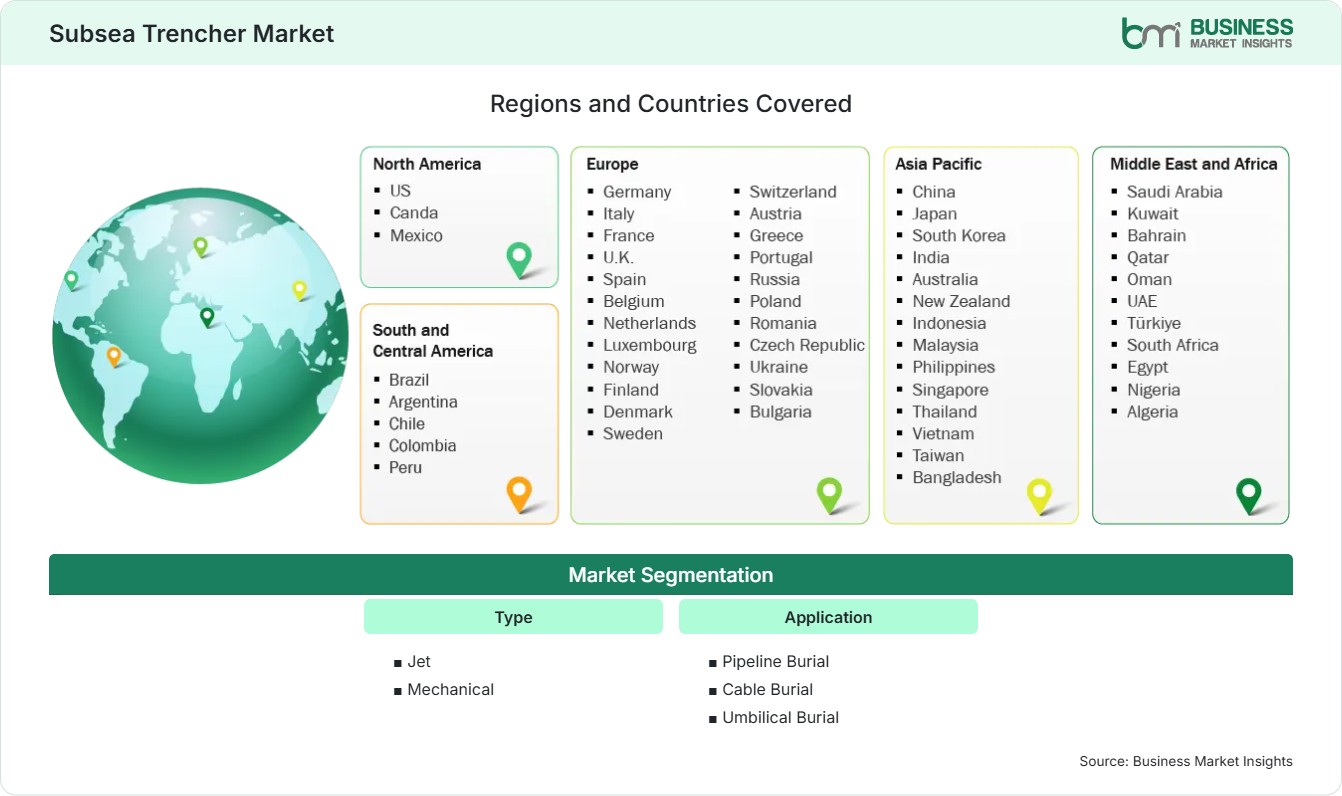
Global Market Geography
FREE PDF
Request your free sample
Request free sample
Segment Analysis

Subsea Trencher Market Segmentation

Type

Jet trenchers account for a 55%–59% share in 2025 and are projected to grow at a CAGR of 5.4%–6.0%. Their adoption is supported by efficient soil fluidization, rapid cable burial, flexible deployment, and suitability for soft to medium seabeds. The Subsea Trencher Market scope therefore increasingly includes hybrid equipment architectures combining jetting, cutting, sensing, and adaptive control technologies for complex seabed conditions and deeper burial requirements.

  • Jet: Jet systems fluidize seabed sediments using high-pressure water, allowing cables to settle into trenches efficiently. Adoption is strongest in softer soils, offshore wind, and cable burial operations requiring rapid production.
  • Mechanical: Mechanical systems use cutting wheels, chains, or related excavation tools to penetrate harder seabeds. Demand is supported by challenging geological conditions where jetting alone cannot achieve required burial depth.

Application

Cable Burial represents a 37%–41% share in 2025 and is projected to grow at a CAGR of 6.2%–7.0%, making it the highest-growth application. Offshore wind, telecommunications, interconnectors, and power transmission projects increasingly require reliable protection against external damage. The Subsea Trencher Market trends increasingly favor equipment offering accurate depth control, route tracking, and minimal seabed disturbance.

  • Pipeline Burial: Pipeline burial protects subsea energy infrastructure against hydrodynamic forces, fishing activity, anchors, and seabed movement. Demand is linked to offshore oil, gas, carbon transport, and emerging energy infrastructure.
  • Cable Burial: Cable burial protects power and telecommunications assets from external interference and seabed hazards. Offshore wind, interconnectors, data infrastructure, and rising cable density are strengthening long-term equipment demand.
  • Umbilical Burial: Umbilical burial secures control and power connections between subsea production equipment and host facilities. Growth is supported by subsea field developments, tiebacks, and increasingly complex offshore production architectures.
Market Forces

Subsea Trencher Market Dynamics

Key Market Drivers

Offshore Wind and Subsea Power Infrastructure Expansion

Offshore wind farm construction is resulting in an increase in subsea power cables that need to be protected along export and inter-array pathways. In this respect, it becomes clear that trenching capacity becomes more strategically important as the cable laying schedule depends on vessels coordination, equipment and favorable weather conditions. The Subsea Trencher Market growth outlook is therefore increasingly tied to grid expansion rather than offshore generation alone. As the number of corridors increases, trenchers have to provide stable burial depth as well as minimize the disturbance to the seabed.

Rising Protection Requirements for Critical Subsea Assets

The subsea cables and pipelines will be exposed to risk factors such as anchors, fishing, seabed movement, weather conditions, and man-made operations. Due to the rise in the strategic value of energy and telecommunications networks, more efforts are being made to enhance the security of assets and verify their burials. In this respect, the Subsea Trencher market trends have started moving towards those trenchers that offer capabilities in monitoring, tracking, and verifying burials. Those companies capable of providing trenching equipment for high volume cables will gain from this situation.

Technological Advancement in Adaptive Trenching Systems

Sensor technology, control programs, ROVs, and modular tools have been advancing the performance of trenchers on diverse seabeds. The latest generation of systems utilizes mechanical cutting and water jets to adjust to varying soils as opposed to sticking to one technique. Digital systems have the ability to measure burial depths, positions of the machinery, tool performance, and the response of the seabed in real time, making it possible to rectify any inconsistencies in the installation process. This eliminates possibilities of inadequate burial and costly repairs. With projects venturing further down into deep and complicated areas, intelligent control systems will be a defining feature in equipment choice.

Key Market Opportunities

Integrated Trenching and Cable Installation Services

Equipment suppliers have an opportunity to expand beyond machine sales by integrating trenching with cable installation, burial verification, inspection, and intervention services. Project owners increasingly prefer coordinated delivery because vessel mobilization, weather windows, cable logistics, and seabed conditions must be managed as a single operational sequence. Integrated providers can improve equipment utilization and capture recurring service revenue through maintenance and intervention campaigns. Jan De Nul's planned investment in additional cable vessels and trenching support vessels demonstrates the commercial value of combining installation and protection capabilities. The Subsea Trencher Market Forecasts therefore favor companies capable of delivering equipment, engineering, operations, and lifecycle support as a unified proposition.

Asia Pacific Localization and New Marine Infrastructure

There are considerable opportunities in the Asia Pacific to localize the use of subsea trenchers. This will help in the growth of offshore wind farms, telecommunication systems, and inter-island electricity grids in the region. Localization will help save costs and also take care of any preferences from the authorities of the respective nations for localization. India is a particularly attractive market because of the development of data and subsea cables which require marine engineers. A 2026 report on Dredging Corporation of India Limited pointed out how there were plans to undertake subsea data cable dredging.

Low-Impact and Environmentally Optimized Burial Technologies

The growing environmental monitoring regime is bringing new possibilities in terms of trenchers that can minimize sediment disturbance, bury at an optimal depth, and conduct seabed monitoring. Such projects as offshore wind farms in coastal and special marine waters require tools that are capable of ensuring accuracy in installation without creating additional turbidity and excavation. The development of Sunfish cable-burial machine by Jan De Nul Group until 2026 for TenneT projects in the North Sea and Wadden Sea of Germany shows the way to go in terms of developing such equipment.

Market Restraints and Challenges

High Capital Intensity and Specialized Vessel Dependence

Factor: Subsea trenchers require specialized engineering, high-pressure systems, heavy-duty cutting equipment, launch and recovery infrastructure, and compatible vessels, creating substantial capital requirements for manufacturers and contractors.

Impact: High investment thresholds can limit new entrants and increase financial exposure when project schedules are delayed. Equipment utilization is also dependent on vessel availability, weather windows, offshore permitting, and synchronized cable or pipeline installation campaigns. A trencher that remains idle between projects can generate weak asset returns despite high acquisition costs. This dynamic can strengthen the position of established providers with diversified fleets and international project pipelines while making market entry more difficult for independent equipment manufacturers.

Variable Seabed Conditions and Project Execution Risk

Factor: There may be abrupt changes in seabed geology on the same route, and depending on whether there is sand, clay, gravel, rock, boulder, or mobile sediment, different approaches to excavation would be required.

Impact: Unforeseen conditions can affect the efficiency of trenching operations, cause more wear and tear on equipment, necessitate changing equipment, or add another pass which increases the offshore schedule. Furthermore, the level of burial also has to strike a balance between mechanical resistance and thermal efficiency, especially when burying high voltage power cables whereby too much burial will affect heat dissipation.

Company Analysis

Competitive Landscape

Competitive dynamics reflect a combination of specialized equipment engineering, offshore construction expertise, subsea services, cable installation capability, and vessel access. The Subsea Trencher Market analysis indicates that companies with integrated project capabilities can compete on operational reliability and lifecycle economics, while technology specialists differentiate through tooling performance, automation, and modular designs.

Company Name

Overview

Products and Services relevant to this market

Helix Energy Solutions Group, Inc.

US-based offshore energy services provider with extensive subsea intervention and marine project capabilities supporting complex offshore infrastructure requirements.

Subsea intervention, robotics, offshore construction, well intervention, vessel-based services, and subsea engineering capabilities relevant to trenching support operations.

Royal IHC

Netherlands-based maritime engineering group specializing in advanced vessels, equipment, and integrated offshore and dredging solutions.

Subsea equipment, dredging technologies, offshore engineering, specialized vessels, and seabed intervention systems supporting trenching applications.

Mastenbroek Limited

UK specialist in trenching equipment with expertise in mechanical and cable-related trenching technologies.

Cable trenchers, trenching machinery, specialized excavation equipment, and engineering solutions applicable to subsea and nearshore infrastructure.

DeepOcean Group Holding AS

Norwegian subsea services provider delivering installation, inspection, maintenance, recycling, and marine construction services.

Subsea construction, cable installation, trenching support, survey, inspection, intervention, and offshore project management.

Osbit Limited

UK offshore technology and engineering company developing advanced subsea trenchers, ploughs, and cable installation equipment.

Subsea trenchers, cable burial systems, ploughs, launch and recovery systems, control technology, and integrated offshore engineering.

Seatools B.V.

Netherlands-based subsea technology company specializing in engineered systems, controls, and marine equipment.

Subsea trenching equipment, hydraulic systems, control technology, monitoring, ROV interfaces, and custom subsea machinery.

Barth Hollanddrain B.V.

Netherlands-based specialist involved in drainage and trenching technologies with capabilities applicable to specialized excavation environments.

Trenching systems, drainage technology, excavation solutions, and equipment engineering relevant to cable and pipeline burial applications.

Soil Machine Dynamics Limited

UK engineering company known for heavy subsea equipment, remotely operated vehicles, and seabed intervention systems.

Subsea trenchers, ROVs, seabed excavation systems, cutting tools, and heavy-duty subsea machinery for offshore infrastructure.

Allseas Group S.A.

Swiss offshore contractor with large-scale pipeline installation and offshore construction capabilities.

Pipeline installation, subsea construction, offshore vessels, deepwater engineering, and integrated marine infrastructure services.

Global Marine Group

UK subsea cable specialist providing installation, maintenance, and marine engineering services for critical cable infrastructure.

Subsea cable installation, burial, maintenance, repair, survey, trenching support, and cable protection services.

Trust & Transparency

Research Methodology

The market analysis combines proprietary research with secondary data from government agencies, company disclosures, regulatory filings, industry databases and expert interviews. Market estimates are validated through data triangulation, cross-market benchmarking and analyst review.

View Full Research Methodology

Questions Answered

Frequently Asked Questions

What should buyers evaluate when selecting a subsea trencher?

Buyers should assess burial depth, soil compatibility, production rate, vessel integration, launch and recovery requirements, power consumption, remote monitoring, maintenance needs, environmental performance, and the supplier's ability to provide offshore support throughout the asset lifecycle.

Why are modular trenchers becoming strategically important?

Modular equipment allows operators to change tooling, cutting systems, jetting arrangements, and control configurations according to project requirements. This flexibility can improve fleet utilization and reduce the need to maintain separate specialized machines for every seabed condition.

What is driving demand for deeper subsea trenching in the Subsea Trencher Market?

The Subsea Trencher Market report highlights that offshore wind farms are moving farther offshore, while larger power cables and interconnectors require robust protection. Deeper burial is increasingly required in areas with intense marine activity or challenging seabed conditions, driving demand for high-powered trenching systems capable of ensuring long-term cable integrity and operational reliability.

How does cable burial support subsea infrastructure resilience?

Burial reduces exposure to anchors, fishing gear, hydrodynamic forces, seabed movement, and other external threats. As subsea power and telecommunications infrastructure becomes more strategically important, reliable burial and verification are becoming integral to long-term asset protection.

What factors determine whether jet or mechanical trenching is selected?

Jet trenching is generally suited to softer sediments where fluidization enables efficient burial, while mechanical trenching is preferred for harder seabeds. Hybrid systems increasingly combine both approaches to manage variable geological conditions along a single route.

Access the Full Subsea Trencher Market Report

Get segment-level forecasts, regional estimates, competitive benchmarking, company profiles and downloadable Excel datasets.

Access the full Subsea Trencher Market Report
350 pages PDF & Excel | 2026-08-18
Similar Research

Related Market Reports