
Structural Steel Fabrication Market Outlook: Size, Share, Trends, Growth Analysis, Competitive Landscape & Forecast, 2026-2033

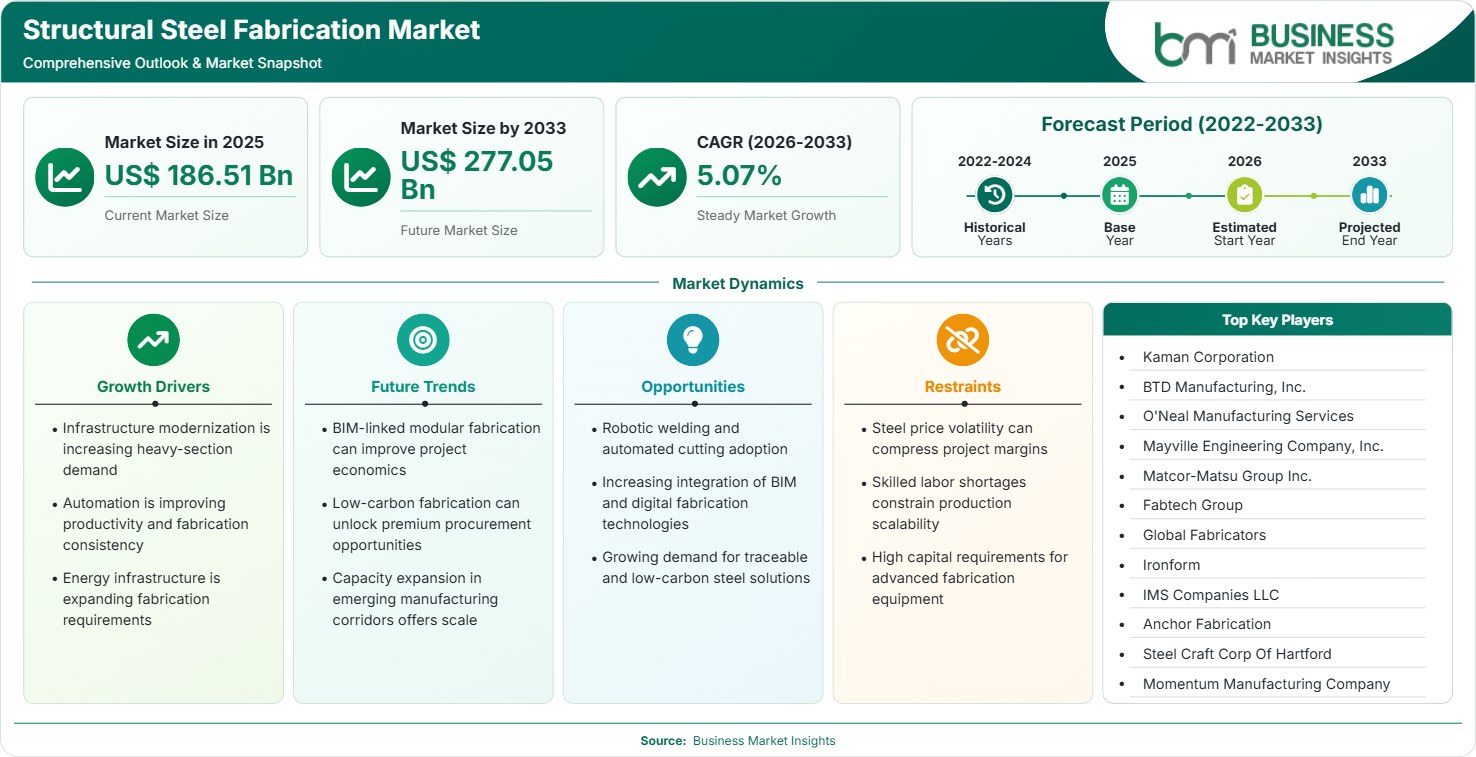
The Structural Steel Fabrication Market size was valued at US$ 186.51 Billion in 2025 and is projected to reach US$ 277.05 Billion by 2033, growing at a CAGR of 5.07% during 2026–2033, supported by infrastructure modernization, industrial expansion, modular construction, energy projects, digital fabrication, and low-carbon procurement opportunities.

Report Coverage
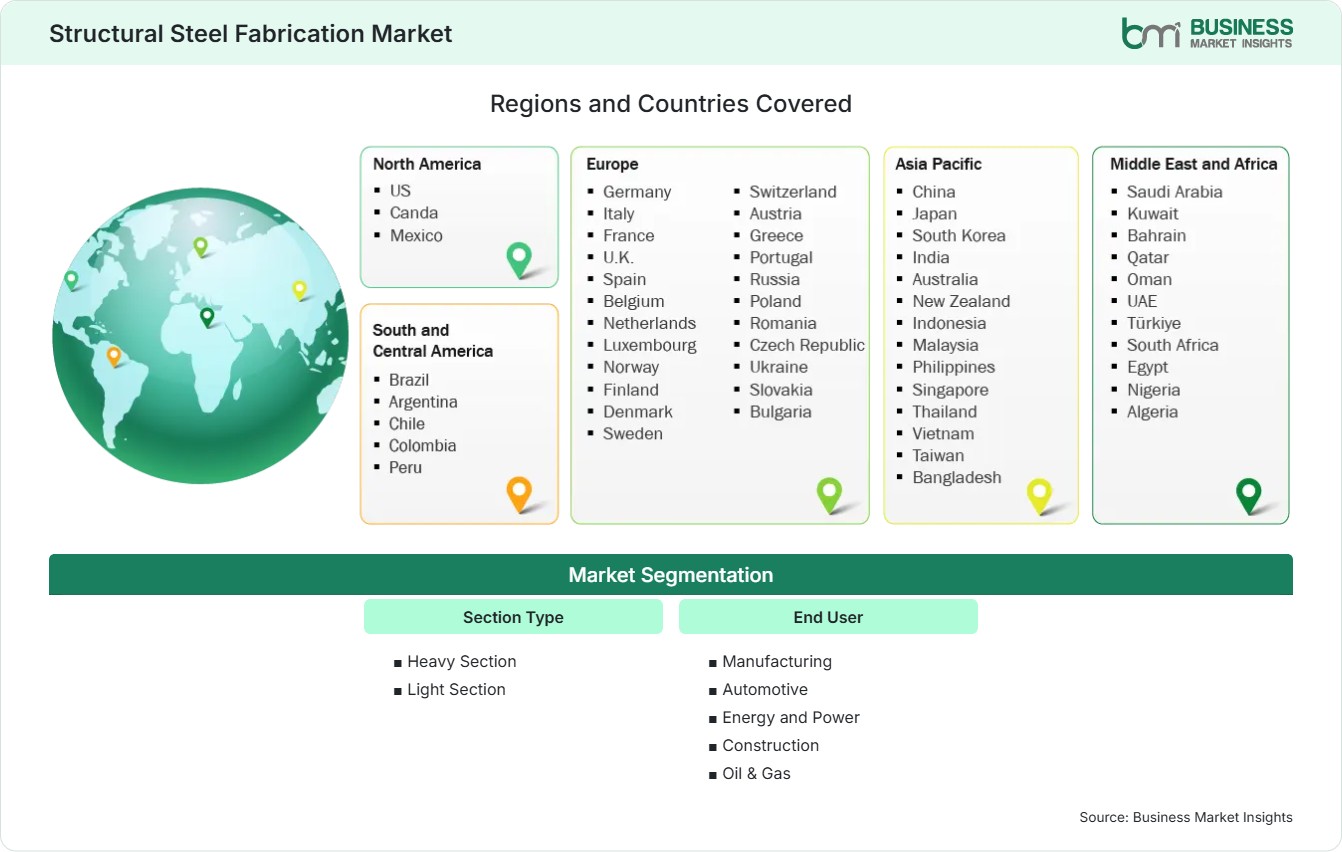
  • Section Type: Heavy Section, Light Section
  • End User: Manufacturing, Automotive, Energy and Power, Construction, Oil & Gas
US$ 186.51 Bn Market size in 2025
US$ 277.05 Bn Market Size by 2033
5.07% CAGR, 2026 - 2033
2026-2033 Forecast Period

AI Overview

Structural Steel Fabrication Market Summary

  • North America Region: North America holds a Structural Steel Fabrication Market share of 27%–30% in 2025, with a CAGR of 4.4%–4.9%, supported by infrastructure renewal, reshoring, data centers, advanced manufacturing, and domestic sourcing requirements. The U.S. market is projected to expand at a 4.3%–4.8% CAGR, driven by infrastructure modernization, industrial construction, data centers, defense facilities, and domestic steel procurement.
  • Fastest Growing Region: Asia Pacific holds market share of 42%–44% in 2025, with CAGR of 5.7%–6.3%, supported by Indian infrastructure investment, Southeast Asian manufacturing expansion, logistics facilities, renewable projects, urbanization, and industrial relocation.
  • Leading Segment: Heavy Section holds Structural Steel Fabrication Market share of 42%–45% in 2025, with CAGR of 5.8%–6.3%, supported by high-rise construction, bridges, factories, logistics centers, industrial structures, transport infrastructure, and large load-bearing frameworks.
  • High Growth Segment: Energy and Power represents a high-growth end-user opportunity, with modeled share of 14%–17% of the Structural Steel Fabrication Market in 2025 and CAGR of 6.2%–6.8%, supported by grids, renewable projects, substations, power plants, storage facilities, and electrification investments.
  • Key Market Opportunity: Fabricators can capture premium value through BIM-linked production, robotic welding, modular assemblies, renewable infrastructure, data centers, traceable materials, and low-carbon steel specifications across increasingly complex projects.
  • Major Market Players: Kaman Corporation, BTD Manufacturing, Inc., O'Neal Manufacturing Services, Mayville Engineering Company, Inc., Matcor-Matsu Group Inc., Fabtech Group, Global Fabricators, Ironform, IMS Companies LLC, Anchor Fabrication, Steel Craft Corp Of Hartford, Momentum Manufacturing Company, Tenere Inc., Defiance Metal Products Inc., Global Engineering, and Shanghai Canhu Industry Co. Ltd.
Strategic Insights

Structural Steel Fabrication Market: Strategic Insights

Structural Steel Fabrication Market Strategic Framework
FREE PDF
Request your free sample
Request free sample
Stakeholder View

Key Takeaways

  • Supply-chain competitiveness increasingly depends on a fabricator's ability to integrate steel sourcing, engineering, cutting, welding, coating, inspection, logistics, and installation support rather than compete solely on fabrication price.
  • Energy infrastructure, data centers, industrial reshoring, logistics facilities, and transportation projects offer stronger incremental demand potential than mature building applications because they require engineered structural packages and schedule-sensitive delivery.
  • Robotic welding, automated cutting, BIM interoperability, digital nesting, machine vision, and production analytics are becoming practical productivity tools, particularly where fabricators face skilled-welder shortages and rising quality documentation requirements.
  • India and Southeast Asia present compelling investment cases because infrastructure and manufacturing expansion create new fabrication capacity requirements while demand remains less saturated than in mature North American and European markets.
  • Acquisition activity is becoming strategically important as fabricators seek geographic coverage, specialized engineering, automation capability, and access to higher-value end markets. Mayville Engineering Company's Accu-Fab acquisition illustrates this capability-led consolidation trend.
  • Low-emission steel procurement is creating a developing differentiation layer. Fabricators able to document material origin, recycled content, embodied-carbon attributes, welding qualifications, and quality traceability can compete for specification-sensitive projects.
Geographic Outlook

Structural Steel Fabrication Market Regional Highlights

North America Structural Steel Fabrication Market

North America represents a 27%–30% share in 2025 and a 4.4%–4.9% CAGR during 2026–2033. Infrastructure renewal, reshoring, data-center construction, defense investment, and domestic sourcing requirements sustain demand. The region favors certified fabricators capable of managing engineering, welding, coating, inspection, logistics, and schedule-critical assemblies. North American Structural Steel Fabrication Market conditions also encourage automation because labor availability remains a constraint. Current industry benchmarks identify heavy sections as a major regional product category and emphasize infrastructure, industrial reshoring, and data centers as demand catalysts.

  • Industrial reshoring increases demand for factory structures, crane-support frames, platforms, mezzanines, and equipment-support assemblies requiring high fabrication precision.
  • Data-center construction is creating demand for structural frames, equipment supports, electrical infrastructure, and rapidly deployable fabricated assemblies.
  • Domestic procurement policies and steel trade measures can improve local order opportunities while increasing input-cost volatility and contract-risk exposure.
  • Fabricators increasingly invest in automation, apprenticeship programs, and multi-site capacity to offset skilled labor shortages and improve production resilience.

US Structural Steel Fabrication Market

The United States accounts for 78%–82% of North American value in 2025 and is modeled at a 4.3%–4.8% CAGR through 2033. Infrastructure investment, advanced manufacturing, defense facilities, logistics centers, power infrastructure, and data-center construction support project pipelines. Domestic steel sourcing requirements strengthen opportunities for local fabrication, although tariffs and material-price volatility can complicate fixed-price contracts. Industry evidence also shows expanding fabrication capacity and technology investments among major U.S. suppliers.

  • Federal infrastructure and domestic-content requirements favor fabricators with traceable sourcing, certified welding procedures, inspection systems, and established compliance documentation.
  • Industrial and data-center projects reward suppliers capable of engineering-to-fabrication integration, modular delivery, accelerated production, and repeatable quality.
  • Regional capacity expansion is visible among suppliers such as BTD Manufacturing, which opened a 335,000-square-foot Dawsonville facility in 2025.

Europe Structural Steel Fabrication Market

Europe represents a 20%–22% share in 2025 and a 3.8%–4.4% CAGR of the Structural Steel Fabrication Market during 2026–2033. Germany, the United Kingdom, France, Italy, and the Nordic markets remain important for industrial buildings, transport infrastructure, renewable-energy structures, and engineered construction. Germany and the Nordic region offer stronger high-value growth potential as decarbonization increases demand for documented low-emission materials. European fabricators face higher energy and compliance costs, but these constraints also favor technologically capable suppliers.

  • Germany combines industrial demand with strict carbon and traceability expectations, encouraging fabricators to integrate environmental documentation into project qualification.
  • The United Kingdom benefits from transport, energy, and industrial infrastructure projects requiring engineered structural assemblies and certified fabrication.
  • Nordic markets provide opportunities in offshore wind, renewable infrastructure, industrial modernization, and low-carbon steel procurement.
  • European steel transition policies are increasing the strategic importance of near-zero-emission materials and coordinated demand commitments.

Asia Pacific Structural Steel Fabrication Market

The Asia Pacific market is expected to have a 42-44% share by 2025 and a 5.7-6.3% CAGR for 2026-2033, which makes it the fastest-growing regional market. China continues to be the largest manufacturer, but India, Indonesia, Vietnam, Thailand, Malaysia, and the Philippines benefit from the industrial shift, logistics growth, and infrastructure and energy investments. Public equity markets highlight Asia-Pacific as the largest regional market, with India as a key contributor.

  • India combines roads, railways, airports, ports, industrial parks, and urban infrastructure with a fabrication Structural Steel Fabrication Market forecasts at 7.35% CAGR through 2031.
  • Southeast Asian manufacturing relocation supports demand for factories, warehouses, logistics facilities, process structures, and equipment-support frames.
  • China remains important because of its industrial ecosystem, although property-sector weakness is shifting demand toward manufacturing, infrastructure, and specialized applications.
  • Japan and South Korea favor higher-specification fabrication, automation, precision engineering, and infrastructure replacement rather than volume-driven construction growth.

Rest of World Structural Steel Fabrication Market

Rest of World accounts for a 9%–11% share in 2025 and a 5.0%–5.7% CAGR of the Structural Steel Fabrication Market through 2033. South and Central America benefit from infrastructure, industrial, energy, and housing investment, with Brazil providing the strongest regional manufacturing base. The Middle East and Africa offer faster opportunities through logistics, airports, energy facilities, industrial cities, and major urban development. Gulf projects particularly favor heavy sections, modular assemblies, and internationally certified fabrication capabilities.

  • Brazil benefits from infrastructure and social-housing activity, while regional steel demand is projected to strengthen as construction investment improves.
  • Saudi Arabia and the United Arab Emirates offer premium opportunities through giga-projects, airports, hospitality, transport, renewable energy, and industrial development.
  • South Africa provides demand through mining, power, logistics, industrial facilities, and infrastructure maintenance requiring durable fabricated structures.
  • Gulf local-content policies can encourage regional fabrication capacity, creating opportunities for joint ventures, technology transfer, and localized engineering.
  • Latin American fabricators can improve competitiveness by combining local steel sourcing with modular production, engineering services, and project-specific logistics.
Global Market Geography
FREE PDF
Request your free sample
Request free sample
Segment Analysis

Structural Steel Fabrication Market Segmentation

Section Type

Heavy Sections continue to dominate the section-type category, with a predicted market share of 42%–45% in 2025 and a CAGR of 5.8%–6.3% for 2026–2033. Light sections are used for secondary structural support and equipment construction, while specialty sections are valuable in scenarios where engineering tolerances and material efficiency matter to cost economics. Heavy Sections are projected to account for a 42.87% share and a CAGR of 6.05% in the Structural Steel Fabrication Market till 2031, supporting the modeled range.

  • Heavy Section: Beams and columns remain essential for bridges, high-rise buildings, industrial facilities, logistics centers, and long-span structures requiring high load-bearing capacity and established design standards.
  • Light Section: Lighter structural members support secondary frames, platforms, equipment supports, commercial structures, and applications where reduced material weight improves handling and installation efficiency.

End User

  • The construction sector will continue to account for the largest share of end-users, since fabricated steel is used in commercial and industrial buildings, transport infrastructure, warehouses, and large public buildings. Energy & Power is the fastest-growing industry vertical, with a forecast CAGR of 6.2%-6.8% from 2026 to 2033. Application-specific frames and assemblies for manufacturing, automotive, and Oil & Gas sectors, along with diversified industrial applications, help expand demand even in cyclical industries in the Structural Steel Fabrication Market growth. Construction is considered the major end-use application by the public market research.
  • Manufacturing: Factory expansion, automation, industrial equipment, platforms, supports, and material-handling systems generate recurring demand for engineered fabricated structures.
  • Automotive: Vehicle plants, assembly lines, warehouses, equipment supports, and production-system modifications require precise structural components with repeatable dimensional quality.
  • Energy and Power: Grid modernization, renewable generation, substations, storage facilities, and power plants require heavy structural frames, platforms, equipment supports, and modular assemblies.
  • Construction: Commercial buildings, industrial sheds, logistics centers, bridges, airports, and infrastructure projects remain major consumers of fabricated load-bearing steel.
  • Oil & Gas: Refineries, processing facilities, terminals, pipelines, offshore structures, and maintenance programs require corrosion-resistant and specification-compliant fabricated steel assemblies.
Market Forces

Structural Steel Fabrication Market Dynamics

Key Market Drivers

Infrastructure modernization is increasing heavy-section demand

Infrastructure renovation is fueling market expansion, as bridges, transportation hubs, logistics centers, industrial parks, and public buildings require robust load-bearing assemblies. Heavy sections accounted for 42.87% of the total market share in the current publicly available 2025 benchmark and are forecast to grow at a CAGR of 6.05% from 2026 to 2031. Government-supported infrastructure projects provide visibility for several years, while prefabrication reduces labor and installation time on construction sites. Reshoring manufacturing activities provides yet another source of demand since new manufacturing plants, warehouses, process buildings, and supporting structures will be required. The nature of large-scale projects and strict engineering specifications favors manufacturers that are capable of design-to-fabrication, certified welding processes, inspections, and logistics. These requirements are reinforcing Structural Steel Fabrication Market trends toward integrated production rather than commodity-only steel processing.

Automation is improving productivity and fabrication consistency

Automation is emerging as an important productivity factor amid a shortage of skilled welders, fitters, programmers, and detailers. Processes such as CNC cutting, robotic welding, automated material handling, nesting, laser measurement, and BIM-integrated fabrication help the manufacturer improve repeatability without manual rework. Today’s industry trend analysis recognizes robotic welding, CNC cutting, and BIM-integrated fabrication as key technological advances. The use of automation also improves traceability, as the production process links drawings, material certifications, weld information, inspection reports, and shipping documents. The potential is especially useful for infrastructure, energy, aerospace manufacturing, and high-quality industrial projects. For small fabricators, the use of automation cells will be more common rather than complete automation due to capital investment in bottlenecks.

Energy infrastructure is expanding fabrication requirements

Investments in energy transition are expanding fabrication needs beyond traditional structures. The fabrication of wind towers, substations, transmission lines, battery storage facilities, hydrogen facilities, power plants, and the electrification of industry requires structures, platforms, access systems, equipment mounting, and modular skids. According to the IEA, efforts to decarbonize steel must be supplemented by stronger demand signals for near-zero-emission materials and enhanced international cooperation. In this way, opportunities will arise for fabrication providers capable of delivering evidence-based material traceability and near-zero-emission steel alternatives. Another factor that works in favor of engineering-oriented suppliers is that the fabrication of structures should meet the demands of engineering solutions with respect to mechanical, electrical, transportation, and installation considerations.

Key Market Opportunities

BIM-linked modular fabrication can improve project economics

Fabrication using BIM offers a way to provide higher-end value services, as it allows the creation of models that can link engineering, materialization, cutting, welding, inspection, logistics, and even the installation of the structure. Fabrication companies that use model-based processes can discover problems earlier, better materialize nests, standardize assemblies, and install ready packages. Such potential is particularly great in warehouses, data centers, industrial plants, airports, and modular structures, where repetitive components can significantly improve productivity. Research conducted in India on fabrication shows that BIM-based detailing and modular assembly off-site can reduce on-site labor needs in certain situations.

Low-carbon fabrication can unlock premium procurement opportunities

Low-carbon procurement is creating a developing premium segment for fabricators capable of documenting recycled content, steelmaking route, emissions intensity, chain of custody, and project-level environmental information. According to the IEA, near-zero-emission markets for steel require greater commitment from the demand side to standardize definitions, certifications, and procurement practices. Although fabricators cannot control upstream emissions during steel production, they have been taking greater control over material selection, scrap management, and efficiencies in processing, coating, transportation, and documentation. Auditable material databases can help suppliers assist contractors with carbon in materials requirements. This allows differentiating based on transparency rather than price.

Capacity expansion in emerging manufacturing corridors offers scale

Emerging industrial zones offer fabricators an opportunity to build regional capabilities closer to end customers and steel distribution networks. India, Southeast Asia, Mexico, Saudi Arabia, and the United Arab Emirates offer a combination of infrastructure investments and growing manufacturing systems. Localized fabrication could reduce transportation costs, shorten shipping time, streamline coordination, and meet local content requirements. An example of a company that built regional capabilities to take on larger, more complex projects is BTD Manufacturing, which announced plans to expand operations in Georgia by 2025. Another example is O’Neal Manufacturing Services, which opened a tenth fabrication plant in Kingsport, USA.

Market Restraints and Challenges

Steel price volatility can compress project margins

Factor: volatile steel prices can change procurement costs after quotations are submitted, particularly when projects use fixed-price contracts and long production schedules.

Impact: fabricators can experience margin compression, working-capital pressure, renegotiation disputes, or delayed purchasing decisions. Steel remains a large component of structural fabrication cost, making sudden movements in plate, beam, coil, energy, transportation, and coating prices commercially important. Trade restrictions can amplify regional price differences and complicate sourcing strategies. Fabricators can reduce exposure through indexed contracts, supplier diversification, shorter quotation validity periods, advance purchasing, and clearer escalation clauses. However, smaller companies often have weaker negotiating power and limited access to financial hedging. This restraint is therefore most acute for project-driven fabricators competing for price-sensitive contracts.

Skilled labor shortages constrain production scalability

Factor: shortages of qualified welders, fitters, detailers, programmers, inspectors, and supervisors restrict the ability to expand fabrication capacity quickly.

Impact: labor scarcity can increase wage costs, extend lead times, reduce equipment utilization, and constrain acceptance of new projects. Automation addresses repetitive processes but does not eliminate the need for skilled personnel capable of programming, quality control, fit-up, repair, engineering interpretation, and complex assembly. Industry analysis specifically identifies skilled-labor shortages as a continuing fabrication constraint. Fabricators are responding through apprenticeship programs, technical partnerships, cross-training, robotics, and multi-site production. The challenge remains structural because workforce development takes years, while infrastructure and industrial projects can generate demand faster than qualified labor pools can expand.

Company Analysis

Competitive Landscape

The Structural Steel Fabrication Market analysis indicates a fragmented competitive environment in which capabilities, geographic coverage, engineering depth, automation, quality certification, and end-market specialization influence supplier selection.

Company Name

Overview

Products and Services relevant to this market

Kaman Corporation

Diversified manufacturer with engineered-component capabilities and acquisition-led expansion across industrial and aerospace markets.

Precision manufacturing, engineered metal components, complex assemblies, machining, forming, and build-to-print production.

BTD Manufacturing, Inc.

U.S. custom metal manufacturer expanding capacity and automation to serve complex customer programs.

Fabrication, laser cutting, stamping, welding, painting, tooling, assembly, and inventory management.

O'Neal Manufacturing Services

North American fabricated-metal supplier serving large OEMs through a multi-site production network.

Steel fabrication, cutting, forming, welding, machining, tube processing, assembly, and special profiles.

Mayville Engineering Company, Inc.

Vertically integrated manufacturer serving construction, commercial vehicle, power, agriculture, and other industrial markets.

Fabrication, forming, laser cutting, welding, coating, assembly, machining, and engineered components.

Matcor-Matsu Group Inc.

North American metal manufacturer providing integrated fabrication and manufacturing capabilities.

Metal forming, stamping, fabrication, welding, tooling, assembly, and engineered components.

Fabtech Group

Fabrication-focused supplier supporting industrial customers with engineered metal-processing capabilities.

Structural fabrication, welding, cutting, forming, machining, assembly, and project-based metalwork.

Global Fabricators

Fabrication specialist serving customers requiring engineered steel and metal assemblies.

Cutting, forming, welding, structural assemblies, custom fabrication, and industrial project support.

Ironform

Metal fabrication company serving transportation and industrial applications with engineered component production.

Forming, stamping, welding, laser cutting, fabrication, coating, and assemblies.

IMS Companies LLC

Integrated manufacturing organization serving industrial customers with metal-processing expertise.

Fabrication, machining, forming, welding, assembly, engineering, and production support services.

Anchor Fabrication

Custom fabrication provider supporting industrial and commercial requirements with engineered metalwork.

Structural fabrication, welding, cutting, forming, assembly, and project-specific steel components.

Steel Craft Corp Of Hartford

Regional fabrication specialist focused on custom metalwork and structural applications.

Structural steel, miscellaneous metals, welding, cutting, fabrication, installation support, and custom assemblies.

Momentum Manufacturing Company

Contract manufacturer providing fabricated and engineered components for industrial customers.

CNC fabrication, forming, welding, machining, assembly, finishing, and production engineering.

Tenere Inc.

Global contract manufacturer providing complex metal and other engineered components for OEMs.

Fabrication, sheet-metal forming, machining, welding, finishing, prototyping, and integrated assemblies.

Defiance Metal Products Inc.

Custom metal manufacturer serving industrial customers with precision fabrication capabilities.

Laser cutting, forming, welding, machining, fabrication, finishing, and engineered metal assemblies.

Global Engineering

Engineering and manufacturing supplier combining design expertise with fabricated-component production.

Engineering, fabrication, machining, welding, structural assemblies, and custom industrial components.

Shanghai Canhu Industry Co. Ltd.

China-based industrial manufacturer positioned within the Asian fabrication and component supply ecosystem.

Metal fabrication, structural components, welding, machining, forming, and customized industrial assemblies.

Trust & Transparency

Research Methodology

The market analysis combines proprietary research with secondary data from government agencies, company disclosures, regulatory filings, industry databases and expert interviews. Market estimates are validated through data triangulation, cross-market benchmarking and analyst review.

View Full Research Methodology

Questions Answered

Frequently Asked Questions

Where are capacity investments most attractive?

India, Southeast Asia, Mexico, Saudi Arabia, and the United Arab Emirates provide attractive opportunities because industrialization, infrastructure programs, energy investment, and localized manufacturing are increasing demand for regional fabrication capacity.

What role will low-carbon steel play in procurement?

Low-carbon steel can become a qualification factor where contractors and asset owners measure embodied emissions. Fabricators able to document material origin, recycled content, emissions information, and traceability can improve eligibility for sustainability-focused projects.

How can smaller fabricators compete with larger suppliers?

Smaller suppliers can differentiate through faster response, specialized welding qualifications, niche engineering, regional logistics, rapid prototyping, low-volume complex assemblies, and digital production visibility rather than competing primarily on fabrication volume.

Why are heavy sections still commercially important?

Heavy beams and columns remain central to bridges, high-rise buildings, factories, logistics facilities, and transport infrastructure because these applications require high load-bearing capacity, standardized engineering specifications, and reliable structural performance.

Which application offers the strongest strategic upside for fabricators?

Energy infrastructure, data centers, industrial reshoring, and renewable projects offer attractive upside because they combine structural demand with engineering complexity, schedule sensitivity, and requirements for specialized assemblies.

Access the Full Structural Steel Fabrication Market Report

Get segment-level forecasts, regional estimates, competitive benchmarking, company profiles and downloadable Excel datasets.

Access the full Structural Steel Fabrication Market Report
350 pages PDF & Excel | 2026-08-27