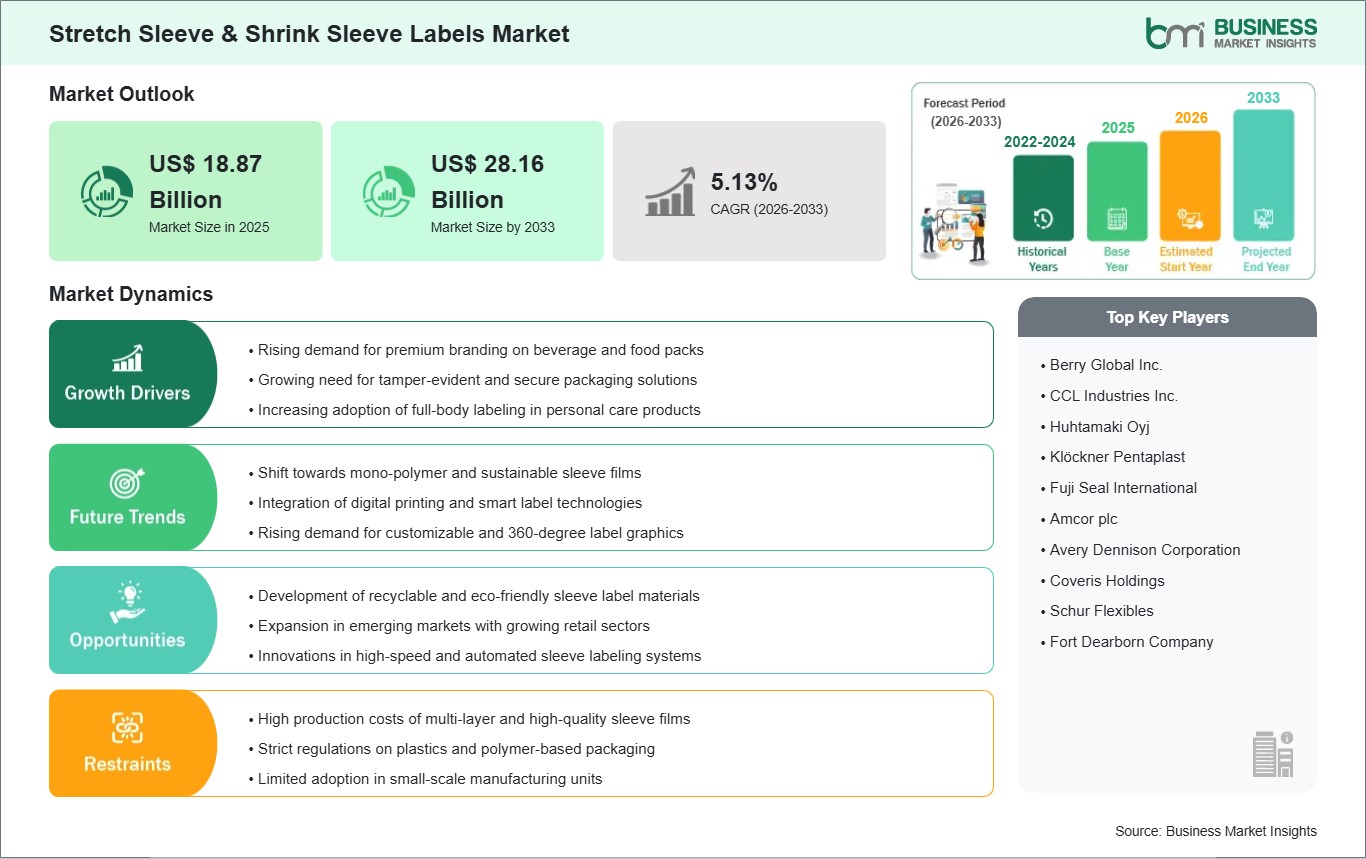
The Stretch Sleeve & Shrink Sleeve Labels Market size is expected to reach US$ 28.16 billion by 2033 from US$ 18.87 billion in 2025. The market is estimated to record a CAGR of 5.13% from 2026 to 2033.
The global Stretch Sleeve & Shrink Sleeve Labels Market has experienced strong growth because various industries increasingly seek modern packaging solutions that create substantial market impact. These labels provide a flexible solution that enables businesses to display complete brand identity while protecting products and displaying evidence of tampering. In North America and Europe, retailers and beverage companies drive demand for stretch and shrink sleeves, which they use to package multipacks and promotional items and create unique displays at retail stores. Food and beverage manufacturers increasingly prefer these labels because they conform to complex container shapes, which allow 360-degree graphics, nutritional information and compliance labeling. Organizations now implement security-based sleeve solutions because they recognize the need to safeguard against counterfeiting while protecting their brand identity.
The market includes several advantages, which face certain restrictions. Manufacturers must develop recyclable and sustainable sleeve solutions because environmental concerns and rising regulatory requirements related to plastics and polymer-based films create difficulties in their operations. The production costs of high-quality shrink sleeve labels, which require multi-layer printing and advanced coatings, exceed those of traditional labeling solutions, resulting in delayed implementation by smaller manufacturers. Emerging markets experience operational difficulties because supply chain networks require specialized printing equipment and application equipment to function.
The worldwide market is growing because Asian and South American regions are transforming their packaging industries through their urban development, rising consumer spending and expanding organized retail sectors. Material scientists have developed new biodegradable polymers and mono-layer recyclable sleeves, which create pathways for environmentally responsible brands to achieve their sustainability goals while maintaining their upscale product presentation. The development of high-speed sleeve application machinery enables manufacturers to achieve efficient production processes while maintaining flexible manufacturing capabilities, which help different industries to use this technology for their beverage and personal care, pharmaceutical and industrial product manufacturing needs.

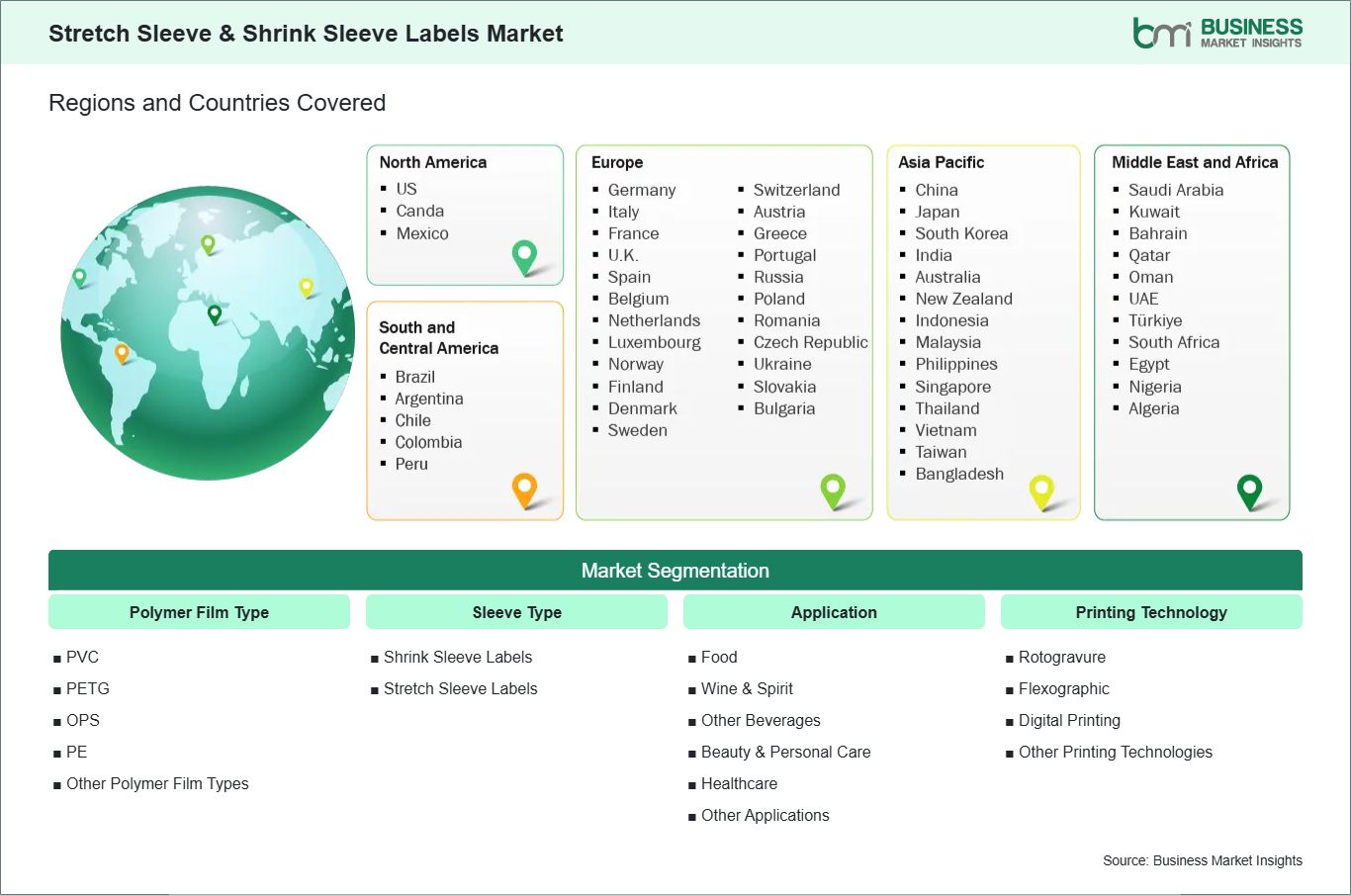
Key segments that contributed to the derivation of the stretch sleeve & shrink sleeve labels market analysis are polymer film type, sleeve type, application and printing technology.
The global stretch sleeve and shrink sleeve labels market is significantly driven by the rising demand for premium branding on beverage and food packs because manufacturers increasingly view packaging as a strategic tool for product differentiation in crowded retail marketplaces. Sleeve labels provide brands with complete surface coverage, which enables them to display their most important graphics together with product details and marketing content that will help their products stand out on store shelves while appealing to their target audience. Beverage producers in North America and Europe use shrink and stretch sleeves to create unique branding identities through their bottled water, carbonated drinks and craft beverage products because these packaging solutions allow them to create special designs without changing their bottle shapes or manufacturing processes. This trend is reinforced by retail formats that prioritize aesthetic appeal and brand storytelling to influence purchase decisions.
The Asia Pacific region has experienced fast expansion in its modern retail sector, e-commerce industry and packaged food market, which has led to more businesses using sleeve labels to achieve effective branding and meet the international labeling needs of their multilingual product packages. The beverage industry in the region, together with food manufacturers, now uses shrink sleeves as their primary packaging solution to meet all government regulations while delivering an upscale appearance to their products. The Middle East and Africa, together with South and Central America, experience the same transitions because urban areas expand and people acquire more money to spend, which leads packaged goods businesses to boost their brand recognition through better sleeve design work. Furthermore, the expansion of health‑oriented and functional beverage categories — including sports drinks, plant‑based beverages, and ready‑to‑drink teas — has expanded opportunities for sleeve label usage. These products often benefit from the flexibility of full‑body label surfaces to communicate ingredient benefits, certifications, and brand narratives, reinforcing the role of premium sleeve labeling in global food and beverage packaging strategies.
A major global opportunity for the stretch sleeve and shrink sleeve labels market lies in the development of recyclable and eco‑friendly sleeve label materials that align with evolving sustainability expectations. Traditional multi‑layer polymer sleeve films, while effective in visual impact and performance, present challenges for recycling streams. In response, major suppliers and converters are innovating mono‑polymer and easily separable film structures that facilitate recycling and reduce environmental footprint. In Europe, stringent packaging waste regulations and extended producer responsibility frameworks have accelerated adoption of recyclable sleeve solutions, with converters optimizing film compositions to match regional recycling infrastructure.
North American brands are increasingly integrating eco‑certified sleeve films into their packaging roadmaps, driven by corporate sustainability pledges and retailer environmental standards. These recyclable sleeve materials enable brands to maintain premium aesthetics while addressing consumer concerns about plastics waste, supporting circular economy ambitions. In Asia Pacific, where recycling systems are rapidly evolving, recyclable sleeve films offer a pathway for brands to pre‑empt regulatory changes and appeal to environmentally conscious consumers. Companies are forming partnerships with local recyclers and industry associations to pilot recyclable sleeve programs that can scale across densely populated markets.
Additionally, opportunities exist in bio‑based and biodegradable sleeve films for niche and specialized categories, such as organic foods and natural personal care products. These alternative materials help brands differentiate through eco‑credentials while exploring new applications beyond traditional beverage and food packaging. Collectively, the expansion of recyclable and eco‑friendly sleeve label materials presents a strategic growth avenue, balancing visual performance with environmental responsibility in the global stretch and shrink sleeve labels market.
The stretch sleeve & shrink sleeve labels market demonstrates steady growth, with size and share analysis highlighting evolving trends and competitive dynamics among key players. The report examines subsegments categorized within polymer film type, sleeve type, application and printing technology, offering insights into their contribution to overall market performance.
By polymer film type, the PVC subsegment dominated the market in 2025, driven by its excellent printability, flexibility, and cost-effectiveness for label applications.
Based on sleeve type, the shrink sleeve labels subsegment dominated the market in 2025, driven by high demand for 360-degree branding, tamper-evidence, and full-body labeling.
In terms of application, the other beverages subsegment dominated the market in 2025, driven by strong global consumption and widespread use of sleeve labels for multipack and single-serve bottles.
Based on printing technology, the rotogravure subsegment dominated the market in 2025, driven by its high-quality printing capability, efficiency for large-volume production, and superior color reproduction.
| Report Attribute | Details |
|---|---|
| Market size in 2025 | US$ 18.87 Billion |
| Market Size by 2033 | US$ 28.16 Billion |
| Global CAGR (2026 - 2033) | 5.13% |
| Historical Data | 2022-2024 |
| Forecast period | 2026-2033 |
| Segments Covered | By Polymer Film Type
|
|
Regions and Countries Covered
| |
| North America | US, Canada, Mexico |
| Europe | Belgium, Austria, Finland, Denmark, Greece, Poland, Romania, Russia, Ukraine, Czech Republic, Slovakia, Bulgaria, Italy, Luxembourg, Germany, Switzerland, France, Netherlands, Norway, Portugal, Spain, Sweden, United Kingdom |
| Asia-Pacific | Australia, China, India, Japan, South Korea, Indonesia, Malaysia, Philippines, Singapore, Thailand, Vietnam, Bangladesh, New Zealand, Taiwan |
| South and Central America | Brazil, Argentina, Peru, Chile, Colombia |
| Middle East and Africa | Bahrain, Kuwait, Oman, Qatar, Saudi Arabia, United Arab Emirates, Turkiye, South Africa, Egypt, Algeria, Nigeria |
| Market leaders and key company profiles |
|
The "Stretch Sleeve & Shrink Sleeve Labels Market Size and Forecast (2022 - 2033)" report provides a detailed analysis of the market covering below areas:
The geographical scope of the Stretch Sleeve & Shrink Sleeve Labels Market report is divided into North America, Asia Pacific, Europe, Middle East & Africa, and South & Central America. North America held the largest share in 2025.
The global stretch sleeve and shrink sleeve labels market maintains its strongest presence in North America because the region's consumer packaged goods and beverage and personal care industries require complete body labels, which provide branding, compliance and tamper-proof evidence. The United States and Canada lead in the adoption of multi‑color, high‑definition sleeve labels owing to well‑established printing infrastructure, consumer preference for premium packaging, and widespread use in multipack bundling and promotional SKUs. Organizations across North America pursue sustainability initiatives that create demand for recyclable and mono-polymer sleeve films because these films allow brands to achieve visual appeal through their packaging design.
European markets exhibit maturity because environmental regulations create market barriers that force businesses to meet high standards that require products to demonstrate both quality and recycling capabilities. German businesses, French companies and U.K. firms frequently adopt recyclable shrink sleeve materials and solvent-free inks to comply with circular economy goals, while the retail and beverage sectors exploit sleeve labels for differentiated shelf presence and regulatory information. The
Asia Pacific region experiences strong demand for stretch and shrink sleeve labels because urbanization increases, disposable income rises, and organized retail expands throughout China, India, Japan and Southeast Asia markets, especially in the food and beverage and cosmetics and pharmaceutical sectors that need customized shapes and eye-catching graphics to compete.
The Middle East and Africa market demonstrates gradual development through increasing sleeve label usage for oil and beverage products and industrial products, while the UAE, Saudi Arabia and South Africa markets work to improve product security through retail modernization.
The South and Central America region, which includes Brazil, Mexico and Argentina, witnesses strong growth because consumer goods manufacturing and retail expansion create new market opportunities for brands that use sleeve labels to enhance product security and marketing options and regional brand recognition.
The supply chain advancements and the label printing technology investments enable wider adoption of technologies, which sustainability trends drive regional converters to investigate recyclable and lightweight sleeve solutions. Consumer demand for convenient packaging solutions that tell visual stories through premium packaging drives the global market for stretch and shrink sleeve labels in all areas of the world.

The Stretch Sleeve & Shrink Sleeve Labels Market is evaluated by gathering qualitative and quantitative data post primary and secondary research, which includes important corporate publications, association data, and databases. A few of the key developments in the stretch sleeve & shrink sleeve labels market are:
The Stretch Sleeve & Shrink Sleeve Labels Market is valued at US$ 18.87 Billion in 2025, it is projected to reach US$ 28.16 Billion by 2033.
As per our report Stretch Sleeve & Shrink Sleeve Labels Market, the market size is valued at US$ 18.87 Billion in 2025, projecting it to reach US$ 28.16 Billion by 2033. This translates to a CAGR of approximately 5.13% during the forecast period.
The Stretch Sleeve & Shrink Sleeve Labels Market report typically cover these key segments-
The historic period, base year, and forecast period can vary slightly depending on the specific market research report. However, for the Stretch Sleeve & Shrink Sleeve Labels Market report:
The Stretch Sleeve & Shrink Sleeve Labels Market is populated by several key players, each contributing to its growth and innovation. Some of the major players include:
The Stretch Sleeve & Shrink Sleeve Labels Market report is valuable for diverse stakeholders, including:
Essentially, anyone involved in or considering involvement in the Stretch Sleeve & Shrink Sleeve Labels Market value chain can benefit from the information contained in a comprehensive market report.
Please tell us your area of interest
(Market Segments/ Regions and Countries/ Companies)