
Spunbond Nonwoven Market Outlook: Size, Share, Trends, Growth Analysis, Competitive Landscape & Forecast, 2026–2033

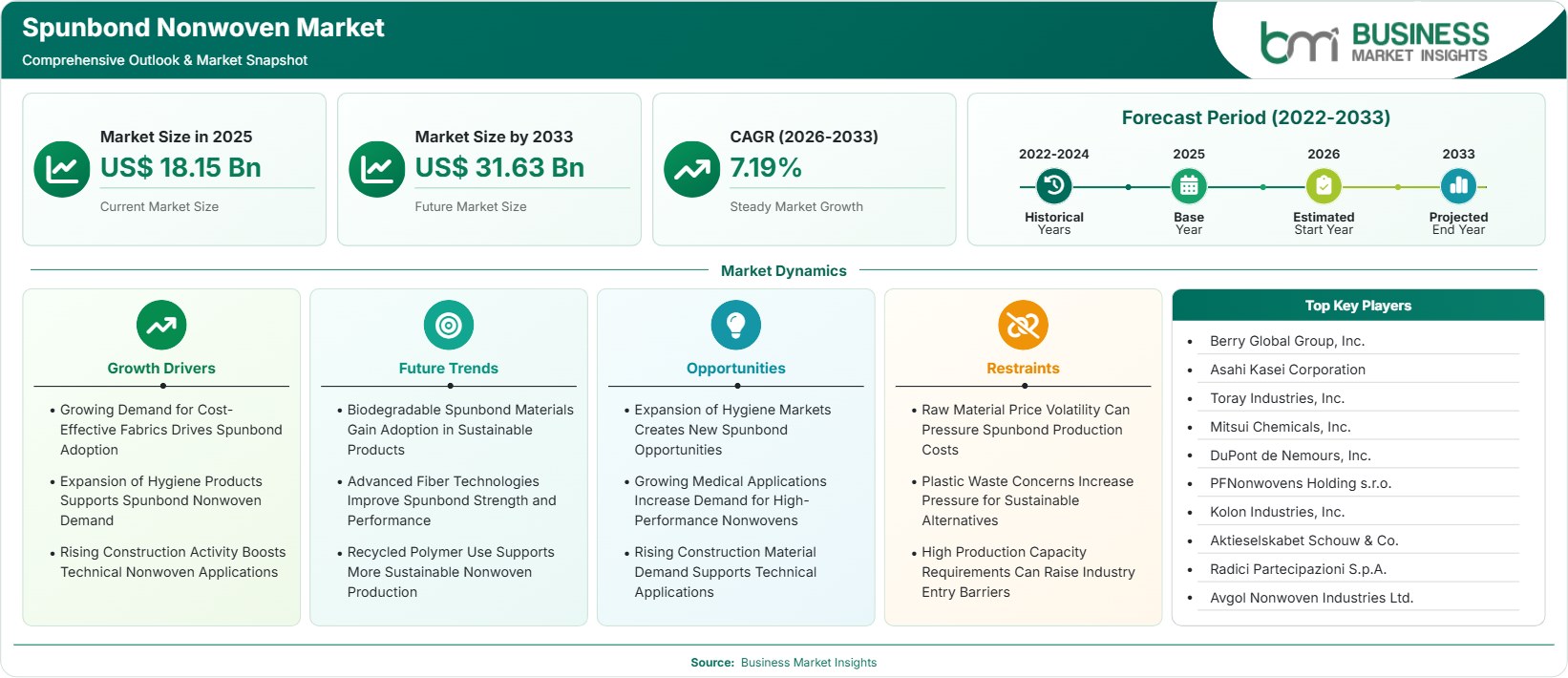
The Spunbond Nonwoven Market size was valued at US$ 18.15 Billion in 2025 and is projected to reach US$ 31.63 Billion by 2033, growing at a CAGR of 7.19% during 2026–2033, driven by hygiene consumption, geotextiles, and demand for lightweight, economical, durable materials.

Report Coverage
  • Function: Disposable, Durable
  • Material: Polypropylene, Polyethylene, Polyester, Others
  • Application: Personal Care & Hygiene, Geotextiles, Medical, Others
US$ 18.15 Bn Market size in 2025
US$ 31.63 Bn Market Size by 2033
7.19% CAGR, 2026 - 2033
2026-2033 Forecast Period

AI Overview

Spunbond Nonwoven Market Summary

  • North America: holds 23%–26% share in 2025, growing at a CAGR of 6.3%–7.0% during 2026–2033, supported by hygiene consumption, healthcare demand, construction, geotextiles, lightweight materials, and sustainability-led product development. The US accounts for 78%–83% of regional demand and is projected to grow at 6.5%–7.2% CAGR through 2033, supported by healthcare, hygiene, construction, and industrial applications.
  • Fastest Growing Region: Asia Pacific holds 41%–44% share in 2025, expanding at a CAGR of 8.1%–8.8% during 2026–2033, supported by expanding hygiene consumption, healthcare infrastructure, and rising demand for economical nonwoven materials.
  • Leading Segment: Disposable holds 54%–58% share in 2025, growing at a CAGR of 7.4%–8.2% during 2026–2033, supported by hygiene consumption, medical requirements, and increasing demand for single-use nonwoven products.
  • High Growth Segment: Medical holds 14%–18% share in 2025, growing at a CAGR of 8.6%–9.4% during 2026–2033, supported by healthcare infrastructure, infection-control requirements, and increasing consumption of specialized medical nonwovens globally.
  • Key Market Opportunity: Growing hygiene consumption, healthcare infrastructure, construction requirements, and geotextile deployment create opportunities for lightweight spunbond structures with improved softness, strength, filtration, sustainability, and material efficiency.
  • Major Market Players: Berry Global Group, Inc., Asahi Kasei Corporation, Toray Industries, Inc., Mitsui Chemicals, Inc., DuPont de Nemours, Inc., PFNonwovens Holding s.r.o., Kolon Industries, Inc., Aktieselskabet Schouw & Co.; Radici Partecipazioni S.p.A., Avgol Nonwoven Industries Ltd.
Strategic Insights

Spunbond Nonwoven Market: Strategic Insights

Spunbond Nonwoven Market Strategic Framework
FREE PDF
Request your free sample
Request free sample
Stakeholder View

Key Takeaways

  • The value chain is shifting towards polymer integration, high-speed extrusion, spunbonds, finishing, conversion, and materials science for specific applications, hence putting more emphasis on manufacturing efficiency and resin uniformity.
  • Disposables present the largest market volume, while medical and technical applications present the best value-added potential in terms of specialized structures and better performance.
  • Material development is increasingly focused on lower basis weights, improved softness, higher strength, enhanced barrier performance, and greater incorporation of recycled or renewable feedstocks.
  • Asia Pacific offers the strongest investment opportunity because expanding hygiene consumption, healthcare infrastructure, construction activity, and manufacturing capacity support both domestic demand and export-oriented production.
  • Strategic investment is increasingly directed toward capacity expansion, sustainability-oriented materials, production efficiency, and application diversification rather than volume expansion alone.
  • Geotextiles provide an important diversification avenue because infrastructure development creates recurring requirements for separation, filtration, drainage, reinforcement, and erosion-control materials.
Geographic Outlook

Spunbond Nonwoven Market Regional Highlights

North America Spunbond Nonwoven Market

North America holds 23%–26% share in 2025 and North America Spunbond Nonwoven Market forecast to grow at 6.3%–7.0% CAGR through 2033. The region benefits from established hygiene markets, healthcare expenditure, construction activity, and technical textile consumption. The US accounts for 78%–83% of regional demand and remains the principal market.

  • Consumption in the healthcare segment drives the demand for reliable and consistent performance of nonwovens, prompting suppliers to optimize the strength, softness, barriers, and quality of manufacture.
  • The personal care segment still continues to be an important consumer of volume, where the demand is determined by hygiene consumption, as well as preferences for comfort and controlled basis weight.
  • There is growth in construction and geotextiles usage, where nonwovens are used as separators, filters, drainage, reinforcement, and protection materials.
  • Sustainability requirements are encouraging greater attention to recyclable structures, and reduced basis weights across high-volume commercial applications.

US Spunbond Nonwoven Market

The US Spunbond Nonwoven Market accounts for 78%–83% of North American demand in 2025 and is projected to grow at 6.5%–7.2% CAGR through 2033. Demand is supported by established personal care consumption, healthcare applications, construction activity, and industrial requirements. Buyers increasingly emphasize material consistency, supply reliability, performance specifications, and sustainability attributes.

  • Healthcare and medical applications represent stable demand due to the need for consistency in the physical properties of protective and disposable products along with quality and reliable supply in healthcare-related manufacturing chains.
  • Construction demand helps technical applications where filtration, separation, reinforcement, drainage, and protection are required, thus extending the range of application beyond traditional disposable uses.
  • Sustainability needs are driving the interest in lighter structures and materials using less polymer but still maintaining necessary mechanical and functional properties.

Europe Spunbond Nonwoven Market

Europe Spunbond Nonwoven Market holds 20%–23% share in 2025 and is projected to grow at 5.8%–6.5% CAGR through 2033. Germany, Italy, France, the UK, and Spain represent leading markets, while Italy is projected to grow at 6.5%–7.2% CAGR. Demand is shaped by hygiene, medical, construction, automotive-related technical applications, and environmental requirements.

  • Germany represents an important industrial market supported by technical textiles, healthcare, construction, and advanced manufacturing requirements that favor consistent nonwoven performance.
  • Italy provides strong technical textile demand and is projected to achieve 6.5%–7.2% CAGR, supported by manufacturing capabilities, construction requirements, and diversified industrial applications.
  • France and the UK provide established hygiene and healthcare demand while sustainability requirements increasingly influence material selection and product development decisions.
  • European environmental priorities encourage lightweight designs, efficient polymer consumption, improved recyclability, and alternative feedstock strategies across nonwoven manufacturing and converting.

Asia Pacific Spunbond Nonwoven Market

Asia Pacific Spunbond Nonwoven Market holds 41%–44% share in 2025 and is projected to grow at 8.1%–8.8% CAGR through 2033. China, Japan, India, South Korea, and Southeast Asia represent major markets, while India is projected to grow at 9.0%–9.8% CAGR. Expanding hygiene consumption, healthcare infrastructure, construction, urbanization, and manufacturing capacity support demand.

  • China provides substantial demand across hygiene, medical, construction, and industrial applications, supported by extensive manufacturing capacity and large downstream converting operations.
  • India provides the strongest growth opportunity, with 9.0%–9.8% CAGR supported by hygiene consumption, healthcare expansion, infrastructure development, and increasing penetration of nonwoven materials.
  • Japan and South Korea have an interest in high-value-added products due to health care applications, technical textiles, industrial materials, and advanced manufacturing needs.
  • Southeast Asia represents market potential for production and consumption due to growth in hygienic products as a result of urbanization and increased healthcare spending.

Rest of World Spunbond Nonwoven Market

South and Central America provide growing demand across hygiene, healthcare, construction, agriculture, and infrastructure applications. Brazil and Mexico are leading markets, while Colombia and Chile provide additional opportunities. Brazil benefits from a large consumer base and diversified industrial activity, supporting demand for disposable and durable nonwoven materials across several downstream applications.

The Middle East and Africa Spunbond Nonwoven Market provide opportunities through healthcare development, construction, infrastructure, hygiene consumption, and technical textile applications. Rest of World holds 10%–13% share in 2025 and is projected to grow at 6.4%–7.1% CAGR through 2033 as nonwoven penetration increases.

  • Brazil provides broad demand across personal care, healthcare, construction, and industrial applications, supported by a large domestic market and expanding infrastructure requirements.
  • Mexico offers opportunities across hygiene, medical, construction, and industrial applications as manufacturing activity and consumer product demand continue to diversify.
  • Gulf markets support technical nonwoven demand through construction, infrastructure, healthcare, and industrial development requiring durable filtration, protection, and separation materials.
  • South Africa provides demand across healthcare, construction, mining-related applications, agriculture, and infrastructure, creating opportunities for technical and durable spunbond structures.
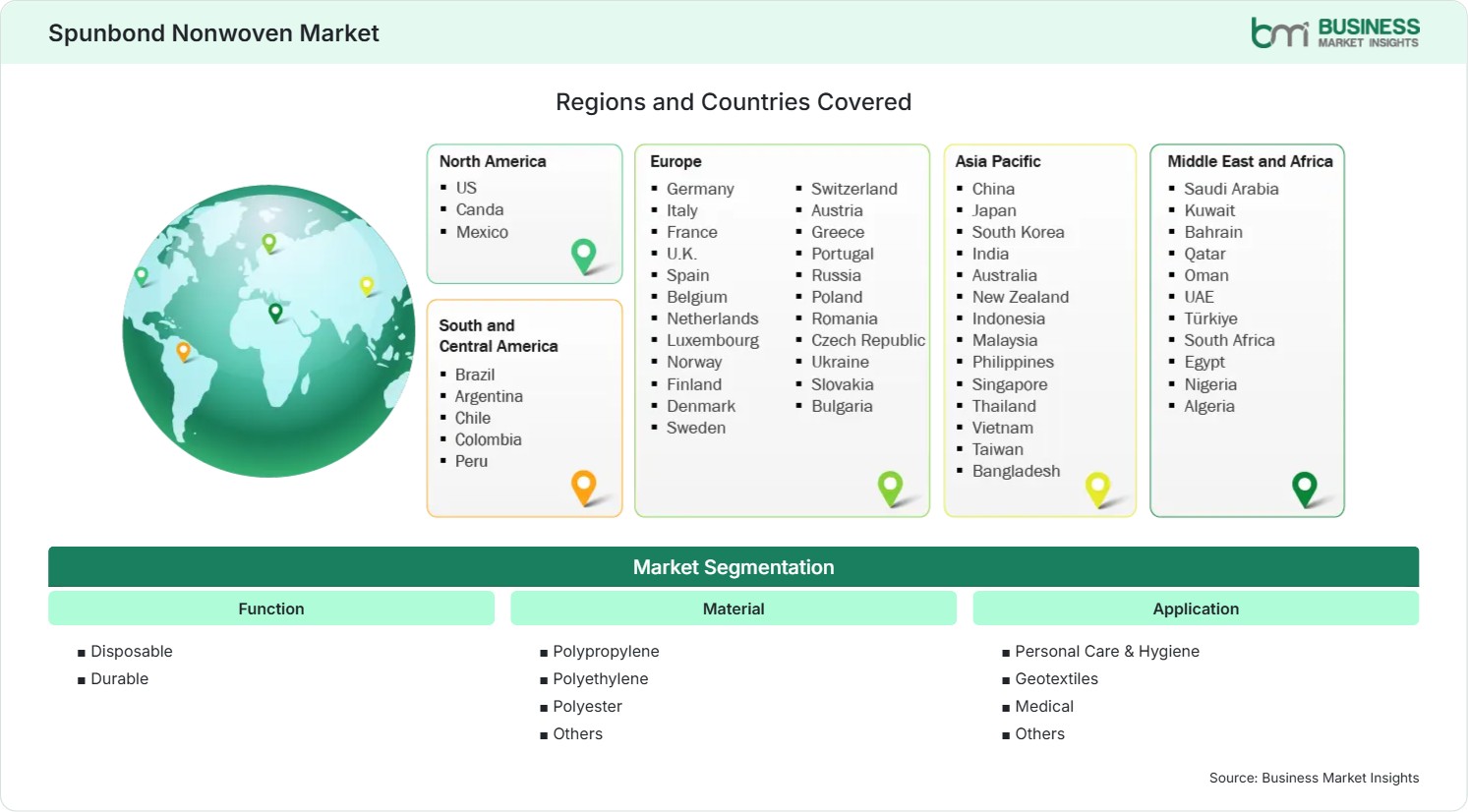
Global Market Geography
FREE PDF
Request your free sample
Request free sample
Segment Analysis

Spunbond Nonwoven Market Segmentation

Function

Disposable holds 54%–58% share in 2025 and is projected to grow at 7.4%–8.2% CAGR through 2033. High volume hygiene and health care use drives demand, whereas durable products uses drive construction, agriculture, industrial, and technical demands. Lightweight performance, durability, softness, and material efficiencies are being developed by manufacturers to meet demands based on specifications and sustainable trends.

  • Disposable: High volume hygiene and health care use drives demand, whereas lightweight structure, softness, efficiency, and disposability help support adoption.
  • Durable: Durable uses such as construction, geotextile, industrial, and technical applications drive demand for materials with higher mechanical performance.

Material

Polypropylene holds 58%–62% share in 2025 and is projected to grow at 6.9%–7.7% CAGR through 2033. Efficiency in processing, weight to strength ratios, and logistics chain help in making it widely used. Polyethylene and polyester cater to special performance needs, whereas the use of different materials is growing due to considerations of cost, durability, and recycling.

  • Polypropylene: Efficient processing, lightweight performance, strength, and established production infrastructure make polypropylene the principal material for high-volume spunbond applications.
  • Polyethylene: Polyethylene supports applications requiring flexibility, moisture resistance, and specific barrier characteristics, particularly where polymer properties influence product performance.
  • Polyester: Polyester provides higher durability and dimensional stability for applications requiring stronger mechanical performance, longer service life, and resistance to demanding operating conditions.

Application

Personal Care & Hygiene holds 52%–56% Spunbond Nonwoven Market share in 2025 and is projected to grow at 7.3%–8.1% CAGR through 2033. Medical applications are developing faster as healthcare requirements expand. Geotextiles provide an important technical avenue, supported by infrastructure development and requirements for filtration, separation, drainage, reinforcement, and erosion control.

  • Personal Care & Hygiene: High consumption of hygiene products supports spunbond demand, with softness, strength, lightweight construction, liquid management, and production efficiency influencing material selection.
  • Geotextiles: Infrastructure development drives demand for nonwoven geotextiles used in separation, filtration, drainage, reinforcement, erosion control, and soil stabilization applications.
  • Medical: Healthcare applications require controlled quality, consistent performance, barrier characteristics, and suitable softness, supporting demand for specialized spunbond structures in medical products.
Market Forces

Spunbond Nonwoven Market Dynamics

Key Market Drivers

Growing Demand for Cost-Effective Fabrics Drives Spunbond Adoption

Spunbond production offers effective production of non-wovens with consistent basis weight, quality, and output. By lowering basis weight, polymer usage can be reduced while retaining necessary tensile strength and functionality. Efficiency is critical in this case since the prices of resins have a significant impact on conversion and purchases. Thus, manufacturers are trying to optimize their processes to retain performance and at the same time limit the number of materials used. This creates a positive outlook for the future development of the Spunbond Nonwoven Market growth.

Expansion of Hygiene Products Supports Spunbond Nonwoven Demand

The hygiene products constitute a large market due to the ability of spunbond materials to offer softness, strength, breathability, and control over liquid management properties in disposable products. Factors such as population growth, urbanization, change in consumer behavior, and growing awareness about personal hygiene continue to drive consumption in different categories of products. Thinner structures that use less material yet maintain product performance are what manufacturers are looking for. This creates a need for fine fibers, optimization of basis weight, better bonding, and multi-layer construction.

Rising Construction Activity Boosts Technical Nonwoven Applications

Construction activity is expanding the role of spunbond materials beyond disposable products by creating demand for geotextiles and protective technical structures. Nonwoven materials can support filtration, separation, drainage, reinforcement, erosion control, and protection in infrastructure projects. Their lightweight nature and consistent physical characteristics make them suitable for applications requiring controlled material placement and dependable performance. Infrastructure development also creates recurring requirements across roads, drainage systems, foundations, land stabilization, and related projects.

Key Market Opportunities

Expansion of Hygiene Markets Creates New Spunbond Opportunities

Expanding hygiene markets create opportunities for producers to supply lighter, softer, stronger, and more resource-efficient structures. Product manufacturers increasingly require materials that provide comfort and functional performance while controlling basis weight and conversion costs. This creates room for innovation in fiber fineness, bonding, multilayer structures, surface properties, and polymer selection. Emerging markets provide particularly strong potential as hygiene product penetration increases and consumer purchasing patterns shift toward packaged personal care products.

Growing Medical Applications Increase Demand for High-Performance Nonwovens

Medical applications offer an attractive growth opportunity because healthcare systems require dependable materials for protective and disposable products. Demand is influenced by healthcare infrastructure expansion, infection-control practices, surgical activity, and increasing requirements for controlled product quality. Medical-grade spunbond structures can be engineered for strength, softness, breathability, barrier performance, and process consistency depending on the intended use. Producers can therefore differentiate through specialized material characteristics rather than competing only on volume and price.

Rising Construction Material Demand Supports Technical Applications

Technical applications provide an opportunity to diversify demand beyond consumer-oriented products and improve exposure to infrastructure-related investment. Geotextiles can address requirements for soil separation, filtration, drainage, reinforcement, erosion control, and stabilization. Increasing infrastructure development creates recurring demand for materials that can be produced consistently at scale while meeting defined mechanical and permeability specifications. Producers can improve competitiveness through optimized basis weight, higher tensile strength, puncture resistance, dimensional stability, and application-specific surface characteristics.

Market Restraints and Challenges

Raw Material Price Volatility Can Pressure Spunbond Production Costs

Factor: Polypropylene, polyethylene, and polyester represent important inputs for spunbond production, making manufacturing economics sensitive to polymer prices, energy costs, transportation expenses, and broader petrochemical market conditions. Impact: Significant input-cost changes can compress producer margins, increase converter purchasing costs, and complicate long-term pricing arrangements. High-volume disposable applications are particularly sensitive because material costs represent an important component of total product economics.

Plastic Waste Concerns Increase Pressure for Sustainable Alternatives

Factor: Many spunbond structures rely on synthetic polymers, creating environmental concerns related to waste generation, disposal, recycling complexity, and end-of-life management. Impact: Increasing sustainability expectations can raise compliance requirements, influence procurement decisions, and accelerate demand for recyclable, renewable, or lower-material alternatives. Producers face pressure to reduce environmental impacts without sacrificing softness, strength, barrier performance, or production efficiency. The challenge is particularly relevant where customers demand measurable environmental improvements without accepting meaningful deterioration in product performance.

Company Analysis

Competitive Landscape

The Spunbond Nonwoven Market analysis reflects competition across integrated polymer and fiber producers, nonwoven manufacturers, technical material suppliers, and diversified chemical companies. Competitive differentiation increasingly depends on production scale, polymer processing, basis-weight control, softness, strength, application-specific engineering, supply reliability, and sustainability capabilities.

Company Name

Overview

Products and Services relevant to this market

Berry Global Group, Inc.

Diversified manufacturer with extensive nonwoven and engineered material capabilities serving consumer and industrial applications.

Spunbond and other nonwoven materials, hygiene components, healthcare materials, technical fabrics, and engineered solutions.

Asahi Kasei Corporation

Diversified Japanese materials company with nonwoven and fiber technologies serving healthcare and industrial markets.

Spunbond nonwovens, synthetic fibers, filtration materials, healthcare products, and performance-oriented materials.

Toray Industries, Inc.

Global advanced materials producer with nonwoven capabilities across hygiene and industrial applications.

Nonwoven fabrics, synthetic fibers, functional materials, hygiene products, and technical textile solutions.

Mitsui Chemicals, Inc.

Chemicals and materials producer supplying polymers and nonwoven-related technologies across multiple applications.

Polyolefin materials, spunbond nonwovens, hygiene materials, functional polymers, and industrial solutions.

DuPont de Nemours, Inc.

Materials company offering engineered nonwoven and protective material technologies for specialized applications.

Nonwoven protective materials, hygiene-related materials, filtration solutions, industrial fabrics, and engineered structures.

PFNonwovens Holding s.r.o.

Nonwoven producer focused on hygiene, medical, and technical applications with global manufacturing capabilities.

Spunbond, meltblown, composite nonwovens, hygiene materials, medical fabrics, and sustainable material solutions.

Kolon Industries, Inc.

Advanced materials manufacturer serving industrial, textile, and specialized nonwoven applications.

Nonwoven fabrics, industrial fibers, functional materials, filtration products, and technical textile solutions.

Aktieselskabet Schouw & Co.

Diversified industrial investment company with activities spanning nonwovens and related manufacturing operations.

Nonwoven materials, technical fabrics, industrial materials, and application-focused manufacturing solutions.

Radici Partecipazioni S.p.A.

Diversified chemical and materials group with expertise in synthetic fibers and nonwoven-related applications.

Synthetic fibers, polypropylene materials, technical textiles, nonwovens, and specialty material solutions.

Avgol Nonwoven Industries Ltd.

Nonwoven manufacturer focused strongly on hygiene and high-volume spunbond material requirements.

Spunbond nonwovens, hygiene fabrics, medical materials, lightweight structures, and application-specific nonwoven solutions.

Trust & Transparency

Research Methodology

The market analysis combines proprietary research with secondary data from government agencies, company disclosures, regulatory filings, industry databases and expert interviews. Market estimates are validated through data triangulation, cross-market benchmarking and analyst review.

View Full Research Methodology

Questions Answered

Frequently Asked Questions

What supports long-term demand for durable spunbond materials?

Infrastructure development, geotextile deployment, industrial applications, construction activity, and technical textile requirements support durable material demand.

How is sustainability influencing spunbond production?

Sustainability is encouraging lightweight structures, recyclable designs, renewable feedstocks, improved material efficiency, and better end-of-life considerations.

Which applications offer greater product differentiation in Spunbond Nonwoven Market report?

Medical, geotextile, and other technical applications generally provide greater scope for differentiation because buyers evaluate specialized performance characteristics rather than relying primarily on volume and price.

Why is basis-weight reduction important for manufacturers in Spunbond Nonwoven Market?

Lower basis weight can reduce polymer consumption and material cost while improving resource efficiency. Maintaining required mechanical and functional performance during lightweighting is therefore a major product-development objective.

What factors determine spunbond material selection?

Material selection depends on required tensile strength, softness, basis weight, barrier performance, durability, processing requirements, application conditions, cost targets, and sustainability specifications.

Access the Full Spunbond Nonwoven Market Report

Get segment-level forecasts, regional estimates, competitive benchmarking, company profiles and downloadable Excel datasets.

Access the full Spunbond Nonwoven Market Report
350 pages PDF & Excel | 2026-08-24