
Solid-State Battery Materials Market Outlook: Size, Share, Trends, Growth Analysis, Competitive Landscape & Forecast, 2026-2033

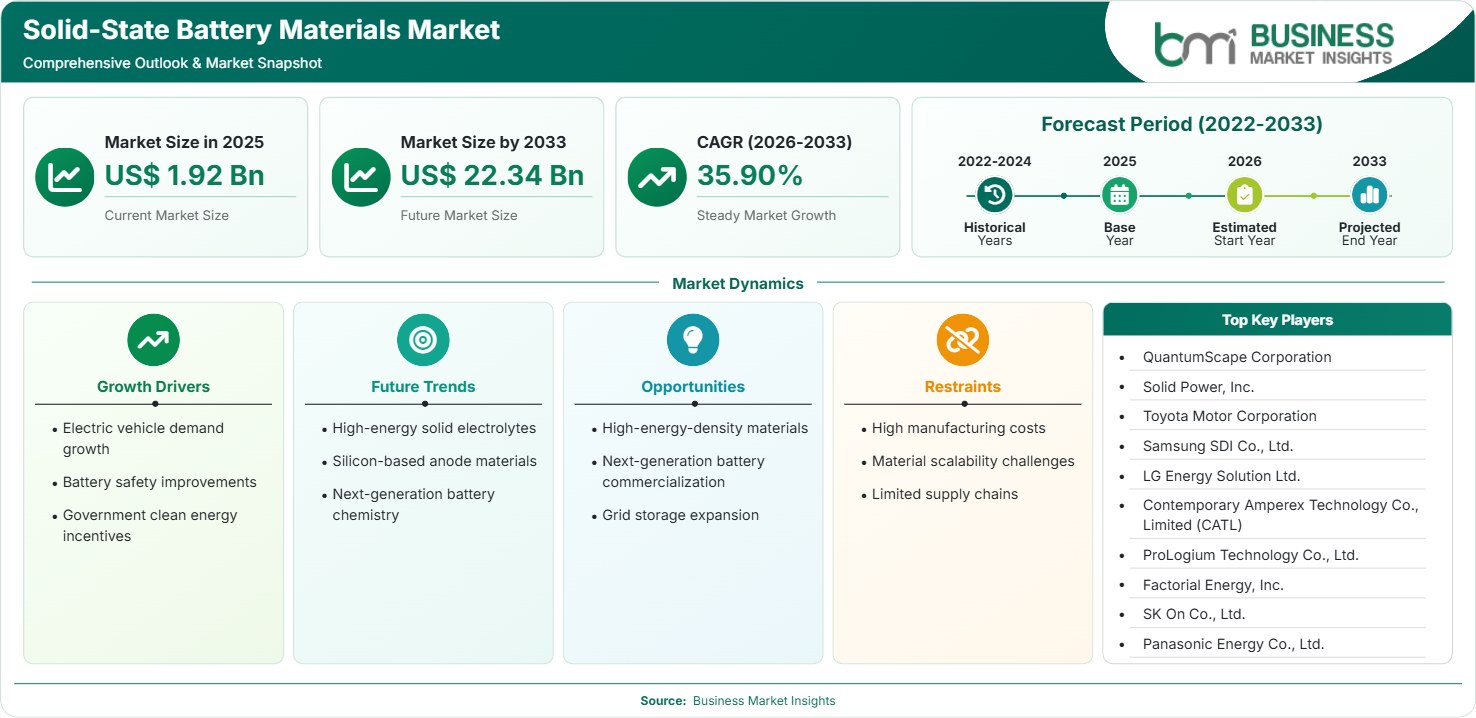
The Solid-State Battery Materials Market size was valued at US$ 1.92 billion in 2025 and is projected to reach US$ 22.34 billion by 2033, growing at a CAGR of 35.90% during 2026–2033. Growth is driven by electric vehicle demand growth, battery safety improvements, and government clean energy incentives, while opportunities are emerging through high-energy-density materials, next-generation battery commercialization, and grid storage expansion.

Report Coverage
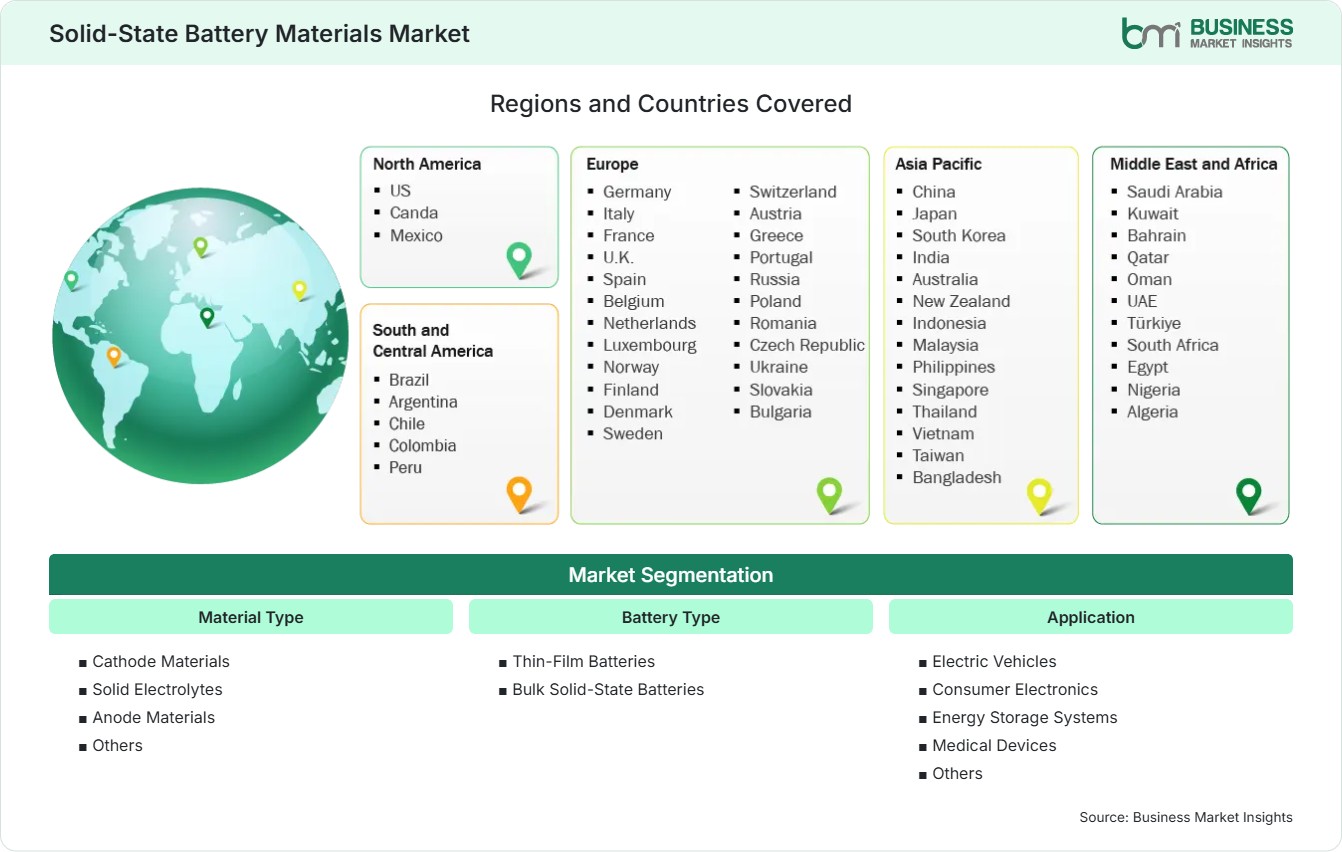
  • Material Type: Cathode Materials, Solid Electrolytes, Anode Materials, Others
  • Battery Type: Thin-Film Batteries, Bulk Solid-State Batteries
  • Application: Electric Vehicles, Consumer Electronics, Energy Storage Systems, Medical Devices, Others
US$ 1.92 Bn Market size in 2025
US$ 22.34 Bn Market Size by 2033
35.90% CAGR, 2026 - 2033
2026-2033 Forecast Period

AI Overview

Solid-State Battery Materials Market Summary

  • North America Region: North America accounts for approximately 28%–32% market share in 2025 and is projected to grow at a 34.5%–35.5% CAGR during 2026–2033. The region benefits from EV manufacturing investments, battery innovation programs, and clean energy policies supporting advanced battery material development. The U.S. market is supported by solid-state battery research investments and is estimated to grow at approximately 34.8%–35.8% CAGR.
  • Fastest Growing Region: Asia Pacific represents around 45%–49% of the global market in 2025 and is expected to expand at 36.5%–37.5% CAGR through 2033. Battery manufacturing expansion, EV production growth, government incentives, and strong presence of cell manufacturers are accelerating regional solid-state battery material adoption.
  • Leading Segment: Cathode Materials hold approximately 35%–39% market share in 2025 and are expected to grow at a 35.0%–36.0% CAGR. Increasing demand for high-capacity battery chemistries and improved energy density is driving development of advanced cathode formulations for next-generation batteries.
  • High Growth Segment: Solid Electrolytes represent approximately 25%–29% market share in 2025 and are projected to grow at 38.0%–39.0% CAGR. Safety advantages, higher energy density potential, and replacement of liquid electrolytes are accelerating investment in solid electrolyte technologies.
  • Key Market Opportunity: Advanced solid-state materials with improved conductivity, energy density, and scalability are creating opportunities for battery manufacturers targeting electric vehicles, energy storage, and next-generation electronics applications.
  • Major Market Players: QuantumScape Corporation, Solid Power, Inc., Toyota Motor Corporation, Samsung SDI Co., Ltd., LG Energy Solution Ltd., Contemporary Amperex Technology Co., Limited (CATL), ProLogium Technology Co., Ltd., Factorial Energy, Inc., SK On Co., Ltd., and Panasonic Energy Co., Ltd.
Strategic Insights

Solid-State Battery Materials Market: Strategic Insights

Solid-State Battery Materials Market Strategic Framework
FREE PDF
Request your free sample
Request free sample
Stakeholder View

Key Takeaways

  • Advanced battery materials are becoming strategically important as automotive and energy industries seek higher-performance alternatives to conventional lithium-ion technologies.
  • Solid electrolytes and high-energy-density cathode materials offer strong growth potential due to their role in improving battery safety and performance.
  • Material innovation is focused on improving ionic conductivity, interface stability, manufacturing efficiency, and commercial scalability.
  • Asia Pacific provides significant investment opportunities due to strong battery manufacturing ecosystems, EV production capacity, and technology development activities.
  • Battery manufacturers and automotive companies are increasing partnerships, research investments, and commercialization initiatives to accelerate solid-state battery adoption.
  • Grid storage expansion and clean energy integration are creating additional demand opportunities for advanced solid-state battery materials.
Geographic Outlook

Solid-State Battery Materials Market Regional Highlights

North America Solid-State Battery Materials Market

North America accounted for approximately 28%–32% of the global market in 2025 and is projected to grow at a 34.5%–35.5% CAGR during 2026–2033. The region is strengthening its position through battery research investments, electric vehicle manufacturing expansion, and government support for domestic energy storage supply chains. The Solid-State Battery Materials Market share is supported by automotive partnerships, advanced material development programs, and increasing focus on safer high-performance battery technologies.

  • The United States represents the dominant contributor due to strong EV investments, battery research initiatives, and growing domestic manufacturing capabilities.
  • Automotive manufacturers are partnering with battery developers to accelerate solid-state battery commercialization for electric mobility applications.
  • Government clean energy incentives are encouraging investments in advanced battery materials and localized supply chains.
  • Research institutions and technology companies are advancing solid electrolyte and next-generation cathode material development.

US Solid-State Battery Materials Market

The United States represented approximately 24%–28% of the global market revenue in 2025 and is expected to expand at a 34.8%–35.8% CAGR through 2033. The country remains a key innovation hub due to strong battery research capabilities, EV market expansion, and investments in domestic battery manufacturing. Federal clean energy initiatives and private sector funding are supporting the development of advanced solid-state materials for automotive, electronics, and energy storage applications.

  • EV manufacturers are increasing investments in solid-state battery partnerships to improve vehicle range, safety, and charging performance.
  • Domestic battery startups are developing innovative electrolyte and electrode materials to address commercialization challenges.
  • Government-supported battery programs are strengthening local manufacturing and reducing dependence on imported battery technologies.

Europe Solid-State Battery Materials Market

Europe accounted for approximately 18%–22% of the global market in 2025 and is expected to grow at a 34.0%–35.0% CAGR between 2026 and 2033. Germany, France, the United Kingdom, and Sweden are key contributors due to automotive electrification strategies and battery manufacturing investments. Germany is estimated to grow at 34.2%–35.2% CAGR, while France is expected to expand at 33.8%–34.8% CAGR due to increasing clean energy initiatives and EV technology development.

  • European automotive companies are investing in solid-state battery partnerships to strengthen future electric vehicle competitiveness.
  • Germany is emerging as a major battery technology hub due to automotive manufacturing expertise and research infrastructure.
  • Government initiatives supporting sustainable transportation are increasing demand for advanced battery materials.
  • Battery recycling and circular economy strategies are influencing future material development approaches across the region.

Asia Pacific Solid-State Battery Materials Market

Asia Pacific accounted for approximately 45%–49% of the global market in 2025 and represents the fastest-growing region with a projected 36.5%–37.5% CAGR during 2026–2033. China, Japan, South Korea, and Taiwan are leading regional development due to established battery manufacturing ecosystems and strong EV adoption. China is projected to grow at 36.8%–37.8% CAGR, while Japan is expected to expand at 36.2%–37.2% CAGR due to advanced battery research capabilities.

  • China remains a major market due to extensive battery manufacturing capacity and government support for EV technologies.
  • Japan continues advancing solid-state battery research through automotive innovation and material development programs.
  • South Korean battery manufacturers are investing in advanced materials to improve next-generation battery competitiveness.
  • Regional suppliers are developing scalable production methods for solid electrolytes and advanced electrode materials.
  • Growing electric vehicle production is increasing demand for high-performance battery material solutions.

Rest of World Solid-State Battery Materials Market

Latin America, the Middle East, and Africa collectively represented approximately 3%–6% of global revenue in 2025 and are forecast to grow at a 35.0%–36.0% CAGR between 2026 and 2033. Brazil, Mexico, UAE, and South Africa are emerging markets influenced by electrification initiatives, renewable energy investments, and future battery storage requirements. The Solid-State Battery Materials Market trends in these regions are shaped by increasing interest in clean energy technologies and advanced storage solutions.

  • Latin American countries are exploring battery technologies to support electric mobility and renewable energy integration.
  • Brazil and Mexico are developing EV ecosystems that may increase future demand for advanced battery materials.
  • Middle Eastern countries are investing in clean energy diversification and energy storage infrastructure development.
  • UAE and Saudi Arabia are exploring advanced battery technologies for sustainable transportation initiatives.
  • African markets are expected to benefit from future renewable energy storage requirements and electrification programs.
Global Market Geography
FREE PDF
Request your free sample
Request free sample
Segment Analysis

Solid-State Battery Materials Market Segmentation

Material Type

Material Type represents the core technology segment, accounting for approximately 88%–92% of the global market share in 2025 and expanding at a 35.5%–36.3% CAGR between 2026 and 2033. Increasing investments in advanced battery chemistry are accelerating demand for cathode materials, solid electrolytes, and anode materials. Battery manufacturers are focusing on improving conductivity, energy density, thermal stability, and production scalability. In solid-state battery materials market, material innovation remains central to commercialization efforts as companies seek solutions that enable safer, longer-range, and higher-performance solid-state batteries for electric vehicles and energy storage applications.

  • Cathode Materials: Cathode materials represent a leading segment due to their impact on battery capacity, voltage performance, and energy density improvements in next-generation solid-state cells.
  • Solid Electrolytes: Solid electrolytes are gaining strong attention due to their ability to improve safety, eliminate liquid electrolyte risks, and enable higher energy-density battery architectures.
  • Anode Materials: Advanced anode materials are being developed to enhance capacity, improve cycling performance, and support lithium-metal-based solid-state battery technologies.
  • Others: Other materials include separators, binders, additives, and supporting components required for improved solid-state battery manufacturing performance and reliability.

Battery Type

Battery Type segmentation accounted for approximately 80%–84% of market demand in 2025 and is projected to grow at a 35.7%–36.5% CAGR through 2033. In solid-state battery materials market, demand is increasing across thin-film and bulk solid-state battery technologies as manufacturers target applications ranging from consumer electronics to electric vehicles. Bulk solid-state batteries are gaining importance due to their potential for higher capacity and automotive applications, while thin-film batteries continue supporting specialized electronics and compact energy storage requirements.

  • Thin-Film Batteries: Thin-film batteries are adopted in compact applications requiring lightweight designs, high reliability, and integration into medical devices and advanced electronics.
  • Bulk Solid-State Batteries: Bulk solid-state batteries are experiencing strong development activity due to their potential for electric vehicles, higher capacity storage, and improved safety performance.

Application

Application segmentation accounted for approximately 86%–90% of global market demand in 2025 and is expected to grow at a 35.8%–36.6% CAGR during 2026–2033. Electric vehicles represent the primary growth area due to demand for improved range, safety, and charging performance. Energy storage systems and consumer electronics applications are also expanding as solid-state technology advances toward commercial deployment and broader market acceptance.

  • Electric Vehicles: Electric vehicles represent the largest application opportunity due to automotive demand for safer batteries with higher energy density and longer driving range.
  • Consumer Electronics: Consumer electronics applications are adopting solid-state batteries to enable compact designs, improved safety, and longer operating performance in portable devices.
  • Energy Storage Systems: Energy storage systems are emerging applications as renewable energy expansion increases demand for safe, durable, and efficient battery technologies.
  • Medical Devices: Medical device manufacturers are exploring solid-state batteries for reliable, compact, and long-life power solutions in specialized healthcare equipment.
  • Others: Other applications include aerospace, wearable technology, industrial electronics, and emerging technologies requiring advanced battery performance characteristics.
Market Forces

Solid-State Battery Materials Market Dynamics

Key Market Drivers

Rising Electric Vehicle Demand and Battery Electrification

The accelerating adoption of electric vehicles is a major driver for advanced battery material development as automakers seek higher-performance alternatives to conventional lithium-ion systems. Solid-state batteries offer potential improvements in safety, energy density, and charging performance, making them attractive for future EV platforms. The Solid-State Battery Materials Market growth is supported by increasing automotive investments, battery technology partnerships, and government electrification initiatives across major economies. Vehicle manufacturers are collaborating with material suppliers and battery developers to overcome commercialization barriers and establish scalable production capabilities. Growing consumer demand for longer driving ranges and safer battery systems is encouraging continued research into advanced cathode materials, solid electrolytes, and lithium-based anode technologies.

Improving Battery Safety Through Solid Electrolyte Innovation

Battery safety improvements are accelerating investment in solid-state materials as industries seek alternatives that reduce risks associated with conventional liquid electrolyte batteries. Solid electrolytes provide enhanced thermal stability and lower flammability potential, supporting applications where safety is a critical requirement. The Solid-State Battery Materials Market trends are influenced by continuous innovation in ceramic, sulfide, and polymer electrolyte materials designed to improve conductivity and manufacturing feasibility. Battery companies are focusing on interface engineering, material compatibility, and production optimization to achieve reliable performance. These advancements are strengthening the commercial potential of solid-state batteries across electric vehicles, consumer electronics, and stationary energy storage applications.

Government Support for Clean Energy and Battery Innovation

Government incentives, energy policies on clean energy, and battery material development projects are fueling the development of sophisticated battery material ecosystem globally. Nations are making investments in the production of batteries, research facilities, and material chain development to ensure energy security and electrification. Public funding projects are fostering cooperation between auto companies, universities, and battery material developers. Positive policies are overcoming challenges of the development and deployment of solid-state batteries through encouraging innovations, mass production, and sustainable energy solutions. Such projects are offering an enabling environment for material producers that develop new generation cathode materials, electrolytes, and anodes.

Key Market Opportunities

Development of High-Energy-Density Battery Materials

There are several benefits from the emergence of high energy density materials as battery makers look towards developing better batteries for electric cars. Improvements in lithium metal anodes, high-capacity cathode materials, and solid electrolytes are paving the way towards making better batteries with better range and efficiency. Companies that are able to develop solutions for the issues of conductivity, stability, and manufacturing can take advantage of various opportunities in the battery market. Carmakers are focusing on collaboration with material manufacturers so they can get hold of new technology.

Commercialization of Next-Generation Solid-State Batteries

The shift from research in laboratories to manufacturing in commercial settings is generating business opportunities along the value chain of the solid-state batteries. Manufacturers of batteries, automakers, and material suppliers are making investments aimed at improving manufacturing, decreasing costs, and making scalable manufacturing a reality. The successful commercialization will open up demands in the electric vehicle sector, consumer electronics, and energy storage industry during solid-state battery materials market forecasts. Manufacturers of materials, scalable production processes, and supply chains stand to gain from potential future growth in the market. Collaboration between technology developers and manufacturers is key for success in the future.

Expansion of Grid Energy Storage Applications

Increasing use of renewable energy sources provides an opportunity for developing more sophisticated battery technology used in the grid-scale energy storage sector. The solid-state batteries promise to have a number of benefits such as increased safety, operational lifetime, and performance stability that are crucial characteristics for grid-scale storage facilities. Higher integration of solar and wind energy is generating increasing need for energy storage devices that could provide energy management functions in the grid. The material developers focus on solutions suitable for stationary use, which require high levels of safety and durability.

Market Restraints and Challenges

High Manufacturing Costs and Commercialization Barriers

Factor: Solid-state battery production currently involves expensive materials, specialized manufacturing processes, and complex fabrication requirements compared with conventional lithium-ion technologies.

Impact: Higher production cost may lead to postponement of commercialization and adoption due to lack of economies of scale. The processing, quality control and manufacture of batteries remain a challenge for companies that are trying to move from pilot-scale production to full-scale manufacture. The developers of the batteries are working on optimizing their processes and automating the production in order to lower their costs. But it is crucial to keep in mind that competitive pricing will be vital for commercial success.

Material Scalability and Supply Chain Challenges

Factor: Scaling production of advanced solid-state battery materials requires consistent supply chains, specialized manufacturing capabilities, and reliable availability of critical raw materials.

Impact: In solid-state battery materials market, scalability constraints may inhibit output, raise costs, and hinder the widespread deployment of such batteries for many uses that have high demand, such as electric cars. The material providers need to deal with issues related to the mass production of electrolytes, uniformity, and compatibility with the current battery manufacturing process. Businesses are focusing on building their supply chains and manufacturing capabilities to tackle such constraints. Scalable production ecosystems are necessary to make such materials commercially viable.

Company Analysis

Competitive Landscape

The Solid-State Battery Materials Market analysis highlights a competitive environment driven by battery manufacturers, automotive companies, energy technology providers, and specialized solid-state battery developers. Advanced cathode materials, solid-state electrolyte technology, lithium metal anodes, and scalable manufacturing processes are some of the technological areas receiving significant investment in order to fast-track commercialization. Strategic alliances, pilot production scale-up, research collaboration, and supply chain optimization are some of the competitive aspects among players in the sector.

Company Name

Overview

Products and Services relevant to this market

QuantumScape Corporation

Battery technology company focused on developing next-generation solid-state lithium-metal batteries.

Solid-state battery technology, ceramic separators, lithium-metal battery platforms, and EV battery solutions.

Solid Power, Inc.

Solid-state battery developer specializing in sulfide-based electrolyte technology.

Solid electrolytes, solid-state battery cells, lithium-metal battery technology, and automotive battery solutions.

Toyota Motor Corporation

Automotive manufacturer investing heavily in solid-state battery development.

Solid-state battery technology, EV platforms, battery research, and next-generation mobility solutions.

Samsung SDI Co., Ltd.

Battery manufacturer developing advanced energy storage technologies.

Solid-state batteries, battery cells, energy storage solutions, and advanced material development.

LG Energy Solution Ltd.

Global battery producer advancing next-generation battery technologies.

EV batteries, solid-state battery research, battery materials, and energy storage systems.

Contemporary Amperex Technology Co., Limited (CATL)

Major battery manufacturer investing in advanced battery technologies.

Battery cells, energy storage systems, solid-state battery research, and battery material technologies.

ProLogium Technology Co., Ltd.

Solid-state battery company specializing in ceramic electrolyte technology.

Solid-state battery cells, ceramic electrolytes, EV battery solutions, and manufacturing technologies.

Factorial Energy, Inc.

Battery technology company developing scalable solid-state battery solutions.

Solid-state battery cells, electrolyte technology, EV battery platforms, and automotive partnerships.

SK On Co., Ltd.

Battery manufacturer developing advanced lithium battery technologies.

EV batteries, solid-state battery research, battery materials, and energy storage technologies.

Panasonic Energy Co., Ltd.

Battery manufacturer supplying advanced battery solutions for mobility applications.

Lithium-ion batteries, advanced battery materials, EV battery technologies, and energy storage solutions.

Industry Activity

Recent Developments

June 2026

BASF launched Oppanol N PLUS, a high-performance polyisobutene binder for next-generation electric vehicle batteries, including solid-state batteries, at The Battery Show Europe 2026. The binder enhances the performance of cathodes, anodes, and electrolytes by improving mechanical stability and manufacturing consistency for advanced battery production.

June 2026

Gelion entered a three-year collaboration with Nissan Technical Centre Europe and the University of Oxford to accelerate the development of solid-state lithium-sulfur batteries through the CoRe SoLiS project. The initiative integrates Gelion's Nano Encapsulated Sulfur cathode technology to develop safer, longer-lasting, and lower-cost solid-state battery solutions.

May 2026

Solid Power completed site acceptance testing for SK On's pilot cell line and continued commissioning of its continuous sulfide electrolyte pilot production facility. The company also expanded electrolyte shipments to Samsung SDI, strengthening the commercialization of solid-state battery materials and manufacturing capabilities.

January 2026

Syensqo and Axens launched Argylium, a joint venture focused on developing and scaling advanced sulfide solid electrolyte materials for all-solid-state batteries in Europe. The partnership aims to accelerate commercialization of next-generation solid-state battery technologies and expand regional manufacturing capabilities by 2030.

Trust & Transparency

Research Methodology

The market analysis combines proprietary research with secondary data from government agencies, company disclosures, regulatory filings, industry databases and expert interviews. Market estimates are validated through data triangulation, cross-market benchmarking and analyst review.

View Full Research Methodology

Questions Answered

Frequently Asked Questions

What challenges affect solid-state battery commercialization?

High manufacturing costs, material scalability limitations, production complexity, and the need for reliable supply chains remain major challenges affecting widespread commercialization.

What applications will benefit from solid-state battery materials market?

Electric vehicles, consumer electronics, energy storage systems, medical devices, and emerging mobility applications are expected to benefit from advanced solid-state battery technologies.

Why are solid-state batteries important for electric vehicles?

Solid-state batteries can potentially provide improved safety, longer driving range, faster charging capabilities, and enhanced performance compared with conventional battery technologies.

Which material segment has strong growth potential?

In solid-state battery materials market report, solid electrolytes have strong growth potential due to their role in improving battery safety, enabling higher energy density, and replacing conventional liquid electrolyte systems.

What is driving demand for solid-state battery materials?

Electric vehicle adoption, demand for safer batteries, clean energy incentives, and the need for higher energy-density storage technologies are driving investment in solid-state battery materials.

Access the Full Solid-State Battery Materials Market Report

Get segment-level forecasts, regional estimates, competitive benchmarking, company profiles and downloadable Excel datasets.

Access the full Solid-State Battery Materials Market Report
350 pages PDF & Excel | 2026-07-31