Market Summary
Executive Summary and Global Market Analysis
Battery recycling systems for electric vehicles involve collecting, dismantling, processing, and recovering valuable materials from used battery packs. These activities help recycle materials and reduce problems related to disposing of end-of-life energy storage components. Recycling facilities use chemical, thermal, and mechanical methods to extract metals that can be reused in battery manufacturing and other industries. The growth of electric mobility infrastructure has raised the demand for organized battery waste management systems. Automotive electrification efforts in both developed and developing countries are producing more retired batteries that need careful processing. Manufacturers and recycling companies are improving their reverse logistics to secure important raw materials and maintain a stable, long-term supply for battery production. Lithium-ion batteries remain highly relevant commercially due to their widespread use in passenger and commercial electric vehicles.
Hydrometallurgical processing is preferred for efficiently recovering high-value metals while minimizing material loss during extraction. Passenger cars significantly contribute to recycling volumes as battery replacement cycles speed up with the rise in electric vehicle adoption in urban transport systems. The industry is focusing on direct recycling methods, automated disassembly systems, and closed-loop material recovery models. Processing facilities are integrating new separation technologies to enhance the purity of cobalt, nickel, and lithium recovery. There is also a shift toward lowering energy use during recycling processes while improving scalability to handle different battery types. Increased competition in the sector shows rising investments in local processing facilities, optimizing material recovery, and building supply chain partnerships. Industry players are stressing long-term agreements for feedstock and local recycling operations to support ongoing battery production. Regulations regarding waste management, transport safety, and the use of recycled materials continue to shape operational strategies across the market.
Segment Analysis
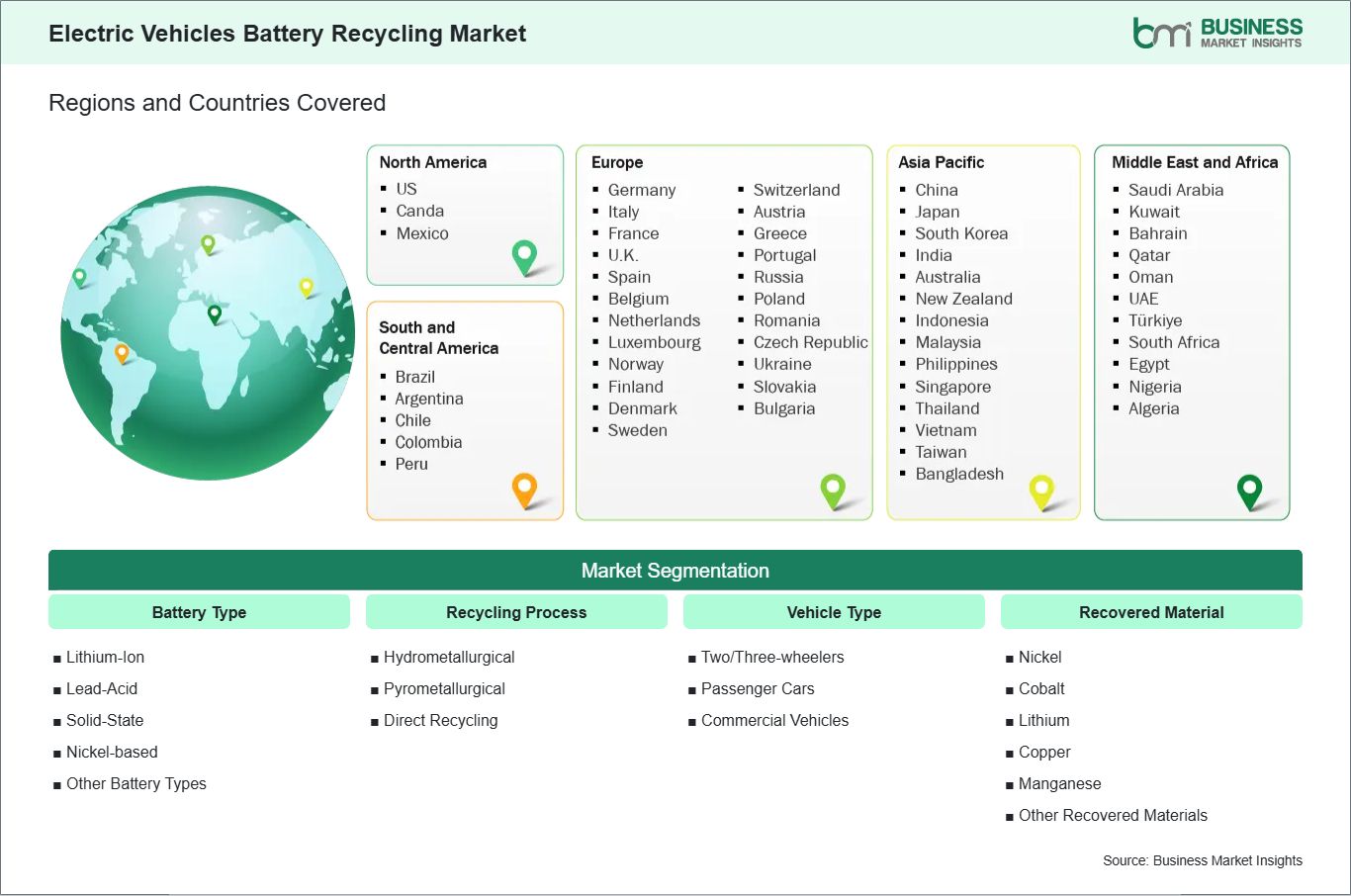
Electric Vehicles Battery Recycling Market Segmentation
The Electric Vehicles Battery Recycling market demonstrates differentiated operational priorities across battery type, processing technologies, vehicle categories, and recovered material.
By Battery Type
- Lithium-Ion – Dominates recycling activity due to extensive electric vehicle deployment.
- Lead-Acid – Maintains stable recovery infrastructure with established processing systems.
- Solid-State – Emerging recycling focus aligned with next-generation battery commercialization.
- Nickel-based – Supports industrial applications requiring specialized metal extraction methods.
- Other Battery Types – Includes niche chemistries with limited but evolving recycling demand.
By the Recycling Process
- Hydrometallurgical – Enhances metal recovery precision through chemical separation techniques.
- Pyrometallurgical – Handles mixed battery waste streams using high-temperature treatment.
- Direct Recycling – Preserves cathode structure for improved material reutilization efficiency.
By Vehicle Type
- Two/Three-wheelers – Generates rising recycling volumes across urban mobility applications.
- Passenger Cars – Contributes substantial end-of-life battery processing requirements.
- Commercial Vehicles – Requires large-capacity battery dismantling and material recovery operations.
By Recovered Material
- Nickel – Supports cathode manufacturing and industrial alloy applications.
- Cobalt – Retains strong strategic importance within battery supply chains.
- Lithium – Encourages closed-loop recovery initiatives among battery manufacturers.
- Copper – Recovered from wiring and conductive battery components.
- Manganese – Gains relevance with evolving cathode chemistry preferences.
- Other Recovered Materials – Includes aluminum, graphite, plastics, and secondary compounds.
Market Forces
Electric Vehicles Battery Recycling Market Drivers and Opportunities
Expansion of Electric Vehicle Production and Battery Disposal Volumes
The quick shift towards electric transportation has resulted in more lithium-ion battery systems in global car markets. As older electric vehicles reach their replacement dates, recycling facilities are receiving more end-of-life battery packs that need organized material recovery processes. Regulations focused on sustainable battery disposal are encouraging industries to depend more on efficient recycling systems. This change impacts how battery makers and automotive suppliers get raw materials. Using recovered metals reduces the need for newly mined resources and helps ensure a steady supply for large-scale battery production. Recycling networks also assist governments with environmental issues related to hazardous battery waste and disposal in landfills.
Advancement of Closed-Loop Battery Material Recovery Systems
Battery manufacturers are increasingly exploring closed-loop recycling models that return recovered metals to new battery production. Innovations in direct recycling and automated disassembly systems allow for better preservation of battery-grade materials during extraction. These advancements create opportunities to improve efficiency and reduce material processing losses. Future growth relies on local recycling infrastructure and partnerships between car manufacturers and recycling companies. Regional processing centers can shorten transportation distances and help achieve domestic material security goals. As battery chemistries evolve, improved recovery technologies may make it easier to extract higher-purity materials from complex battery types.
Size and Share Analysis
Electric Vehicles Battery Recycling Market Size and Share Analysis
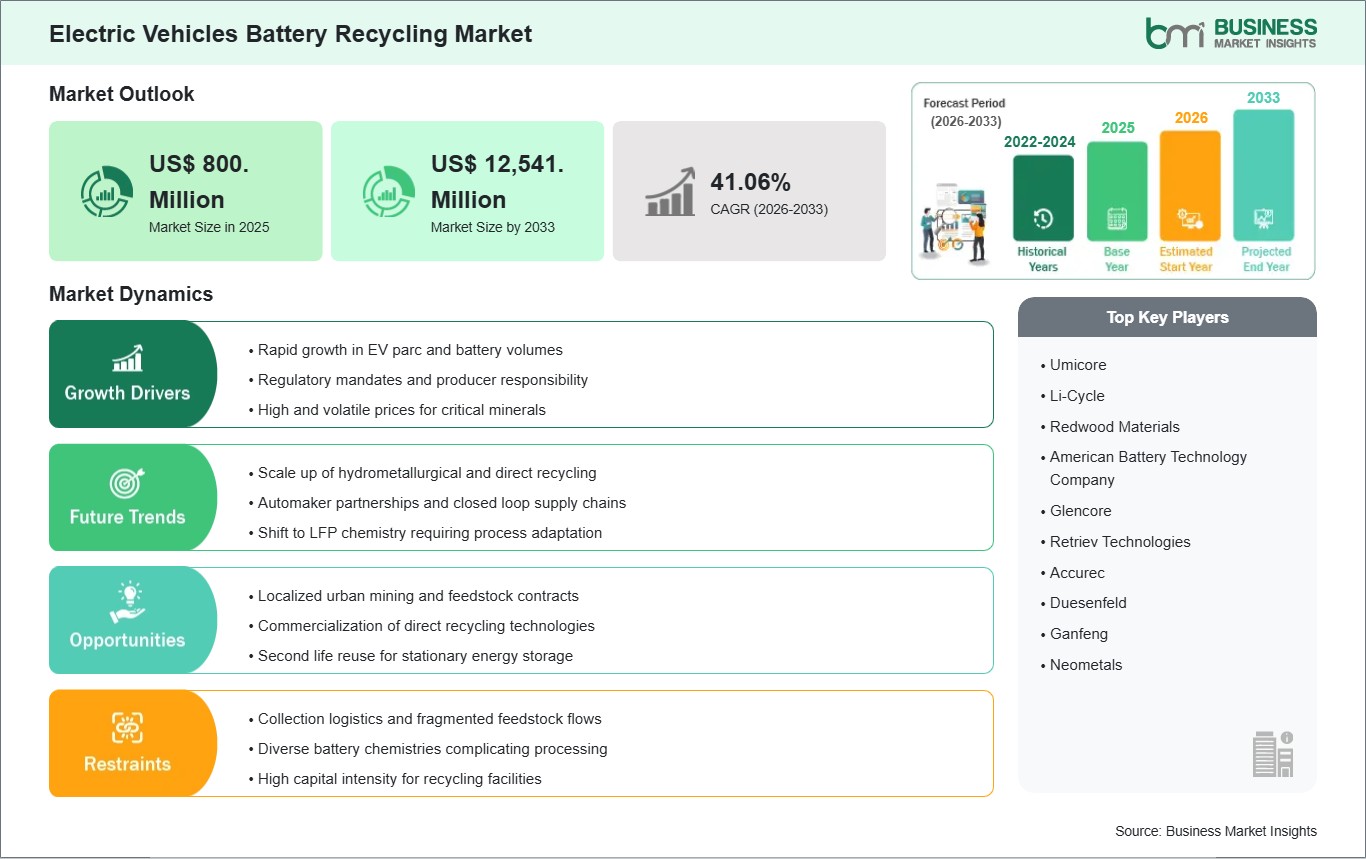
The Electric Vehicles Battery Recycling Market is projected to grow from US$ 800.0 Million in 2025 to US$ 12,541.0 Million by 2033 , registering a CAGR of 41.06% from 2026 to 2033. Industry expansion reflects strengthening investment in battery collection infrastructure, material recovery technologies, and reverse logistics capabilities supporting electric mobility supply chains.
Lithium-ion batteries account for substantial recycling activity due to their extensive utilization across modern electric vehicle platforms. Hydrometallurgical processing maintains a notable commercial preference because of its capability to recover high-value materials with improved extraction efficiency and lower contamination levels during processing operations.
Passenger cars represent a major application segment within recycling networks as electric vehicle ownership expands across metropolitan transportation systems. Recovery demand for cobalt, lithium, nickel, and copper remains commercially significant because these materials support battery manufacturing continuity and long-term raw material availability strategies.
Report Coverage
Electric Vehicles Battery Recycling Market Report Coverage and Deliverables
The " Electric Vehicles Battery Recycling Market Size and Forecast (2022-2033)" report provides a detailed analysis of the market covering below areas:
- Market size and forecast at global, regional, and country levels for all market segments covered under the scope
- Market trends, as well as drivers, restraints, and opportunities
- Market analysis covering key trends, global and regional framework, major players, regulations, and recent developments
- Industry landscape and competition analysis covering market concentration, heat map analysis, prominent players, and recent developments for the Electric Vehicles Battery Recycling market
- Detailed company profiles, including SWOT analysis
Geographic Insights
Electric Vehicles Battery Recycling Market Geographic Insights
The Electric Vehicles Battery Recycling market shows diverse regional adoption patterns influenced by industrial electrification priorities, environmental regulations, material recovery infrastructure, and automotive manufacturing concentration. Governments and private operators are strengthening battery collection systems to manage rising end-of-life battery volumes. Regional policy frameworks increasingly emphasize circular economy objectives and localized sourcing strategies for critical battery materials.
North America is seeing strong operational activity due to growth in electric vehicle manufacturing and investments in battery processing facilities. Recycling operators are improving material recovery to support local battery supply chains and lessen dependence on imported raw materials. Collaboration among automotive manufacturers, recyclers, and technology developers is encouraging effective battery lifecycle management.
Asia Pacific continues to do well because of high levels of electric vehicle production and significant battery manufacturing capacity. Countries in this region are creating recycling regulations and expanding processing infrastructure to secure a long-term supply of essential materials. The electrification of urban transportation and the rising use of two- and three-wheel electric vehicles are boosting the demand for battery recycling.
Europe is focusing on sustainable battery management through strict environmental rules and policies that promote circular material use. Manufacturers in the region are strengthening closed-loop recovery systems to help reduce carbon and improve supply chain resilience. Emerging markets in the Middle East, Africa, and South and Central America are slowly building battery recycling networks while also adopting electric mobility and upgrading infrastructure.
Industry Activity
Recent Developments
The Electric Vehicles Battery Recycling market is evaluated by gathering qualitative and quantitative data post-primary and secondary research, which includes important corporate publications, association data, and databases. A few of the key developments in the Electric Vehicles Battery Recycling market are:
- In March 2026, Tozero opened its first industrial demonstration plant for battery recycling in Bavaria, Germany. Built in six months, the facility can process more than 1,600 tons of battery scrap each year. It turns end-of-life batteries into lithium, graphite, and a nickel-cobalt mix. Using a special acid-free hydrometallurgical process, Tozero says that recycling happens in one cycle, producing high-purity lithium carbonate and other materials ready for manufacturing.
- In May 2026, India and the EU started a project worth US$ 17.47 million (RS 169 Crore) to improve recycling technologies for electric vehicle batteries. This partnership focuses on recovering critical minerals and supporting a circular economy. It is part of their work under the India-EU Trade and Technology Council to strengthen critical mineral supply chains.
Trust & Transparency
Research Methodology
The market analysis combines proprietary research with secondary data from government agencies, company disclosures, regulatory filings, industry databases and expert interviews. Market estimates are validated through data triangulation, cross-market benchmarking and analyst
review.
View Full Research Methodology
Key Sources Referred:
European Commission US Department of Energy International Energy Agency Company Websites Company Annual Reports Company Investor Presentations