
Snake Robots Market Outlook: Size, Share, Trends, Growth Analysis, Competitive Landscape & Forecast, 2026-2033

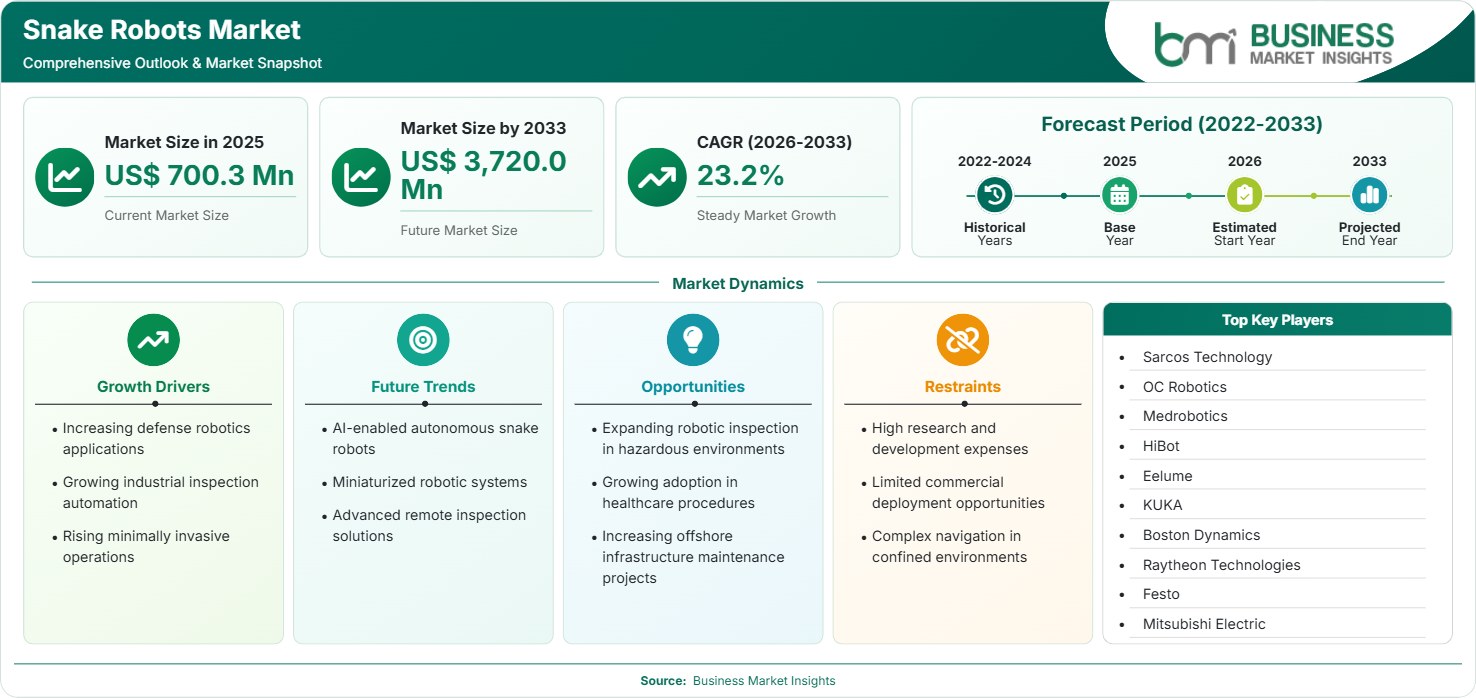
The Snake Robots Market size was valued at US$ 700.3 Million in 2025 and is projected to reach US$ 3,720.0 Million by 2033, growing at a CAGR of 23.22% from 2026 to 2033, driven by defense robotics adoption, industrial inspection automation, minimally invasive procedures, hazardous environment operations, and advanced robotic engineering developments.

Report Coverage
  • Application: Nuclear Decommissioning, Maintenance, Monitoring & Surveillance, Rescue Operations, Surgeries, Others
  • Industry: Healthcare, Defence, Automotive, Aviation, Others
US$ 700.3 Mn Market size in 2025
US$ 3,720.0 Mn Market Size by 2033
23.2% CAGR, 2026 - 2033
2026-2033 Forecast Period

01 AI Overview

Snake Robots Market Summary

  • North America Region: North America holds market share of 38%–41% in 2025, growing with a CAGR of 21%–23% influenced by defense modernization, medical robotics investments, industrial automation, and advanced research programs. The US market expands with CAGR of 21%–23% during 2026–2033 supported by military robotics initiatives, healthcare innovation, and inspection automation demand.
  • Fastest Growing Region: Asia Pacific represents a share range of 24%–27% in 2025, expanding with a CAGR of 25%–27% driven by industrial automation, healthcare technology adoption, infrastructure development, and increasing investments in robotics research across emerging economies.
  • Leading Segment: Monitoring & Surveillance represents the leading application segment with a share range of 28%–31% in 2025, growing at a CAGR of 22%–24% due to demand for remote inspection, defense monitoring, and industrial safety applications.
  • High Growth Segment: Surgeries demonstrate a share range of 12%–15% in 2025, expanding at a CAGR of 26%–28% due to increasing minimally invasive procedures, precision medicine adoption, and advancements in surgical robotics.
  • Key Market Opportunity: Opportunities are concentrated in hazardous environment inspection, medical robotics, offshore infrastructure monitoring, defense applications, and advanced automation solutions requiring flexible robotic systems.
  • Major Market Players: Sarcos Technology, OC Robotics, Medrobotics, HiBot, Eelume, KUKA, Boston Dynamics, Raytheon Technologies, Festo, Mitsubishi Electric.
02 Strategic Insights

Snake Robots Market: Strategic Insights

Snake Robots Market Strategic Framework
FREE PDF
Request your free sample
Request free sample
03 Stakeholder View

Key Takeaways

  • The robotics ecosystem is shifting toward specialized flexible systems capable of performing tasks in restricted, hazardous, and complex operating environments.
  • Healthcare, defense, and industrial inspection applications represent major growth opportunities as organizations seek safer and more efficient alternatives to manual operations.
  • Innovation priorities are focused on autonomous navigation, artificial intelligence integration, advanced sensors, and improved mechanical flexibility for diverse applications.
  • Asia Pacific provides a strong investment opportunity due to expanding industrial automation, healthcare modernization, and increasing robotics research activities.
  • Strategic collaborations between robotics companies, defense organizations, healthcare providers, and industrial operators are shaping commercialization pathways.
04 Geographic Outlook

Snake Robots Market Regional Highlights

North America Snake Robots Market

North America accounted for a share range of 38%–41% in 2025 and is projected to grow at a CAGR of 21%–23% during 2026–2033. The region maintains leadership due to strong defense spending, advanced healthcare systems, industrial automation adoption, and extensive robotics research capabilities. The Snake Robots Market share in North America is supported by investments in specialized robotic technologies and high-value applications.

  • The United States remains the largest regional contributor due to defense robotics programs, medical innovation, and industrial inspection requirements.
  • Healthcare institutions are increasingly exploring robotic technologies for precision procedures and minimally invasive surgical applications.
  • Industrial companies are adopting robotic inspection systems to improve safety and reduce human exposure to hazardous environments.
  • Research institutions continue developing advanced robotic platforms through collaborations with technology companies and government agencies.

US Snake Robots Market

The US represented a share range of 33%–36% in 2025 and is expected to expand at a CAGR of 21%–23% between 2026–2033. The country remains a major market due to defense technology investments, advanced healthcare infrastructure, and industrial automation initiatives. Demand is supported by applications requiring flexible robotic movement, remote operation, and improved operational safety.

  • Defense organizations are evaluating advanced robotic systems for reconnaissance, inspection, and operations in challenging environments.
  • Hospitals and research centers are increasing investment in robotic-assisted procedures requiring enhanced precision and flexibility.
  • Energy and infrastructure companies are adopting robotic inspection technologies to reduce operational risks.
  • Technology companies are developing artificial intelligence-enabled robotic platforms for specialized applications.

Europe Snake Robots Market

Europe held a share range of 27%–30% in 2025, growing at a CAGR of 22%–24% during 2026–2033. The region benefits from strong engineering capabilities, healthcare technology adoption, and industrial automation initiatives. Germany, the United Kingdom, and France represent leading markets, while Nordic countries demonstrate opportunities through offshore infrastructure maintenance and advanced robotics research.

  • Germany supports market expansion through industrial automation expertise and advanced manufacturing capabilities.
  • The United Kingdom is developing robotics applications across healthcare, defense, and infrastructure inspection sectors.
  • France is investing in medical robotics and industrial automation technologies supporting specialized applications.
  • European research institutions continue advancing flexible robotic designs and autonomous operating capabilities.

Asia Pacific Snake Robots Market

Asia Pacific accounted for a share range of 24%–27% in 2025 and is expanding at a CAGR of 25%–27% during 2026–2033. The region represents the fastest-growing market due to increasing industrial automation, healthcare technology adoption, defense modernization, and infrastructure development. China, Japan, South Korea, and India are driving regional expansion through robotics research, manufacturing capabilities, and advanced automation investments.

  • China is expanding robotics adoption through industrial automation programs, manufacturing modernization, and investments in advanced robotic technologies.
  • Japan continues strengthening its robotics ecosystem through healthcare robotics development, industrial automation expertise, and precision engineering capabilities.
  • South Korea is increasing adoption of robotic solutions across manufacturing, defense, and smart infrastructure applications.
  • India is developing robotics capabilities through technology investments, healthcare innovation, and industrial modernization initiatives.

Rest of World Snake Robots Market

Rest of World represented a share range of 6%–9% in 2025, growing at a CAGR of 22%–24% during 2026–2033. Latin America, the Middle East, and Africa are adopting specialized robotic systems through infrastructure development, defense modernization, and industrial safety requirements. Brazil, Saudi Arabia, and the UAE are emerging markets supported by energy projects and automation initiatives.

  • Brazil is adopting robotic inspection solutions across industrial facilities, energy infrastructure, and specialized maintenance operations.
  • Middle Eastern countries are investing in advanced robotics for oil and gas inspection, defense applications, and infrastructure management.
  • The UAE is supporting robotics adoption through technology-focused development programs and smart infrastructure initiatives.
  • African markets are gradually exploring robotic technologies for mining, infrastructure inspection, and hazardous operational environments.
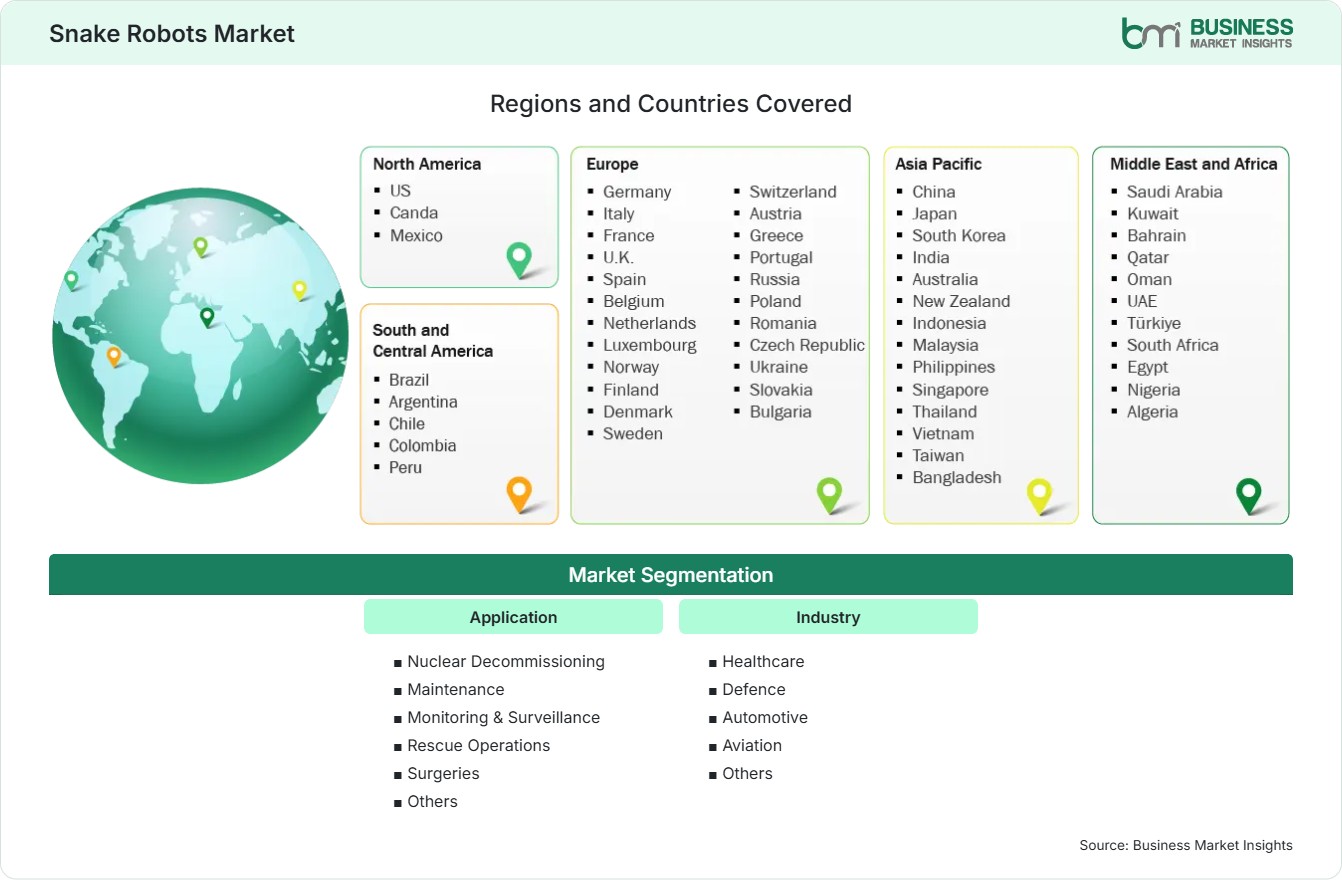
Global Market Geography
FREE PDF
Request your free sample
Request free sample
05 Segment Analysis

Snake Robots Market Segmentation

Application

The application segment is driven by increasing demand for flexible robotic systems across specialized environments requiring precision, mobility, and safety. Monitoring & Surveillance represented the leading application with a share range of 28%–31% in 2025 and CAGR of 22%–24% between 2026–2034. The Snake Robots Market scope is expanding through defense, healthcare, infrastructure, and industrial inspection applications.

  • Nuclear Decommissioning: Snake robots support nuclear facility inspection and dismantling activities by accessing confined areas while reducing human exposure to hazardous radiation environments.
  • Maintenance: Maintenance applications are increasing as industries adopt robotic systems for equipment inspection, repair assistance, and preventive monitoring in complex operational environments.
  • Monitoring & Surveillance: Monitoring and surveillance applications benefit from robotic mobility, remote operation capabilities, and advanced sensors used in defense, industrial, and infrastructure environments.
  • Rescue Operations: Rescue operations utilize flexible robots for accessing dangerous locations, supporting emergency response teams, and improving safety during disaster recovery activities.
  • Surgeries: Surgical applications are expanding through robotic-assisted procedures requiring enhanced precision, flexibility, and minimally invasive operating capabilities.

Industry

The industry segment demonstrates increasing adoption across healthcare, defense, automotive, aviation, and other sectors requiring specialized robotic capabilities. Healthcare applications are gaining momentum due to minimally invasive procedures and surgical innovation, while defense and industrial sectors utilize snake robots for inspection and operational safety. The Snake Robots Market trends indicate growing diversification across commercial and mission-critical applications.

  • Healthcare: Healthcare organizations are adopting robotic systems for minimally invasive surgeries, precision procedures, and advanced medical technology applications.
  • Defence: Defense applications involve reconnaissance, surveillance, hazardous environment operations, and specialized missions requiring adaptable robotic mobility.
  • Automotive: Automotive manufacturers utilize robotic technologies for inspection, automation support, and advanced production processes.
  • Aviation: Aviation companies deploy robotic systems for aircraft inspection, maintenance activities, and safety improvement initiatives.
06 Market Forces

Snake Robots Market Dynamics

Key Market Drivers

Increasing Defense Robotics Applications

Defense organizations are increasing investments in advanced robotic systems capable of operating in complex and hazardous environments. The Snake Robots Market growth is supported by military requirements for surveillance, reconnaissance, inspection, and tactical support applications. The ability of the robots to adapt their designs makes them accessible to restricted places and safer for the people since robots minimize any risk due to human involvement in such dangerous situations. Governments of all over the world encourage the use of autonomous and remote robots to increase the defense capabilities of nations. Robots have become more efficient due to advancement in sensors, communications, and artificial intelligence.

Growing Industrial Inspection Automation

Industrial inspection automation is accelerating as companies seek safer and more efficient methods for monitoring infrastructure, machinery, and critical assets. The Snake Robots Market trends reflect increasing adoption of robotic inspection systems in industries where confined spaces, hazardous conditions, and complex structures create operational challenges. The energy, manufacturing, and infrastructure industries are employing adaptive robots to enhance maintenance efficiency and minimize downtime. This is done through the incorporation of remote monitoring features that use built-in cameras, sensors, and data analytic abilities. With the growing automation in industrial plants, the need for inspection tools grows continually.

Rising Minimally Invasive Operations

The development of minimally invasive medical procedures has led to a need for sophisticated robotic technology that can operate accurately inside intricate body cavities. The snake-like robotic design offers more maneuverability than the traditional surgical tools. These techniques are being investigated by healthcare providers to ensure surgical accuracy and shortened recovery periods. Robotic-assisted surgery platforms featuring improved control mechanisms and image capturing technologies have been attracting research investment from various organizations in the fields of research and medical technology. The current trend in health care innovation and demand for accuracy in procedures has facilitated the development of the new generation of surgical robots.

Key Market Opportunities

Expanding Robotic Inspection in Hazardous Environments

Environmental hazard inspection is a potential field because there is the need for safe solutions to inspect hazardous areas. There is increased demand for robotic solutions in industries where there are energy power stations, nuclear plants, oil platforms, and industries that work in tough environmental conditions. Robotic snakes are capable of going into small confined areas and offer real-time information using sensors and cameras. Increasing focus on workplace safety and operational efficiency is encouraging industries to adopt advanced inspection technologies. Expansion of infrastructure projects worldwide is expected to strengthen snake robots market forecasts.

Growing Adoption in Healthcare Procedures

The implementation of healthcare offers chances as hospitals look for highly advanced robotic technology that is needed in their precise and minimally invasive procedures. There are robotic systems that can help hospitals make use of surgical techniques since they will provide more maneuvering ability. The increased spending on research of medical robots motivates companies to develop advanced robotic systems that are suited for special surgical cases. Robotic-assisted surgeries have been adopted by hospitals and surgical centers with an aim of improving efficiency and patient outcomes. It can be beneficial for those who focus on developing medical robotic applications.

Increasing Offshore Infrastructure Maintenance Projects

There are plenty of growth prospects in offshore facility maintenance owing to rising demands for inspections and repairs of structures under water and in hard-to-reach places. There is a need for robotics that can help carry out maintenance activities in harsh conditions on behalf of energy companies running their facilities offshore. Expansion of offshore energy projects and aging infrastructure assets is increasing demand for reliable robotic maintenance solutions. Technology providers investing in durable designs, autonomous navigation, and remote operation capabilities can address growing industry needs. The adoption of robotic maintenance solutions can improve safety and reduce operational disruptions.

Market Restraints and Challenges

High Research and Development Expenses

Factor: Advanced robotic development requires substantial investment in engineering, artificial intelligence, sensor technologies, materials research, and testing processes.

Impact: High research and development expenses can slow commercialization timelines and limit participation from smaller technology companies. Snake robots require complex mechanical designs, advanced control systems, and reliable operational capabilities to function effectively across specialized applications. Continuous innovation is necessary to improve mobility, autonomy, durability, and safety performance. Companies must balance research investment with commercial scalability to achieve sustainable growth. Limited access to funding and lengthy development cycles may affect the speed of product advancement across emerging robotics applications.

Limited Commercial Deployment Opportunities

Factor: Limited large-scale commercial adoption across industries creates challenges due to specialized application requirements and restricted deployment environments.

Impact: Lower market penetration can affect production volumes, profitability, and return on investment for robotics manufacturers. Many snake robot applications remain concentrated in research, defense, healthcare, and niche industrial environments requiring customized solutions. Organizations may hesitate to adopt these technologies due to integration complexity, operational training needs, and uncertain economic benefits. Manufacturers are addressing this challenge by improving affordability, expanding application areas, and developing versatile robotic platforms. Wider commercialization will depend on successful demonstrations, regulatory approvals, and increased awareness among potential users.

07 Company Analysis

Competitive Landscape

The Snake Robots Market analysis highlights a competitive environment influenced by robotic innovation, application-specific engineering, automation capabilities, and strategic partnerships. Leading companies are focusing on flexible robotic designs, artificial intelligence integration, healthcare applications, defense solutions, and industrial inspection technologies to expand commercial opportunities.

Company Name

Overview

Products and Services relevant to this market

Sarcos Technology

Robotics technology company developing advanced mobile robotic systems.

Flexible robotic platforms, industrial robotics, remote operation technologies.

OC Robotics

Robotics company specializing in snake-arm robotic systems.

Snake-arm robots, industrial inspection solutions, maintenance robotics.

Medrobotics

Medical technology company focused on flexible surgical robotics.

Flexible surgical robots, minimally invasive procedure technologies.

HiBot

Robotics company developing flexible and inspection robotic systems.

Snake robots, pipe inspection systems, robotic solutions.

Eelume

Underwater robotics company focused on autonomous inspection systems.

Underwater snake robots, offshore inspection, subsea maintenance solutions.

KUKA

Global automation company providing industrial robotic solutions.

Industrial robots, automation systems, robotic integration technologies.

Boston Dynamics

Robotics company developing advanced mobile robotic platforms.

Autonomous robots, robotic mobility systems, inspection solutions.

Raytheon Technologies

Aerospace and defense technology company providing advanced systems.

Defense robotics technologies, autonomous systems, surveillance solutions.

Festo

Automation technology company specializing in industrial solutions.

Robotics, automation systems, intelligent motion technologies.

Mitsubishi Electric

Technology company providing automation and industrial equipment solutions.

Industrial automation, robotic systems, control technologies.

08 Industry Activity

Recent Developments

February 2026

Tokyo Electric Power Company (TEPCO) unveiled a snake-like robotic arm designed for inspection and debris removal operations at the Fukushima Daiichi nuclear power plant. The 22-meter robotic system is being used to support remote handling and investigation in highly hazardous environments.

December 2024

RoBoa (ETH Zurich spin-off) won the Swiss Technology Award 2024 for its snake-like robot technology, recognizing the potential of the system for industrial inspection and search-and-rescue applications and supporting its commercialization pathway.

November 2024

ETH Zurich the university’s Autonomous Systems Lab announced the development of RoBoa, a snake-like robot designed for search-and-rescue operations and industrial inspection. The robot can extend up to 100 meters, navigate narrow spaces such as pipes and debris areas, and is being advanced toward market readiness through commercialization efforts.

July 2024

DTech (IIT Delhi technology initiative) the company/research team showcased COBRA, a snake-like search-and-rescue robot designed for challenging environments, highlighting applications in disaster response and exploration where conventional robots may have limited access.

10 Trust & Transparency

Research Methodology

The market analysis combines proprietary research with secondary data from government agencies, company disclosures, regulatory filings, industry databases and expert interviews. Market estimates are validated through data triangulation, cross-market benchmarking and analyst review.

View Full Research Methodology

11 Questions Answered

Frequently Asked Questions

How does the Snake Robots Market Report help businesses?

The market report provides insights into technology trends, competitive positioning, regional opportunities, application growth areas, and investment considerations.

What factors limit widespread snake robot adoption?

High development costs, limited commercial deployment, application-specific requirements, and integration challenges can restrict broader adoption across industries.

How is healthcare influencing snake robot development?

Healthcare is supporting innovation through demand for minimally invasive procedures, surgical precision, and flexible robotic systems capable of operating in complex anatomical areas.

Why are snake robots useful for hazardous environments?

Snake robots can navigate confined spaces, provide remote inspection capabilities, and reduce human exposure to dangerous conditions in industrial and infrastructure applications.

What industries are driving demand for snake robots market?

Defense, healthcare, automotive, aviation, energy, and industrial inspection sectors are driving adoption due to requirements for flexible robotics in complex and hazardous environments.

Access the Full Snake Robots Market Report

Get segment-level forecasts, regional estimates, competitive benchmarking, company profiles and downloadable Excel datasets.

Access the full Snake Robots Market Report
350 pages PDF & Excel | 2026-07-30