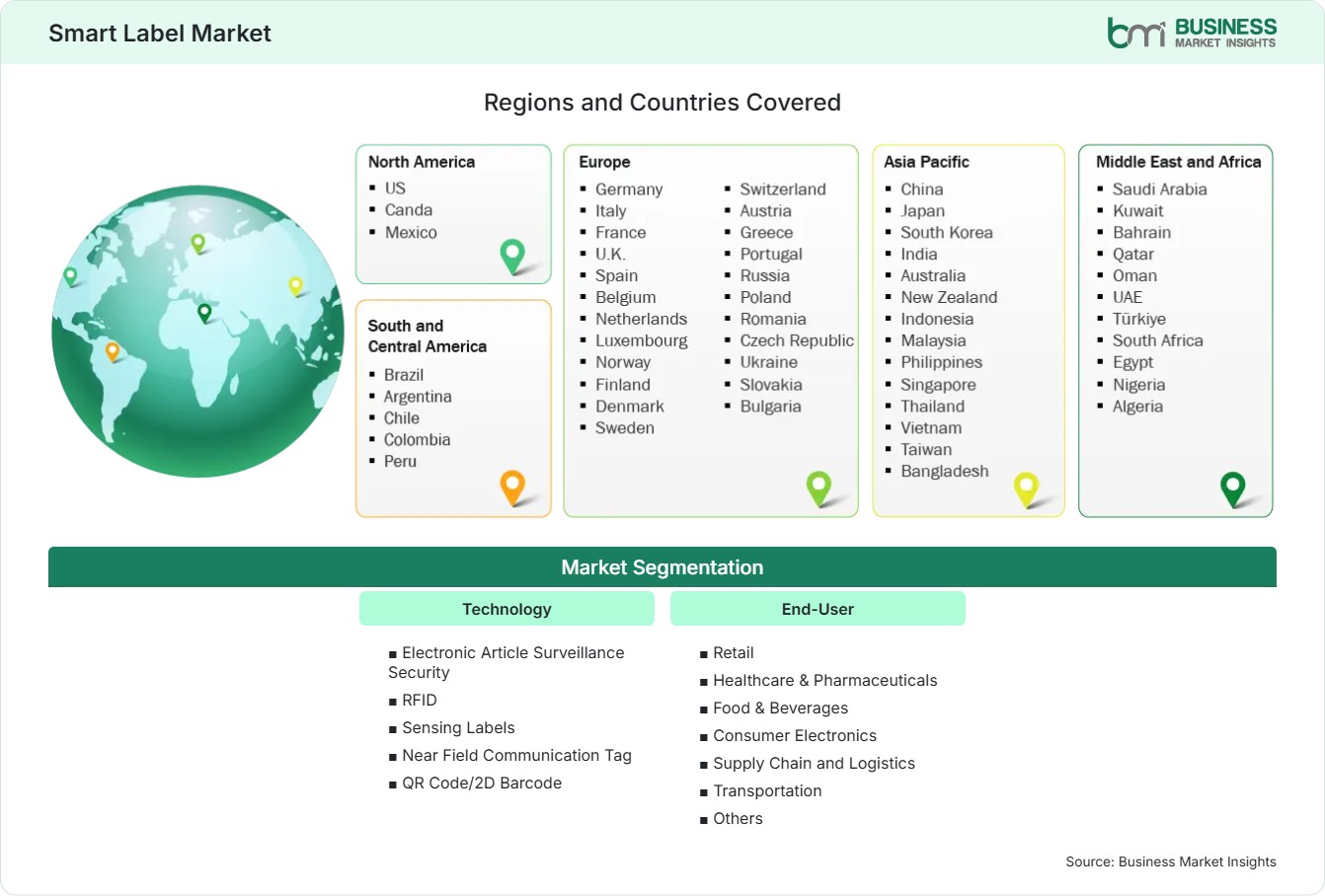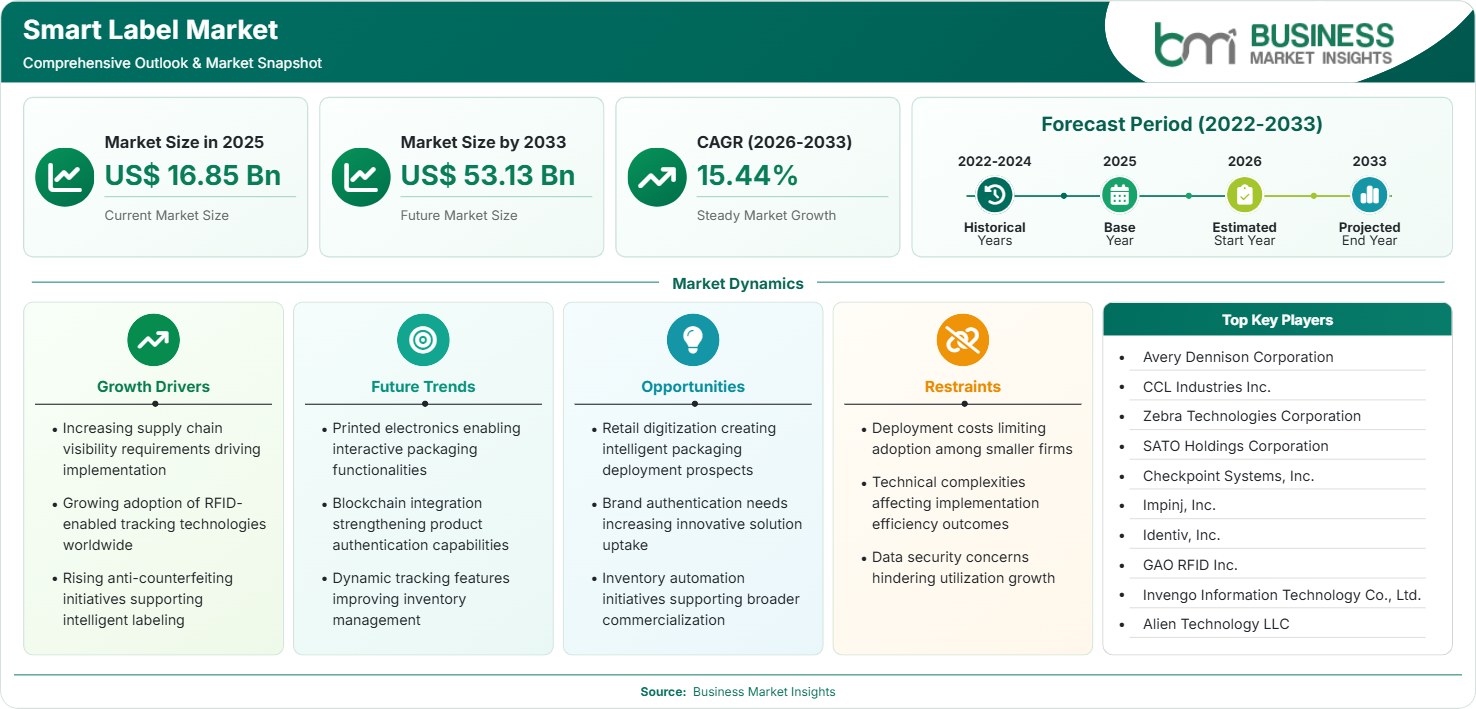
Smart Label Market Regional Highlights
North America Smart Label Market
North America accounted for approximately 34%–37% of global Smart Label Market revenue in 2025 and is projected to expand at a 13.8%–14.6% CAGR through 2033. High adoption levels by retailers, hospitals, logistics centers, and consumer products continue to ensure regional dominance. Large-scale RFID adoption by retailers and logistics centers is making sure that there is improved visibility in inventory management and reduced discrepancies.
- The major retailers are still putting into practice inventory management systems equipped with RFID to improve the accuracy of order fulfillment, increase their awareness of stock levels, and enhance their omnichannel operations, at the same time allowing for scalable deployment in both distribution and retail environments.
- Pharmaceutical companies are now using intelligent identification technologies more to comply with serialization requirements and to improve the authentication of their products throughout complex supply chains.
- The pace at which money is being invested in warehouse automation is increasing its use throughout logistics networks, which in turn enables real-time tracking, greater operational transparency, and improved accuracy of shipments in distribution hubs.
- Sustainability initiatives are promoting the development of intelligent packaging solutions that can be recycled, opening up possibilities for new materials and more environmentally aware product designs.
US Smart Label Market
The United States represented approximately 78%–82% of North American revenue in 2025 and is expected to register a 14.0%–14.8% CAGR through 2033. Rising investments in supply-chain resilience and enterprise digitization are also sustaining demand. Smart Label Market share remains particularly strong across retail distribution networks, where inventory accuracy and fulfillment speed have become important competitive differentiators.
- Retail chains are still extending their RFID programs from clothing into the areas of groceries, consumer electronics, and general merchandise, thus promoting wider acceptance in various retail categories.
- Healthcare providers are now combining connected identification systems with inventory management software to enhance pharmaceutical tracking and ensure regulatory compliance.
- The growth of e-commerce is aiding the expansion of fulfillment centers as companies aim to improve their shipment visibility and reduce operational inefficiencies.
- Technology providers are still launching cloud-connected platforms to enhance their capabilities in the areas of data analytics, asset management, and operational intelligence.
Europe Smart Label Market
Europe held approximately 27%–30% of the global Smart Label Market revenue during 2025 and is forecast to grow at a 14.2%–15.2% CAGR through 2033. This regulatory focus on traceability, sustainability, and consumer transparency ensures good adoption in the region. The top market is Germany due to the presence of a manufacturing sector and the high industrial automation capability. Eastern Europe has been growing rapidly.
- German manufacturers are now incorporating identification technologies into their Industry 4.0 initiatives to enhance production visibility and inventory performance.
- France and the United Kingdom are still expanding the use of intelligent packaging in their food, beverage, and healthcare supply chains.
- The regulations concerning sustainability are promoting investments in packaging formats that are recyclable and have the capability of engaging consumers digitally.
- In central and eastern Europe, there is an increasing number of deployments as logistics modernization and retail investments speed up the implementation of technology.
Asia Pacific Smart Label Market
Asia Pacific accounted for approximately 26%–29% of industry revenue in 2025 and is expected to achieve the fastest expansion with a 17.8%–18.8% CAGR through 2033. Industrialization, growth in organized retailing, and electronics manufacturing are leading to increased adoption in the region. China is the biggest market for the region, whereas India shows the greatest momentum in terms of growth. Smart Label Market growth is even more enhanced by digital transformation initiatives, export-oriented value chains, and growing investment in automated warehouses and intelligent logistics infrastructure in emerging markets.
- Chinese manufacturers are now adopting RFID-equipped systems to improve the efficiency of their export supply chains and to enhance the accuracy of their inventory management.
- India is gaining from the formalisation of retail, the expansion of digital commerce, and greater investments in logistics modernization initiatives.
- Japan and South Korea are still promoting innovation by means of advanced electronics manufacturing and through developments in intelligent packaging.
- The increasing awareness of food safety is leading to greater use of traceability technologies in both agricultural and packaged food supply chains.
- The growth in cross-border trade is increasing the need for better shipment monitoring and product authentication facilities.
Rest of World Smart Label Market
The Rest of World region accounted for approximately 8%–10% of global Smart Label Market revenue in 2025 and is anticipated to grow at a 15.0%–16.0% CAGR through 2033. Retail modernization and export of agricultural products are aiding South and Central American nations, with Brazil leading the pack in terms of contribution within the region.
In the Middle East and Africa, logistics development, the development of the pharmaceutical industry, and smart cities are aiding in driving the process. Currently, the United Arab Emirates is one of the fastest-growing nations in terms of momentum due to digital trade logistics infrastructure development.
- Brazil is still working to improve the systems it has for tracing products in its exports of food, in the distribution of healthcare products, and in its retail supply chains.
- The Gulf countries are now using intelligent logistics technologies to back their strategies aimed at trade diversification and the development of e-commerce.
- The increasing level of activity in the manufacture of pharmaceuticals is leading healthcare networks to adopt authentication and serialization solutions.
- The modernization of the infrastructure is leading to more opportunities for deployment in the areas of transportation, warehousing, and the industrial supply chain.