
Smart Building Market Size, Share, Trends & Forecast Report, 2026–2033

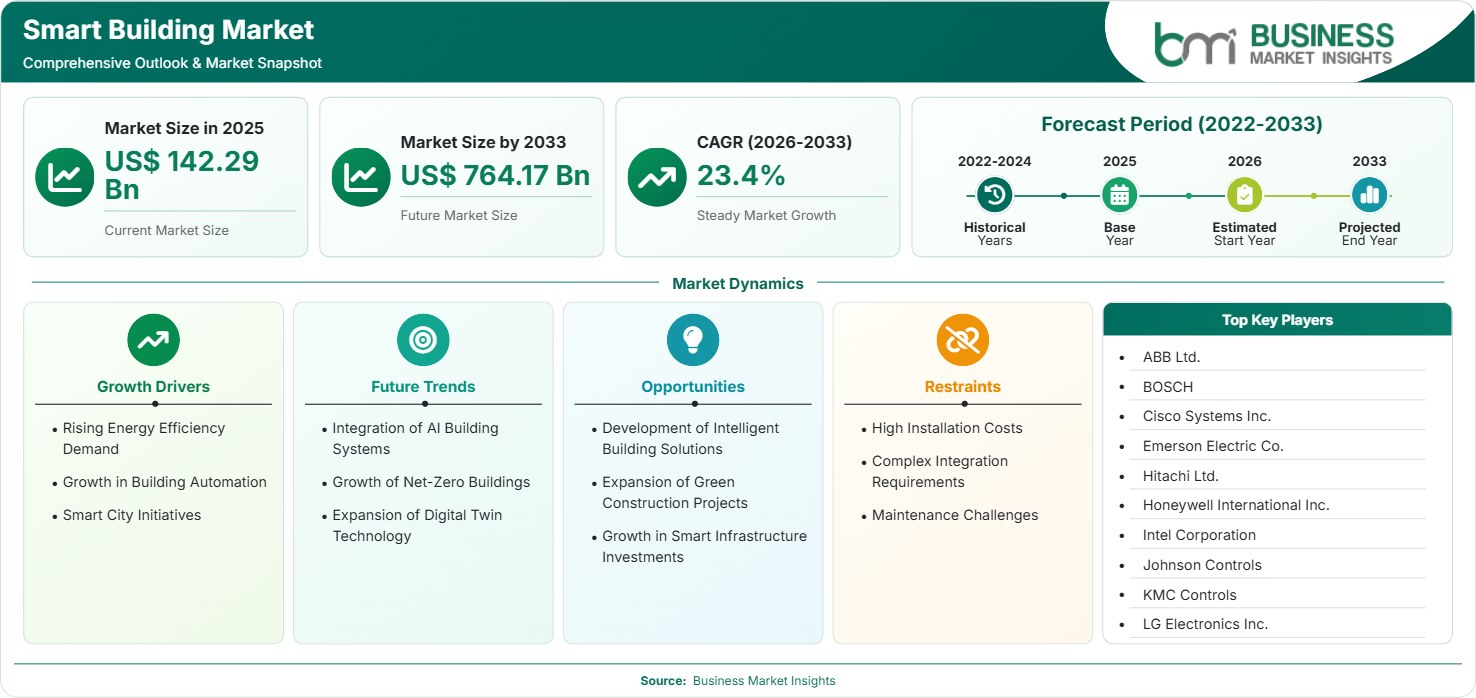
The Smart Building Market size was valued at US$ 142.29 Billion in 2025 and is projected to reach US$ 764.17 Billion by 2033, growing at a CAGR of 23.4% during 2026–2033, driven by rising energy efficiency demand, building automation adoption, smart city initiatives, intelligent building solutions, green construction projects, and smart infrastructure investments.

Report Coverage
  • Component: Solution, Services
  • Application: Residential, Commercial
US$ 142.29 Bn Market size in 2025
US$ 764.17 Bn Market Size by 2033
23.4% CAGR, 2026 - 2033
2026-2033 Forecast Period

AI Overview

Smart Building Market Summary

  • North America Region: North America holds market share of 34%–38% in 2025, growing with a CAGR of 22.8%–23.5% influenced by building automation adoption, energy optimization requirements, smart infrastructure investments, and sustainability initiatives. The US market demonstrates growth with a CAGR of 23.0%–23.7% from 2026–2033, supported by commercial building modernization, connected systems, and energy management solutions.
  • Fastest Growing Region: Asia Pacific holds market share of 27%–31% in 2025, growing with a CAGR of 24.0%–24.8% influenced by smart city development, urban expansion, green construction projects, and increasing investment in intelligent building infrastructure.
  • Leading Segment: Solution component holds market share of 68%–72% in 2025, growing with a CAGR of 23.1%–23.8% influenced by demand for energy management, security systems, building automation, and integrated infrastructure solutions.
  • High Growth Segment: Services component holds market share of 28%–32% in 2025, growing with a CAGR of 24.0%–24.7% influenced by system integration needs, deployment complexity, maintenance requirements, and customized smart building implementation.
  • Key Market Opportunity: Intelligent building solutions, green construction projects, and smart infrastructure investments create opportunities through energy optimization, automation, sustainability improvements, and connected building management systems.
  • Major Market Players: ABB Ltd., BOSCH, Cisco Systems Inc., Emerson Electric Co., Hitachi Ltd., Honeywell International Inc., Intel Corporation, Johnson Controls, KMC Controls, and LG Electronics Inc.
Strategic Insights

Smart Building Market: Strategic Insights

Smart Building Market Strategic Framework
FREE PDF
Request your free sample
Request free sample
Stakeholder View

Key Takeaways

  • The smart building ecosystem includes technology providers, automation companies, system integrators, construction firms, facility managers, and energy solution providers supporting intelligent infrastructure development.
  • Energy management systems, security solutions, and integrated automation platforms represent major growth opportunities as building owners prioritize efficiency, safety, and operational optimization.
  • Innovation is shifting toward artificial intelligence-based building management, predictive analytics, connected sensors, digital twins, and autonomous infrastructure control systems.
  • Asia Pacific offers strong investment opportunities due to urbanization, smart city programs, expanding commercial construction, and increasing focus on sustainable infrastructure development.
  • Strategic collaborations, technology partnerships, and solution integration initiatives are shaping competition as companies expand capabilities across connected building ecosystems.
  • Sustainability objectives and regulatory efficiency requirements are becoming important market factors, encouraging adoption of intelligent systems that reduce energy consumption and improve building performance.
Geographic Outlook

Smart Building Market Regional Highlights

North America Smart Building Market

North America Smart Building Market share accounted for a 34%–38% in 2025 and is projected to expand at a CAGR of 22.8%–23.5% during 2026–2033. The region maintains leadership due to advanced commercial infrastructure, energy efficiency regulations, smart technology adoption, and the modernization of existing buildings. The US and Canada represent major markets, supported by building automation investments, sustainability targets, and increasing deployment of integrated management systems across commercial facilities.

  • Commercial buildings are adopting automation systems to improve energy efficiency and operational performance.
  • Smart HVAC and lighting solutions are expanding through sustainability-focused building upgrades.
  • Facility managers are investing in connected monitoring systems for improved asset management.
  • Government efficiency initiatives are supporting intelligent building technology adoption.
  • Cloud-based building management platforms are gaining acceptance among large property operators.

US Smart Building Market

The US market represented a 30%–34% share in 2025 and is estimated to grow at a CAGR of 23.0%–23.7% between 2026 and 2033. The country remains a leading contributor due to strong commercial construction activity, advanced technology infrastructure, and increasing demand for energy-efficient buildings. Organizations are deploying connected solutions to reduce costs and improve facility management capabilities.

  • Commercial property owners are adopting smart systems for energy optimization and automation.
  • Building automation investments are increasing across offices, retail facilities, and campuses.
  • Security and access control solutions are expanding through connected infrastructure upgrades.
  • Smart building platforms are integrating analytics for predictive facility management.

Europe Smart Building Market

Europe market held a 24%–28% share in 2025 and is forecast to register a CAGR of 22.5%–23.2% during 2026–2033. The region benefits from strict energy efficiency standards, sustainable construction initiatives, and increasing adoption of green building technologies. Germany, the UK, France, Italy, and the Netherlands represent key markets, with Germany leading through industrial expertise and strong environmental regulations.

  • Energy efficiency regulations are encouraging adoption of intelligent building management systems.
  • Germany is expanding smart infrastructure through sustainable construction initiatives.
  • European commercial buildings are integrating automated energy and security solutions.
  • Green building certifications are increasing demand for connected technologies.
  • Facility operators are adopting digital platforms for improved resource management.

Asia Pacific Smart Building Market

Asia Pacific Smart Building Market accounted for a 27%–31% share in 2025 and is expected to grow at the fastest CAGR of 24.0%–24.8% between 2026–2033. Rapid urbanization, smart city development, and expanding construction activities are supporting regional growth. China, Japan, India, South Korea, and Southeast Asian countries represent major markets, with India and China showing significant opportunities through large-scale infrastructure investments.

  • Smart city projects are accelerating adoption of intelligent building technologies.
  • Commercial construction growth is increasing demand for automated building solutions.
  • Energy management systems are gaining importance across new infrastructure projects.
  • Developers are integrating smart technologies into residential complexes.
  • Government sustainability programs are supporting green building investments.

Rest of World Smart Building Market

Rest of World Smart Building Market represented a 6%–10% share in 2025 and is projected to grow at a CAGR of 22.7%–23.4% from 2026–2033. Latin America, Middle East, and Africa markets are developing through infrastructure modernization, urban expansion, and sustainability initiatives. Brazil, Mexico, UAE, Saudi Arabia, and South Africa represent important markets driven by commercial development, smart city investments, and increasing demand for efficient building management systems.

  • Latin American markets are adopting smart technologies across commercial and public infrastructure projects.
  • Brazil and Mexico are expanding intelligent building adoption through urban development initiatives.
  • Middle Eastern countries are investing in smart cities and advanced building infrastructure.
  • African urbanization is creating demand for efficient facility management solutions.
  • Regional construction projects are incorporating connected systems for improved performance.
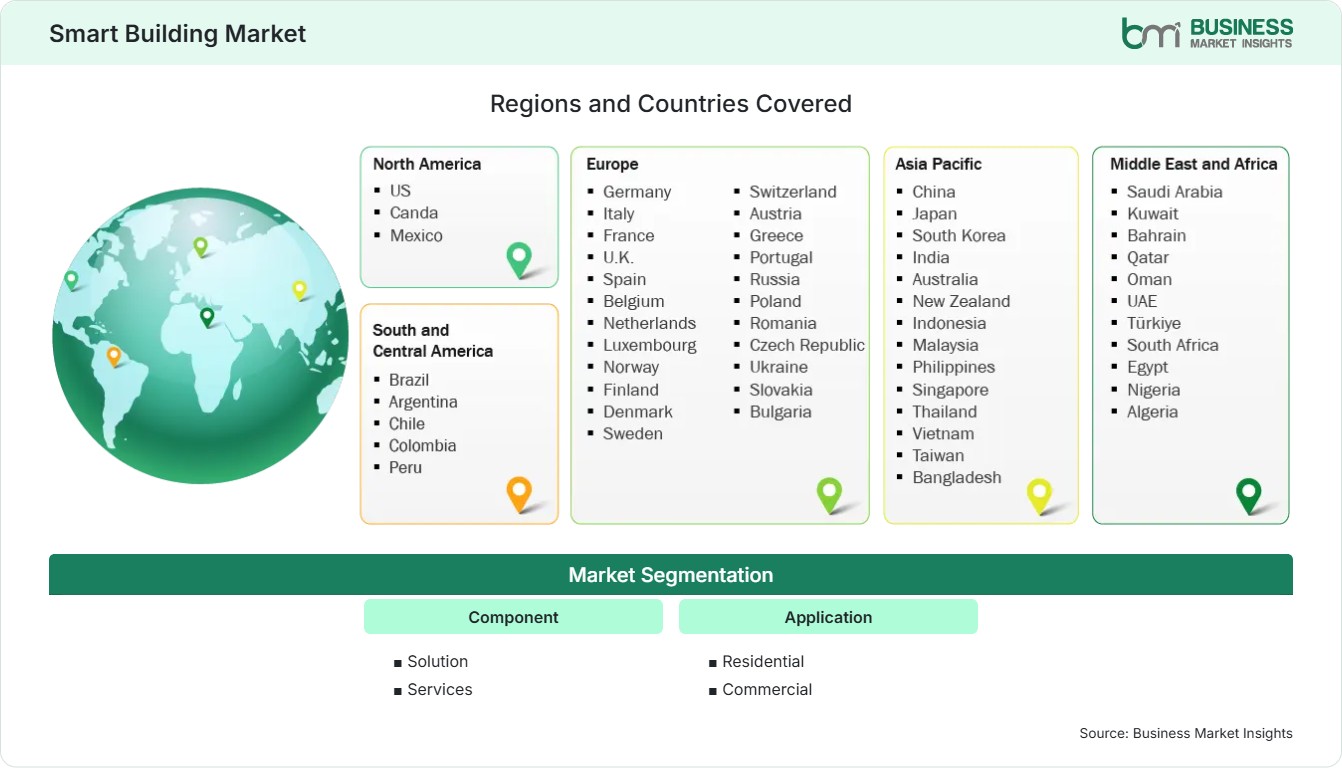
Global Market Geography
FREE PDF
Request your free sample
Request free sample
Segment Analysis

Smart Building Market Segmentation

Component

Component segmentation includes solutions and services supporting intelligent building operations. Solutions maintained a leading position in 2025 with a 68%–72% share and are expected to grow at a CAGR of 23.1%–23.8% from 2026–2033. Growth is supported by increasing adoption of automation systems, energy management platforms, security solutions, and integrated building infrastructure technologies.

  • Solution: Solutions enable automation, monitoring, energy optimization, security management, and intelligent infrastructure control across buildings.
  • Building Infrastructure Management: Building infrastructure systems improves parking management, water monitoring, and elevator operations through connected technologies.
  • Parking Management System: Parking systems optimize vehicle flow, space utilization, and user convenience through automated monitoring solutions.
  • Smart Water Management System: Smart water systems enable efficient consumption monitoring, leak detection, and resource optimization.
  • Elevators & Escalators System: Connected elevator systems improve operational efficiency, safety monitoring, and predictive maintenance capabilities.
  • Security and Emergency Management: Security systems enhance building safety through access control, surveillance, and emergency response technologies.
  • Access Control System: Access control solutions provide secure entry management through digital authentication and monitoring capabilities.
  • Video Surveillance System: Video surveillance systems support security monitoring through intelligent cameras and analytics technologies.
  • Safety System: Safety systems improve emergency detection, response coordination, and occupant protection within buildings.
  • Energy Management: Energy management solutions optimize electricity usage through intelligent HVAC and lighting control systems.
  • HVAC Control System: HVAC control systems improve climate management, comfort levels, and energy efficiency through automation.
  • Lighting Control System: Lighting systems reduce energy consumption through automated controls, sensors, and adaptive illumination technologies.
  • Services: Services support system integration, deployment, maintenance, and customization of smart building technologies.
  • System Integration and Deployment: Integration services enable seamless connection of building systems and efficient implementation of intelligent solutions.

Application

Application segmentation includes residential and commercial buildings. Commercial applications represent a significant share due to increasing demand for energy optimization, security management, and operational efficiency across offices, retail facilities, and large infrastructure projects. Residential adoption is increasing through smart home integration and demand for connected living environments.

  • Residential: Residential buildings adopt smart technologies for energy management, security enhancement, automation, and improved occupant convenience.
  • Commercial: Commercial facilities implement smart systems for operational efficiency, sustainability, security, and optimized building performance.
Market Forces

Smart Building Market Dynamics

Key Market Drivers

Rising Energy Efficiency Demand

Increased demand for energy efficiency drives the development of intelligent building solutions, since property owners want to decrease their energy usage, minimize costs, and environmental impact. Intelligent buildings allow automating heating, ventilation, air conditioning, lighting, and energy distribution due to continuous measurement and optimization of the processes. The growth of the market is facilitated by growing sustainability requirements, energy laws, and the reduction of carbon emissions on the part of companies. Smart Building Market trends imply wider use of energy management systems, sensors, and analytics solutions. Building operators are investing in technologies that improve resource utilization, enhance occupant comfort, and support long-term operational efficiency across residential and commercial facilities.

Growth in Building Automation

The increase in building automation will lead to an increase in the size of the market as companies continue to incorporate automated systems to help with the various operations within their buildings. Such automation systems incorporate heating, ventilation, air conditioning control systems, lighting systems, security systems, and building monitoring systems. The Smart Building Market growth will be influenced by the growing need for centralized management, predictive maintenance, and optimization of the processes within the organization. The trends in the market include increased adoption of artificial intelligence, Internet of Things technology, and cloud-based platforms in buildings.

Smart City Initiatives

Smart city projects are driving demand for intelligent building solutions due to investments made by authorities and municipalities in interconnected infrastructures, sustainable developments, and resource management. Intelligent buildings become an integral part of urban digital transformations that help optimize energy use, provide increased security and better public services. Factors driving the market growth include increased investment in urban redevelopment and sustainable construction initiatives. Smart Building Market trends show increased connectivity of buildings with the overall smart city ecosystem using networks and data platforms.

Key Market Opportunities

Development of Intelligent Building Solutions

Intelligent building technology development offers chances because companies are asking for advanced solutions that will allow them to integrate automation, analytics, security, and energy management into one platform. Developers are creating software that will allow monitoring of processes, predictions, and automated decisions within buildings. Adoption of artificial intelligence, digital twins, and IoT technologies allows better building intelligence and flexibility. Businesses that develop interoperable and scalable solutions have good chances because there is increased demand for such products from owners of commercial properties and infrastructure developers.

Expansion of Green Construction Projects

The increasing number of green building projects is opening up numerous business opportunities for smart buildings as there is more focus on sustainable architecture and efficient resource use. The Smart Building Market Forecast indicates the growing demand for intelligent technologies that can help realize green building goals by improving energy efficiency, minimizing waste, and enhancing environmental performance. New buildings are increasingly using intelligent energy management systems, automated lighting, and monitoring tools as part of sustainability standards. Also, various governments and organizations are encouraging environmentally friendly constructions through various energy efficiency schemes. Therefore, firms that offer services in line with green building standards have business opportunities because of the increasing need for cost-effective technology solutions.

Growth in Smart Infrastructure Investments

Growth in smart infrastructure investments is creating opportunities as governments, enterprises, and developers modernize buildings with connected technologies. Investments in digital infrastructure, urban development, and intelligent facilities are increasing the demand for integrated building management solutions. Smart infrastructure projects require technologies that improve operational efficiency, safety, energy management, and occupant experiences. Companies providing automation platforms, connectivity solutions, and system integration services are positioned to support large-scale transformation initiatives. The increasing focus on resilient and sustainable infrastructure is encouraging the adoption of advanced building technologies across commercial complexes, residential developments, and public facilities worldwide.

Market Restraints and Challenges

High Installation Costs

Factor: High installation costs associated with smart building technologies, advanced sensors, automation systems, and infrastructure upgrades create adoption barriers for many organizations.

Impact: Significant upfront investments can delay implementation decisions, particularly for small and medium-sized property owners with limited capital availability. Smart building deployment often requires hardware installation, software integration, professional services, and workforce training. Although long-term energy savings and operational benefits can offset expenses, initial costs remain a major consideration. Companies are addressing this challenge through modular solutions, scalable platforms, and phased implementation strategies that allow gradual adoption of intelligent building technologies.

Complex Integration Requirements

Factor: Complex integration requirements between existing building systems, new digital platforms, and multiple technology providers create implementation challenges.

Impact: Integration difficulties can extend project timelines, increase operational complexity, and increase maintenance requirements for smart building deployments. Many buildings contain legacy infrastructure that requires compatibility solutions before adopting advanced automation technologies. Successful implementation requires skilled system integrators, standardized communication protocols, and effective cybersecurity management. Organizations must carefully evaluate technology compatibility and deployment strategies to achieve reliable performance. Addressing integration challenges remains essential for the broader adoption of smart building solutions across diverse building environments.

Company Analysis

Competitive Landscape

The Smart Building Market analysis highlights competition among automation providers, technology companies, building solution developers, and system integration specialists delivering intelligent infrastructure solutions. Companies are focusing on energy management, automation platforms, security systems, IoT integration, and sustainable building technologies. Leading players are expanding capabilities through innovation, partnerships, and digital transformation initiatives across residential and commercial applications.

Company Name

Overview

Products and Services relevant to this market

ABB Ltd.

Technology company providing automation and electrification solutions.

Building automation, energy management, control systems, and smart infrastructure solutions.

BOSCH

Global technology company offering connected building solutions.

Smart building systems, security solutions, sensors, and automation technologies.

Cisco Systems Inc.

Networking and digital technology provider.

Building connectivity, IoT platforms, security systems, and smart infrastructure solutions.

Emerson Electric Co.

Industrial technology company serving automation markets.

Building management systems, HVAC controls, and automation solutions.

Hitachi Ltd.

Technology company providing digital infrastructure solutions.

Smart building platforms, energy management, and connected infrastructure services.

Honeywell International Inc.

Building technology and automation solutions provider.

Building controls, security systems, energy management, and automation platforms.

Intel Corporation

Semiconductor and technology company supporting intelligent systems.

IoT processors, edge computing, and smart building technology platforms.

Johnson Controls

Building technology company specializing in facility solutions.

Building automation, HVAC controls, security systems, and energy management solutions.

KMC Controls

Automation company focused on building control technologies.

HVAC controls, building automation systems, and connected management solutions.

LG Electronics Inc.

Consumer and commercial technology company.

Smart building solutions, HVAC systems, displays, and connected technologies.

Industry Activity

Recent Developments

November 2025

Schneider Electric SE launched EcoStruxure Foresight Operation, an AI-powered platform designed to unify energy, power, and building systems into a single intelligent operating environment. The solution enables building operators to improve visibility, predictive insights, and operational efficiency across smart building infrastructure.

August 2025

Johnson Controls International plc launched OpenBlue Visitor, a digital visitor management solution within its OpenBlue smart building ecosystem. The platform enables secure, automated visitor access management and supports smarter workplace operations through connected building technologies.

July 2025

Siemens AG announced a collaboration with Microsoft Corporation to improve IoT interoperability for buildings by connecting Siemens’ Building X digital building platform with Microsoft Azure IoT Operations. The partnership aims to simplify access to building data and improve integration of connected building systems.

June 2025

Honeywell International Inc. launched Honeywell Connected Solutions, an AI-powered building management platform that integrates building software and technologies into a unified interface. The solution is designed to provide facility operators with real-time visibility and AI-driven insights for improving building operations.

Trust & Transparency

Research Methodology

The market analysis combines proprietary research with secondary data from government agencies, company disclosures, regulatory filings, industry databases and expert interviews. Market estimates are validated through data triangulation, cross-market benchmarking and analyst review.

View Full Research Methodology

Questions Answered

Frequently Asked Questions

What does the Smart Building Market Report indicate about future opportunities?

The report indicates opportunities in intelligent building solutions, green construction projects, smart infrastructure investments, AI-based management platforms, and connected automation technologies.

How do smart buildings support sustainability objectives?

Smart buildings support sustainability through automated energy management, efficient HVAC operations, intelligent lighting controls, resource monitoring, and data-driven optimization of building performance.

Which component segment leads the market?

The solution component segment leads due to strong demand for energy management systems, security solutions, building automation technologies, and integrated infrastructure management platforms.

Why are organizations adopting smart building technologies?

Organizations are adopting smart building technologies to reduce energy consumption, improve operational efficiency, enhance security, optimize facility management, and create better occupant experiences through connected systems.

What factors are driving growth in the Smart Building Market?

The market is driven by rising energy efficiency demand, building automation adoption, smart city initiatives, sustainability goals, and increasing investment in intelligent infrastructure solutions.

Access the Full Smart Building Market Report

Get segment-level forecasts, regional estimates, competitive benchmarking, company profiles and downloadable Excel datasets.

Access the full Smart Building Market Report
350 pages PDF & Excel | 2026-07-31