
Situational Awareness Market Outlook: Size, Share, Trends, Growth Analysis, Competitive Landscape & Forecast, 2026-2033

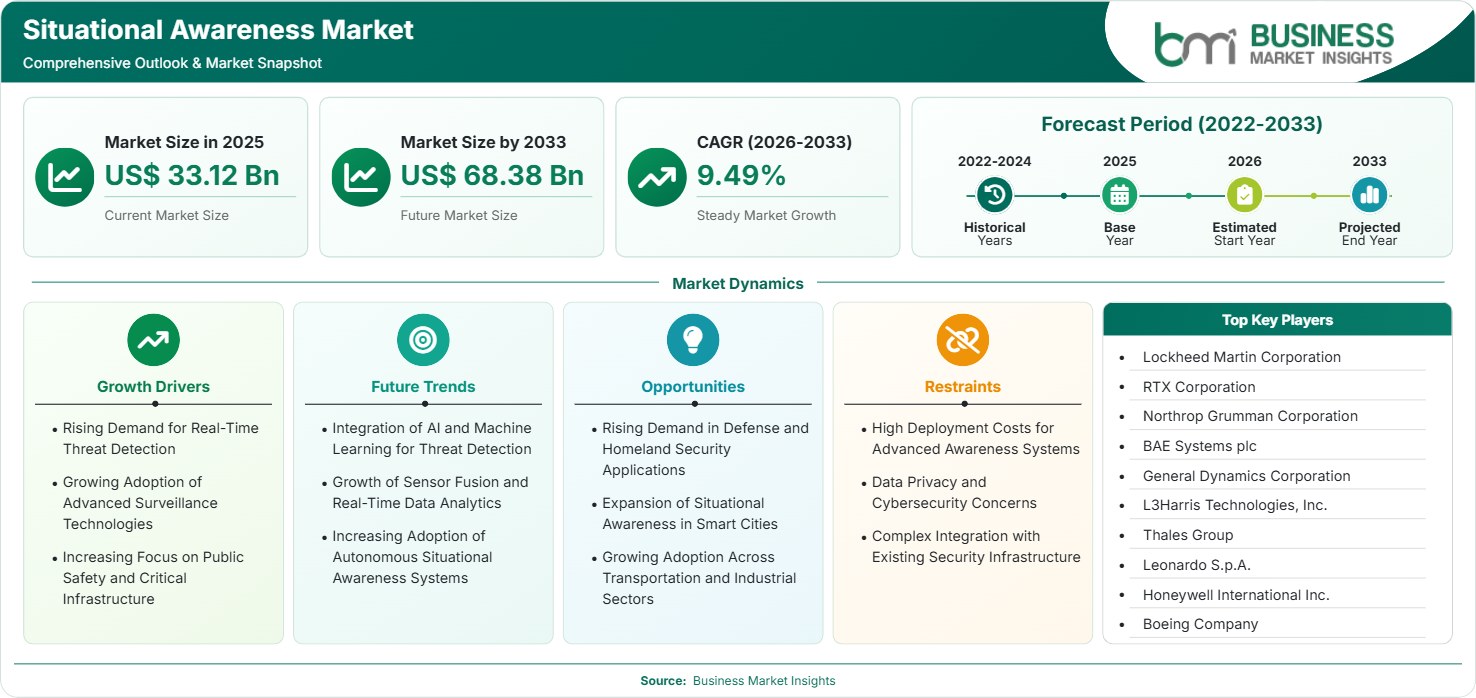
The Situational Awareness Market size was valued at US$ 33.12 Billion in 2025 and is projected to reach US$ 68.38 Billion by 2033, growing at a CAGR of 9.49% during 2026–2033. Rising defense modernization programs, increasing border security requirements, growing investments in surveillance technologies, and expanding demand for real-time operational intelligence are supporting market growth globally.

Report Coverage
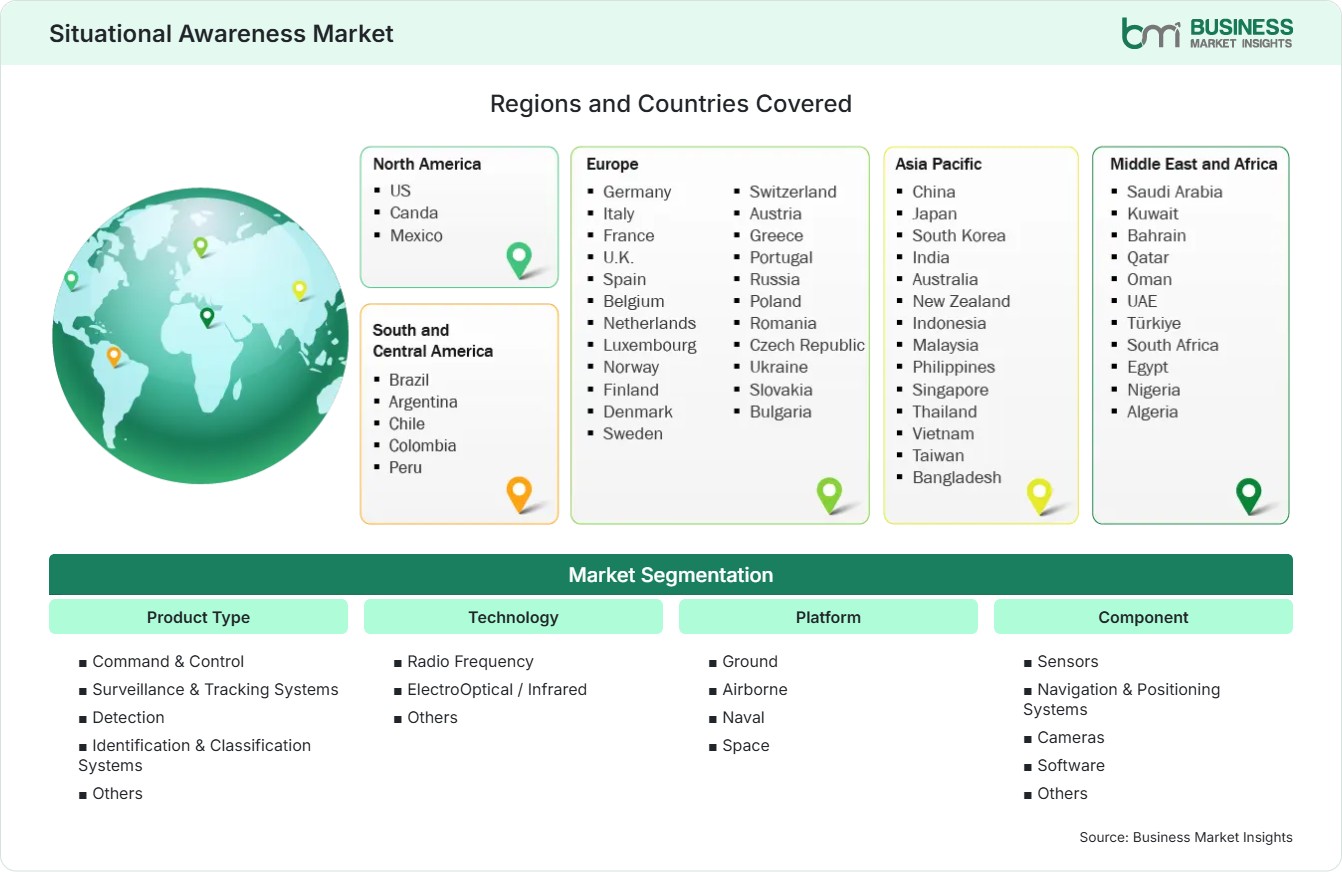
  • Product Type: Command & Control , Surveillance & Tracking Systems, Detection, Identification & Classification Systems, Others
  • Technology: Radio Frequency , ElectroOptical / Infrared , Others
  • Platform: Ground, Airborne, Naval, Space
  • Component: Sensors, Navigation & Positioning Systems , Cameras, Software, Others
  • End User: Army, Navy, Air Force, Aviation Authorities, Others
US$ 33.12 Bn Market size in 2025
US$ 68.38 Bn Market Size by 2033
9.49% CAGR, 2026 - 2033
2026-2033 Forecast Period

AI Overview

Situational Awareness Market Summary

  • North America Region: North America holds a market share of 36%–39% in 2025, growing with a CAGR of 9.1%–9.8% during 2026–2033. Strong defense spending, advanced surveillance infrastructure, and increasing adoption of network-centric warfare systems continue supporting regional leadership. The U.S. situational awareness market is expected to register a CAGR of 9.3%–10.0%.
  • Fastest Growing Region: Asia Pacific accounts for 28%–31% share in 2025 and is projected to grow at a CAGR of 10.2%–10.9% through 2033. Rising defense budgets, territorial security concerns, and growing procurement of advanced surveillance systems continue driving regional growth.
  • Leading Segment: Command & Control (C2) represents 31%–34% share in 2025 and is expected to grow at a CAGR of 9.7%–10.4% through 2033. Increasing emphasis on integrated battlefield management and operational coordination continues supporting segment dominance.
  • High Growth Segment: Sensors account for 26%–29% share in 2025 and are forecast to grow at a CAGR of 10.0%–10.7% during 2026–2033. Growing deployment of multi-domain surveillance and monitoring systems continues accelerating segment growth.
  • Key Market Opportunity: Expansion of AI-enabled intelligence systems, multi-domain surveillance platforms, autonomous monitoring technologies, and integrated command networks is creating substantial growth opportunities.
  • Major Market Players: Lockheed Martin, Northrop Grumman, Raytheon Technologies Corporation, BAE Systems, L3Harris Technologies, Thales, Saab, Leonardo, Airbus, and Indra Sistemas.
Strategic Insights

Situational Awareness Market: Strategic Insights

Situational Awareness Market Strategic Framework
FREE PDF
Request your free sample
Request free sample
Stakeholder View

Key Takeaways

  • Situational awareness systems are becoming critical components of modern defense and security operations.
  • Command & Control systems continue dominating due to their central role in operational coordination.
  • Sensors remain the fastest-growing component segment.
  • Multi-domain surveillance capabilities are increasingly driving procurement decisions.
  • Artificial intelligence integration is enhancing operational intelligence and decision-making.
  • North America remains the leading situational awareness market due to extensive defense technology investments.
  • Asia Pacific is projected to witness the fastest growth owing to rising security modernization initiatives.
  • Autonomous surveillance and data fusion technologies are expected to create significant future opportunities.
Geographic Outlook

Situational Awareness Market Regional Highlights

North America Situational Awareness Market

North America accounts for 36%–39% Situational Awareness Market share in 2025 and is projected to grow at a CAGR of 9.1%–9.8% through 2033. The region benefits from extensive defense modernization programs, advanced surveillance infrastructure, and strong investments in intelligence technologies.

  • Defense agencies are increasingly investing in integrated command and control ecosystems to enhance operational effectiveness across multiple domains.
  • Military modernization initiatives continue driving procurement of advanced surveillance, tracking, and threat detection systems.
  • Border security organizations are deploying sophisticated situational awareness platforms to improve monitoring and response capabilities.
  • AI-enabled intelligence and data fusion technologies are gaining wider adoption to improve faster decision-making.
  • Aerospace and homeland security applications continue expanding demand for real-time operational visibility solutions.
  • Strong research and development activity remains supportive of innovation and long-term market growth.

US Situational Awareness Market

The United States contributes approximately 90%–94% of North American revenue and is expected to register a CAGR of 9.3%–10.0% through 2033. The country remains the largest situational awareness market due to its substantial defense expenditure and advanced military infrastructure.

  • Defense programs continue emphasizing network-centric warfare and integrated battlefield awareness capabilities.
  • Investments in space-based monitoring systems are strengthening intelligence gathering and operational visibility.
  • Homeland security initiatives are increasing deployment of surveillance and threat detection technologies.
  • Military organizations are expanding adoption of AI-powered analytics and autonomous monitoring platforms.
  • Cross-domain communication systems continue improving coordination among defense and emergency response agencies.
  • Government funding remains a key driver for technological development and system upgrades.

Europe Situational Awareness Market

Europe represents 22%–25% of global revenue in 2025 and is anticipated to expand at a CAGR of 9.5%–10.2% through 2033. Growing defense preparedness, border security initiatives, and investments in advanced monitoring systems continue supporting regional growth.

  • Germany continues leading regional demand through ongoing defense modernization and security infrastructure investments.
  • Poland is among the fastest-growing markets and is estimated to register a CAGR of 10.4%–11.1% during the forecast period.
  • Defense organizations are increasingly implementing integrated surveillance and battlefield management systems.
  • Border monitoring capabilities are being expanded to address evolving security challenges.
  • Military alliances continue encouraging interoperability and adoption of advanced situational awareness technologies.
  • Investments in aerospace and maritime security applications remain important contributors to market growth.

Asia Pacific Situational Awareness Market

Asia Pacific accounts for 28%–31% of global revenue in 2025 and is expected to achieve the fastest CAGR of 10.2%–10.9% through 2033. Increasing defense expenditures, territorial security concerns, and military capability enhancement programs continue supporting robust regional growth.

  • China remains the largest regional situational awareness market due to extensive defense modernization and surveillance technology investments.
  • India is projected to achieve approximately 11.1%–11.8% CAGR, supported by border security requirements and military modernization initiatives.
  • Regional governments are increasingly investing in intelligence, surveillance, and reconnaissance platforms.
  • Defense forces are expanding deployment of sensor networks and advanced command systems.
  • Maritime surveillance programs continue creating substantial opportunities for situational awareness providers.
  • Growing emphasis on national security and digital defense infrastructure remains supportive of long-term market expansion.

Rest of World Situational Awareness Market

Rest of World accounts for 8%–11% of global revenue in 2025 and is projected to expand at a CAGR of 8.3%–9.0% through 2033. Rising investments in homeland security, military modernization, and critical infrastructure protection are supporting market growth across Latin America, the Middle East, and Africa.

  • Brazil continues generating demand through defense modernization and public security enhancement programs.
  • The UAE is witnessing increasing deployment of integrated surveillance and monitoring systems across strategic assets.
  • Saudi Arabia is expected to achieve approximately 9.2%–9.9% CAGR through 2033, supported by defense transformation initiatives.
  • Border protection and critical infrastructure security remain major areas of investment.
  • Smart security and intelligence platforms are gaining importance among regional governments.
  • Rising geopolitical concerns continue supporting long-term demand for advanced situational awareness solutions.
Global Market Geography
FREE PDF
Request your free sample
Request free sample
Segment Analysis

Situational Awareness Market Segmentation

Product Type

The product type segment represents the core systems utilized to collect, process, analyze, and disseminate operational intelligence across defense, homeland security, aviation, and critical infrastructure applications. This segment accounts for approximately 31%–34% share in 2025 and is projected to grow at a CAGR of 9.7%–10.4% through 2033. The expanding Situational Awareness Market Scope is supported by increasing investments in defense modernization, rising cross-domain security requirements, and growing demand for integrated operational intelligence systems.

  • Command & Control (C2): Command & Control systems dominate the market due to their critical role in coordinating operations, integrating intelligence feeds, and supporting real-time decision-making across military and civil security environments.
  • Surveillance & Tracking Systems: Surveillance and tracking solutions continue witnessing substantial adoption because they provide persistent monitoring, target tracking, and operational visibility across land, air, maritime, and critical infrastructure environments.
  • Detection, Identification & Classification Systems: These systems are increasingly deployed to improve threat detection accuracy, object classification, and early warning capabilities across security-sensitive applications.
  • Others: Other product categories include communication platforms, intelligence management systems, operational dashboards, and mission-support solutions.

Technology

The technology segment highlights the major sensing and monitoring technologies powering situational awareness solutions. This segment accounts for approximately 38%–41% share in 2025 and is expected to register a CAGR of 9.8%–10.5% through 2033. Current Situational Awareness Market Trends indicate increasing adoption of sensor fusion technologies, intelligent analytics, and multi-domain surveillance capabilities.

  • Radio Frequency (RF): RF technologies remain widely utilized for communication intelligence, signal monitoring, radar systems, battlefield surveillance, and electronic warfare applications.
  • Electro-Optical / Infrared (EO/IR): EO/IR technologies continue experiencing significant demand due to their ability to support target detection, imaging, tracking, and night-time surveillance operations.
  • Others: Other technologies include radar systems, acoustic sensing, satellite-based monitoring, artificial intelligence-enabled analytics, and advanced geospatial intelligence platforms.

Platform

The platform segment reflects the primary operational domains where situational awareness systems are deployed. This segment accounts for approximately 43%–46% share in 2025 and is forecast to grow at a CAGR of 9.9%–10.6% through 2033.

  • Ground: Ground platforms dominate the market due to extensive deployment across military bases, border security operations, battlefield environments, and critical infrastructure monitoring applications.
  • Airborne: Airborne systems are increasingly utilized for reconnaissance, intelligence gathering, surveillance missions, and airspace monitoring activities.
  • Naval: Naval platforms continue experiencing strong demand due to maritime surveillance, coastal security, fleet protection, and naval operational awareness requirements.
  • Space: Space-based solutions are gaining importance for communication monitoring, earth observation, missile detection, and strategic intelligence gathering applications.

Component

The component segment represents the hardware and software elements enabling operational intelligence and situational awareness functions. This segment accounts for approximately 26%–29% share in 2025 and is expected to grow at a CAGR of 10.0%–10.7% through 2033.

  • Sensors: Sensors dominate the market due to increasing deployment of advanced monitoring systems capable of collecting real-time environmental, operational, and threat-related information.
  • Navigation & Positioning Systems (PNT/GNSS): Positioning technologies remain essential for accurate location tracking, navigation support, and operational coordination.
  • Cameras: Advanced imaging systems continue supporting surveillance, reconnaissance, and monitoring activities across multiple operational domains.
  • Software: Software platforms are increasingly utilized to process data, support analytics, integrate intelligence streams, and enhance decision-making effectiveness.
  • Others: Other components include communication systems, display platforms, processors, data storage solutions, and networking infrastructure.

End-User

The end-user segment highlights the primary organizations utilizing situational awareness systems to improve operational effectiveness, security, and mission success. This segment accounts for approximately 36%–39% share in 2025 and is projected to grow at a CAGR of 9.6%–10.3% through 2033.

  • Army: Army organizations remain the largest users due to extensive requirements for battlefield visibility, force protection, and operational coordination.
  • Navy: Naval forces continue investing in situational awareness solutions to improve maritime surveillance, fleet management, and threat identification capabilities.
  • Air Force: Air force organizations increasingly deploy integrated monitoring and intelligence systems to strengthen airspace awareness and mission effectiveness.
  • Aviation Authorities: Aviation authorities utilize situational awareness platforms to improve air traffic management, operational safety, and emergency response capabilities.
  • Others: Other end users include homeland security agencies, border protection organizations, emergency response teams, law enforcement agencies, and critical infrastructure operators.
Market Forces

Situational Awareness Market Dynamics

Key Market Drivers

Rising Demand for Real-Time Threat Detection

The increasing complexity of modern security environments is significantly driving demand for real-time threat detection capabilities across defense, homeland security, and critical infrastructure sectors. Organizations require the ability to identify, assess, and respond to potential risks before they escalate into operational disruptions or security incidents. Situational awareness systems provide continuous monitoring capabilities combined with advanced analytics to improve threat visibility and response effectiveness. Governments and security agencies are increasingly investing in technologies capable of delivering immediate operational intelligence. As security challenges continue evolving, demand for real-time awareness solutions is expected to remain a major market growth driver.

Growing Adoption of Advanced Surveillance Technologies

Surveillance technologies are becoming increasingly sophisticated, enabling organizations to gather higher-quality intelligence across multiple operational domains. Modern situational awareness platforms integrate sensors, radar systems, cameras, geospatial intelligence tools, and artificial intelligence capabilities to provide comprehensive monitoring functionality. These technologies enhance visibility across geographic areas while improving detection accuracy and operational efficiency. Defense agencies and security organizations are expanding investments in advanced surveillance infrastructure to support mission-critical objectives. This trend continues accelerating adoption of integrated situational awareness solutions worldwide.

Increasing Focus on Public Safety and Critical Infrastructure

Governments and infrastructure operators are prioritizing investments that strengthen public safety and protect strategic assets from evolving threats. Transportation hubs, power plants, communication networks, industrial facilities, and urban infrastructure require continuous monitoring and operational oversight. Situational awareness platforms help organizations identify vulnerabilities, improve emergency response coordination, and maintain operational continuity. Increased concern regarding physical security and operational resilience continues supporting implementation across civil and industrial applications. As infrastructure systems become more interconnected, demand for advanced awareness capabilities is expected to increase further.

Key Market Opportunities

Rising Demand in Defense and Homeland Security Applications

Defense and homeland security organizations continue representing one of the most significant growth opportunities for market participants. Increasing geopolitical tensions, cross-border security challenges, and modernization initiatives are encouraging governments to upgrade surveillance and intelligence capabilities. Situational awareness technologies help improve operational coordination, force protection, and mission effectiveness while supporting strategic decision-making. Continuous procurement of next-generation defense technologies remains supportive of market expansion. Vendors offering advanced monitoring and intelligence solutions are expected to benefit from sustained investment programs.

Expansion of Situational Awareness in Smart Cities

The emergence of smart city initiatives is creating attractive opportunities for situational awareness providers. Urban authorities are increasingly implementing intelligent monitoring systems to improve traffic management, emergency response, public safety, and infrastructure performance. Sensors, cameras, analytics platforms, and integrated communication systems are being deployed to create more responsive urban environments. These technologies help municipal authorities improve operational efficiency while enhancing citizen safety. As smart city investments continue growing globally, adoption of situational awareness solutions is expected to accelerate significantly.

Growing Adoption Across Transportation and Industrial Sectors

Transportation operators and industrial organizations are increasingly incorporating situational awareness technologies to improve safety, operational efficiency, and asset management performance. Transportation networks rely on real-time visibility to manage traffic, monitor infrastructure, and coordinate responses to operational disruptions. Industrial companies utilize advanced monitoring solutions to oversee facilities, improve worker safety, and protect critical assets. Growing digitalization and automation initiatives are expanding deployment opportunities across these sectors. Long-term Situational Awareness Market Forecast projections remain favorable as organizations continue investing in intelligent monitoring technologies.

Market Restraints and Challenges

High Deployment Costs for Advanced Awareness Systems

Factor: Comprehensive situational awareness platforms often require significant investments in surveillance infrastructure, communication networks, software platforms, sensors, data centers, and integration services. Large-scale deployments can involve substantial procurement and maintenance expenses.

Impact: High implementation costs may slow adoption among budget-constrained organizations and developing regions. Decision-makers may face challenges balancing operational requirements with available financial resources, potentially affecting procurement timelines and market expansion.

Data Privacy and Cybersecurity Concerns

Factor: Situational awareness systems process large volumes of operational, surveillance, location, and intelligence-related information across interconnected digital networks. These systems may face cybersecurity risks, unauthorized access attempts, and regulatory scrutiny regarding data management practices.

Impact: Cybersecurity threats and privacy concerns can increase implementation complexity and compliance requirements. Organizations must invest in data protection frameworks, secure communications, and risk management strategies to ensure operational integrity, which may increase overall deployment costs and project complexity.

Company Analysis

Competitive Landscape

The Situational Awareness Market Analysis is characterized by strong competition among defense contractors, surveillance technology providers, aerospace companies, security solution developers, and intelligence platform providers. Market participants are focusing on AI-enabled analytics, sensor fusion technologies, integrated command and control systems, real-time intelligence platforms, and multi-domain operational awareness solutions to strengthen their market positions. Rising defense modernization initiatives, growing investments in homeland security, and increasing demand for advanced surveillance infrastructure continue driving innovation across the market. Companies are investing in autonomous monitoring technologies, advanced sensor networks, cybersecurity capabilities, and next-generation battlefield management systems to address evolving security requirements.

Company Name

Overview

Products and Services Relevant to this Market

Lockheed Martin

Global aerospace and defense company serving military and security organizations worldwide.

Command and control systems, surveillance platforms, sensor integration solutions, intelligence systems, and battlefield management technologies.

Northrop Grumman

Defense technology company specializing in advanced security and mission systems.

Situational awareness platforms, surveillance systems, radar technologies, ISR solutions, and integrated command systems.

Raytheon Technologies Corporation

Aerospace and defense company focused on sensing, intelligence, and security technologies.

Surveillance solutions, threat detection systems, sensor networks, command systems, and integrated defense technologies.

BAE Systems

Defense and security company providing advanced military technologies.

Battlefield awareness systems, electronic warfare solutions, surveillance platforms, and intelligence management technologies.

L3Harris Technologies

Defense communications and intelligence solutions provider.

ISR systems, communication networks, surveillance technologies, mission systems, and situational awareness platforms.

Thales

Global technology company serving defense, aerospace, and security sectors.

Command and control solutions, surveillance systems, navigation technologies, and operational intelligence platforms.

Saab

Defense and security technology company focused on surveillance and monitoring systems.

Radar systems, battlefield management platforms, intelligence solutions, and situational awareness technologies.

Leonardo

Aerospace and defense company providing integrated security and defense systems.

Surveillance platforms, sensors, command systems, intelligence technologies, and operational monitoring solutions.

Airbus

Aerospace company supplying defense and security technologies globally.

Intelligence systems, surveillance platforms, geospatial technologies, and integrated situational awareness solutions.

Indra Sistemas

Technology company specializing in defense, transportation, and security solutions.

Command and control platforms, surveillance systems, air traffic monitoring solutions, and security intelligence technologies.

Trust & Transparency

Research Methodology

The market analysis combines proprietary research with secondary data from government agencies, company disclosures, regulatory filings, industry databases and expert interviews. Market estimates are validated through data triangulation, cross-market benchmarking and analyst review.

View Full Research Methodology

Questions Answered

Frequently Asked Questions

How is artificial intelligence influencing the situational awareness industry?

Artificial intelligence is improving threat detection, predictive analytics, sensor fusion, automated monitoring, and decision-support capabilities, enabling organizations to process large amounts of operational data more efficiently and accurately.

What does this Situational Awareness Market Report cover?

This report covers product type analysis, technology assessment, platform evaluation, component analysis, end-user assessment, regional trends, competitive landscape analysis, market drivers, opportunities, restraints, challenges, and future growth prospects through 2033.

Why do Sensors represent the high-growth component segment?

Sensors are experiencing strong growth because they serve as the foundation of situational awareness systems by collecting real-time operational, environmental, and threat-related information across multiple domains.

Which product type segment dominates the market?

Command & Control (C2) dominates the market due to its critical role in integrating intelligence data, coordinating operations, enhancing decision-making, and supporting mission execution across defense and security applications.

What is driving growth in the Situational Awareness market?

Rising demand for real-time threat detection, growing adoption of advanced surveillance technologies, increasing focus on public safety and critical infrastructure security, and expanding defense modernization initiatives are major factors driving market growth.

Access the Full Situational Awareness Market Report

Get segment-level forecasts, regional estimates, competitive benchmarking, company profiles and downloadable Excel datasets.

Access the full Situational Awareness Market Report
350 pages PDF & Excel | 2026-08-20