
SiC Power Electronics Market Outlook: Size, Share, Trends, Growth Analysis, Competitive Landscape & Forecast, 2022-2033

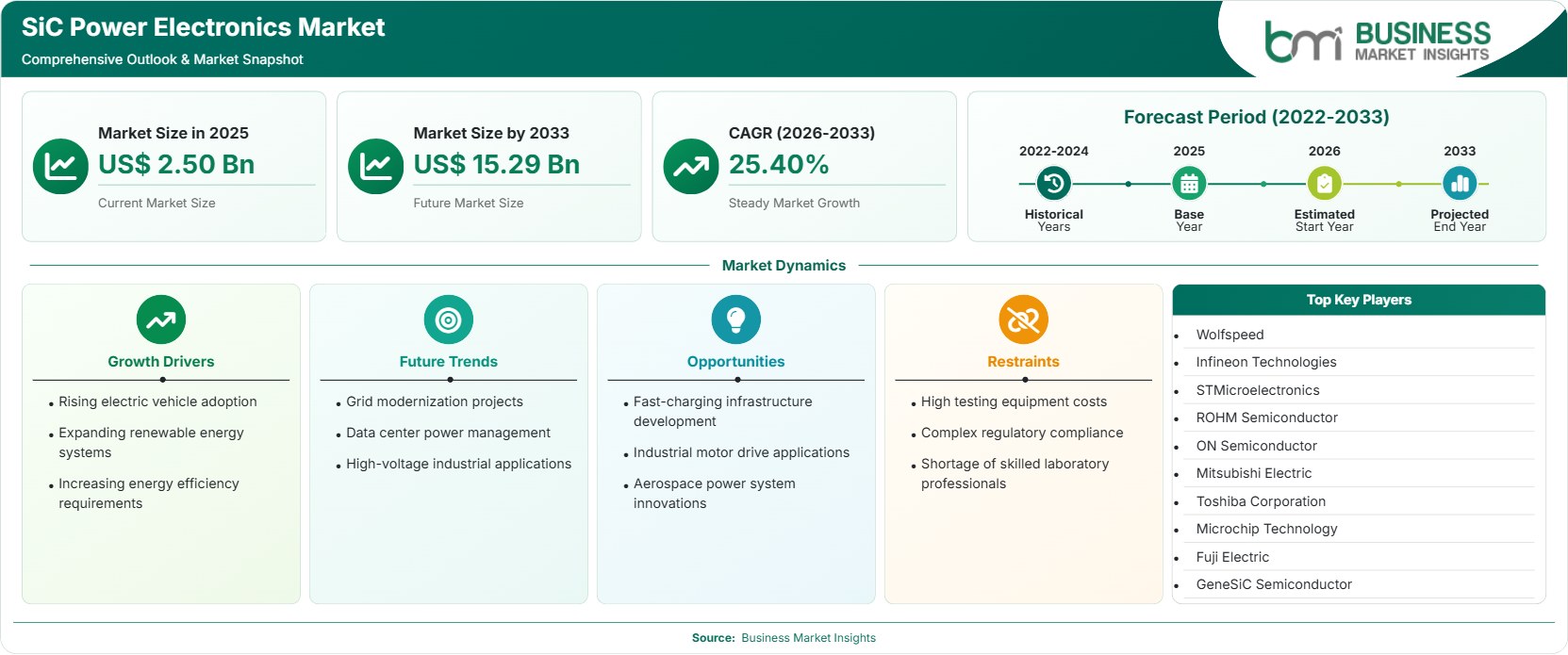
The SiC Power Electronics Market size was valued at US$ 2.5 billion in 2025 and is projected to reach US$ 15.29 billion by 2033, growing at a CAGR of 10.65% during 2026–2033. Rising electric vehicle adoption, rapid renewable energy deployment, and increasing energy efficiency requirements continue accelerating market expansion, while fast-charging infrastructure and industrial electrification create significant opportunities for next-generation wide-bandgap semiconductor technologies.

Report Coverage
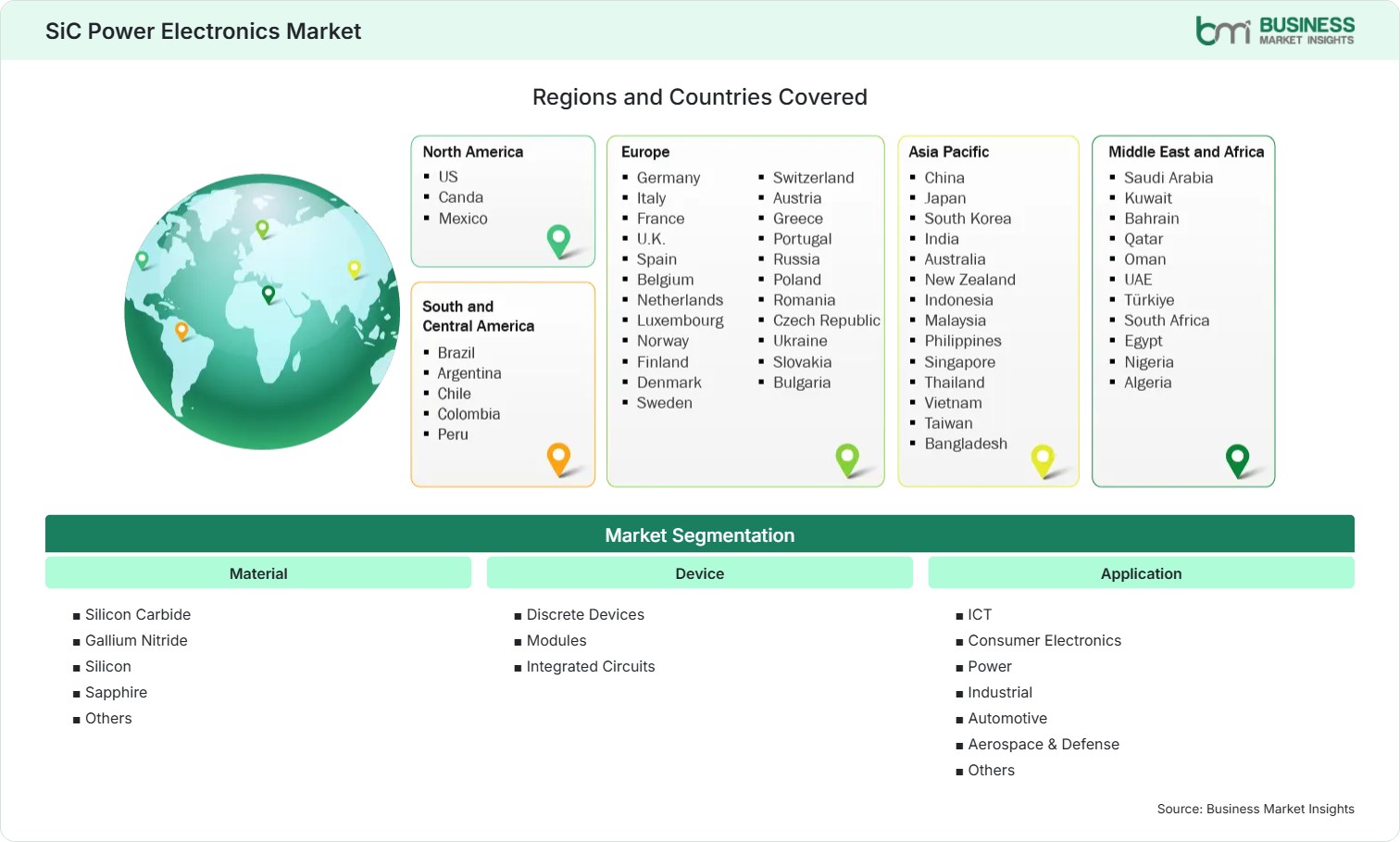
  • Material: Silicon Carbide, Gallium Nitride, Silicon, Sapphire, Others
  • Device: Discrete Devices, Modules, Integrated Circuits
  • Application: ICT, Consumer Electronics, Power, Industrial, Automotive, Aerospace & Defense, Others
US$ 2.50 Bn Market size in 2025
US$ 15.29 Bn Market Size by 2033
25.40% CAGR, 2026 - 2033
2026-2033 Forecast Period

01 AI Overview

SiC Power Electronics Market Summary

  • North America Region: North America holds 31%–34% market share in 2025 and is projected to grow at a CAGR of 10.2%–10.9% during 2026–2033, supported by EV manufacturing investments, semiconductor fabrication expansion, and renewable energy deployment. The United States remains the largest regional market with strong government incentives and domestic semiconductor manufacturing initiatives, registering a CAGR of 10.4%–11.1%.
  • Fastest Growing Region: Asia Pacific accounts for 39%–42% of the market in 2025 and is expected to register a CAGR of 11.7%–12.4% during 2026–2033. Strong electric vehicle production, expanding power electronics manufacturing, and increasing renewable energy installations continue driving regional demand.
  • Leading Segment: Silicon Carbide (SiC) holds 68%–71% market share in 2025 and is projected to expand at a CAGR of 11.2%–11.9% through 2033. Superior switching efficiency, higher thermal conductivity, and reduced power losses continue strengthening adoption across automotive and industrial applications.
  • High Growth Segment: Automotive represents 35%–38% of market revenue in 2025 and is anticipated to grow at a CAGR of 12.3%–13.0% during 2026–2033. Increasing electric vehicle production, onboard charging systems, traction inverters, and battery management applications continue driving segment expansion.
  • Key Market Opportunity: Growing deployment of ultra-fast EV charging infrastructure, industrial automation, and aerospace electrification creates substantial opportunities for high-performance SiC power devices with superior efficiency and thermal performance.
  • Major Market Players: Wolfspeed, Inc., Infineon Technologies AG, STMicroelectronics N.V., ROHM Co., Ltd., onsemi, Mitsubishi Electric Corporation, Toshiba Corporation, Microchip Technology Incorporated, Fuji Electric Co., Ltd., and GeneSiC Semiconductor Inc.
02 Strategic Insights

SiC Power Electronics Market: Strategic Insights

SiC Power Electronics Market Strategic Framework
FREE PDF
Request your free sample
Request free sample
03 Stakeholder View

Key Takeaways

  • The value chain is becoming increasingly integrated through collaborations among wafer manufacturers, device suppliers, module manufacturers, automotive OEMs, and power electronics system integrators to improve supply security and production scalability.
  • Automotive electrification, renewable energy inverters, industrial motor drives, and EV charging infrastructure represent the strongest long-term commercial opportunities for suppliers of SiC-based power electronics.
  • Innovation is shifting toward 200 mm SiC wafers, advanced packaging technologies, higher-voltage MOSFETs, integrated power modules, and improved thermal management solutions that enhance system efficiency.
  • Asia Pacific remains the most attractive investment destination due to strong EV manufacturing ecosystems, expanding semiconductor fabrication capacity, and supportive industrial policies in China, Japan, South Korea, and India.
  • Strategic partnerships, long-term wafer supply agreements, and capacity expansion projects are reshaping competitive dynamics as manufacturers seek to address increasing global demand for wide-bandgap semiconductor devices.
  • Companies investing in substrate manufacturing, vertical integration, and advanced fabrication technologies are expected to gain significant competitive advantages as supply constraints gradually ease.
04 Geographic Outlook

SiC Power Electronics Market Regional Highlights

North America SiC Power Electronics Market

North America accounted for 31%–34% of the SiC Power Electronics Market share in 2025 and is expected to register a CAGR of 10.2%–10.9% through 2033. Strong electric vehicle manufacturing, government support for semiconductor localization, and increasing investments in renewable energy projects continue strengthening regional demand. The presence of leading SiC device manufacturers and advanced R&D capabilities further reinforces market leadership.

  • Government semiconductor incentive programs encourage domestic wafer production and power semiconductor manufacturing, reducing import dependence while strengthening regional supply chain resilience.
  • Rapid deployment of EV charging infrastructure continues increasing demand for high-efficiency SiC MOSFETs, power modules, and onboard charging systems.
  • Renewable energy projects increasingly utilize SiC-based power conversion technologies to improve inverter efficiency and reduce system losses.
  • Automotive OEMs continue collaborating with semiconductor manufacturers to secure long-term SiC supply for future electric vehicle platforms.
  • Industrial automation investments accelerate adoption of high-performance power electronics for robotics, factory automation, and intelligent power management.

US SiC Power Electronics Market

The United States represented 26%–29% of global revenue in 2025 and is projected to expand at a CAGR of 10.4%–11.1% during 2026–2033. Rising EV production, semiconductor manufacturing investments, and federal support for domestic chip fabrication continue supporting sustained market expansion.

  • Expansion of domestic semiconductor fabrication facilities strengthens national supply chain resilience for advanced power electronics.
  • Increasing EV manufacturing capacity drives demand for traction inverters, onboard chargers, and high-voltage SiC devices.
  • Growing investments in utility-scale renewable energy projects encourage widespread deployment of efficient power conversion technologies.
  • Defense and aerospace programs continue adopting wide-bandgap semiconductors for high-reliability power applications.

Europe SiC Power Electronics Market

Europe accounted for 24%–27% of global revenue in 2025 and is anticipated to grow at a CAGR of 10.5%–11.2% during 2026–2033. Germany remains the largest regional market, while Italy is projected to register the fastest growth with a CAGR of 11.3%–12.0%, supported by EV manufacturing and industrial automation investments.

  • Germany leads regional adoption through its advanced automotive manufacturing ecosystem and industrial power electronics expertise.
  • Italy records strong growth owing to increasing investments in semiconductor manufacturing and renewable energy technologies.
  • European decarbonization initiatives continue driving demand for efficient power conversion systems.
  • Automotive electrification remains the primary application supporting long-term regional expansion.
  • Public funding for semiconductor innovation strengthens development of next-generation SiC manufacturing capabilities.

Asia Pacific SiC Power Electronics Market

Asia Pacific represented 39%–42% of market revenue in 2025 and is projected to achieve the highest CAGR of 11.7%–12.4% through 2033. China leads regional demand, while India is expected to record the fastest growth at 12.8%–13.5%, driven by semiconductor investments, EV production, and renewable energy deployment.

  • China dominates regional production through extensive semiconductor manufacturing capacity and EV supply chains.
  • India experiences accelerated growth supported by semiconductor incentive programs and domestic SiC manufacturing initiatives.
  • Japan remains a global leader in SiC wafer technology, automotive electronics, and industrial power devices.
  • South Korea expands investments in next-generation semiconductor fabrication for automotive and industrial applications.
  • Regional manufacturers continue increasing production capacity to address growing global demand for wide-bandgap semiconductors.

Rest of World SiC Power Electronics Market

The Rest of World accounted for 5%–8% of global revenue in 2025 and is forecast to expand at a CAGR of 10.8%–11.5% through 2033. Brazil represents the leading South American market, while the United Arab Emirates records the fastest regional growth with a CAGR of 11.4%–12.1%, supported by renewable energy investments and industrial modernization.

Growing investments in power infrastructure, industrial electrification, and renewable energy projects continue supporting demand for efficient power semiconductor technologies across Latin America, the Middle East, and Africa.

  • Brazil benefits from expanding renewable energy installations requiring efficient power conversion technologies.
  • The United Arab Emirates strengthens regional demand through smart infrastructure and clean energy investments.
  • Mining, oil and gas, and industrial automation projects increasingly adopt high-efficiency power electronics.
  • International semiconductor suppliers continue expanding regional sales and technical support networks.
  • Grid modernization projects create new opportunities for advanced power conversion systems utilizing SiC technology.
Global Market Geography
FREE PDF
Request your free sample
Request free sample
05 Segment Analysis

SiC Power Electronics Market Segmentation

Material

The material segment forms the technological foundation of the market, with Silicon Carbide (SiC) maintaining clear leadership due to its superior electrical conductivity, high-temperature operation, and lower switching losses compared with conventional semiconductor materials. This segment accounted for 68%–71% of market revenue in 2025 and is projected to grow at a CAGR of 11.2%–11.9% during 2026–2033. The SiC Power Electronics Market scope continues expanding as manufacturers increasingly adopt wide-bandgap materials for electric mobility, renewable energy systems, industrial automation, and high-voltage power conversion applications.

  • Silicon Carbide (SiC): Silicon carbide remains the preferred material for high-power applications because of its excellent thermal conductivity, higher breakdown voltage, superior switching efficiency, and reduced energy losses.
  • Gallium Nitride (GaN): Gallium nitride continues gaining adoption in compact, high-frequency power conversion systems requiring faster switching performance, improved efficiency, and reduced component size across consumer electronics and telecommunications.
  • Silicon (Si): Conventional silicon devices continue serving cost-sensitive power applications despite gradual substitution by wide-bandgap semiconductors in high-voltage and high-efficiency operating environments.
  • Sapphire: Sapphire substrates support selected semiconductor manufacturing processes owing to their thermal stability, electrical insulation properties, and compatibility with advanced electronic component fabrication.
  • Others: Other advanced substrate materials support specialized semiconductor applications requiring customized electrical, thermal, or mechanical performance characteristics for emerging power electronics technologies.

Device

The device segment continues expanding with increasing demand for integrated power conversion solutions. Modules remain the dominant category, accounting for 44%–47% of total market revenue in 2025 while registering a CAGR of 11.4%–12.1% through 2033. Growing deployment across electric vehicles, renewable energy inverters, industrial motor drives, and power transmission systems continues strengthening SiC Power Electronics Market trends.

  • Discrete Devices: Discrete power devices remain widely utilized in switching, power management, automotive electronics, and industrial control applications requiring flexible circuit design and high operating efficiency.
  • Modules: Power modules integrate multiple semiconductor devices into compact solutions, improving reliability, thermal performance, and power density for electric vehicles, renewable energy systems, and industrial equipment.
  • Integrated Circuits (ICs): Integrated circuits continue expanding across intelligent power management applications through higher integration, reduced footprint, and improved energy efficiency for advanced electronic systems.

Application

Application diversity continues expanding as industries prioritize higher energy efficiency and electrification. Automotive remains the largest application segment, representing 35%–38% of market revenue in 2025 while growing at a CAGR of 12.3%–13.0% during 2026–2033. Increasing electric vehicle production, charging infrastructure investments, and demand for efficient traction inverters continue supporting long-term market expansion.

  • ICT: Information and communication technology applications increasingly utilize high-efficiency power electronics for data centers, telecommunications infrastructure, and advanced computing systems requiring reliable power conversion.
  • Consumer Electronics: Consumer electronics manufacturers adopt advanced power semiconductors to improve charging efficiency, reduce energy consumption, and enhance thermal performance in compact electronic devices.
  • Power: Electric utilities and renewable energy operators increasingly deploy high-efficiency SiC devices within smart grids, energy storage systems, solar inverters, and power conversion infrastructure.
  • Industrial: Industrial automation, robotics, factory equipment, and motor drive systems increasingly rely on SiC power electronics to improve operational efficiency and reduce energy consumption.
  • Automotive: Automotive remains the fastest-expanding application owing to increasing electric vehicle production, onboard chargers, traction inverters, DC-DC converters, and battery management systems.
  • Aerospace & Defense: Aerospace and defense sectors increasingly utilize high-reliability power semiconductors capable of operating under extreme temperatures, demanding environments, and mission-critical operating conditions.
  • Others: Additional applications include railway electrification, medical equipment, marine systems, and specialized industrial power conversion technologies requiring superior efficiency and reliability.
06 Market Forces

SiC Power Electronics Market Dynamics

Key Market Drivers

Rising electric vehicle adoption

The accelerating global transition toward electric mobility is significantly increasing demand for SiC power electronics across traction inverters, onboard chargers, DC-DC converters, and battery management systems. SiC devices offer superior efficiency, faster switching speeds, and reduced thermal losses compared with conventional silicon components, enabling extended driving range and improved vehicle performance. SiC Power Electronics Market growth continues to benefit from government incentives promoting zero-emission transportation, expanding EV production capacity, and increasing investments by global automotive manufacturers in next-generation electric vehicle platforms.

Expanding renewable energy systems

Rapid deployment of solar photovoltaic installations, wind power projects, battery energy storage systems, and smart grid infrastructure continues driving adoption of high-efficiency power semiconductors. SiC technology enables improved inverter performance, lower conversion losses, and enhanced system reliability for renewable energy applications. Governments worldwide continue investing in clean energy transition strategies and grid modernization initiatives, creating sustained long-term demand for advanced power conversion technologies capable of supporting higher energy efficiency and operational reliability.

Increasing energy efficiency requirements

Industries worldwide are prioritizing energy-efficient electrical systems to reduce operational costs and comply with increasingly stringent energy performance regulations. SiC power electronics significantly improve switching efficiency, reduce heat generation, and enable compact system designs across industrial automation, transportation, power distribution, and consumer electronics. SiC Power Electronics Market trends continue reflecting increasing adoption of wide-bandgap semiconductors as organizations seek higher performance while minimizing electricity consumption and carbon emissions.

Key Market Opportunities

Fast-charging infrastructure development

Rapid expansion of electric vehicle charging networks is creating substantial opportunities for high-power SiC semiconductor devices capable of supporting ultra-fast charging applications. Higher switching frequencies, lower conduction losses, and improved thermal performance enable charging systems to deliver faster charging times while improving overall system efficiency. Growing public and private investments in charging infrastructure continue supporting long-term market expansion for advanced SiC-based power conversion technologies.

Industrial motor drive applications

Industrial automation continues generating demand for energy-efficient motor drive systems capable of reducing electricity consumption and improving manufacturing productivity. SiC-based power electronics enable compact, reliable, and highly efficient variable frequency drives operating under demanding industrial environments. Increasing factory automation, robotics adoption, and smart manufacturing initiatives create significant opportunities for suppliers developing advanced industrial power semiconductor solutions.

Aerospace power system innovations

Modern aerospace platforms increasingly require lightweight, compact, and highly reliable electrical power systems capable of operating under extreme environmental conditions. SiC Power Electronics Market Forecasts indicate growing utilization of SiC devices across electric aircraft, satellite power systems, military electronics, and advanced avionics owing to their superior thermal stability, high-voltage capability, and enhanced energy efficiency.

Market Restraints and Challenges

High production costs

Factor: Manufacturing SiC wafers and power devices requires complex crystal growth processes, specialized fabrication technologies, and advanced packaging methods that substantially increase production costs compared with conventional silicon semiconductors.

Impact: High costs in manufacturing lead to higher prices in products and result in inability to use the product where costs matter, thereby putting pressure on manufacturers to increase efficiency in production.

Limited manufacturing capacity

Factor: Global production capacity for high-quality SiC substrates and epitaxial wafers remains relatively constrained as demand continues expanding across automotive, industrial, and renewable energy sectors.

Impact: Issues with availability could lead to extended lead times, purchasing difficulties, and price fluctuations for downstream manufacturers. Organizations continue to expand their capacity, vertical integration, and manufacturing capabilities to strengthen their supply chain and facilitate future growth.

07 Company Analysis

Competitive Landscape

The competitive landscape is characterized by rapid capacity expansion, strategic wafer supply agreements, vertical integration, and continuous innovation in wide-bandgap semiconductor technologies. SiC Power Electronics Market analysis indicates that leading manufacturers are investing in 200 mm wafer production, advanced SiC MOSFETs, integrated power modules, and automotive-grade solutions to address accelerating demand from electric vehicles, renewable energy, industrial automation, and aerospace applications.

Company Name

Overview

Products and Services Relevant to this Market

Wolfspeed, Inc.

Leading vertically integrated SiC materials and power device manufacturer specializing in wide-bandgap semiconductor technologies.

SiC substrates, SiC MOSFETs, Schottky diodes, power modules, RF devices, and semiconductor manufacturing solutions.

Infineon Technologies AG

Global semiconductor leader providing energy-efficient power electronics for automotive, industrial, and renewable energy markets.

CoolSiC™ MOSFETs, power modules, IGBTs, gate drivers, automotive power semiconductors, and industrial power solutions.

STMicroelectronics N.V.

Global semiconductor manufacturer with a comprehensive portfolio of SiC power devices for automotive and industrial applications.

SiC MOSFETs, SiC diodes, intelligent power modules, automotive semiconductors, and industrial power management solutions.

ROHM Co., Ltd.

Japanese semiconductor company recognized for advanced SiC power devices and automotive semiconductor technologies.

SiC MOSFETs, SiC Schottky barrier diodes, power modules, gate drivers, and automotive power electronics.

onsemi

Major supplier of intelligent power and sensing technologies supporting vehicle electrification and industrial automation.

EliteSiC MOSFETs, SiC power modules, intelligent power devices, automotive semiconductors, and energy-efficient power solutions.

Mitsubishi Electric Corporation

Global manufacturer of power semiconductors serving transportation, industrial automation, and energy infrastructure markets.

SiC power modules, intelligent power modules, industrial inverters, railway power devices, and automotive semiconductors.

Toshiba Corporation

Diversified technology company providing advanced power semiconductor solutions for industrial and automotive applications.

SiC MOSFETs, power ICs, discrete semiconductors, automotive power devices, and industrial electronics.

Microchip Technology Incorporated

Semiconductor manufacturer delivering embedded control and high-performance power management technologies.

SiC MOSFETs, power modules, microcontrollers, analog ICs, gate drivers, and embedded power management solutions.

Fuji Electric Co., Ltd.

Industrial technology company specializing in power electronics, factory automation, and energy management systems.

SiC power modules, industrial inverters, power semiconductors, energy conversion systems, and drive technologies.

GeneSiC Semiconductor Inc.

Specialist manufacturer of silicon carbide power semiconductor devices for demanding industrial and defense applications.

SiC MOSFETs, Schottky diodes, rectifiers, power modules, and high-voltage semiconductor solutions.

08 Industry Activity

Recent Developments

December 2025

Infineon Technologies AG announced a major milestone in its 200 mm silicon carbide (SiC) wafer technology, enabling higher-volume production of automotive and industrial SiC power devices to support rapidly growing global demand.

October 2025

Mitsubishi Electric Corporation completed a new 200 mm SiC wafer manufacturing facility at its Power Device Works in Kumamoto, Japan, significantly expanding production capacity for next-generation power semiconductors serving automotive and industrial markets.

September 2025

Wolfspeed, Inc. commercially launched its 200 mm silicon carbide materials portfolio, marking a significant advancement toward large-scale SiC manufacturing for electric vehicles, renewable energy systems, and industrial power electronics.

April 2025

Infineon Technologies AG completed the acquisition of Marvell Technology's Automotive Ethernet business, strengthening its automotive semiconductor portfolio and complementing its silicon carbide power electronics offerings for electric vehicles.

10 Trust & Transparency

Research Methodology

The market analysis combines proprietary research with secondary data from government agencies, company disclosures, regulatory filings, industry databases and expert interviews. Market estimates are validated through data triangulation, cross-market benchmarking and analyst review.

View Full Research Methodology

11 Questions Answered

Frequently Asked Questions

Which region is expected to lead the SiC Power Electronics Market during the forecast period?

Asia Pacific is expected to maintain its leading position due to strong semiconductor manufacturing capabilities, expanding electric vehicle production, rapid renewable energy deployment, and significant investments in advanced power electronics across China, Japan, South Korea, and India.

What are the major opportunities for market participants?

Key opportunities include expansion of fast-charging infrastructure, increasing industrial motor drive deployments, aerospace electrification, smart grid modernization, and continued innovation in high-voltage SiC power modules.

Which application is expected to witness the fastest growth?

Automotive is projected to remain the fastest-growing application owing to increasing deployment of SiC devices in electric vehicle traction inverters, onboard chargers, DC-DC converters, and battery management systems.

Which material dominates the market?

Silicon Carbide (SiC) remains the dominant material because of its superior thermal conductivity, higher switching frequency, lower power losses, and ability to operate efficiently under high-voltage and high-temperature conditions.

What are the primary factors driving the market?

The SiC Power Electronics Market report highlights that the market is primarily driven by increasing electric vehicle production, expanding renewable energy installations, rising demand for energy-efficient power conversion, and growing adoption of wide-bandgap semiconductor technologies across automotive, industrial, and aerospace applications.

Access the Full SiC Power Electronics Market Report

Get segment-level forecasts, regional estimates, competitive benchmarking, company profiles and downloadable Excel datasets.

Access the full SiC Power Electronics Market Report
350 pages PDF & Excel | 2026-07-28