
Outdoor Power Equipment Market Outlook: Size, Share, Trends, Growth Analysis, Competitive Landscape & Forecast, 2026-2033

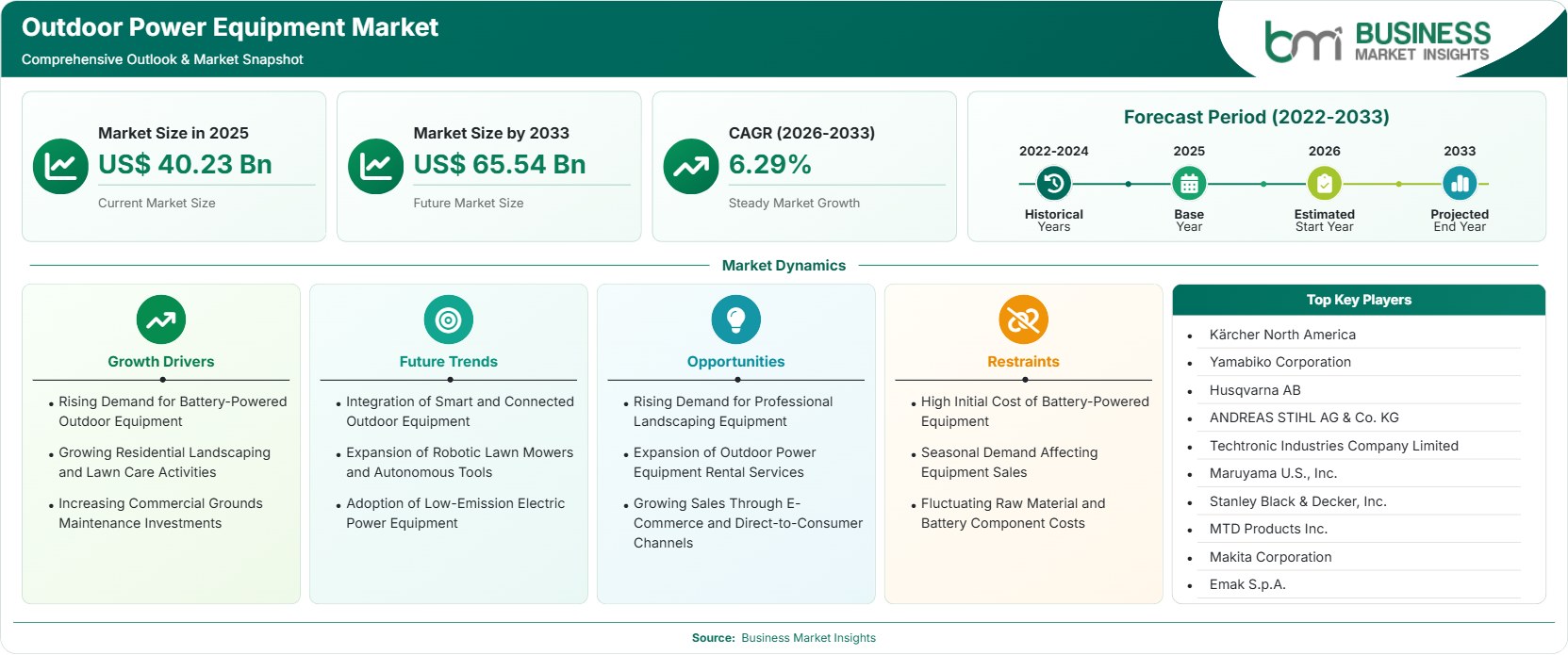
The Outdoor Power Equipment Market size was valued at US$ 40.23 Billion in 2025 and is projected to reach US$ 65.54 Billion by 2033, growing at a CAGR of 6.29% during 2026–2033. Increased use of battery-operated equipment, growing landscaping practices at residences, investments in commercial land upkeep, and continuous improvements in robotic technology for outdoor equipment are generating great business opportunities for equipment manufacturers.

Report Coverage
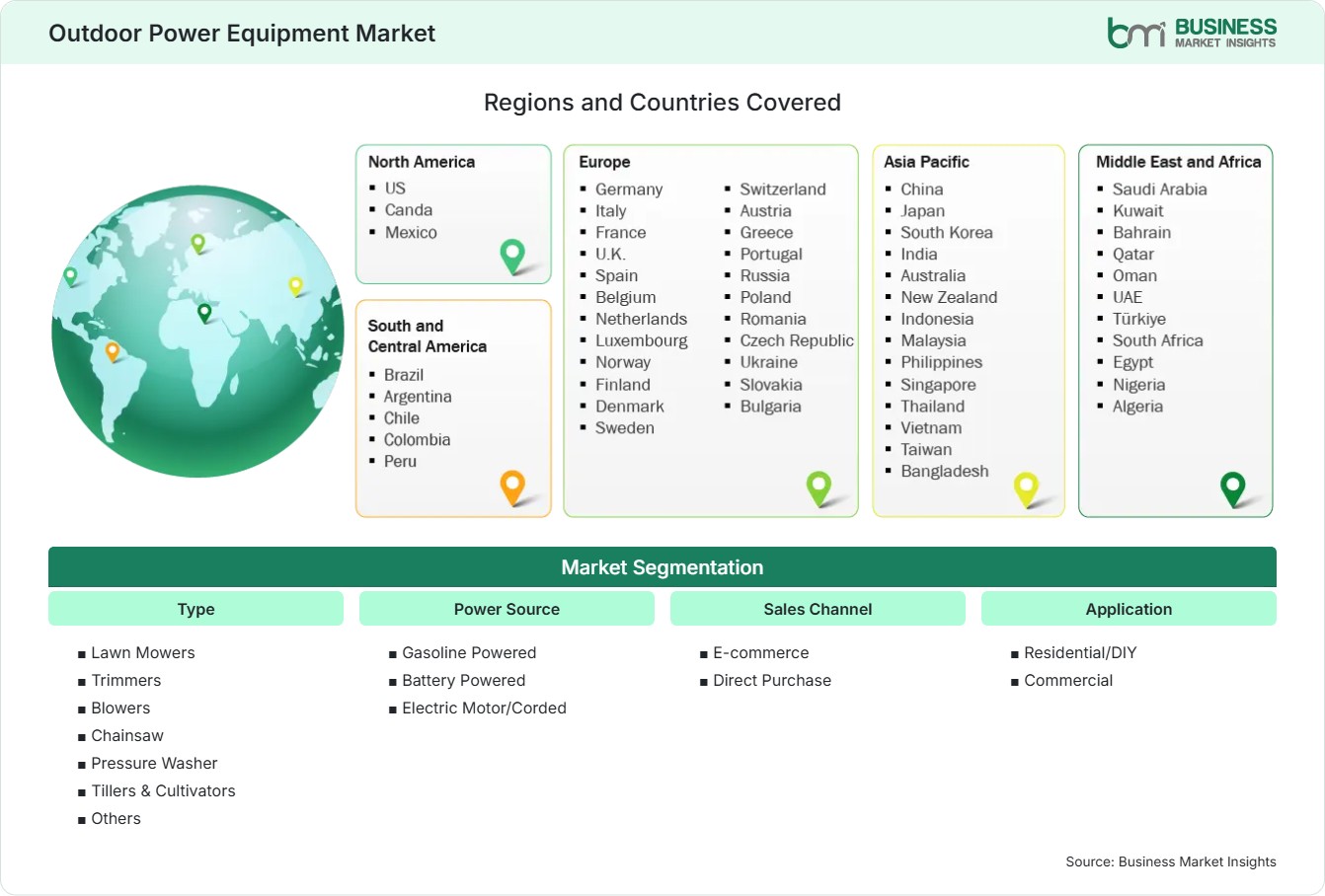
  • Type: Lawn Mowers, Trimmers, Blowers, Chainsaw, Pressure Washer, Tillers & Cultivators, Others
  • Power Source: Gasoline Powered, Battery Powered, Electric Motor/Corded
  • Sales Channel: E-commerce, Direct Purchase
  • Application: Residential/DIY, Commercial
US$ 40.23 Bn Market size in 2025
US$ 65.54 Bn Market Size by 2033
6.29% CAGR, 2026 - 2033
2026-2033 Forecast Period

AI Overview

Outdoor Power Equipment Market Summary

  • North America Region: North America holds 36%–39% outdoor power equipment market share in 2025 and is projected to expand at a 5.8%–6.2% CAGR during 2026–2033, supported by mature landscaping industries, rapid battery equipment adoption, and commercial fleet modernization. The United States benefits from strong residential lawn care spending and professional landscaping demand, advancing at approximately 5.9%–6.3% CAGR through 2033.
  • Fastest Growing Region: Asia Pacific accounts for 27%–30% market share in 2025 and is anticipated to register 7.3%–7.8% CAGR during 2026–2033. Urban green infrastructure projects, rising disposable income, expanding residential gardening culture, and increasing mechanization of landscape maintenance continue accelerating equipment demand across developing economies.
  • Leading Segment: Lawn Mowers represent 39%–42% market share in 2025 and are expected to grow at 6.0%–6.5% CAGR through 2033. Increasing residential lawn ownership, commercial turf management, robotic mower adoption, and replacement demand continue supporting sustained segment expansion across developed and emerging markets.
  • High Growth Segment: Battery Powered equipment holds 31%–34% market share in 2025 while advancing at 8.6%–9.2% CAGR during 2026–2033. Improved lithium-ion battery performance, stricter emission regulations, reduced maintenance requirements, and lower operating noise are accelerating customer transition from gasoline-powered equipment.
  • Key Market Opportunity: Expanding smart landscaping ecosystems integrating robotic equipment, IoT connectivity, fleet management software, predictive maintenance, and autonomous operation provide manufacturers opportunities to increase recurring revenue through digital services and premium product offerings.
  • Major Market Players: Kärcher North America, Yamabiko Corporation, Husqvarna AB, ANDREAS STIHL AG & Co. KG, Techtronic Industries Company Limited, Maruyama U.S., Inc., Stanley Black & Decker, Inc., MTD Products Inc., Makita Corporation, and Emak S.p.A.
Strategic Insights

Outdoor Power Equipment Market: Strategic Insights

Outdoor Power Equipment Market Strategic Framework
FREE PDF
Request your free sample
Request free sample
Stakeholder View

Key Takeaways

  • The industry is shifting from traditional engine-focused manufacturing to integrated ecosystems that combine battery technology, software, connectivity, and aftermarket services.
  • Battery-powered equipment and robotic lawn care solutions offer significant long-term growth opportunities, driven by demand for efficient, low-emission, and low-maintenance landscaping equipment in residential and commercial sectors.
  • Innovation is focused on AI-powered navigation, GPS guidance, IoT connectivity, predictive maintenance, and fleet management, enabling manufacturers to differentiate products through smart technologies rather than engine performance alone.
  • Asia Pacific remains the most attractive growth region due to rapid urbanization, expanding green infrastructure, rising incomes, and increasing mechanization.
  • The outdoor power equipment market trends suggest that the strategic investments, acquisitions, regional manufacturing expansion, supply chain localization, and growing e-commerce platforms are enhancing innovation, resilience, customer reach, and aftermarket services, supporting long-term market growth.
Geographic Outlook

Outdoor Power Equipment Market Regional Highlights

North America Outdoor Power Equipment Market

North America accounts for 36%–39% of the Outdoor Power Equipment Market share in 2025 and is projected to expand at a 5.8%–6.2% CAGR through 2033. High household lawn ownership, established landscaping service providers, and widespread replacement demand support regional leadership. Growing adoption of battery-powered equipment, robotic lawn mowers, and commercial fleet electrification continues strengthening market competitiveness.

  • Rising consumer preference for cordless outdoor equipment is driving manufacturers to expand lithium-ion product portfolios, offering longer runtime, lower maintenance, and improved sustainability for residential landscaping.
  • Commercial landscaping companies are adopting connected fleet management systems to optimize equipment utilization, enable predictive maintenance, and reduce operating costs.
  • Public investments in parks, recreational facilities, and green infrastructure continue supporting demand for commercial-grade outdoor equipment.
  • Equipment rental providers are expanding cordless offerings, improving accessibility for contractors and homeowners.

US Outdoor Power Equipment Market

The United States contributes 82%–85% of North American revenue and is anticipated to register a 5.9%–6.3% CAGR during the forecast period. A large installed base of residential lawns, strong commercial landscaping demand, and continuous product replacement cycles sustain equipment sales. Growing investments in robotic mowing systems, battery-powered handheld equipment, and smart landscape management technologies continue strengthening industry competitiveness while encouraging manufacturers to expand domestic distribution and service networks.

  • Large residential property ownership maintains stable demand for lawn mowers, trimmers, blowers, and pressure washers, supported by seasonal replacement purchases and premium equipment upgrades.
  • Professional landscaping companies increasingly adopt battery-powered commercial equipment to improve worker productivity, reduce operating costs, and comply with state-level environmental regulations targeting small engine emissions.
  • Retailers continue strengthening omnichannel sales strategies by combining physical dealerships with online purchasing platforms, enhancing customer accessibility and aftermarket support services.

Europe Outdoor Power Equipment Market

Europe represents 24%–27% market share in 2025 and is expected to grow at a 5.7%–6.1% CAGR through 2033. Environmental regulations, expanding battery equipment adoption, and increasing automation across landscape maintenance continue driving regional demand. Germany remains the leading country owing to its advanced manufacturing base and landscaping equipment industry, while Poland demonstrates the fastest growth with a projected CAGR of 6.8%–7.2% supported by infrastructure development and residential landscaping expansion.

  • Strict environmental regulations continue encouraging rapid transition toward low-noise, battery-powered outdoor equipment throughout residential and municipal landscaping operations.
  • Robotic lawn mower adoption is increasing across Western Europe due to labor shortages, high landscaping costs, and growing consumer acceptance of autonomous maintenance technologies.
  • Manufacturers continue expanding regional production facilities to strengthen supply chain resilience while reducing delivery times and transportation-related costs.
  • Professional landscaping contractors increasingly prioritize premium commercial equipment offering improved durability, productivity, and digital fleet management capabilities.

Asia Pacific Outdoor Power Equipment Market

Asia Pacific accounts for 27%–30% market share in 2025 and is forecast to register the fastest regional CAGR of 7.3%–7.8% during 2026–2033. Rising urbanization, increasing disposable income, expanding residential landscaping, and government investments in parks and smart city developments are driving equipment demand. China leads the regional outdoor power equipment market due to its manufacturing ecosystem and large domestic consumption, while India is expected to witness the fastest growth with a CAGR of 8.1%–8.5% through the forecast period, supported by infrastructure expansion and growing mechanization of landscape maintenance.

  • Rapid urbanization across China, India, and Southeast Asia is driving investments in residential, commercial, and public green spaces, increasing demand for landscaping and lawn maintenance equipment.
  • Manufacturers are expanding regional production and distribution networks to strengthen supply chains, lower costs, and meet rising demand for battery-powered outdoor equipment.
  • Growing awareness of low-noise, eco-friendly solutions is accelerating adoption of cordless lawn mowers, trimmers, and blowers in urban markets.
  • Commercial landscaping providers are investing in professional-grade battery-powered equipment to improve productivity and comply with stricter environmental and noise regulations.

Rest of World Outdoor Power Equipment Market

The Rest of World region represents 9%–11% market share in 2025 and is projected to expand at a 6.4%–6.8% CAGR through 2033. South & Central America continues benefiting from expanding residential construction and commercial landscaping activities, while the Middle East & Africa experiences increasing demand driven by tourism infrastructure, premium real estate developments, and public green space investments. Brazil remains the leading market within South & Central America, whereas Saudi Arabia demonstrates the fastest regional growth with a projected CAGR of 7.0%–7.4% supported by large-scale urban development projects.

  • Brazil leads the regional market, supported by expanding residential construction, commercial landscaping projects, and increasing mechanization of grounds maintenance across public and private facilities.
  • Saudi Arabia is experiencing rising demand driven by tourism developments, smart city projects, and investments in parks, recreational facilities, and urban landscaping.
  • Expanding hospitality, golf course, and resort developments across the Middle East are increasing demand for premium commercial outdoor power equipment.
  • Growing awareness of battery-powered equipment is encouraging the gradual replacement of conventional gasoline-powered products across residential and commercial landscaping applications.
Global Market Geography
FREE PDF
Request your free sample
Request free sample
Segment Analysis

Outdoor Power Equipment Market Segmentation

Type

The Type segment accounted for 48%–51% of the market in 2025 and is expected to grow at a 6.2%–6.6% CAGR through 2033. Growth is driven by rising residential lawn care, commercial landscaping, and increasing adoption of battery-powered and robotic equipment.

  • Lawn Mowers: Largest segment supported by residential lawn care, commercial landscaping, and replacement demand.
    • Walk-behind Mowers: Preferred for small and medium lawns due to affordability and maneuverability.
    • ZTR Mowers: Designed for large commercial landscapes requiring speed and productivity.
    • Riding Mower: Used for large residential and commercial properties with higher cutting capacity.
    • Robotic Mower: Fast-growing through AI navigation, GPS, obstacle detection, and automated operation.
    • Lawn & Garden Tractor: Provides mowing and towing capabilities for estate and large-property maintenance.
  • Trimmers: Driven by landscaping, garden maintenance, and roadside vegetation management.
    • Hedge Trimmer: Used for shaping hedges and shrubs with clean, precise cutting.
    • Brush Cutter & Trimmer: Suitable for dense vegetation, roadside clearing, and agricultural use.
    • Edge Trimmer/Edger: Creates clean lawn borders around sidewalks and flower beds.
  • Blowers: Increasing demand for residential and commercial debris management.
    • Snow Blower: Used for snow removal in residential and commercial properties.
    • Leaf Blower: Clears leaves and debris with growing adoption of battery-powered models.
  • Chainsaw: Widely used in forestry, landscaping, and tree maintenance.
  • Pressure Washer: Supports residential, commercial, and industrial cleaning applications.
  • Tillers & Cultivators: Used in gardening, landscaping, horticulture, and small-scale farming.

By Power Source

The Power Source segment represented 34%–37% of the outdoor power equipment market in 2025 and is projected to grow at a 7.1%–7.6% CAGR through 2033, supported by advances in battery technology and demand for sustainable equipment.

  • Gasoline Powered: Preferred for heavy-duty commercial landscaping and forestry requiring extended runtime.
  • Battery Powered: Fastest-growing category due to lower emissions, quieter operation, and reduced maintenance.
  • Electric Motor/Corded: Popular for lightweight residential applications and smaller maintenance tasks.

By Sales Channel

Manufacturers are strengthening omnichannel strategies by combining digital platforms with traditional dealer networks to improve accessibility and customer support.

  • E-commerce: Expands access through online marketplaces, manufacturer websites, financing, and home delivery.
  • Direct Purchase: Authorized dealers provide demonstrations, technical support, financing, and maintenance services for professional users.

By Application

The Application segment is expected to grow at a 6.3%–6.8% CAGR through 2033, driven by increasing landscaping and property maintenance across residential and commercial sectors.

  • Residential/DIY: Largest segment, supported by growing homeownership, gardening, and cordless equipment adoption.
  • Commercial: Growing demand from municipalities, landscaping contractors, golf courses, hospitality, sports facilities, and institutional properties.
Market Forces

Outdoor Power Equipment Market Dynamics

Key Market Drivers

Rising Demand for Battery-Powered Outdoor Equipment

Technological developments in the realm of lithium-ion batteries are revolutionizing the outdoor power equipment industry through enhancing runtime, increasing charging times, and increasing operational efficiency. Battery-operated power equipment generates reduced noise pollution, is emission free, and requires lower maintenance costs compared to gasoline-powered machines. Regulatory bodies in North America and Europe have been implementing stringent emission regulations with regard to small off-road engines, thus promoting the adoption of cleaner technologies. Manufacturers are designing battery systems that support a range of devices running on one battery system.

Growing Residential Landscaping and Lawn Care Activities

Residential landscaping has become an important contributor to equipment demand as homeowners increasingly invest in lawn maintenance, gardening, and outdoor living spaces. Rising homeownership, higher spending on home improvement, and greater consumer interest in aesthetically maintained landscapes are supporting purchases of lawn mowers, trimmers, blowers, and pressure washers. The popularity of DIY gardening continues expanding across developed and emerging outdoor power equipment markets, encouraging manufacturers to introduce lightweight, easy-to-operate, and ergonomically designed equipment. Smart irrigation systems and automated lawn maintenance solutions are also increasing awareness of advanced landscaping technologies. Growing adoption of robotic lawn mowers and connected outdoor equipment further strengthens demand.

Increasing Commercial Grounds Maintenance Investments

Professional ground maintenance by business organizations is constantly growing as far as investments go, aimed at improving the look, safety, and usability of outdoor places both private and public. Public parks, educational institutions, airports, golf fields, sports complexes, hotels, and other commercial real estate projects need robust outdoor power equipment able to withstand the workload that comes every day. Professional landscapers are constantly upgrading their equipment to battery-operated equipment with productivity-boosting technology to decrease labor costs.

Key Market Opportunities

Rising Demand for Professional Landscaping Equipment

Professional landscaping companies are experiencing increasing demand from municipalities, commercial properties, residential communities, hospitality facilities, and institutional campuses seeking year-round maintenance services. This trend is encouraging contractors to invest in durable, high-capacity equipment capable of improving productivity while minimizing operating expenses. Manufacturers are responding by introducing advanced battery-powered commercial equipment featuring connected fleet management, predictive maintenance capabilities, and improved ergonomics. Outdoor power equipment market forecasts indicate sustained investment in premium professional equipment as labor shortages encourage greater reliance on automation, fleet optimization, and intelligent maintenance technologies.

Expansion of Outdoor Power Equipment Rental Services

The trend of renting is getting more appealing for homeowners, contractors and other customers interested in using professional equipment without spending much money on the purchase of such equipment. The companies involved in equipment rentals have been enhancing their fleets of products with such equipment as battery-powered lawn mowers, chainsaws, pressure washers, tillers and other commercial landscaping equipment, which can meet different needs of their customers. This way of doing business provides higher utilization of the equipment and gives an opportunity to the customers to try out new technology before buying it.

Growing Sales Through E-Commerce and Direct-to-Consumer Channels

Digital commerce continues reshaping equipment purchasing behavior by allowing manufacturers to engage customers directly while expanding product accessibility beyond traditional dealership networks. Online platforms provide detailed product specifications, comparison tools, customer reviews, financing options, and virtual demonstrations that support informed purchasing decisions. Direct-to-consumer sales also enable manufacturers to strengthen customer relationships, improve profit margins, and gather valuable outdoor power equipment market insights through digital interactions. Growing confidence in digital purchasing, particularly among residential users, creates significant opportunities for expanding sales of cordless outdoor power equipment and related accessories.

Market Restraints and Challenges

High Initial Cost of Battery-Powered Equipment

Factor: The equipment that is powered by batteries is usually quite expensive at the time of purchase because of high-quality batteries, electronic systems, brushless motor, and smart technology used in the equipment. Even though operating costs may be cheaper in the long term, the problem is in the initial purchase cost.

Impact: High acquisition costs hinder the shift from gas-operated tools and also lengthen the cycles of product purchases. The commercial customers, who deal with large tool fleets, will delay moving towards electrical systems due to significant capital investments, while residential customers are going to prefer traditional goods due to relatively low prices for them.

Seasonal Demand Affecting Equipment Sales

Factor: Outdoor equipment purchases are related to seasonable weather conditions, climate differences between regions, and landscape cycles. Lawn care equipment sells best during spring and summer seasons, whereas snow removal machines require winter conditions to be used, causing irregularities in annual purchases.

Impact: The fluctuations of seasons create problems of inventory management, uncertainties in production planning, and unstable revenues for companies. Unpredictable changes in weather can affect the demand for equipment greatly, leading to oversupply or temporary lack of supplies. Companies tend to broaden their product lines, build strong global distribution channels, and increase aftermarket offerings in order to minimize reliance on seasonable purchase cycles.

Company Analysis

Competitive Landscape

The competitive landscape is still very vibrant owing to the major players’ focus on electrification, robotics, smart connectivity, and diversification of portfolios in an effort to enhance their market position. The outdoor Power Equipment Market analysis suggest that there is an effort by companies to develop battery technology standards, autonomous systems, manufacture in regions, and optimize the dealers’ network to boost competitiveness. The strategic partnerships, product innovations, and improved after-sales services keep the players differentiated to address the changing demands of different clients.

Company Name

Overview

Products and Services Relevant to this Market

Kärcher North America

A global cleaning technology manufacturer recognized for residential and commercial outdoor maintenance equipment with an extensive international sales and service network.

Pressure washers, sweepers, outdoor cleaning equipment, accessories, maintenance solutions, and commercial cleaning systems supporting residential and professional outdoor applications.

Yamabiko Corporation

Japanese manufacturer specializing in professional outdoor power equipment marketed through globally recognized brands serving landscaping, forestry, and agriculture.

Chainsaws, brush cutters, trimmers, blowers, hedge trimmers, power sprayers, and professional landscaping equipment for commercial and residential customers.

Husqvarna AB

Global leader in intelligent outdoor equipment with strong investments in robotics, battery technology, and connected landscaping solutions across multiple markets.

Robotic lawn mowers, walk-behind mowers, riding mowers, chainsaws, trimmers, blowers, battery systems, and digital fleet management solutions.

ANDREAS STIHL AG & Co. KG

Premium outdoor power equipment manufacturer known for innovation, engineering excellence, and professional-grade products distributed through an extensive dealer network.

Chainsaws, brush cutters, hedge trimmers, blowers, pressure washers, battery-powered equipment, accessories, and landscaping maintenance solutions.

Techtronic Industries Company Limited

Diversified power tool manufacturer expanding cordless outdoor equipment portfolios through continuous battery platform innovation and smart product development.

Battery-powered lawn mowers, string trimmers, blowers, chainsaws, outdoor tools, chargers, batteries, and cordless landscaping equipment.

Maruyama U.S., Inc.

Manufacturer focused on commercial-grade landscaping, vegetation management, and agricultural equipment serving professional users through specialized distribution channels.

Brush cutters, trimmers, blowers, hedge trimmers, power sprayers, and commercial vegetation management equipment designed for demanding operating conditions.

Stanley Black & Decker, Inc.

International industrial company offering outdoor equipment through recognized consumer and professional brands supported by extensive retail distribution.

Lawn mowers, trimmers, blowers, chainsaws, pressure washers, cordless outdoor equipment, batteries, chargers, and maintenance accessories.

MTD Products Inc.

Established outdoor equipment manufacturer supplying residential and commercial landscaping products through multiple globally recognized equipment brands.

Riding mowers, walk-behind mowers, lawn tractors, snow blowers, garden equipment, replacement parts, and outdoor maintenance solutions.

Makita Corporation

Leading cordless power equipment manufacturer leveraging advanced battery technologies across professional construction and landscaping applications.

Cordless lawn mowers, hedge trimmers, chainsaws, blowers, brush cutters, batteries, chargers, and commercial outdoor maintenance equipment.

Emak S.p.A.

Italian manufacturer specializing in outdoor power equipment for gardening, forestry, agriculture, and professional landscape maintenance markets worldwide.

Lawn mowers, chainsaws, brush cutters, hedge trimmers, blowers, cultivators, and professional outdoor equipment supported by aftermarket services.

Trust & Transparency

Research Methodology

The market analysis combines proprietary research with secondary data from government agencies, company disclosures, regulatory filings, industry databases and expert interviews. Market estimates are validated through data triangulation, cross-market benchmarking and analyst review.

View Full Research Methodology

Questions Answered

Frequently Asked Questions

What does the outdoor power equipment market report cover?

The market report provides comprehensive insights into market size, regional analysis, competitive landscape, segmentation, growth drivers, opportunities, restraints, technological developments, and future business prospects through 2033.

Which power source is expected to witness the fastest growth?

Battery-powered equipment is projected to record the fastest growth due to improvements in lithium-ion batteries, quieter operation, and increasingly stringent environmental regulations limiting small-engine emissions.

Which product segment holds the largest market share?

Lawn mowers represent the leading product category because they are widely used across residential properties, commercial landscapes, golf courses, sports facilities, and public parks requiring regular maintenance.

Which region dominates the market?

North America remains the leading regional market due to strong residential lawn ownership, a mature professional landscaping industry, and early adoption of battery-powered and robotic outdoor equipment.

What is driving demand in the outdoor power equipment market growth?

Growing adoption of battery-powered equipment, increasing residential lawn care activities, and technological advancements such as robotic mowing are the primary demand drivers.

Access the Full Outdoor Power Equipment Market Report

Get segment-level forecasts, regional estimates, competitive benchmarking, company profiles and downloadable Excel datasets.

Access the full Outdoor Power Equipment Market Report
350 pages PDF & Excel | 2026-08-06