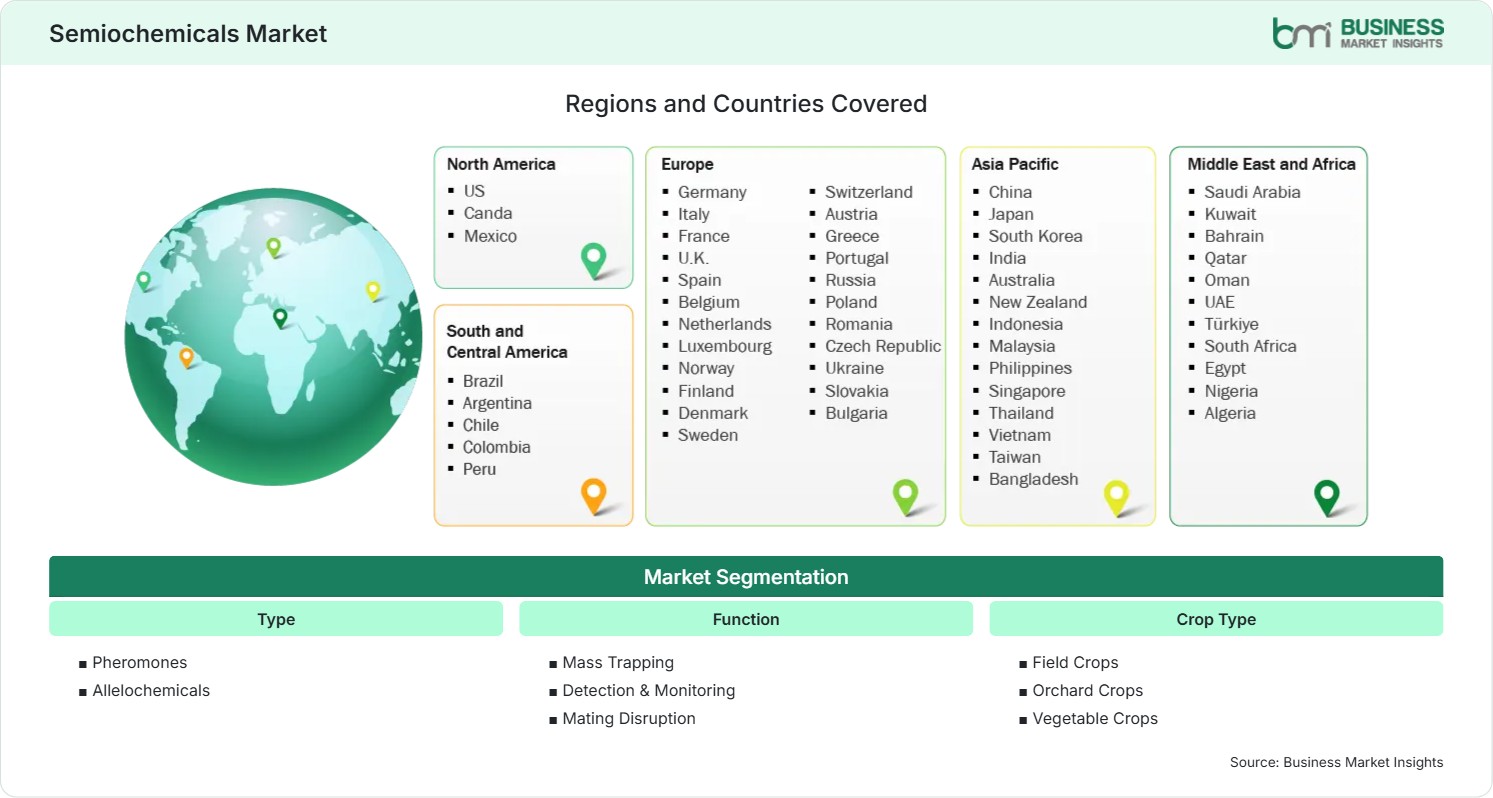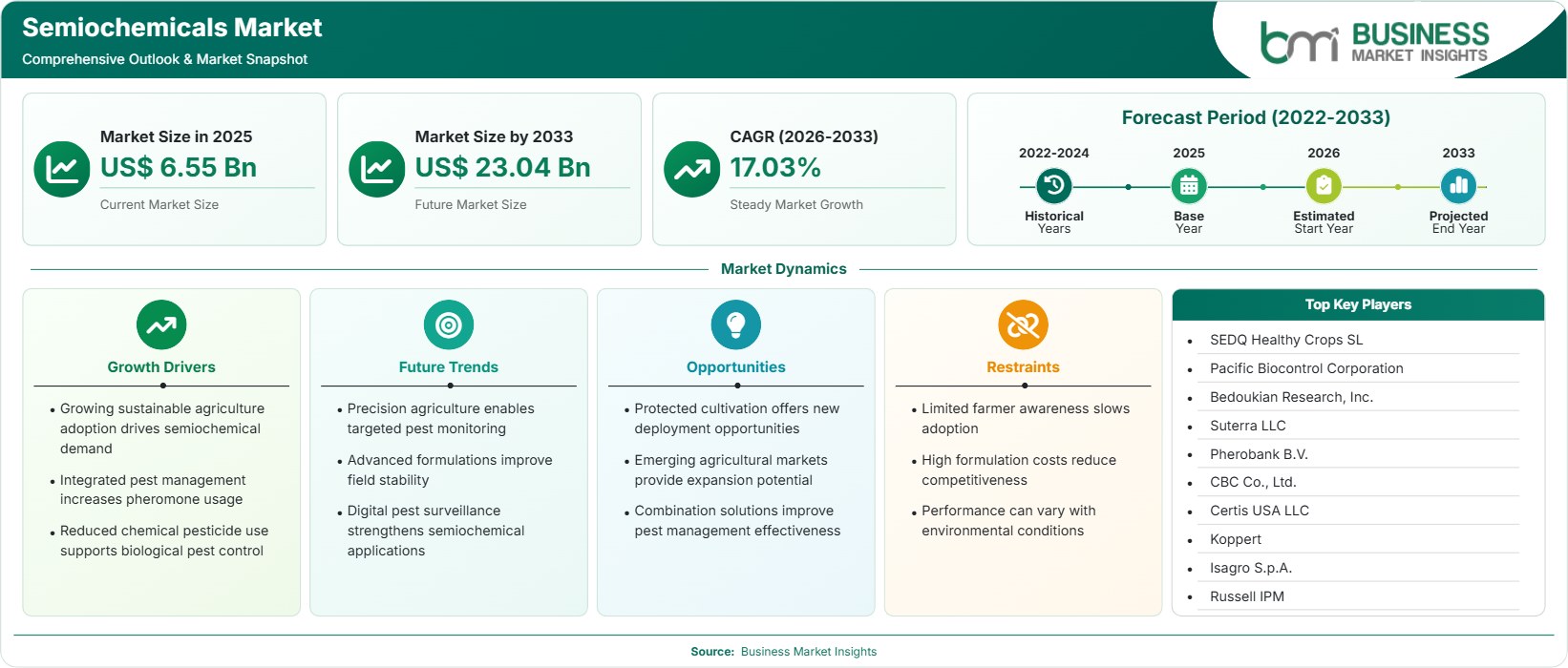
Semiochemicals Market Regional Highlights
North America Semiochemicals Market
North America represented 36%–39% Semiochemicals Market share in 2025 and is expected to advance at a 15.2%–15.9% CAGR through 2033. Adoption remains strongest within specialty crops, orchards, vineyards, and large-scale agricultural operations. Strong regulatory support for environmentally responsible crop-protection practices, coupled with widespread integrated pest management implementation, sustains commercial demand. The United States drives regional revenue generation, while Canada benefits from growing biological agriculture programs and increasing emphasis on sustainable farming productivity improvements.
- Large specialty-crop acreage supports broad deployment of monitoring and mating-disruption technologies across fruit, vegetable, and vineyard cultivation systems.
- Biological pest-management adoption continues increasing as growers pursue residue reduction and regulatory compliance objectives while maintaining production efficiency.
- Precision agriculture integration allows real-time pest monitoring and supports more targeted intervention strategies across commercial farming operations.
- Public and private agricultural sustainability initiatives continue supporting investment in environmentally friendly crop-protection technologies.
- Advanced distribution networks accelerate product penetration and facilitate farmer access to innovative crop-protection solutions.
US Semiochemicals Market
The United States accounts for approximately 79%–83% share within North America and is forecast to expand at 15.4%–16.0% CAGR during 2026–2033. Extensive specialty-crop production, high technology adoption, and strong participation in integrated pest management programs contribute to market leadership. Commercial growers increasingly utilize monitoring systems and mating-disruption approaches to improve pest-control effectiveness while reducing reliance on conventional pesticide applications across multiple crop categories.
- Specialty-crop producers increasingly adopt biological pest-management solutions to improve sustainability metrics and preserve crop quality.
- Research collaborations accelerate commercialization of advanced pheromone formulations and precision monitoring technologies.
- Regulatory trends continue encouraging reduced usage of conventional synthetic crop-protection products.
- Digital farm-management platforms enhance effectiveness through integration of pest surveillance and decision-support systems.
Europe Semiochemicals Market
Europe accounted for 28%–31% share in 2025 and is projected to grow at a 16.1%–16.8% CAGR through 2033. Regulatory emphasis on sustainable agriculture, reduced pesticide dependency, and integrated pest management adoption continues supporting market expansion. Spain remains the leading market due to extensive fruit and vegetable cultivation, while Italy demonstrates high adoption within orchard applications. France and Germany continue investing in biological crop-protection solutions as agricultural producers seek environmentally compliant pest-management strategies aligned with evolving sustainability objectives.
- Spain maintains regional leadership through extensive horticulture production and increasing deployment of pheromone-based pest-management programs.
- Italy records strong demand within orchard cultivation, supported by biological crop-protection requirements and export-oriented agriculture.
- Sustainable farming initiatives continue encouraging transition from conventional pest-control methods toward semiochemical-based approaches.
- Research collaborations between agricultural institutes and commercial suppliers accelerate product innovation and adoption.
- High-value crop cultivation supports continued investment in advanced monitoring and mating-disruption technologies.
Asia Pacific Semiochemicals Market
Asia Pacific held 24%–27% share in 2025 and represents the fastest-growing region with a 19.3%–20.1% CAGR through 2033. Expanding agricultural modernization programs, growing food-security concerns, and increasing adoption of biological crop-protection solutions support demand. China leads regional revenues through large-scale agricultural production, while India demonstrates the strongest growth momentum as growers increasingly implement integrated pest-management practices. Investments in horticulture exports and sustainable productivity improvements further strengthen regional development prospects.
- China benefits from extensive cultivation acreage and increasing adoption of environmentally responsible crop-protection technologies.
- India demonstrates robust commercialization potential due to growing farmer awareness and favorable agricultural modernization programs.
- Southeast Asian countries increasingly implement biological pest-management systems within export-oriented fruit and vegetable production.
- Digital agriculture technologies support broader deployment of monitoring systems and precision pest-management practices.
- Government sustainability initiatives continue encouraging reduced dependency on conventional chemical pesticide applications.
Rest of World Semiochemicals Market
Rest of World represented 7%–10% share in 2025 and is anticipated to expand at a 17.0%–17.8% CAGR through 2033. South and Central America benefit from expanding fruit-export industries and increasing integrated pest management adoption. Middle East and Africa markets remain comparatively smaller but are gaining momentum through horticultural investments and sustainable agriculture programs. Brazil leads regional demand, while South Africa records notable growth through commercial orchard expansion and strengthening biological crop-protection awareness.
- Fruit-export industries increasingly require sustainable pest-management solutions that support compliance with international quality standards.
- Commercial horticulture expansion drives adoption across Brazil, Chile, South Africa, and selected Gulf agricultural projects.
- Biological crop-protection awareness continues improving through demonstration programs and grower education initiatives.
- Investments in protected cultivation systems support adoption of advanced monitoring and mating-disruption technologies.
- Expanding export agriculture creates opportunities for premium biological pest-management products.