
Satellite Internet Market Size, Share, Trends & Forecast Report, 2026–2033

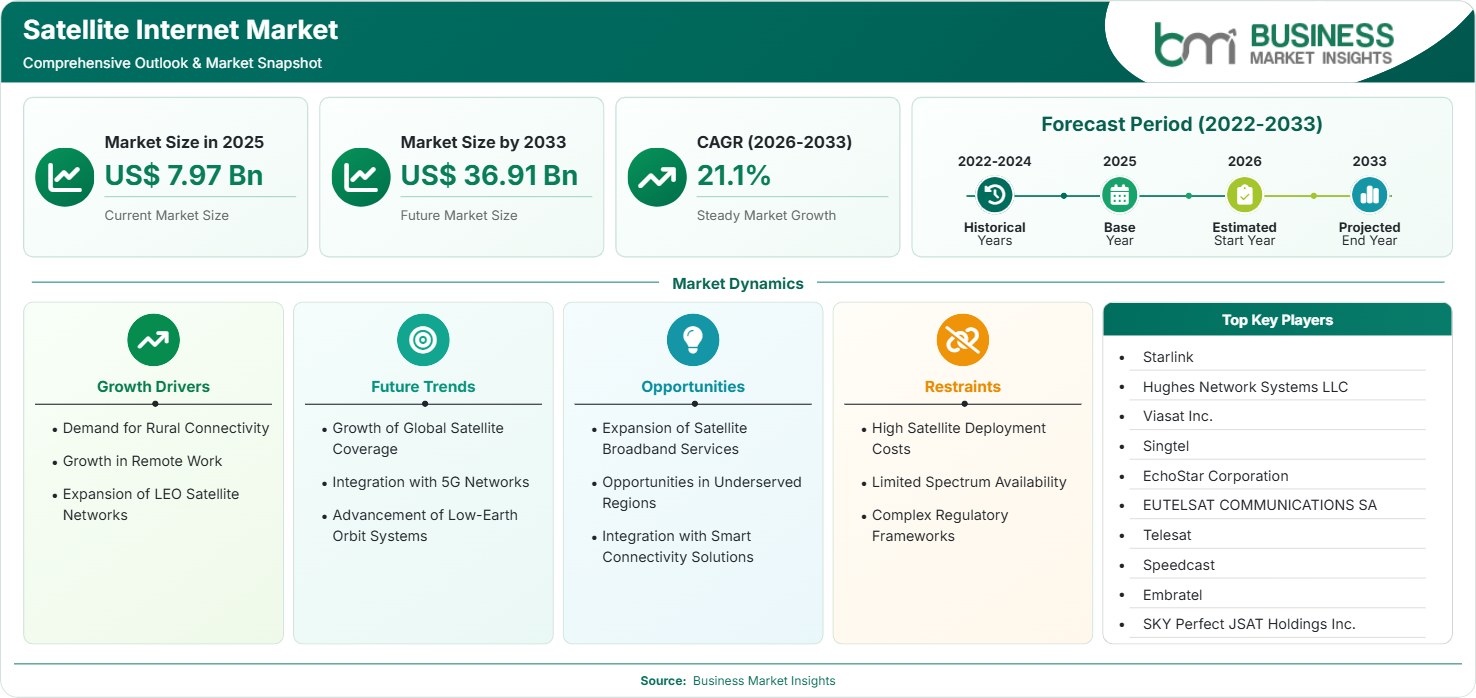
The Satellite Internet Market size was valued at US$ 7.97 Billion in 2025 and is projected to reach US$ 36.91 Billion by 2033, growing at a CAGR of 21.1% during 2026–2033, driven by rural connectivity demand, remote work adoption, LEO satellite expansion, broadband service growth, underserved region opportunities, and smart connectivity integration.

Report Coverage
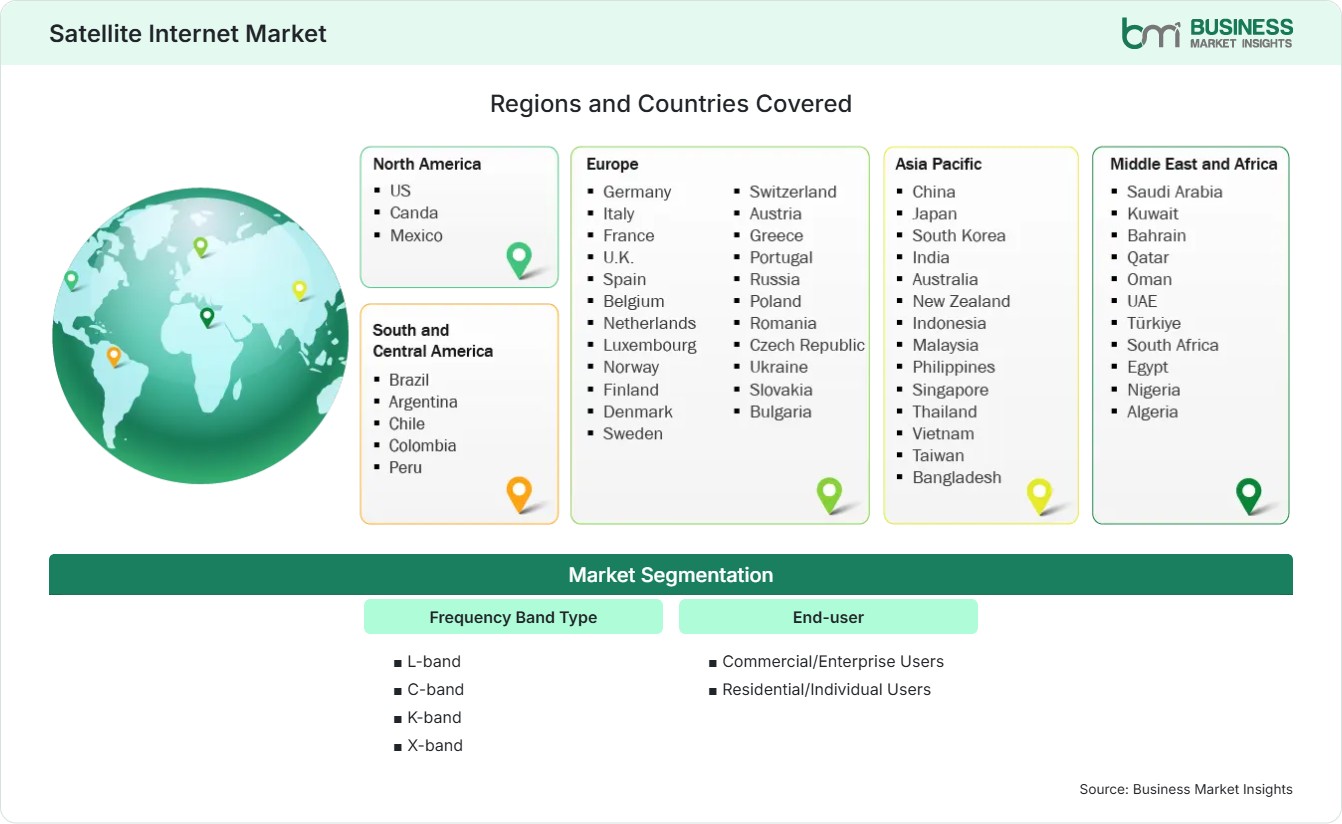
  • Frequency Band Type: L-band, C-band, K-band, X-band
  • End-user: Commercial/Enterprise Users, Residential/Individual Users
US$ 7.97 Bn Market size in 2025
US$ 36.91 Bn Market Size by 2033
21.1% CAGR, 2026 - 2033
2026-2033 Forecast Period

AI Overview

Satellite Internet Market Summary

  • North America Region: North America holds a market share of 36%–40% in 2025, growing with a CAGR of 20.2%–20.8%, influenced by LEO satellite deployment, enterprise connectivity demand, rural broadband initiatives, and defense applications. The US market demonstrates strong growth with a CAGR of 20.4%–20.9% from 2026–2033, supported by satellite broadband adoption, remote connectivity requirements, and commercial network expansion.
  • Fastest Growing Region: Asia Pacific holds a market share of 25%–29% in 2025, growing with a CAGR of 22.5%–23.2%, influenced by digital inclusion programs, expanding broadband requirements, remote area connectivity, and increasing satellite communication investments across emerging economies.
  • Leading Segment: Commercial/Enterprise Users hold market share of 64%–68% in 2025, growing with a CAGR of 21.0%–21.7%, influenced by enterprise networking needs, maritime connectivity, aviation services, remote operations, and government communication requirements.
  • High Growth Segment: Residential/Individual Users hold market share of 32%–36% in 2025, growing with a CAGR of 22.0%–22.8%, influenced by rural broadband demand, improved satellite affordability, and increasing adoption of high-speed internet services in underserved locations.
  • Key Market Opportunity: Expansion of satellite broadband services, connectivity solutions in underserved regions, and integration with smart technologies create opportunities through improved digital access, enterprise transformation, and next-generation communication networks.
  • Major Market Players: Starlink, Hughes Network Systems LLC, Viasat Inc., Singtel, EchoStar Corporation, Eutelsat Communications SA, Telesat, Speedcast, Embratel, and SKY Perfect JSAT Holdings Inc.
Strategic Insights

Satellite Internet Market: Strategic Insights

Satellite Internet Market Strategic Framework
FREE PDF
Request your free sample
Request free sample
Stakeholder View

Key Takeaways

  • The satellite connectivity ecosystem is evolving through collaboration among satellite operators, telecom providers, equipment manufacturers, government agencies, and enterprise users focused on expanding global internet accessibility.
  • Enterprise connectivity, residential broadband, and remote infrastructure applications represent major growth opportunities as organizations seek reliable communication solutions beyond traditional terrestrial networks.
  • Technology innovation is shifting toward LEO satellite constellations, advanced antenna systems, higher-frequency bandwidth utilization, and integrated satellite-terrestrial communication networks.
  • Asia Pacific presents strong investment potential due to large underserved populations, government digital inclusion programs, expanding enterprise connectivity requirements, and increasing satellite infrastructure development.
  • Strategic partnerships, constellation investments, and service expansion initiatives are shaping competitive positioning as companies aim to increase coverage, reduce costs, and improve service performance.
  • Smart connectivity integration is becoming increasingly important as industries adopt satellite-enabled solutions for transportation, maritime operations, disaster response, and remote asset monitoring.
Geographic Outlook

Satellite Internet Market Regional Highlights

North America Satellite Internet Market

North America Satellite Internet Market accounted for a 36%–40% share in 2025 and is projected to expand at a CAGR of 20.2%–20.8% during 2026–2033. The region maintains leadership due to advanced satellite infrastructure, strong enterprise adoption, and government-backed broadband initiatives. The US and Canada represent major markets, supported by rural connectivity programs, commercial satellite services, defense applications, and increasing demand for reliable high-speed internet solutions.

  • LEO satellite network expansion is accelerating broadband availability across rural and geographically isolated communities.
  • Enterprises are adopting satellite connectivity for remote operations, backup networks, and business continuity requirements.
  • Government programs supporting broadband access are increasing satellite service adoption in underserved areas.
  • Maritime and aviation industries are investing in satellite internet solutions for continuous connectivity.
  • Technology providers are improving terminal efficiency and network capacity to support growing user demand.

US Satellite Internet Market

US Satellite Internet Market share represented a 32%–36% share in 2025 and is estimated to grow at a CAGR of 20.4%–20.9% between 2026–2033. The country remains a leading market due to extensive satellite deployment activities, enterprise demand, and initiatives aimed at expanding broadband accessibility. Commercial users, government agencies, and rural households continue driving the adoption of advanced satellite connectivity solutions.

  • Rural broadband initiatives are supporting satellite internet adoption in areas with limited terrestrial network coverage.
  • Enterprises are using satellite connectivity for remote facilities, emergency communications, and operational continuity.
  • LEO constellation deployment is improving latency performance and expanding service availability.
  • Government and defense applications continue supporting demand for secure and reliable satellite networks.

Europe Satellite Internet Market

Europe held a 20%–24% share in 2025 and is forecast to register a CAGR of 19.5%–20.3% during 2026–2033. The region benefits from digital transformation initiatives, connectivity programs, and increasing demand for resilient communication networks. Germany, France, the UK, and Italy represent leading markets, while Eastern European countries demonstrate growth potential through rural broadband expansion and satellite-based connectivity programs.

  • European connectivity initiatives are encouraging satellite adoption for remote and underserved communities.
  • Germany and France are investing in advanced communication infrastructure and satellite technology development.
  • Maritime and aviation sectors are increasing demand for reliable broadband connectivity solutions.
  • Government-supported digital inclusion programs are creating opportunities for satellite service providers.
  • Satellite operators are developing partnerships with telecom companies to expand regional coverage.

Asia Pacific Satellite Internet Market

The Asia Pacific market accounted for a 25%–29% share in 2025 and is expected to expand at the fastest CAGR of 22.5%–23.2% between 2026 and 2033. Rapid digitalization, large rural populations, and expanding connectivity requirements are supporting regional growth. China, India, Japan, Australia, and Southeast Asian countries represent key markets, with India and Southeast Asia showing strong potential due to underserved connectivity demand.

  • Governments are investing in satellite connectivity to improve digital access across remote regions.
  • India and Southeast Asia are expanding broadband infrastructure through satellite-based communication solutions.
  • Enterprises in mining, maritime, and transportation sectors are increasing satellite internet adoption.
  • Rising smartphone usage and digital services are increasing demand for reliable internet access.
  • Regional satellite operators are developing partnerships to improve network availability and affordability.

Rest of World Satellite Internet Market

The rest of the world market represented a 9%–13% share in 2025 and is projected to grow at a CAGR of 21.0%–21.8% from 2026 to 2033. Latin America, the Middle East, and Africa markets are benefiting from digital inclusion initiatives, remote connectivity requirements, and infrastructure limitations. Brazil, Mexico, the UAE, Saudi Arabia, and African nations represent important opportunity markets due to increasing demand for broadband accessibility.

  • Latin American countries are adopting satellite internet to improve connectivity across rural and remote communities.
  • Brazil and Mexico are expanding satellite broadband services for enterprise and residential applications.
  • Middle Eastern markets are investing in advanced connectivity solutions supporting smart city and industrial projects.
  • African regions are using satellite networks to overcome terrestrial infrastructure limitations and expand digital access.
  • International satellite operators are partnering with local providers to improve service reach and affordability.
Global Market Geography
FREE PDF
Request your free sample
Request free sample
Segment Analysis

Satellite Internet Market Segmentation

Frequency Band Type

Frequency band type segmentation plays a critical role in determining satellite internet performance, coverage, and application suitability. K-band represents a leading segment due to higher data transmission capabilities and increasing adoption in broadband services. The segment accounted for a 38%–42% share and is expected to grow at a CAGR of 22.0%–22.7% from 2026–2033, supported by high-throughput satellite development and broadband demand.

  • L-band: L-band supports reliable communication services due to strong signal penetration and suitability for mobile satellite connectivity applications.
  • C-band: C-band provides stable communication performance and is widely used for satellite networks requiring reliability across varying environmental conditions.
  • K-band: K-band enables higher bandwidth satellite internet services and supports broadband applications requiring improved speed and network capacity.
  • X-band: X-band supports specialized communication requirements, including government, defense, and professional satellite connectivity applications.

End-user

End-user segmentation highlights demand from commercial enterprises and residential users seeking reliable internet access. Commercial and enterprise users represented the leading segment in 2025 due to applications across banking, government, maritime, aviation, mining, and media sectors. The segment accounted for a 64%–68% share and is expected to grow at a CAGR of 21.0%–21.7% from 2026–2033.

  • Commercial/Enterprise Users: Commercial users adopt satellite internet for remote operations, enterprise connectivity, government communication, and specialized industry applications.
    • Banking: Banking institutions utilize satellite connectivity for secure communication and reliable network access in remote locations.
    • Government (Maritime and Aviation): Government agencies adopt satellite networks for communication, maritime operations, aviation connectivity, and critical infrastructure support.
    • Mining: Mining companies use satellite internet to support remote sites, operational monitoring, and workforce communication systems.
    • Media and Broadcasting: Media companies utilize satellite connectivity for content transmission, broadcasting operations, and remote production requirements.
    • Construction: Construction companies deploy satellite internet for project sites requiring reliable communication and digital coordination.
    • Transportation: Transportation operators use satellite connectivity for fleet management, tracking systems, and operational communication.
    • Others: Other commercial users include energy, healthcare, emergency services, and remote industries requiring dependable connectivity solutions.
  • Residential/Individual Users: Residential users are adopting satellite internet due to increasing broadband demand, rural connectivity needs, and improved availability of high-speed satellite services.
Market Forces

Satellite Internet Market Dynamics

Key Market Drivers

Demand for Rural Connectivity

The need for connectivity in the rural sector has fastened the development of satellite internet technologies because of the demand for reliable access to broadband internet in such places where there is no adequate infrastructure to achieve that goal. It is necessary to have reliable communication channels to provide the digital transformation in such sectors as agriculture, education, health care, and others. The Satellite Internet Market growth is driven by broadband development programs, the need for connectivity of the underdeveloped population, and investments in satellite infrastructure. The trends include more efficient LEO satellite constellations, affordable user terminals, and hybrid connectivity models.

Growth in Remote Work

Growth in remote work is increasing demand for stable and high-speed connectivity solutions beyond traditional urban networks. Distributed work models have encouraged businesses and professionals to seek reliable internet access in suburban, rural, and remote locations. The market growth benefits from rising dependence on cloud applications, virtual collaboration platforms, and digital business operations. The Satellite Internet Market trends show increased adoption of satellite broadband services by remote workers, small businesses, and organizations requiring backup connectivity. Service providers are improving network speeds, reducing latency, and expanding coverage to support evolving workplace requirements across global markets.

Expansion of LEO Satellite Networks

Expansion in LEO satellite constellations is changing the face of satellite connectivity because of better latency, more data transmission capabilities, and greater availability of services. In contrast to conventional satellites, LEO satellite constellations provide a communication capability that can be used even for broadband connectivity and enterprise services. The Satellite Internet Market growth include satellite deployment on a mass scale, technological innovations, and increased competition amongst network providers. Trends in the market are characterized by investments in reusable space launch technology, advanced antennas, and integrated satellite-terrestrial networks.

Key Market Opportunities

Expansion of Satellite Broadband Services

Expansion of satellite broadband services creates opportunities for operators to reach new customer segments through improved coverage, competitive pricing, and enhanced network performance. Increasing demand for high-speed internet access in remote regions is encouraging providers to scale satellite constellations and develop flexible service plans. Enterprise users are also adopting satellite broadband for backup connectivity, remote operations, and mission-critical applications. Investments in ground infrastructure, user terminals, and service partnerships are supporting broader market penetration. Companies that improve affordability and accessibility can capture opportunities as satellite broadband becomes an important component of global connectivity ecosystems.

Opportunities in Underserved Regions

Opportunities in underserved regions are expanding as governments and organizations prioritize digital inclusion and reliable communication infrastructure. Many rural and isolated communities continue facing limitations from traditional broadband networks due to geographic and economic challenges. Satellite internet provides a scalable solution by delivering connectivity without extensive terrestrial infrastructure development. Providers can benefit through partnerships with governments, telecom operators, and community programs focused on expanding internet access. Increasing demand from education, healthcare, agriculture, and public services is creating new applications for satellite connectivity. These opportunities are expected to support long-term expansion across emerging markets.

Integration with Smart Connectivity Solutions

The integration of smart connectivity services is providing opportunities as a result of the collaboration between satellite connectivity systems, IoT platforms, AI, and communication systems, a development that is bound to improve the Satellite Internet Market Forecast. Sectors like transportation, energy, maritime, and defense are embracing smart connectivity services that need reliable connectivity in remote areas. Companies dealing in satellite services are coming up with integrated platforms that provide real-time monitoring and automation. Partnership between satellite service providers and tech firms is opening up possibilities that go beyond broadband connectivity services. With industries embarking on digital transformation, satellite connectivity becomes integral to smart infrastructure and remote operation models.

Market Restraints and Challenges

High Satellite Deployment Costs

Factor: High satellite deployment costs associated with spacecraft manufacturing, launch services, ground infrastructure, and network maintenance create financial challenges for operators.

Impact: Significant capital requirements can slow constellation expansion, increase service pricing, and create barriers for new market entrants. Developing large-scale satellite networks requires continuous investment in technology development, regulatory approvals, and operational support systems. Although reusable launch technologies and manufacturing improvements are reducing costs, investment requirements remain substantial. Companies must optimize deployment strategies, secure funding partnerships, and improve operational efficiency to achieve sustainable growth in an increasingly competitive satellite connectivity market.

Limited Spectrum Availability

Factor: Limited spectrum availability caused by increasing demand from satellite operators, telecommunications providers, and other communication services creates operational challenges.

Impact: Spectrum constraints can restrict network expansion, increase regulatory complexity, and affect service quality in high-demand regions. Satellite providers must coordinate frequency usage, comply with international regulations, and develop efficient spectrum management strategies. Growing competition for orbital and frequency resources requires careful planning and collaboration among industry stakeholders. Companies investing in advanced spectrum utilization technologies and regulatory expertise can improve network efficiency while addressing challenges associated with expanding satellite internet services globally.

Company Analysis

Competitive Landscape

The Satellite Internet Market analysis highlights competition among satellite operators, communication service providers, and connectivity technology companies. Market participants are focusing on LEO constellation deployment, broadband service expansion, enterprise solutions, and strategic partnerships to strengthen their positions. Companies are investing in advanced satellites, user terminals, and integrated connectivity platforms to address growing global demand.

Company Name

Overview

Products and Services relevant to this market

Starlink

Satellite internet provider focused on global broadband connectivity.

LEO satellite broadband services, user terminals, and enterprise connectivity solutions.

Hughes Network Systems LLC

Satellite communications provider serving residential and enterprise customers.

Satellite broadband, managed network services, and connectivity solutions.

Viasat Inc.

Global satellite communications company providing broadband services.

Satellite internet, enterprise connectivity, aviation, and maritime solutions.

Singtel

Telecommunications company offering global connectivity services.

Satellite communication services, enterprise networking, and connectivity solutions.

EchoStar Corporation

Satellite communications company providing broadband and network services.

Satellite internet services, communication networks, and broadband platforms.

Eutelsat Communications SA

Satellite operator providing connectivity and broadcasting services.

Satellite broadband, communication services, and network solutions.

Telesat

Satellite operator developing advanced connectivity networks.

LEO satellite systems, broadband services, and enterprise connectivity.

Speedcast

Managed communications provider serving remote industries.

Satellite connectivity, maritime communication, and remote network solutions.

Embratel

Telecommunications company providing satellite-based connectivity services.

Satellite communications, enterprise connectivity, and broadband solutions.

SKY Perfect JSAT Holdings Inc.

Japanese satellite operator providing communication services.

Satellite networks, broadband connectivity, and communication infrastructure solutions.

Industry Activity

Recent Developments

November 2025

Viasat Inc. successfully launched its ViaSat-3 Flight 2 (F2) satellite aboard a United Launch Alliance Atlas V rocket. The satellite is designed to expand Viasat’s global satellite broadband capacity, supporting commercial mobility, fixed broadband, and government connectivity services.

July 2025

EUTELSAT COMMUNICATIONS SA expanded its satellite internet offering through a partnership with Station Satcom, integrating Eutelsat OneWeb LEO connectivity into global maritime connectivity solutions. The collaboration combines OneWeb’s low-latency LEO services with existing GEO satellite capabilities for maritime customers.

April 2025

Telesat Corporation announced a multi-year agreement with Viasat Inc. for Telesat Lightspeed Low Earth Orbit (LEO) services. Under the agreement, Viasat plans to integrate Telesat Lightspeed connectivity into its multi-orbit portfolio for aviation, maritime, enterprise, and defense customers.

April 2025

EUTELSAT COMMUNICATIONS SA announced that its OneWeb LEO services became operational for commercial and business aviation customers, with initial aircraft deployments using its high-speed, low-latency satellite connectivity services.

Trust & Transparency

Research Methodology

The market analysis combines proprietary research with secondary data from government agencies, company disclosures, regulatory filings, industry databases and expert interviews. Market estimates are validated through data triangulation, cross-market benchmarking and analyst review.

View Full Research Methodology

Questions Answered

Frequently Asked Questions

What does the Satellite Internet Market Report indicate about future opportunities?

The market report indicates opportunities in satellite broadband expansion, smart connectivity integration, enterprise applications, and underserved region deployment as demand for reliable global communication infrastructure continues increasing.

How is satellite internet supporting underserved regions?

Satellite internet enables connectivity expansion in rural and isolated areas by overcoming geographic limitations associated with terrestrial networks. It supports digital inclusion initiatives across education, healthcare, government services, and community development programs.

Which end-user segment dominates the Satellite Internet Market?

Commercial and enterprise users represent the dominant segment due to increasing adoption across banking, government, maritime, aviation, mining, transportation, and remote industrial operations requiring dependable connectivity.

Why are LEO satellite networks important for satellite internet services?

LEO satellite networks improve connectivity performance through lower latency, higher capacity, and broader coverage compared with traditional satellite systems. They enable applications including broadband access, enterprise communication, and remote operational connectivity.

What factors are driving growth in the market?

Growth is driven by increasing rural connectivity demand, expansion of LEO satellite networks, remote work adoption, and rising requirements for reliable broadband access in locations where terrestrial infrastructure remains limited.

Access the Full Satellite Internet Market Report

Get segment-level forecasts, regional estimates, competitive benchmarking, company profiles and downloadable Excel datasets.

Access the full Satellite Internet Market Report
350 pages PDF & Excel | 2026-07-31